Research / Earnings and valuation
Valero Stock Q3 2026:Earnings Jump as Refining Margins Nearly Triple
As of: Figures are as of Valero Energy's third-quarter 2026 results (the quarter ended 30 September 2026), reported 22 October 2026 in a Form 8-K, with the Form 10-Q filed 28 October 2026. The balance sheet is from that 10-Q; the share count of 278.9 million is as of 23 October 2026. The share price used in our valuation is the NYSE close of VLO on 2 November 2026, $381.46. Analyst data were accessed on 2 November 2026. Published 2 November 2026.
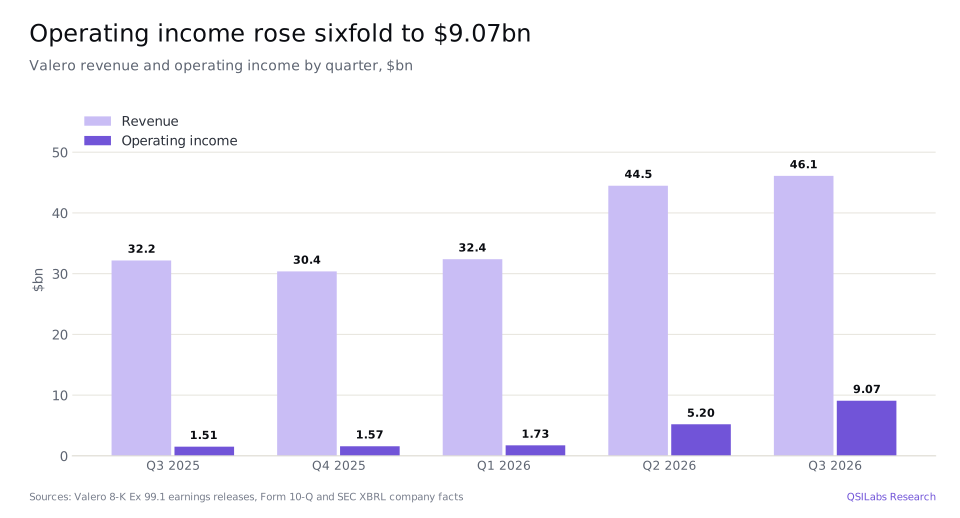
The short answer. Valero stock Q3 2026 is a story of a refining boom that the market already doubts will last. In the three months to 30 September 2026, Valero Energy's refining margin was $39.24 for every barrel it processed, up from $13.14 a year earlier, as diesel and gasoline margins over crude oil roughly tripled. Operating income rose to $9,073m from $1,509m, diluted earnings per share rose to $23.89 from $3.53, and on 27 October the board authorised a new $10.0bn share buyback. The shares closed at $381.46 on 2 November 2026, up 134.3% for the year but 17.0% below their October high. Our discounted cash flow model values the shares at $352.20, about 0.92 times the price; the gap comes mainly from our assumption that margins, now the highest in Valero's recent history, fall back to their long-run average by 2032.
Key takeaways
- Operating income rose sixfold. Operating income was $9,073m, up from $1,509m a year earlier and $5,196m in the June quarter. Revenue rose 43% to $46,098m.
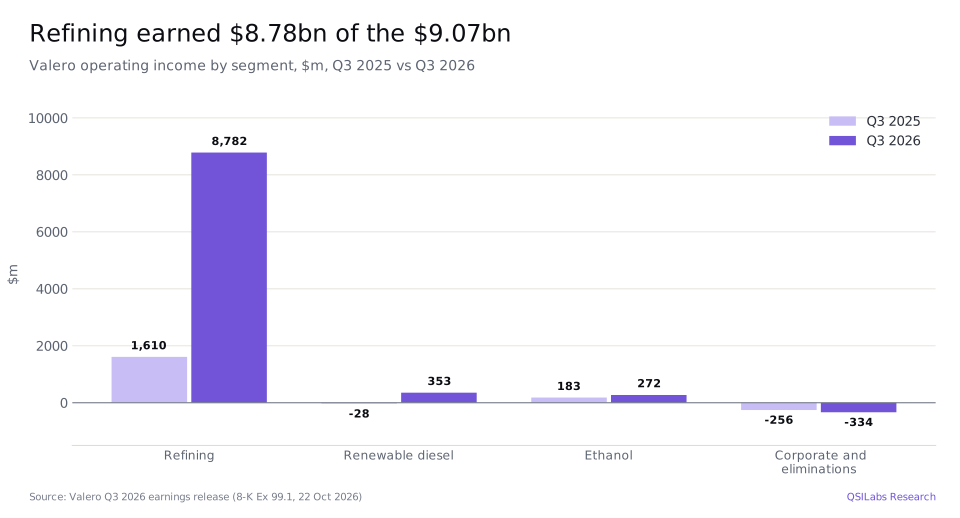
- Refining did almost all of it. The refining segment earned $8,782m, up from $1,610m, on a margin of $39.24 a barrel. Throughput fell 3.7% to 2.97m barrels a day; the Benicia refinery has not refined since April.
- Diesel led the margin surge. On the US Gulf Coast, diesel sold for $72.27 a barrel more than Brent crude, up from $21.05; gasoline's margin rose to $24.08 from $7.78.
- Renewable diesel and ethanol turned up too. Renewable diesel earned $353m after a $28m loss a year earlier, and ethanol earned $272m on production of 4.8m gallons a day, which Valero called a new quarterly record.
- A lot of cash went back. Valero returned 52% of its adjusted operating cash flow of $7.25bn in the quarter, spent $6.2bn on buybacks in the first nine months and still ended September with $9.84bn of cash against $11.0bn of debt and finance leases.
- Our value: $352.20 a share, against a $381.46 close on 2 November 2026. Across costs of capital from 7.4% to 9.4% and terminal growth from 1.5% to 3.5% the model gives $305.61 to $439.32. Analysts' average target is $426.89.
- What to watch. Whether diesel margins hold into 2027, the heavier global maintenance season that Valero expects next year, the Houston refinery purchase from LyondellBasell, and the pace of buybacks under the new $10.0bn programme.
Key numbers from Valero's Q3 2026 earnings
| Measure | Q3 2026 | Q3 2025 | Change |
|---|---|---|---|
| Revenue | $46,098m | $32,168m | +43% |
| Operating income | $9,073m | $1,509m | +501% |
| Refining operating income | $8,782m | $1,610m | +445% |
| Refining margin per barrel | $39.24 | $13.14 | +$26.10 |
| Refining throughput | 2,972k barrels a day | 3,087k barrels a day | -3.7% |
| Net income attributable to Valero | $6,828m | $1,095m | +524% |
| Diluted earnings per share | $23.89 | $3.53 | +577% |
| Adjusted earnings per share | $23.90 | $3.66 | +553% |
| Diluted shares | 285m | 309m | -7.8% |
| Brent crude, average | $91.61 a barrel | $68.14 a barrel | +34% |
Source: Valero third-quarter 2026 earnings release (Form 8-K, Exhibit 99.1, 22 October 2026). Adjusted figures are Valero's non-GAAP measures.
Valero Q3 2026 earnings: what happened
Valero runs 14 refineries in the US, Canada and the UK with combined throughput capacity of about 3.0m barrels a day, and it also owns half of the Diamond Green Diesel renewable diesel joint venture and a network of ethanol plants. Its earnings depend mostly on the gap between what it pays for crude oil and what it gets for gasoline, diesel and jet fuel, known as the crack spread.
That gap widened sharply in the third quarter. Valero's refining margin, the difference between product sales and feedstock costs, was $10,730m, or $39.24 a barrel, against $3,731m, or $13.14 a barrel, a year earlier. Operating costs were $5.03 a barrel and depreciation $2.12, so refining operating income came to $32.09 a barrel. In the release, Chairman and Chief Executive Lane Riggs said: "Our refineries operated at near-record utilization rates, providing a reliable supply of critical transportation fuels during the quarter."
On the earnings call, Gary Simmons, Valero's chief operating officer, said the company had "high confidence that this current crack spread environment is very sustainable," pointing to the cost and difficulty some low-complexity refiners in Asia face in sourcing crude. He also said "we are not seeing any signs of demand destruction at all," with Valero's US wholesale gasoline sales up 4% and diesel up 2% from a year earlier. Another Valero executive on the call said that shipping a very large crude carrier cargo from the Gulf Coast to Asia now costs around $30 to $35 a barrel, against an average of about $5 in 2025.
For the first nine months, revenue was $122,955m, up from $92,315m, net income attributable to Valero was $11,811m against $1,214m, and diluted earnings per share were $40.29 against $3.89. The refining margin averaged $26.09 a barrel, against $11.82.
- 18 Dec 2025VLO closes at $161.94, its 52-week closing lowYahoo Finance
- 31 Dec 2025VLO ends 2025 at $162.79Yahoo Finance
- 23 Mar 2026Fire in a distillate hydrotreater shuts the Port Arthur refinery; it restarts in April at reduced ratesForm 10-Q
- April 2026Refining operations at the Benicia, California refinery ceaseForm 10-Q; earnings call
- 16 Jul 2026Board authorises a $5.0bn share buyback; $3.0bn remains at 30 SepForm 10-Q
- Q3 2026St. Charles FCC unit optimisation project completed on schedule and within budget8-K Ex 99.1
- 14 Oct 2026VLO closes at $459.78, its 52-week closing highYahoo Finance
- 22 Oct 2026Q3 results: operating income $9.07bn, refining margin $39.24 a barrel8-K Ex 99.1
- 27 Oct 2026New $10.0bn buyback authorised; $1.20 quarterly dividend declaredForm 10-Q
- 30 Oct 2026Agreement to buy LyondellBasell's Houston refinery holding company for $320.5m8-K Ex 99.1 (30 Oct)
- 2 Nov 2026VLO closes at $381.46, the price used in our valuationYahoo Finance
- 21 Dec 2026Dividend of $1.20 a share is paidForm 10-Q
- End of 2027Planned restart of about 165,000 barrels a day of capacity at the Houston site8-K Ex 99.1 (30 Oct)
Which Valero segments earned the most?
Refining earned $8,782m of the $9,073m total. The other two segments also improved. Renewable diesel, mostly Diamond Green Diesel, earned $353m against a $28m loss a year earlier: its margin rose to $1.62 a gallon from $0.50 and sales rose to 3.42m gallons a day from 2.72m. Ethanol earned $272m, up from $183m, on 4.8m gallons a day of production, a new quarterly record according to Valero, and an operating income of $0.62 a gallon. Corporate costs and eliminations were $334m, including general and administrative expenses of $308m.
Part of the renewable diesel segment's profit belongs to Valero's joint venture partner in Diamond Green Diesel. In our valuation we deduct that partner's share as noncontrolling interests of $3.11bn, the book value at 30 September.
Why did refining margins jump in 2026?
The margins Valero earns track the market prices of its products against crude oil. Its earnings release shows ultra-low-sulphur diesel margins roughly tripling in every region from the third quarter of 2025: $72.27 a barrel over Brent on the Gulf Coast, $73.54 over WTI in the Mid-Continent, $77.12 over Brent in the North Atlantic and $81.83 for California diesel on the West Coast. Gulf Coast gasoline rose to $24.08 over Brent from $7.78.
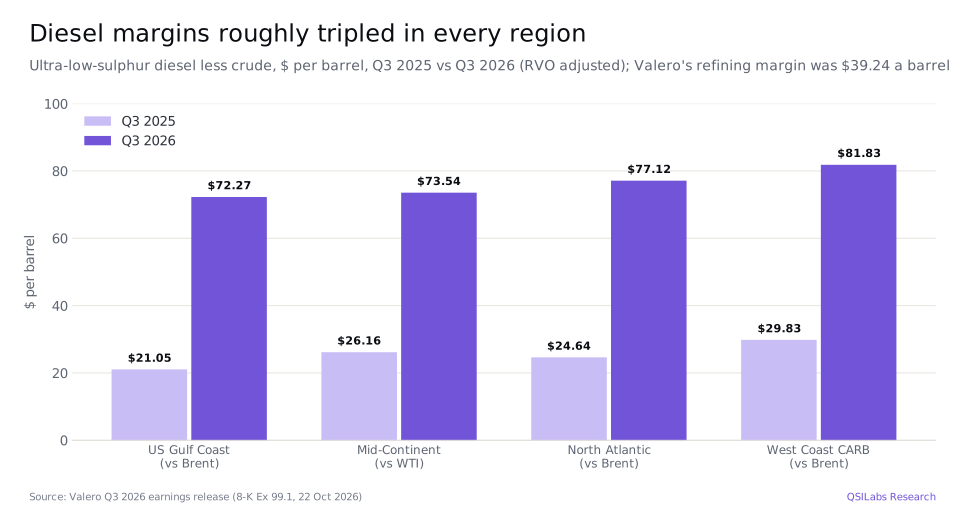
Crude itself was dearer, with Brent averaging $91.61 a barrel against $68.14, but product prices rose faster. Lane Riggs said on the call that the market volatility and tight product inventories of the second quarter continued through the third. US refiners also had cheaper crude than many rivals: Brent averaged .37 a barrel more than WTI, against .11 a year earlier, and freight to move crude to refiners elsewhere had soared. The cost of renewable fuel compliance rose too: the renewable volume obligation cost $14.34 a barrel, up from $6.38, and is already deducted from the product margins above.
What could reverse this is supply. Simmons said that consultants estimate about 1.5m barrels a day of global refinery maintenance was deferred this year, so "you would expect a heavier turnaround season next year". Refineries that delayed work this year may run less reliably, which would keep margins high, or come back with more capacity later, which would lower them.
What did Valero guide for the fourth quarter?
Valero expects to process 2.87m to 2.98m barrels a day across its refineries in the fourth quarter, up to 1.91m of it on the Gulf Coast, slightly below the third quarter's 2.97m at the midpoint. It expects ethanol production of 4.9m gallons a day, net interest expense of about $135m, and depreciation and amortisation of about $700m. Capital investment attributable to Valero for 2026 is still guided at about $2bn, of which about $1.7bn sustains the business.
That sustaining spend includes about $250m to repair the distillate hydrotreater at the Port Arthur refinery, damaged in a fire on 23 March 2026. Valero said repairs remain on track for completion by the end of the year and that it expects a substantial portion of the cost to be covered by insurance. The St. Charles FCC unit optimisation project, a $230m investment to make more alkylate and gasoline, was completed in the third quarter on schedule and within budget. General counsel Richard Joe Walsh said the Benicia refinery in California has been "safely idle" since April and that Valero has no plans to restart it.
How much cash does Valero return to shareholders?
Net cash from operating activities was $6,932m in the third quarter, or $7,253m on Valero's adjusted measure, against capital investments of $432m. Valero returned 52% of the adjusted figure to shareholders. In the first nine months it spent $6.2bn on share purchases, against $1.5bn a year earlier, and paid $1.06bn in dividends. It bought 9.06m shares in the third quarter, and had 278.9m shares outstanding on 23 October 2026.
Buybacks have more room to run. Valero had $3.0bn left at 30 September under the $5.0bn programme authorised in July, and on 27 October the board added a further $10.0bn with no expiration date. It also declared a quarterly dividend of $1.20 a share, payable on 21 December 2026, or $4.80 a year, a yield of 1.26% at the 2 November close.
The balance sheet is strong. Valero ended September with cash of $9.84bn, above its long-term target of $4bn to $5bn, against debt of $8.58bn and finance lease obligations of $2.42bn. It repaid $526m of maturing notes in the quarter, and its debt-to-capital ratio net of cash was 4%. Chief Financial Officer Harminder Bhullar said: "We do have a higher mid cycle view for all the reasons that, you know, Gary, Randy and Lane mentioned. But we still operate in a cyclical industry."
What is Valero buying from LyondellBasell?
On 30 October 2026 Valero agreed to buy LYB Houston Hub Holdings, the holding company for LyondellBasell's Houston refinery site, for $320.5m. The roughly 700-acre site sits next to Valero's Houston refinery on the Houston Ship Channel, and Valero plans to restart about 165,000 barrels a day of light sweet crude capacity there by the end of 2027. The deal is expected to close by the end of 2026, subject to antitrust clearance. The purchase price is about 0.3% of Valero's market value; we have not deducted it because it has not closed, and it would lower our value by about $1.15 a share.
How has VLO stock performed in 2026?
VLO closed 2025 at $162.79 and 2 November 2026 at $381.46, a gain of 134.3%. The shares rose every month from June to October, reached a 52-week closing high of $459.78 on 14 October, and have fallen 17.0% since. They fell 2.4% to $426.28 on 22 October, the day of the results, and 9.2% to $387.34 on 27 October. A year ago, on 3 November 2025, they closed at $171.60.
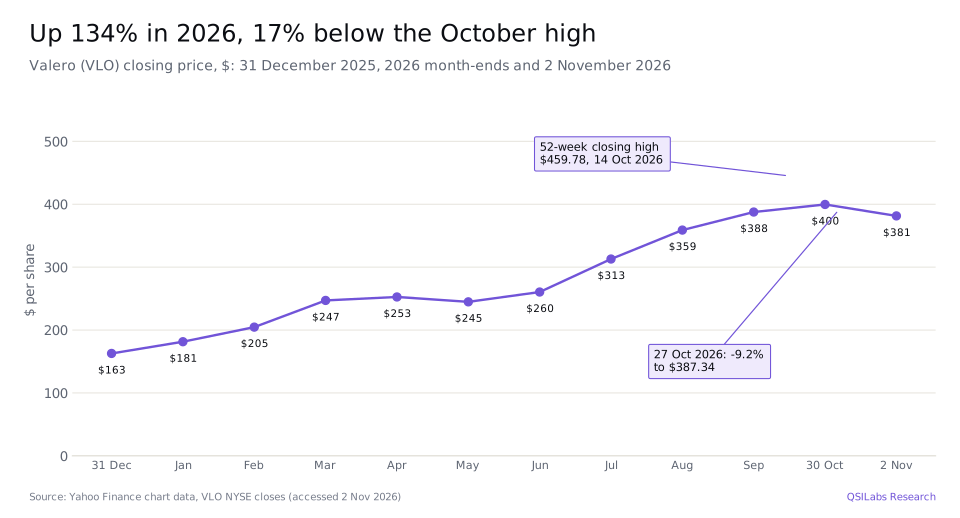
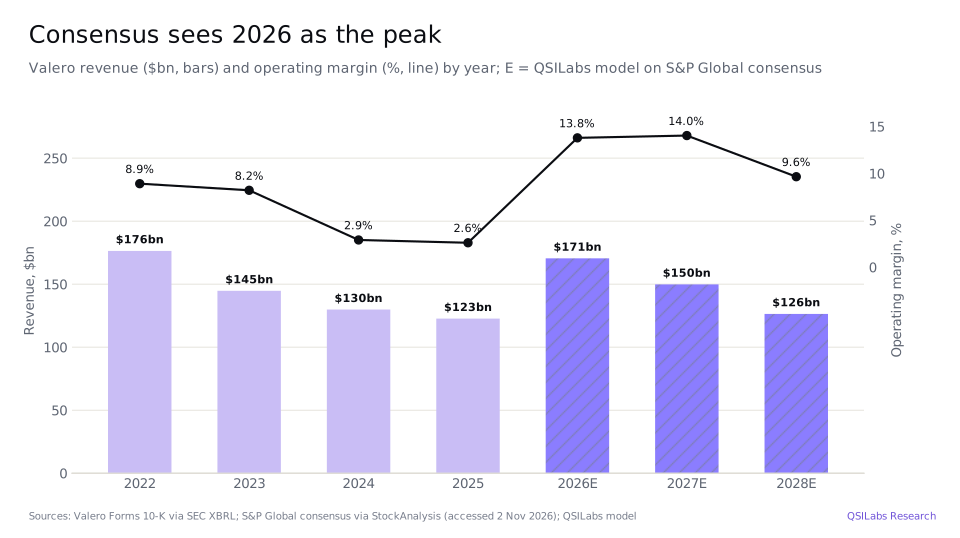
At $381.46 the shares trade at 6.4 times S&P Global consensus earnings per share of $59.73 for 2026 and 7.1 times the $53.56 expected for 2027. A low multiple of peak-year earnings is normal for a refiner: investors expect profits to fall back.
Valero stock Q3 2026: is VLO overvalued?
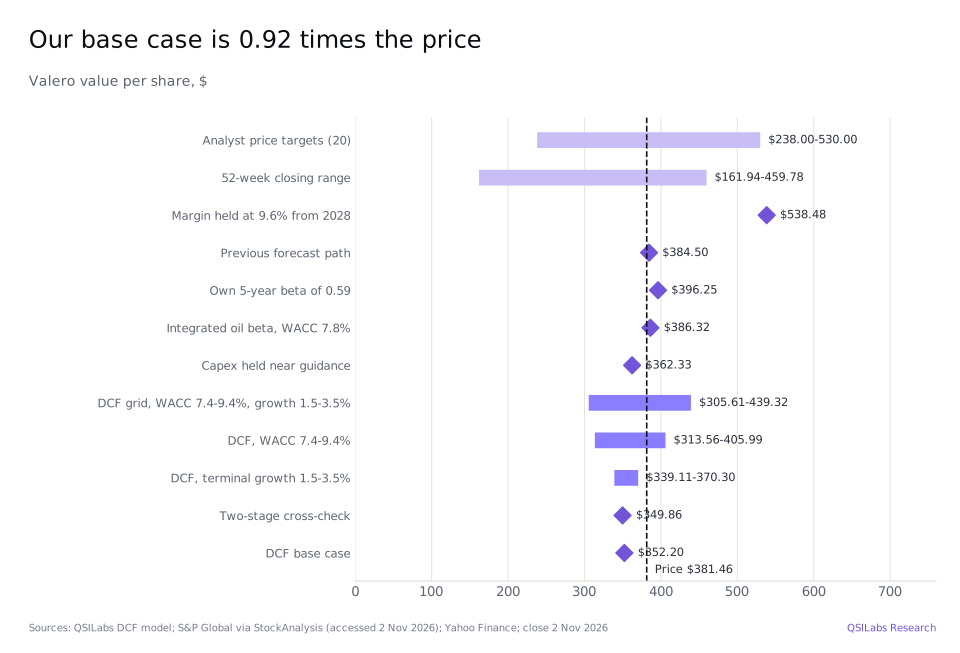
On our numbers, modestly, but the answer depends on how long today's margins last. Our discounted cash flow model values Valero at $352.20 a share, 0.92 times the $381.46 close on 2 November 2026. Our equity value is $98.2bn, against a market value of about $106.4bn.
We value the cash available to all lenders and shareholders, unlevered free cash flow: operating profit after tax at 22.3%, Valero's effective rate in the first nine months, plus depreciation and amortisation, less capital expenditures and the extra working capital that growth needs. That gives $17.76bn for 2026, of which we count only the part still to come after 2 November, $17.67bn in 2027, $10.66bn in 2028 and $5.28bn in 2035. From the enterprise value of $102.01bn we add cash of $9.84bn, deduct debt and finance leases of $11.00bn and noncontrolling interests of $3.11bn, and add a net $0.48bn: equity-method investments of $675m less our estimate of about $193m for asset retirement obligations. Dividing by 278.9m shares gives $352.20.
We discount at a weighted average cost of capital of 8.45%. The cost of equity is 8.82%: a US 10-year Treasury yield of 5.12% plus a beta of 0.79 times an equity risk premium of 4.70%. The beta is Damodaran's global unlevered beta of 0.73 for oilfield services and equipment, the industry in which he classifies US refiners, relevered at Valero's debt-to-equity ratio of 0.10. The risk premium is weighted by where Valero's customers were in 2025: 71.6% of revenue in the United States, 6.6% in Canada, 12.9% in the UK and Ireland, 4.2% in Mexico and Peru and 4.7% elsewhere. Debt is 9.4% of capital, at an after-tax cost of 4.85%. After 2035 we assume growth of 2.5% a year; that terminal value is 42.4% of our enterprise value.
Plainly, the value is below the price because we assume today's margins do not last. Our cash flows peak in 2026 and 2027 and then shrink as the margin returns to its average. The market is pricing in margins that stay higher for longer, which is also management's view. Valero's own five-year beta is 0.59, below the industry figure we use: using it would cut the cost of capital to 7.61% and raise the value to $396.25. Damodaran's integrated oil and gas industry, arguably a closer match for a refiner than oilfield services, has an unlevered beta of 0.59 too; using it gives a cost of capital of 7.77% and a value of $386.32, close to the share price.
Our forecast for Valero
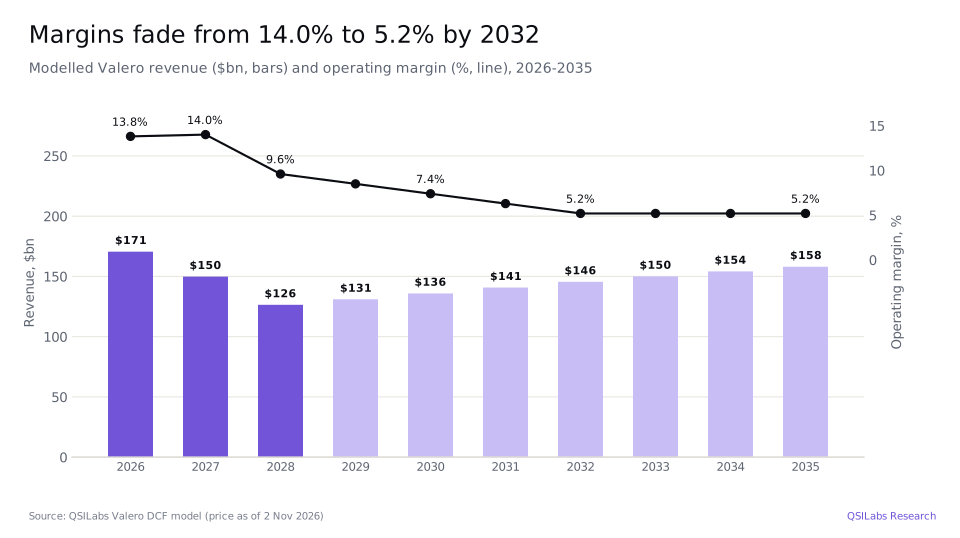
Revenue is $170.55bn in 2026, the first nine months' $122.96bn plus the rest of S&P Global consensus, and $149.84bn in 2027, consensus again, down 12.1%. StockAnalysis reports revenue after excise taxes, so we gross consensus up by the ratio of Valero's reported revenue to that figure in the first nine months, 1.043. For 2028 we apply S&P Global's three-year growth rates from 2025, 1.5% a year for revenue and 43.1% a year for earnings per share, which give revenue of $126.44bn, down 15.6%. From 2029 to 2031 revenue grows 3.65% a year, Mordor Intelligence's forecast growth for independent and merchant refiners to 2031, before fading to 2.5% by 2035. On that path Valero's 2031 revenue of $140.8bn would be about 9.1% of TechSci Research's forecast $1.54 trillion market for refined petroleum products, against 10.5% of the $1.17 trillion market in 2025, so we are not assuming share gains.
The operating margin is 13.8% in 2026 and 14.0% in 2027, from consensus operating income and earnings per share, and 9.6% in 2028, from the three-year earnings growth rate. From there the margin falls in a straight line to 5.16% by 2032 and stays there. That is Valero's average operating margin over 2016 to 2025, total operating profit divided by total revenue, leaving out the pandemic years of 2020 and 2021; including them it would be 4.40%, and the best year in that period, 2022, was 8.9%.
Depreciation and amortisation starts at 1.74% of revenue in 2026, the nine-month rate plus the fourth-quarter guidance, and rises to 1.99% by 2030, Valero's average over 2016 to 2025 excluding 2020 and 2021, the same years as the margin average. Capital expenditures are $2.0bn in 2026, the guidance, then drift up to 2.6% of revenue, about $4.1bn, by 2035, the reinvestment our model needs to support 2.5% growth. That is about double Valero's guidance and recent history, but it makes little difference: holding capital spending at $2.0bn and raising it 2.5% a year gives $362.33. Working capital is 3.07% of revenue.
Our previous model, priced at the 21 October close of $436.75, gave $345.45. It annualised the first half of 2026, let revenue follow crude oil futures with no growth from 2031 to 2035, and used a 2027 margin of 9.0% fading to 5.16%, none of it tied to a published forecast. Run in today's model, with the third-quarter results and the new balance sheet, that old path gives $384.50, so the sourced forecast takes off $32.30, mainly because consensus has revenue falling to $126.4bn in 2028 against about $164bn a year on the old path.
How the number moves if you argue with us
The table shows our value per share at different costs of capital and terminal growth rates. The model reaches the share price only with a cost of capital below about 8% or high terminal growth: at a 7.45% cost of capital and 3.5% growth, the corner of the grid, it gives $439.32, about 1.15 times the price.
| Cost of capital | Growth 1.5% | Growth 2.0% | Growth 2.5% | Growth 3.0% | Growth 3.5% |
|---|---|---|---|---|---|
| 7.449% | $383.61 | $393.81 | $405.99 | $420.83 | $439.32 |
| 7.949% | $359.66 | $367.49 | $376.68 | $387.66 | $401.02 |
| 8.449% | $339.11 | $345.17 | $352.20 | $360.45 | $370.30 |
| 8.949% | $321.26 | $326.00 | $331.43 | $337.70 | $345.07 |
| 9.449% | $305.61 | $309.34 | $313.56 | $318.38 | $323.95 |
A two-stage version of the model, which adds a 10-year period after 2035 in which growth fades gradually to 2.5% and returns on new investment fall towards the cost of capital, gives $349.86. Using a separate cost of capital for each region, each with its own industry beta, gives 8.31% and $358.78.
The assumption that matters most is the margin. If the operating margin stays at 9.6%, the 2028 figure implied by consensus, instead of falling to 5.16%, the model gives $538.48, about 1.41 times the price. For the share price to be right on our method, investors need to believe that refining margins will settle well above their 2016 to 2025 average, which is what Valero's management says it expects.
Risks to the Valero investment case
- The margin cycle. Valero's operating margin was 2.6% in 2025 and 13.8% in 2026 on our numbers. Crack spreads have collapsed after past peaks, and our value already assumes they fade; a faster fall would cut it further, while a slower one would lift it sharply.
- Supply returning. Deferred maintenance, refinery restarts and new capacity elsewhere, including Valero's own planned 165,000 barrel-a-day Houston restart, could all add supply and narrow margins.
- Operating incidents. The Port Arthur fire shut the refinery in March. Large refineries carry fire and outage risk, and insurance covers only part of the cost.
- Regulation. The cost of renewable fuel obligations more than doubled to $14.34 a barrel in the quarter, and Valero has already stopped refining at Benicia; Walsh called the West Coast "a tough environment to operate in".
- Crude and freight. Valero's advantage depends on cheap American crude and on high costs for rivals to source theirs. A fall in freight rates or a narrower gap between US and international crude would erode it.
- Volatility. VLO more than doubled in 2026 and fell 9.2% in a single day on 27 October. Its five-year beta of 0.59 understates how much the shares can move on commodity prices.
FAQ
What value does QSILabs put on Valero shares?
Our discounted cash flow model gives $352.20 a share, against a $381.46 close on 2 November 2026, or about 0.92 times the price. Across costs of capital from 7.4% to 9.4% and terminal growth from 1.5% to 3.5% the value ranges from $305.61 to $439.32. A two-stage cross-check gives $349.86.
Should I buy VLO after the third-quarter report?
We do not give investment advice. On our model the shares trade a little above our estimate of their value, because we assume refining margins fall back to their long-run average by 2032. If you believe margins will stay near the 2028 consensus level of 9.6%, the model gives $538.48. Of 20 analysts polled by S&P Global, the consensus rating is Hold.
How much money did Valero make between July and September 2026?
Net income attributable to Valero was $6,828m, or $23.89 a diluted share, up from $1,095m, or $3.53 a share, a year earlier. Adjusted earnings were $23.90 a share. Operating income was $9,073m on revenue of $46,098m.
What is a crack spread?
It is the gap between the price of a refined product, such as diesel or gasoline, and the price of the crude oil it is made from, usually quoted in dollars a barrel. Valero's profits rise and fall with it. In the third quarter of 2026 Gulf Coast diesel sold for $72.27 a barrel more than Brent crude, up from $21.05 a year earlier.
How big is Valero's dividend?
Valero declared a quarterly dividend of $1.20 a share on 27 October 2026, payable on 21 December. That is $4.80 a year, a yield of 1.26% at the 2 November close of $381.46. Buybacks are a much larger part of what Valero returns: $6.2bn in the first nine months of 2026, against $1.06bn of dividends.
What price target do analysts have for VLO?
According to 20 analysts polled by S&P Global, as shown by StockAnalysis on 2 November 2026, the average 12-month target is $426.89 and the median $440, with a range from $238 to $530. The consensus rating is Hold.
How many refineries does Valero run?
Valero operates 14 petroleum refineries in the US, Canada and the UK with combined throughput capacity of about 3.0m barrels a day. It ran 2.97m barrels a day in the third quarter of 2026. Its Benicia refinery in California stopped refining in April 2026 and Valero has no plans to restart it.
How much debt does Valero carry?
At 30 September 2026 Valero had debt of $8.58bn and finance lease obligations of $2.42bn, against cash of $9.84bn. Its debt-to-capital ratio net of cash was 4%. In our cost of capital, debt is 9.4% of total capital at market values.
What happened at Valero's Port Arthur refinery?
On 23 March 2026 a fire in a distillate hydrotreater unit shut down the Port Arthur refinery. It resumed operations in April at reduced rates. Valero estimates the repair cost at about $250m, expects a substantial portion to be covered by insurance and expects the repairs to be complete by the end of 2026.
Who runs Valero?
Lane Riggs is Valero's Chairman, Chief Executive Officer and President. Gary Simmons is Executive Vice President and Chief Operating Officer, and Harminder Bhullar is Senior Vice President and Chief Financial Officer.
Sources
- Valero Energy, third-quarter 2026 earnings release (Form 8-K, Exhibit 99.1, 22 Oct 2026; accession 0001628280-26-066795) www.sec.gov
- Valero Energy, Form 10-Q for the quarter ended 30 Sep 2026 (accession 0001628280-26-067679) www.sec.gov
- Valero Energy, press release on the LyondellBasell Houston refinery acquisition (Form 8-K, Exhibit 99.1, 30 Oct 2026; accession 0001628280-26-068387) www.sec.gov
- Valero Energy, Form 10-K for the year ended 31 Dec 2025 www.sec.gov
- SEC XBRL company facts for Valero Energy (CIK 1035002): annual revenue and operating income data.sec.gov
- Valero Q3 2026 earnings call transcript, 22 Oct 2026 (The Motley Fool; accessed 2 Nov 2026) www.fool.com
- StockAnalysis: Valero Energy forecast and analyst ratings, S&P Global data (accessed 2 Nov 2026) stockanalysis.com
- StockAnalysis: Valero Energy statistics (accessed 2 Nov 2026) stockanalysis.com
- Mordor Intelligence, Oil Refining Market report (accessed 2 Nov 2026) www.mordorintelligence.com
- TechSci Research, Refined Petroleum Products Market (accessed 2 Nov 2026) www.techsciresearch.com
- Yahoo Finance chart data: VLO closing prices and dividends (November 2025 to November 2026) query1.finance.yahoo.com
- Damodaran Online: global industry betas, cost of capital and country equity risk premiums, January 2026 pages.stern.nyu.edu
- QSILabs Valero Energy discounted cash flow model (internal; price as of 2 Nov 2026)
Disclaimer
This article is for information only and is not investment advice, a recommendation or an offer to buy or sell any security. QSI Labs and its authors may hold positions in the securities discussed. Forecasts and valuations are estimates that depend on assumptions that may prove wrong. Figures are taken from company filings and third-party sources believed to be reliable, but we do not guarantee their accuracy. Do your own research or consult a licensed adviser before investing.
More from QSI Labs
Related analysis: ExxonMobil stock Q3 2026: refining and buybacks, Chevron stock Q3 2026: refining and Venezuela, Southern Copper stock Q3 2026: Tia Maria and copper and NextEra Energy stock Q3 2026: FPL rate base and backlog.
Read our white paper, QSI Labs: An AI-Native Trading Firm Built on a Training Loop (October 2026), available on request, or browse the research index.