Research / Earnings and valuation
Chevron Stock Q3 2026:Record US Refining Lifts Earnings to $9.9bn
As of: Figures are as of Chevron Corporation's Q3 2026 results (quarter ended 30 September 2026), reported on 30 October 2026 in its earnings release (Form 8-K, Exhibit 99.1); the Form 10-Q for the quarter had not been filed at publication. The share price is the NYSE close of CVX on 30 October 2026, $235.52. Published 2 November 2026.
The short answer. Chevron stock Q3 2026 results showed a company running hard: earnings of $9.9bn, up from $3.5bn a year earlier, as US refineries processed a record 1.09 million barrels a day into much more profitable fuel. Adjusted EPS was $5.28, free cash flow was $12.0bn and net debt fell by $7.8bn in the quarter to $20.7bn. Our discounted cash flow model puts Chevron at $167.51 per share, about 29% below the $235.52 close on 30 October 2026: the market is paying for today's oil and refining prices for longer than our model assumes they last.
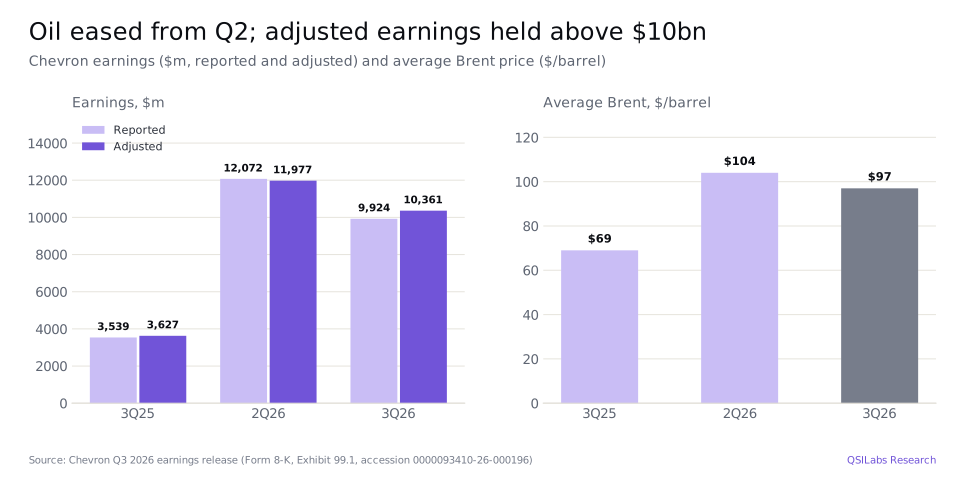
Chevron's third quarter of 2026 was a downstream quarter. Downstream earnings were $4.93bn against $1.14bn a year earlier, with the US refining and marketing business alone earning $3.59bn, up from $638m (Chevron Q3 2026 earnings release). Total earnings were $9.92bn, or $5.06 a share, and adjusted earnings were $10.36bn, or $5.28 a share. Brent averaged $97 a barrel, down from $104 in the second quarter but far above the $69 of a year earlier. The shares rose 1.8% on results day, from $231.46 to $235.52, and are up about 55% since the end of 2025 (Yahoo Finance).
In this article we go through Chevron's Q3 2026 numbers against a year earlier and the previous quarter, segment by segment, the record refinery runs, production, the expanded Venezuela plan, the Hess Midstream deal, cash flow, buybacks and the dividend, and our valuation of CVX, with every assumption laid out so you can argue with it.
Key takeaways
- Valuation: QSILabs values Chevron Corporation (NYSE: CVX) at $167.51 per share as of Q3 2026, against a $235.52 close on 30 October 2026, about 29% below the market price. Our value was $161.16 before the quarter.
- Q3 2026 results: earnings were $9.92bn ($5.06 a share) in the quarter ended 30 September 2026, against $3.54bn ($1.82) a year earlier; adjusted earnings were $10.36bn ($5.28 a share).
- Refining: US refineries ran a record 1.09 million barrels a day at nearly 98% utilisation, and Downstream earnings rose to $4.93bn from $1.14bn on higher margins for refined products.
- Production: output was 3.98 million oil-equivalent barrels a day, down from 4.09 million a year earlier because of lower entitlements at higher prices and the Middle East conflict; US production stayed above 2 million barrels a day for a fifth straight quarter.
- Cash and returns: operating cash flow was $16.0bn and free cash flow $12.0bn in Q3; Chevron paid $3.5bn of dividends, bought back $2.5bn of stock and cut debt by $3.5bn. Net debt was $20.7bn at 30 September, a net debt ratio of 9.6%.
- Strategy: Chevron's Venezuela joint ventures plan to invest $7bn over five years, and a deal with Hess Midstream should cut Bakken midstream costs by about 50%, with a one-time after-tax loss of $3-4bn at closing.
Key numbers from Chevron's Q3 2026 earnings
| Q3 2026 vs Q3 2025, $m | Q3 2025 | Q3 2026 | Change |
|---|---|---|---|
| Sales and other operating revenues | 48,169 | 65,237 | +35% |
| Total revenues and other income | 49,726 | 67,798 | +36% |
| Purchased crude oil and products | 27,398 | 36,534 | +33% |
| Depreciation, depletion and amortization | 5,781 | 6,272 | +8% |
| Income before income tax | 5,414 | 13,625 | +152% |
| Net income attributable to Chevron | 3,539 | 9,924 | +180% |
| Earnings per share, diluted ($) | 1.82 | 5.06 | +178% |
| Weighted-average diluted shares (m) | 1,946 | 1,963 | +1% |
| Net oil-equivalent production (MBOED) | 4,086 | 3,980 | -3% |
Source: Chevron Q3 2026 earnings release, Attachment 1 and the Financial and Business Highlights table (accession 0000093410-26-000196). Capital expenditures were $4.0bn in Q3 2026, $0.4bn lower than a year earlier.
Chevron Q3 2026 earnings: what happened
Chevron nearly tripled its earnings from a year earlier on higher refining margins and higher oil prices, while running its plants close to flat out. Against the third quarter of 2025, earnings rose by $6.39bn to $9.92bn. Against the second quarter they fell by $2.15bn, mostly because oil prices eased and derivative timing effects swung from a $1.54bn gain to a $1.58bn loss. Chairman and CEO Mike Wirth said: "We delivered strong operational performance and disciplined execution, while continuing to invest to grow energy supply." He added: "We're reinvesting to bring more energy to a supply-constrained market."
Two measures need care this quarter. Adjusted earnings, $10.36bn, exclude special items and foreign currency effects: a $160m legal reserve, a $110m impairment, $24m of pension settlement costs and a $143m currency loss. They do not exclude timing effects, which Chevron estimates cut Q3 earnings by $1.58bn. Timing effects are mismatches between marking derivatives to market and delivering the physical barrels, plus LIFO inventory accounting, and they tend to reverse as cargoes are delivered.
For the first nine months of 2026, earnings were $24.21bn ($12.26 a share) against $9.53bn ($5.27) a year earlier, and adjusted EPS was $12.73 against $5.80. The comparison flatters 2026 because the Hess acquisition closed in July 2025, so the first half of last year did not include Hess's assets. Income from equity affiliates, which include Tengizchevroil in Kazakhstan, more than doubled to $2.10bn in Q3. The effective tax rate was 26% in the quarter and 28% for the nine months. Return on capital employed was 17.7% in Q3 and 14.5% for the year to date.
- Q3 2026Venezuela: improved commercial terms and expanded acreage; Chevron moves its Venezuela interests to equity accounting, adding one month of production8-K Ex 99.1
- Q3 2026Offshore discovery in Angola's Lower Congo Basin; exploration agreement with Libya's National Oil Corporation in the Sirte Basin8-K Ex 99.1
- Q3 2026Bunge Chevron Ag Renewables starts up its Destrehan, Louisiana oilseed plant; sale of the Cambodia fuels business completed8-K Ex 99.1
- 30 Sep 2026Board names Jeff Gustavson, President of New Energies, as CFO from 1 January 2027; CFO Eimear Bonner to become President, Oil, Products & GasForm 8-K
- 6 Oct 2026Agreement to hand Chevron's Hess Midstream stake and DJ Basin crude midstream assets to Hess Midstream for $200m and new Bakken termsForm 8-K, Ex 99.1
- 30 Oct 2026Q3 2026 results; CVX closes at $235.52, up 1.8% on the day8-K Ex 99.1; Yahoo Finance
- 10 Dec 2026Q4 dividend of $1.78 a share payable to holders of record on 18 November8-K Ex 99.1
How did each Chevron segment do in Q3 2026?
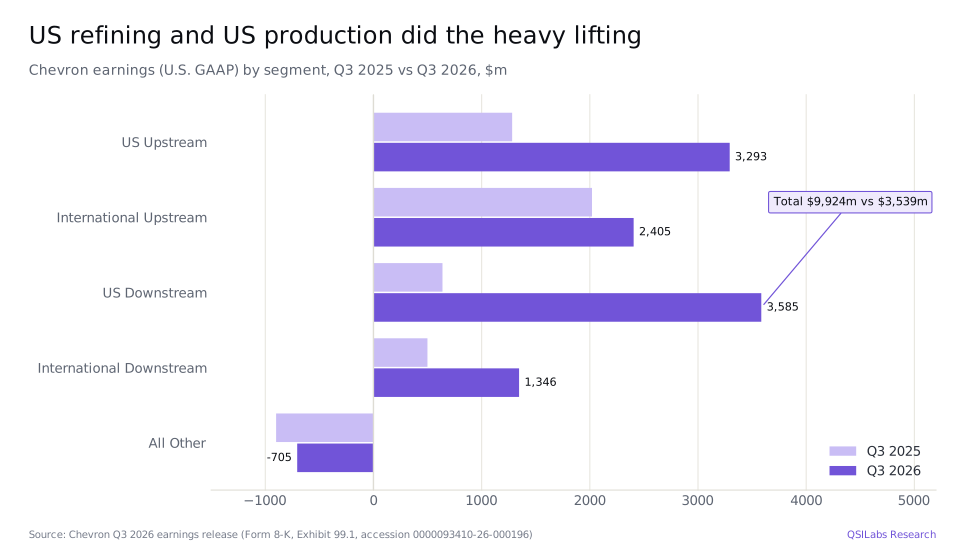
Upstream: oil and gas production
Upstream earned $5.70bn, up from $3.30bn a year earlier and down from $8.18bn in Q2. US Upstream earned $3.29bn against $1.28bn a year earlier, helped by a US liquids realisation of $62.72 a barrel, up from $48.12, and lower operating expenses, including the absence of last year's Hess severance and transaction costs. International Upstream earned $2.41bn against $2.02bn: higher realisations and higher liftings in Venezuela were partly offset by unfavourable timing effects, taxes, currency, the legal reserve and the impairment. Before those special items and currency effects, International Upstream earned $2.81bn. International liquids realisations averaged $86.09 a barrel and international gas $9.44 per thousand cubic feet.
Against the second quarter, Upstream earnings fell by $2.48bn, almost all of it in the international business, where liquids realisations fell to $86.09 from $96.41 and timing effects turned negative.
Downstream: refining and marketing
Downstream earned $4.93bn, more than four times the $1.14bn of a year earlier and about half of Chevron's total earnings. US Downstream earned $3.59bn, up from $638m a year earlier and $2.41bn in Q2, on higher margins for refined products. International Downstream earned $1.35bn against $499m a year earlier, despite unfavourable timing effects, although that was down from $2.46bn in Q2.
All Other
All Other, which holds corporate costs, financing, insurance and technology ventures, had net charges of $705m against $900m a year earlier, helped by favourable tax items and lower interest expense. Interest and debt expense fell to $304m from $370m as Chevron repaid debt.
How did Chevron's refineries perform in Q3 2026?
Chevron's US refineries ran harder than ever. Crude unit inputs reached a record 1.09 million barrels a day in Q3, up 3% from a year earlier and from 1.07 million in Q2, at a crude unit utilisation of nearly 98% (Q3 2026 earnings release). US refined product sales were 1.30 million barrels a day, about level with a year earlier.
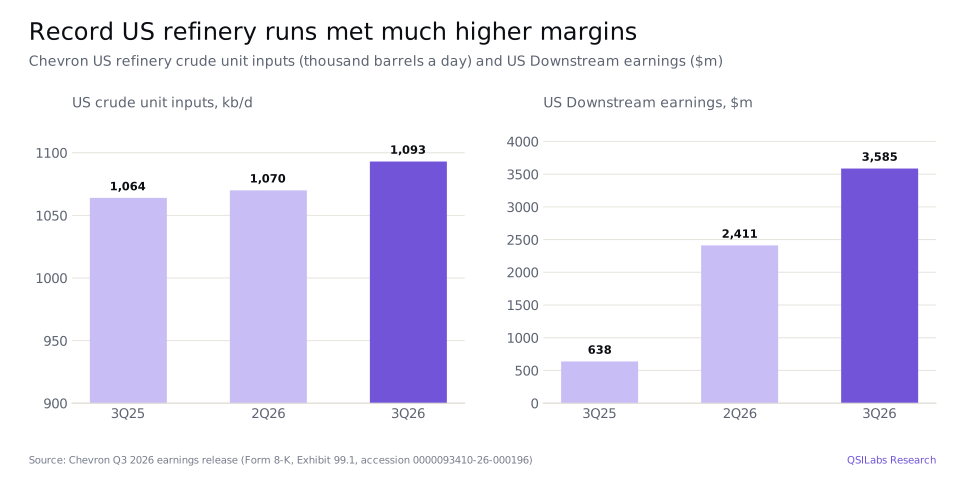
The chart shows where the money came from. Volumes rose only modestly; margins did the work. Chevron says the increase in US Downstream earnings against a year earlier was primarily due to higher margins on refined product sales. Fuel supply was tight in the quarter because the conflict in the Middle East disrupted production and trade, and refiners with full running capacity outside the region captured wide spreads between crude and products. Chevron's international refineries processed 665,000 barrels a day, flat on a year earlier, but international product sales fell 9% to 1.39 million barrels a day because of supply disruptions from the Middle East conflict.
Investors should treat this as a strong but cyclical quarter. A refinery that runs at 98% has little room to add volume, so future Downstream earnings depend mainly on margins. If fuel supply recovers and margins fall back towards the levels of 2025, Downstream earnings fall back with them, and our model assumes they do.
Chevron is also adding feedstock flexibility. In the quarter, Bunge Chevron Ag Renewables started production at its new oilseed-processing plant in Destrehan, Louisiana, which supplies feedstock for renewable transportation fuels. Chevron also completed the sale of its Cambodia downstream fuels business.
What happened to Chevron's oil and gas production?
Chevron produced 3.98 million oil-equivalent barrels a day in Q3 2026, 106,000 fewer than a year earlier and 90,000 fewer than in Q2. Liquids production was 2.47 million barrels a day and gas 9.09 billion cubic feet a day. For the first nine months, production averaged 3.97 million barrels a day against 3.61 million a year earlier, when Hess was included only from July.
The US business held steady at 2.04 million barrels a day, up 3,000 from a year earlier and above 2 million for the fifth consecutive quarter. Project ramp-ups at Ballymore, Whale and Anchor in the Gulf of America offset lower Bakken output. Chevron says US production is up 27% from two years ago. US gas production rose to 3.52 billion cubic feet a day from 3.27 billion.
International production fell to 1.94 million barrels a day from 2.05 million. Two effects drove the decline. Under production-sharing contracts, Chevron's entitlement to barrels falls when prices rise, because fewer barrels are needed to recover costs. And the Middle East conflict disrupted output. Record production at Chevron-operated assets in Australia, new records in the Eastern Mediterranean, and the inclusion of one month of Venezuela production partly offset the decline.
Capital spending is shifting. US Upstream capex fell to $1.67bn from $2.38bn a year earlier, largely because of lower spending in the Permian Basin, while International Upstream capex rose to $1.92bn from $1.73bn. Total capex for the nine months was $12.6bn, with another $0.9bn spent by affiliates.
What does the Venezuela plan mean for Chevron?
Venezuela is now a growth project for Chevron rather than a legacy position. In the quarter Chevron secured improved commercial terms and expanded acreage in the country, which it says support future investment and the potential to more than double production over the next five years. Its joint ventures there plan to invest $7bn over that period. Chevron describes the goal as unlocking low-cost, high-return, long-duration production growth.
The accounting has changed too. Chevron moved its Venezuela interests to equity accounting during the quarter, so Q3 production includes one month of Venezuelan output and earnings include higher Venezuelan liftings. Over time, Venezuela should add barrels and earnings to International Upstream without the capital being fully visible in Chevron's own capex line, because spending by equity-accounted joint ventures is reported as affiliate spending.
The opportunity is large but the risk is political. Chevron's ability to operate in Venezuela depends on US sanctions policy and on the Venezuelan government, and both have changed sharply over the past decade. Our model does not add a separate value for Venezuela; it enters only through our long-run revenue growth of 2-2.5% a year after 2029.
Chevron is also exploring elsewhere. In the quarter it announced an offshore oil and condensate discovery in Angola's Lower Congo Basin and signed an exploration agreement with Libya's National Oil Corporation for the Sirte Basin.
Why is Chevron giving up its Hess Midstream stake?
To cut the cost of moving Bakken oil and gas. On 6 October 2026 Chevron agreed to transfer its ownership interests and general partner position in Hess Midstream LP, plus its DJ Basin crude oil midstream assets, to Hess Midstream. In return it gets extended and improved Bakken midstream contracts, new DJ Basin contracts and $200m in cash (Chevron 8-K, 6 October 2026). Chevron expects its Bakken unit midstream costs to fall by about 50%.
The deal has three financial effects. Chevron will deconsolidate Hess Midstream, including about $3.7bn of its debt. It expects return on capital employed to rise by 0.5 percentage points. And it expects a one-time after-tax loss of about $3bn to $4bn at closing, which it will treat as a special item, because it cannot record future Bakken cost savings as an asset. Andy Walz, President of Downstream, Midstream and Chemicals, said the transaction "lowers our Bakken cost structure while positioning Hess Midstream to advance as an independent company." Closing is expected by the end of 2026.
For valuation, the loss is a non-cash accounting charge, so we exclude it from operating profit. We keep Hess Midstream's debt and noncontrolling interest on the balance sheet as reported at 30 September, because the deal has not closed.
Chevron is also changing its leadership. On 30 September the board named Jeff Gustavson, President of New Energies, as chief financial officer from 1 January 2027; the current CFO, Eimear Bonner, will become President, Oil, Products & Gas, and Vice Chairman Mark Nelson will take responsibility for strategy and business development (Form 8-K).
Chevron cash flow, buybacks and dividend
Chevron generated $16.0bn of operating cash flow in Q3 2026, against $9.4bn a year earlier, helped by higher earnings and larger cash distributions from Tengizchevroil. Excluding working capital, operating cash flow was $16.6bn. After $4.0bn of capex, free cash flow was $12.0bn. Adjusted free cash flow, which adds back working capital, asset-sale proceeds and loan repayments from affiliates, was $14.2bn and benefited from a $1bn loan repayment by Tengizchevroil.
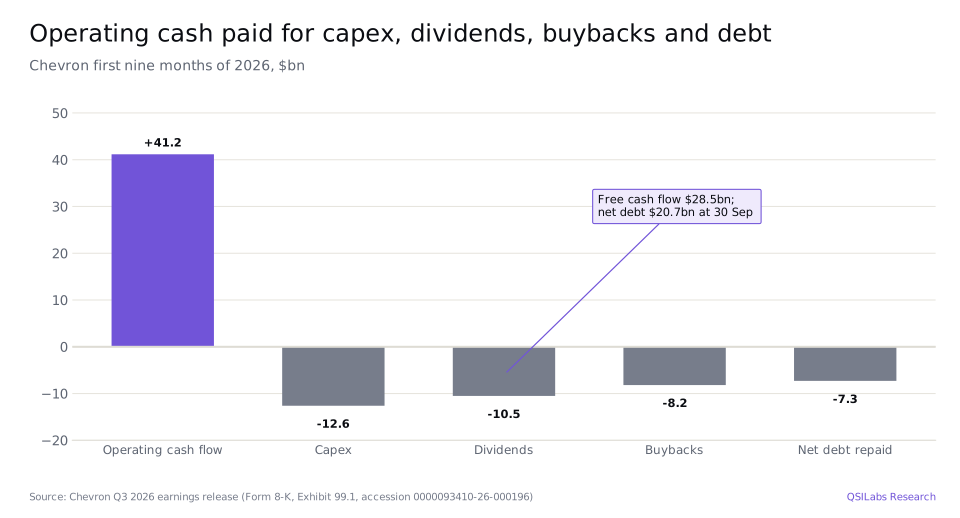
The balance sheet is much stronger than at the start of the year. Total debt fell to $33.5bn at 30 September from $40.8bn at the end of 2025, and cash rose to $12.8bn from $6.3bn. Net debt was $20.7bn, down from $34.5bn at the end of 2025, and the net debt ratio fell to 9.6% from 15.6%. Debt was 0.6 times trailing operating cash flow. Stockholders' equity was $194.3bn.
Chevron's dividend and buybacks
Chevron declared a quarterly dividend of $1.78 a share, payable on 10 December 2026 to holders of record on 18 November. At $235.52, the annualised dividend of $7.12 yields 3.0%. Chevron bought back $2.50bn of stock in Q3 and $8.19bn in nine months, and shares outstanding fell to 1,951 million at 30 September from 1,980 million at the end of 2025. At the Q3 pace, buybacks of about $10bn a year would retire about 2% of a market value of about $460bn.
Chevron stock Q3 2026: is CVX overvalued?
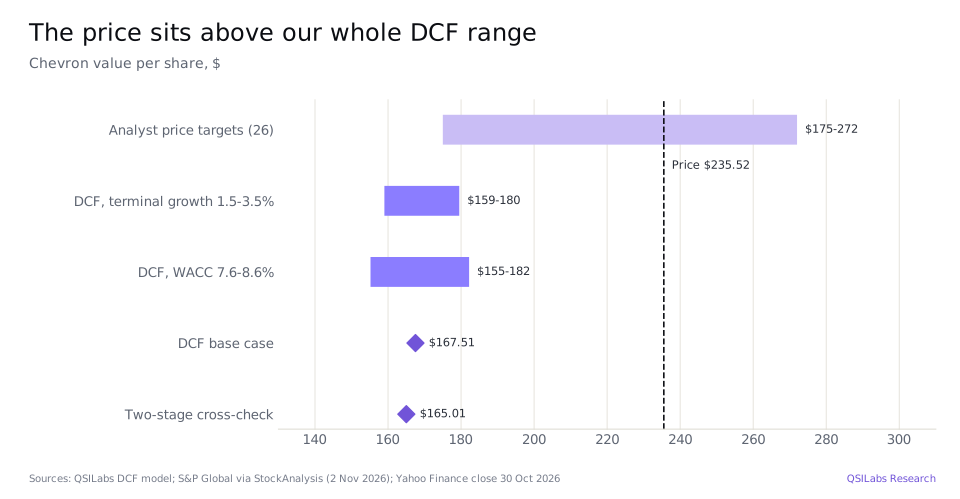
On our numbers, yes. We value Chevron at $167.51 a share, about 29% below the $235.52 close on 30 October 2026; put the other way, the stock trades about 41% above our value. A simpler two-stage cross-check gives $165.01. Analysts are far closer to the price: 26 analysts have an average price target of $241.67 and a median of $243.50, with a range of $175 to $272 and a consensus rating of Buy; 21 rate it Buy or Strong Buy (S&P Global via StockAnalysis, 2 November 2026). Consensus expects EPS of $18.48 in 2026, and Zacks consensus is $15.96 for 2027 (Zacks via Yahoo Finance, 16 October 2026). That puts CVX on 12.7 times 2026 earnings and 14.8 times 2027 earnings.
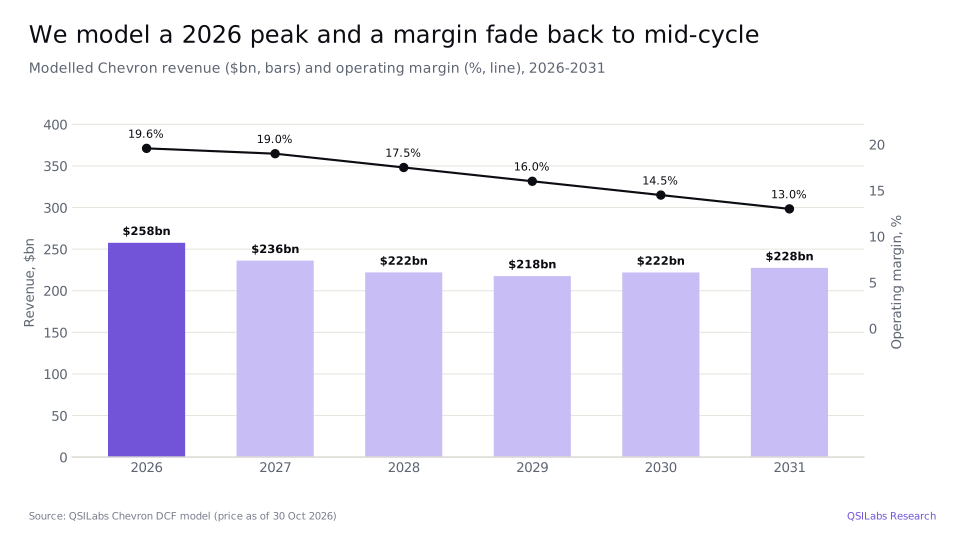
The gap comes down to how long prices stay high. Brent at $97 is about $28 a barrel above where it was a year earlier, and refining margins are well above their 2025 levels. The market price implies that much of that holds. Our model fades Chevron's operating margin from 19.6% in 2026 to 13.0% by 2031, close to the 13.9% Chevron earned in 2024 and above the 11.1% of 2025.
Method
We value Chevron with a discounted cash flow model. Revenue, operating margin, tax, capital spending, depreciation and working capital are forecast year by year to 2035, and free cash flow is discounted at a WACC of 8.05%, a cost of capital weighted by where Chevron earns its revenue, using Damodaran's industry and country data. Terminal growth is 2.5%, and the terminal value is 50.0% of enterprise value. From enterprise value we subtract net debt of $20.7bn and noncontrolling interests of $5.65bn at book value, and divide by 1,957 million diluted shares.
Our main assumptions:
- 2026: revenue of $257.6bn: $186.5bn booked in nine months and about $71.2bn in Q4, slightly above Q3's $67.8bn. Operating profit of $50.5bn, a 19.6% margin, with $35.3bn earned in nine months and $15.2bn assumed for Q4.
- 2027: revenue down 8.3% to $236.2bn, the Zacks consensus level, at an operating margin of 19.0%, consistent with consensus EPS of $15.96.
- 2028-2029: revenue down 6% and then 2% as oil prices and refining margins revert, to $217.6bn in 2029, with margin falling to 16.0%.
- 2030 onwards: revenue grows 2-2.5% a year, helped by Venezuela, the Gulf of America and lower Bakken costs, and operating margin settles at 13.0%.
- Capital spending: $16.9bn in 2026 ($12.6bn in nine months plus about $4.3bn in Q4) and $18.0bn in 2027, with a tax rate of 28.3%, the nine-month effective rate.
Unlevered free cash flow is $38.8bn in 2027, falling to $28.8bn in 2029 and $21.6bn in 2031.
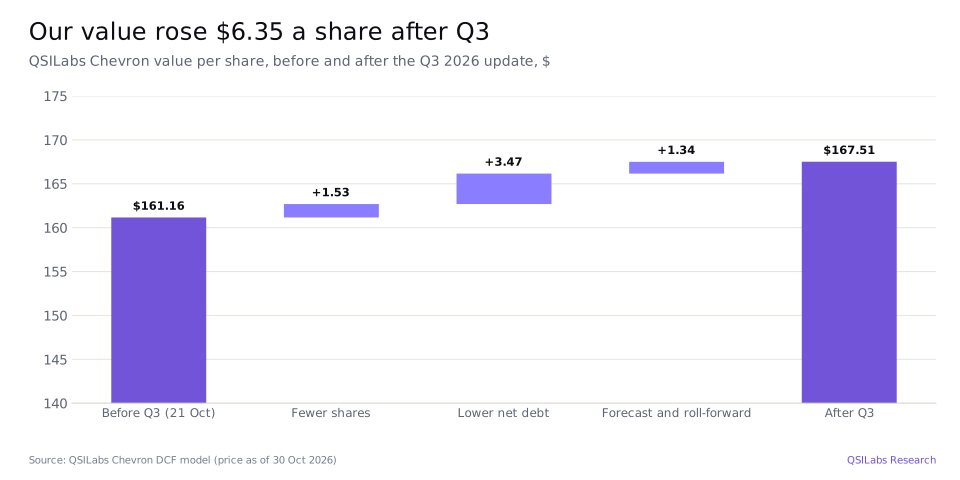
The forecast change was small but not one-directional. We raised 2026 revenue to $257.6bn from $239.3bn, but cut the 2026 operating margin to 19.6% from about 24%, because Q3 operating profit came in below our expectation, and cut the 2027 margin to 19.0% from 21.0% to match consensus earnings. Lower debt and fewer shares did more for the value than the forecast did.
| Value bridge | $bn | Per share ($) |
|---|---|---|
| Present value of free cash flow, 2026-2035 | 177.2 | 90.52 |
| Present value of terminal value | 177.1 | 90.46 |
| Enterprise value | 354.2 | 180.99 |
| Less net debt (debt $33.5bn less cash $12.8bn) | -20.7 | -10.59 |
| Less noncontrolling interests (book value) | -5.7 | -2.89 |
| Equity value | 327.8 | 167.51 |
Source: QSILabs DCF model; balance sheet from the Q3 2026 earnings release; 1,957 million diluted shares.
How the number moves if you argue with us
The discount rate and terminal growth move the value, but none of our sensitivities reaches the share price. A WACC half a point lower, 7.55%, gives $182.20 a share; half a point higher, 8.55%, gives $155.20. At our 8.05% WACC, terminal growth of 1.5% gives $159.00 and 3.5% gives $179.50. An alternative WACC of 7.59%, built from separate regional betas, gives $180.86.
| WACC \ terminal growth | 1.5% | 2.0% | 2.5% | 3.0% | 3.5% |
|---|---|---|---|---|---|
| 7.05% | 185.3 | 192.0 | 200.1 | 210.2 | 223.0 |
| 7.55% | 171.1 | 176.2 | 182.2 | 189.6 | 198.6 |
| 8.05% | 159.0 | 162.9 | 167.5 | 173.0 | 179.5 |
| 8.55% | 148.7 | 151.7 | 155.2 | 159.3 | 164.2 |
| 9.05% | 139.6 | 142.0 | 144.7 | 147.9 | 151.5 |
Value per share, $. Source: QSILabs DCF model.
To justify $235.52, an investor needs a WACC below 7% and terminal growth above 3.5%, or an operating margin that settles well above our 13%. The second is the more realistic route: if Venezuela doubles its output, Bakken costs halve and refining stays tight, Chevron could earn mid-cycle margins in the mid-teens. But that assumes the 2026 price environment is closer to the new normal than the history of the industry suggests.
Risks to the Chevron investment case
- Oil prices: Brent averaged $97 in Q3 against $69 a year earlier. A return to the low $70s would cut Upstream earnings sharply; US liquids realisations rose by $14.60 a barrel against a year earlier.
- Refining margins: Downstream earned about half of Q3 profit. Refineries already run near capacity, so a fall in margins as Middle East supply recovers would flow straight to earnings.
- Middle East disruption: the conflict cut international production and international product sales in Q3. A longer disruption could cost more volume; a quick resolution would lower prices and margins.
- Venezuela: a $7bn joint-venture plan depends on sanctions policy and the Venezuelan government, both of which can change quickly.
- Hess Midstream loss and Bakken: Chevron expects a $3-4bn after-tax loss at closing, and Bakken production was lower in Q3. The cost savings need to show up in earnings to justify the deal.
- Timing effects: derivative and inventory timing effects cut Q3 earnings by $1.58bn after adding $1.54bn in Q2, which makes quarterly earnings hard to read.
- Upside risk: if prices stay near current levels, Venezuela grows on schedule and lower costs lift margins, Chevron could hold margins above our mid-cycle assumption, and our value would be higher.
FAQ
What is QSILabs' value for Chevron stock after Q3 2026 earnings?
QSILabs values Chevron at $167.51 per share, based on a discounted cash flow model updated for Q3 2026 results. That is about 29% below the $235.52 close on 30 October 2026. A two-stage cross-check gives $165.01; analysts' average price target is $241.67.
Is Chevron stock a buy after Q3 2026?
Our model says CVX trades about 41% above our value, because the price assumes today's oil prices and refining margins last longer than we do. The business is strong: earnings nearly tripled from a year earlier, net debt fell by $7.8bn in the quarter and the dividend yields 3.0%. This is not investment advice.
How much did Chevron earn in Q3 2026?
Chevron earned $9.92bn in Q3 2026, or $5.06 a share, against $3.54bn, or $1.82 a share, a year earlier. Adjusted earnings, excluding special items and currency effects, were $10.36bn, or $5.28 a share.
Why did Chevron's earnings rise in Q3 2026?
Mainly higher refining margins and oil prices. Downstream earnings rose to $4.93bn from $1.14bn as US refineries ran a record 1.09 million barrels a day, and US liquids realisations rose to $62.72 a barrel from $48.12. Timing effects of $1.58bn held earnings back.
How much free cash flow did Chevron generate in Q3 2026?
Chevron generated $12.0bn of free cash flow in Q3 2026 from $16.0bn of operating cash flow and $4.0bn of capex. Adjusted free cash flow was $14.2bn. In the first nine months of 2026 free cash flow was $28.5bn, against $11.1bn a year earlier.
What is Chevron's dividend?
Chevron declared a quarterly dividend of $1.78 a share, payable on 10 December 2026 to holders of record on 18 November 2026. That annualises to $7.12, a 3.0% yield at the $235.52 close on 30 October 2026.
What is Chevron doing in Venezuela?
Chevron secured improved commercial terms and expanded acreage in Venezuela in Q3 2026. Its joint ventures plan to invest $7bn over five years, with the potential to more than double production. Chevron moved its Venezuela interests to equity accounting during the quarter.
What is the Chevron and Hess Midstream deal?
Chevron agreed on 6 October 2026 to hand its Hess Midstream stake, general partner position and DJ Basin crude midstream assets to Hess Midstream for $200m and better Bakken contracts. It expects Bakken midstream costs to fall about 50%, about $3.7bn of debt to leave its balance sheet and a one-time after-tax loss of $3-4bn at closing, expected by the end of 2026.
Sources
- Chevron Corporation, Q3 2026 earnings release (Form 8-K, Exhibit 99.1, 30 Oct 2026; accession 0000093410-26-000196) www.sec.gov
- Chevron Corporation, Form 8-K and Exhibit 99.1: divestment of Hess Midstream interests and DJ Basin crude midstream assets (6 Oct 2026; accession 0000093410-26-000192) www.sec.gov
- Chevron Corporation, Form 8-K: officer elections approved 30 Sep 2026 (accession 0000093410-26-000188) www.sec.gov
- Chevron Corporation, Form 10-Q for the quarter ended 30 Jun 2026 (accession 0000093410-26-000167) www.sec.gov
- StockAnalysis: Chevron forecast and analyst ratings, S&P Global data (accessed 2 Nov 2026) stockanalysis.com
- Zacks consensus via Yahoo Finance: 'Chevron Corporation (CVX) Is a Trending Stock' (16 Oct 2026) finance.yahoo.com
- Yahoo Finance chart data: CVX closing prices (November 2025 to November 2026) query1.finance.yahoo.com
- Damodaran Online: cost of capital by industry and country risk data pages.stern.nyu.edu
- QSILabs Chevron discounted cash flow model (internal; price as of 30 Oct 2026)
Disclaimer
This article is for information only and is not investment advice, a recommendation or an offer to buy or sell any security. QSI Labs and its authors may hold positions in the securities discussed. Forecasts and valuations are estimates that depend on assumptions that may prove wrong. Figures are taken from company filings and third-party sources believed to be reliable, but we do not guarantee their accuracy. Do your own research or consult a licensed adviser before investing.
More from QSI Labs
Related analysis: ExxonMobil stock Q3 2026: refining margins and buybacks, JPMorgan stock Q3 2026, Johnson & Johnson stock Q3 2026 and Mastercard stock Q3 2026.
Read our white paper, QSI Labs: An AI-Native Trading Firm Built on a Training Loop (October 2026), available on request, or browse the research index.