Research / Earnings and valuation
Tesla Stock Q3 2026:Cybercab on the Road, Optimus on the Line and $20bn of Capex
Our Tesla stock Q3 2026 review of Tesla, Inc. (NASDAQ: TSLA) starts from a share price of $399.81, the 30 October 2026 close, which values the company at about $1.58 trillion (Yahoo Finance; Form 10-Q share count). In the quarter to 30 September 2026 Tesla booked $28.0bn of revenue, flat on a year earlier, earned an operating margin of 2.6% against 5.8%, and generated $1.5bn of free cash flow after $4.7bn of capital spending (Q3 2026 Update). At the same time it started Cybercab rides in Austin, began early Optimus production in Fremont and formed a special committee to explore a closer relationship with SpaceX. The car business is paying for the future, and the future is what the share price is about.
The short answer. Tesla (TSLA) stock is priced for a very different company from the one in its Q3 2026 accounts. Revenue is flat, operating profit fell 56% and capital spending more than doubled. Our discounted cash flow model, which gives real but probability-weighted credit to robotaxis and Optimus, puts Tesla's value at $35.85 a share, about 91% below the $399.81 close on 30 October 2026. Investors at today's price are paying for an outcome far larger than anything the company has yet reported.
A note on timing. Tesla's fiscal year is the calendar year, so Q3 2026 covers 1 July to 30 September 2026. Tesla published its Q3 2026 Update and held its earnings call on 21 October and filed its Form 10-Q on 22 October. Q4 and full-year 2026 results are expected in late January 2027. Until then, the figures below are Q3 2026 against Q3 2025, with the first nine months of 2026 where useful.
Key takeaways: Tesla stock Q3 2026
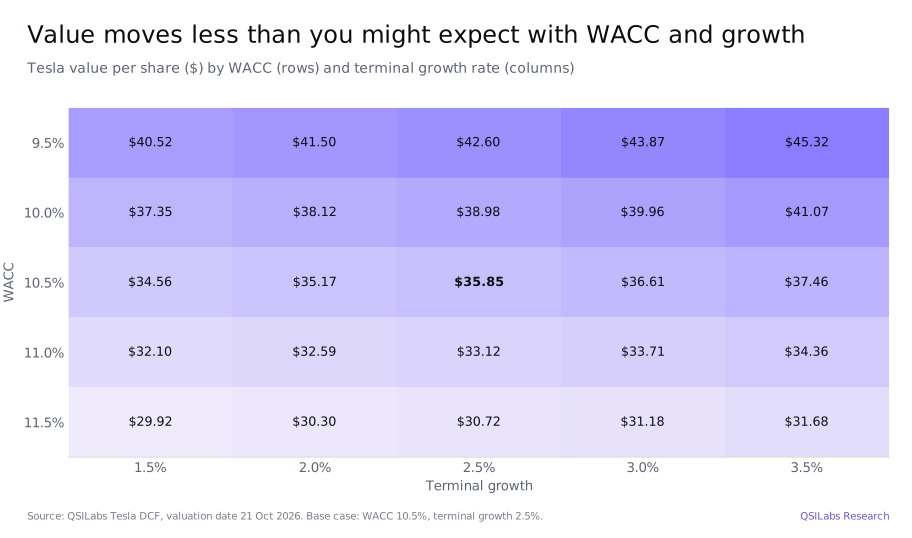
- Value vs price. The QSILabs DCF value for Tesla (TSLA) is $35.85 per share as of Q3 2026, against a $399.81 close on 30 October 2026, which puts the shares about 91% above our estimate. Our full sensitivity range is $29.92 to $45.32.
- Latest results. Tesla reported Q3 2026 revenue of $28.05bn, against $28.10bn a year earlier, operating income of $718m (down 56%), GAAP diluted EPS of $0.22 against $0.39 and non-GAAP EPS of $0.48 against $0.50 (8-K Ex 99.1).
- Cars. Deliveries were 486,532, down 2% year on year, while production rose 4% to 464,391. Tesla says its order backlog is the largest in four years and that battery supply limits output (Q3 2026 Update).
- Autonomy and robots. FSD (Supervised) subscriptions reached 1.74m, up from 1.04m. Cybercab rides began in Austin on 3 September, cumulative unsupervised miles rose eightfold in the quarter to about 2m, and Optimus early production started in Fremont (Q3 2026 Update; Q3 2026 call).
- Cash and capex. Capex was $4.7bn in Q3 and about $20bn for 2026 as a whole. Tesla ended September with $45.4bn of cash and investments and $30bn of undrawn committed credit (Form 10-Q; Q3 2026 call).
- SpaceX. Tesla's board has formed a special committee of disinterested directors to explore deepening the relationship with SpaceX, which could include a business combination; no terms have been agreed (Form 10-Q).
Tesla earnings: how did Q3 2026 compare with last year?
| Metric | Q3 2026 | Q3 2025 | Change |
|---|---|---|---|
| Total revenue | $28,046m | $28,095m | -0.2% |
| Automotive | $20,560m | $21,205m | -3% |
| Energy generation and storage | $2,881m | $3,415m | -16% |
| Services and other | $4,605m | $3,475m | +33% |
| GAAP gross margin | 19.6% | 18.0% | +1.6 pts |
| Operating expenses | $4,776m | $3,430m | +39% |
| Operating income | $718m | $1,624m | -56% |
| GAAP net income | $787m | $1,373m | -43% |
| GAAP diluted EPS | $0.22 | $0.39 | -44% |
| Non-GAAP diluted EPS | $0.48 | $0.50 | -4% |
| Adjusted EBITDA | $3,900m | $4,227m | -8% |
| Operating cash flow | $6,263m | $6,238m | 0% |
| Capital expenditure | $4,732m | $2,248m | +110% |
| Free cash flow | $1,531m | $3,990m | -62% |
| Deliveries | 486,532 | 497,099 | -2% |
| Energy storage deployed | 13.7 GWh | 12.5 GWh | +10% |
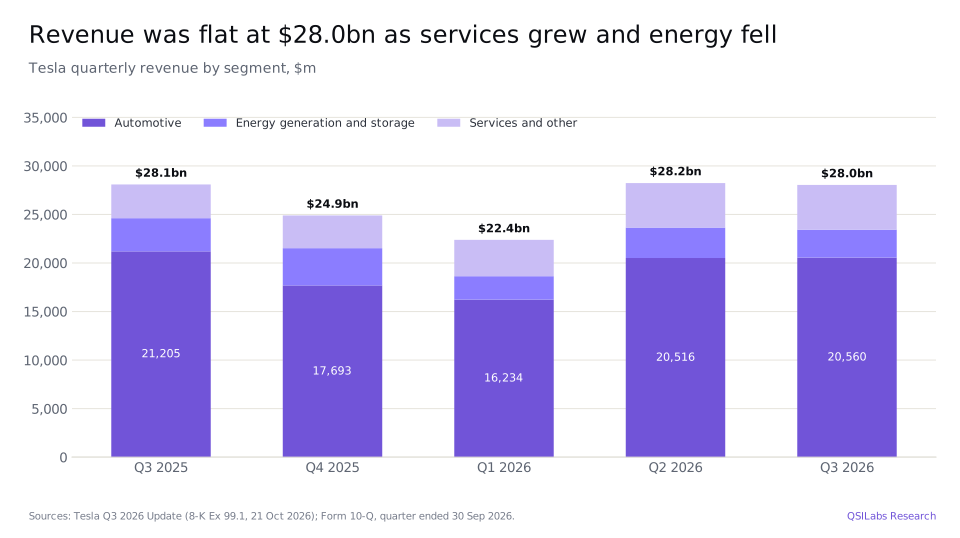
Tesla's Q3 2026 revenue was essentially unchanged from a year earlier at $28.05bn, but the mix moved. Automotive revenue fell 3% to $20.56bn, energy generation and storage fell 16% to $2.88bn, and services and other grew 33% to $4.61bn, helped by Supercharging, insurance and used vehicles (8-K Ex 99.1). Over the first nine months of 2026 revenue was $78.7bn, up 12.5% on the same period of 2025, because the first half of 2025 was weak.
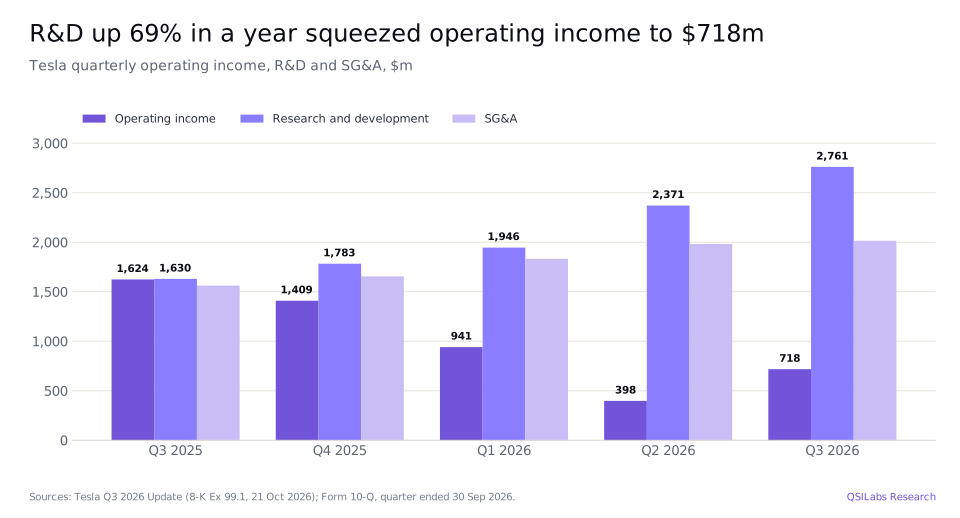
The profit line tells a sharper story. Gross profit rose to $5.49bn and gross margin to 19.6%, from 18.0%, yet operating income fell from $1.62bn to $718m because operating expenses jumped 39% to $4.78bn. Research and development alone was $2.76bn, up 69%, as Tesla spends on AI training compute, Optimus and the Cybercab. GAAP net income attributable to shareholders was $787m, or $0.22 per diluted share, which included a $288m gain on bitcoin and a $142m mark-to-market loss on Tesla's SpaceX shares (Form 10-Q; Q3 2026 call).
On the non-GAAP basis that Tesla uses, which excludes stock-based compensation, net income was $1.70bn and EPS was $0.48, against $0.50 a year earlier. Adjusted EBITDA was $3.90bn, down 8% (8-K Ex 99.1).
Why did Tesla's gross margin rise when profit fell?
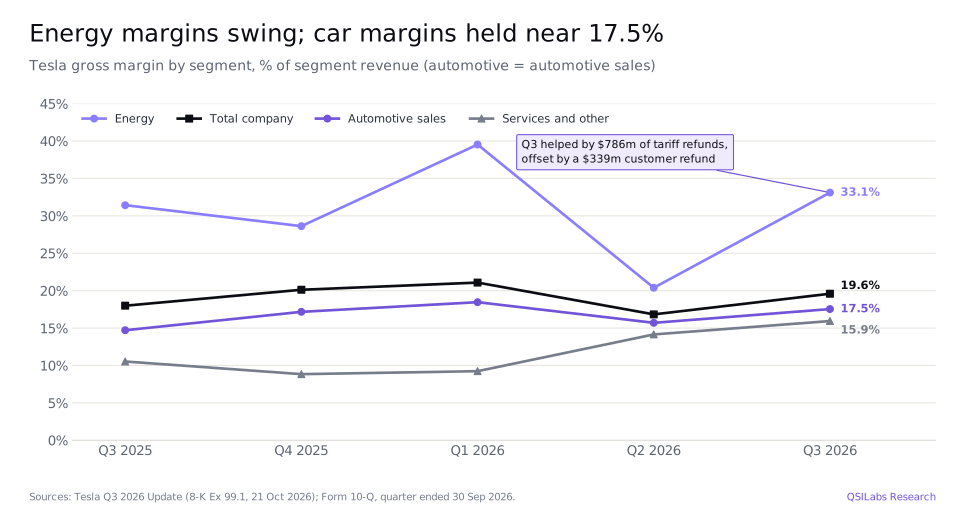
Tesla's 19.6% gross margin in Q3 2026 was flattered by refunds of tariffs paid under the International Emergency Economic Powers Act, and held back by a reversal of regulatory credit revenue, so the underlying margin moved less than the headline suggests. The 10-Q shows $786m of tariff refunds credited to cost of revenue, $526m in energy and $260m in automotive, partly offset by a $339m reduction in energy revenue for refunds owed to customers. Separately, Tesla reversed $475m of regulatory credit revenue, leaving only $113m of credit revenue in the quarter against $417m a year earlier.
On our arithmetic, removing the tariff refunds and the customer refund would have left gross margin at about 17.8%. Adding back the reversed credits as well takes it to about 19.1%, close to the reported figure, because the two items roughly cancel. Management put automotive gross margin excluding regulatory credits at 18.1%, up from 16.3% in Q2, helped by a richer Asia-Pacific mix; without the $260m automotive tariff refund that figure would be about 16.8% (Q3 2026 call; our calculation).
Energy shows the biggest swing. Its reported 33.1% gross margin falls to about 24% once the tariff items are stripped out, still a healthy level for a hardware business but well below what the headline implies. Services and other reached an all-time-high 15.9% margin.
Regulatory credits matter for the trend. They were a $400m-plus quarterly profit stream in 2025 that cost Tesla almost nothing to earn. That stream has now nearly gone, so the car business now has to earn its margin from vehicles alone.
How many cars did Tesla deliver in Q3 2026?
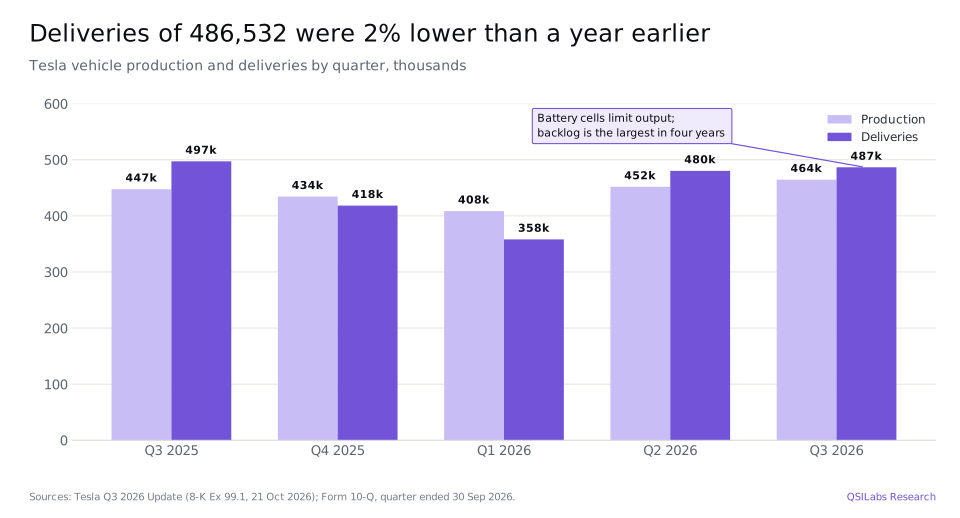
Tesla delivered 486,532 vehicles in Q3 2026, 2% fewer than the 497,099 of Q3 2025 but 1% more than in Q2, and produced 464,391, up 4% (Q3 2026 Update). Model 3 and Model Y production was 457,387, up 5%. Global vehicle inventory ended the quarter at 11 days of supply, which means Tesla sold slightly more cars than it built and drew down stock.
Demand is not the constraint Tesla describes. Management said the order backlog is the largest in four years and that battery cell supply is the limiting factor for production, and it repeated a goal of about 5 million vehicles a year by around 2030, using existing factories before building new ones (Q3 2026 Update; Q3 2026 call). That would be close to three times the 1.79m vehicles we expect Tesla to deliver in 2026. Our model is more cautious: 2.0m deliveries in 2027, 2.5m in 2029 and 3.45m in 2035, with average selling prices of about $41,900 falling 1% a year in 2027 and 2028.
Software is the part of the car business growing fastest. FSD (Supervised) subscriptions reached 1.74m at the end of September, up from 1.04m a year earlier, and management said more than 75% of new North American deliveries now take FSD, an increase of 20 percentage points in a quarter. FSD (Supervised) is now approved in nine European countries (Q3 2026 Update; Q3 2026 call).
Is Tesla's robotaxi business real yet?
Yes, at small scale. Tesla began Cybercab rides in its own fleet in Austin on 3 September 2026, and cumulative unsupervised miles across its robotaxi network rose about eight times in the quarter to roughly 2m (Q3 2026 Update). Chief executive Elon Musk said the Cybercab fleet in Austin had grown about tenfold in its first month. Tesla says it has installed capacity to build more than 125,000 Cybercabs a year in Texas and wants to start selling them to customers by the end of 2026 (Q3 2026 call).
Two million miles is still small. A single large ride-hailing city generates more than that in a day, and Tesla's service still runs in a limited number of US cities. Management said robotaxi revenue should become "noticeable" around the second quarter of 2027.
Regulation is the near-term question. The National Highway Traffic Safety Administration opened audit query AQ26002 on 3 September to examine how Tesla certified that the Cybercab, which has no steering wheel or pedals, meets federal motor vehicle safety standards. Its special order asked 21 sets of questions, and Tesla's sworn response was due on 30 October after a 30-day extension (NHTSA). The inquiry is an information request, not a recall or a finding, but its outcome will shape how fast Cybercabs can be sold and deployed outside Tesla's own fleet.
In our model, robotaxis carry a 60% probability of success. The fleet grows from 10,000 vehicles in 2027 to 650,000 in 2035, and revenue per mile falls from $1.00 to $0.75 as the service scales, giving probability-weighted robotaxi revenue of $14.6bn in 2035.
Optimus, AI compute and capex: where is Tesla spending?
Tesla is spending on four things at once: AI training compute, the Optimus humanoid robot, Cybercab and Semi production lines, and battery and chip supply. Capex was $4.73bn in Q3 2026, against $2.25bn a year earlier, and $13.0bn over the first nine months. Tesla's chief financial officer said full-year 2026 capex would be about $20bn, below the earlier guide of more than $25bn, funded mainly from operating cash flow (Q3 2026 call; Form 10-Q).
- Optimus. Early production has started on a high-volume line in Fremont designed for 20,000 robots a week. Musk said it would take at least a year to approach that rate and that the design is still being refined; external deliveries are expected around the end of 2027 (Q3 2026 call).
- AI compute. Tesla is targeting 400 MW of AI training compute by the end of 2026 for its vehicle and robot software (Q3 2026 Update).
- Chips. Equipment commissioning at an Austin chip fab is planned for 2027, and Tesla and SpaceX plan a jointly built chip plant, Terafab, in Grimes County, Texas, with an initial investment of about $16.8bn and volume production targeted for the third quarter of 2028 (Q3 2026 Update; Yahoo Finance).
- Vehicles. The Tesla Semi is in volume production in Nevada, and the next-generation Roadster, unveiled on 15 October, is slated for production in 2028.
Cash flow held up better than earnings. Operating cash flow was $6.26bn, level with a year earlier, and free cash flow was $1.53bn after a negative $1.09bn in Q2. Tesla ended the quarter with $45.4bn of cash, cash equivalents and investments, up $1.9bn, and arranged $10bn of new revolving credit facilities in September, taking its undrawn committed facilities to $30bn (Form 10-Q).
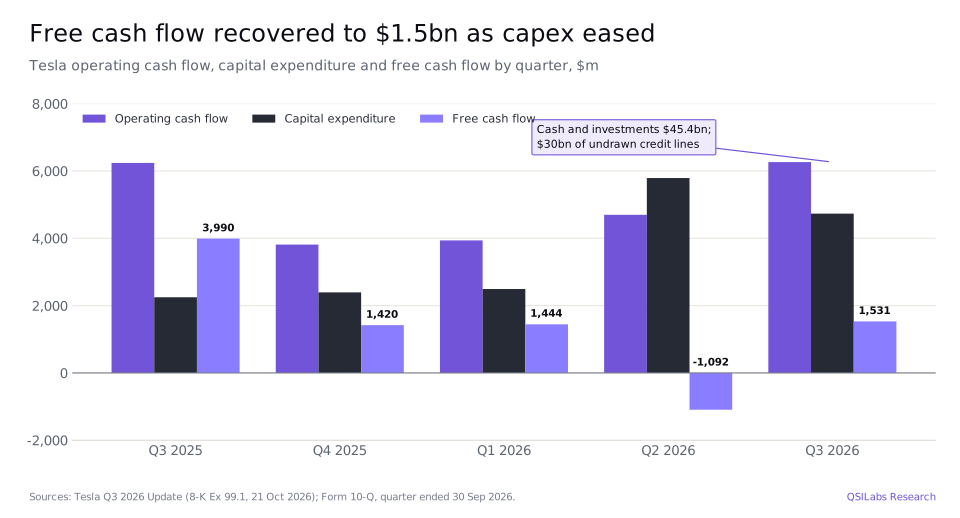
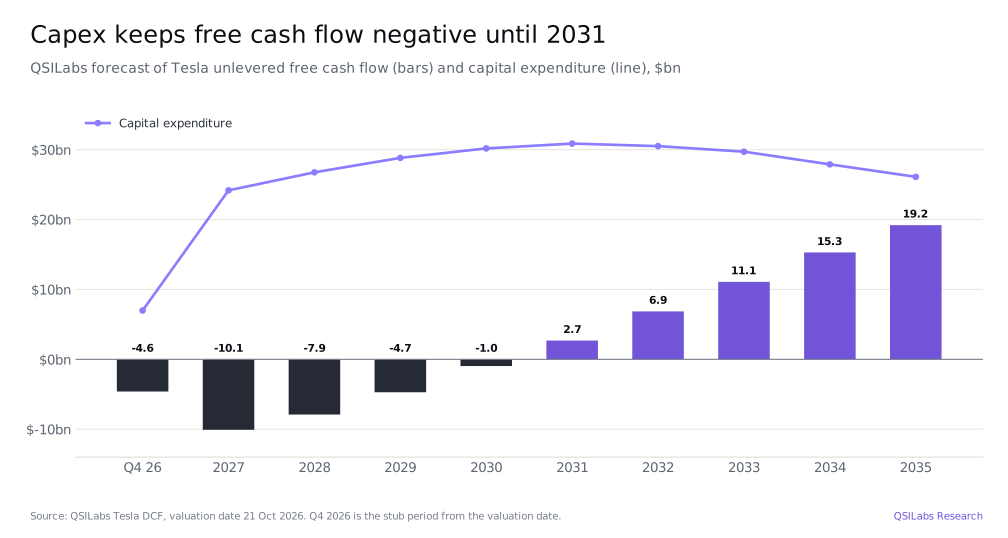
Our model assumes this is the start of a long build. Capex rises from $20bn in 2026 to $24.2bn in 2027 and $26.8bn in 2028 and peaks at about $30.9bn in 2031. That keeps unlevered free cash flow negative every year until 2031.
Tesla energy: is Megapack demand still growing?
Tesla's energy business deployed 13.7 GWh of storage in Q3 2026, up from 12.5 GWh a year earlier, and 36.0 GWh in the first nine months (Q3 2026 Update). Revenue fell 16% to $2.88bn, partly because of the $339m tariff refund owed to customers. Management said Megapack capacity for 2027 is nearly sold out, driven by data centre demand, and the Megafactory in Texas, with 50 GWh of annual capacity, has started production (Q3 2026 call).
SpaceX is one of the customers. Tesla booked $221m of Megapack revenue from SpaceX in Q3 and $626m in the first nine months, and had $729m of receivables from SpaceX at 30 September (Form 10-Q). Tesla's remaining performance obligations, mostly energy contracts, were $10.73bn. We forecast energy revenue of $16.2bn in 2027 and $28.0bn in 2030.
Tesla and SpaceX: what does the special committee mean for Tesla shareholders?
It means a combination is being studied, not that one is agreed. Tesla's 10-Q says its board has formed a special committee of disinterested directors to explore deepening the relationship with SpaceX, which could include a business combination, and that any transaction would need the committee's recommendation and any required shareholder approval. SpaceX disclosed a matching committee on its own Q3 call on 20 October, and Musk, who leads both companies, said he supports the idea, is not taking part in the committees, and that a deal is not certain (TechCrunch; Yahoo Finance).
Tesla already has exposure. It invested about $2bn in SpaceX common stock in March, a stake carried at $2.87bn at 30 September, now valued at SpaceX's quoted share price. Sale restrictions on those shares expire in December 2026 (Form 10-Q). The two companies also trade Megapacks and plan to build Terafab together, but Tesla has not disclosed how the cost of Terafab would be split.
We value the SpaceX stake at its market value of about $3.0bn at our valuation date, and Terafab, at a 50% Tesla share of the first $16.8bn phase, at a small negative $546m, because the plant consumes cash for years before it produces chips. We do not model a combination: without an exchange ratio there is nothing to value, and the economics for Tesla holders would depend entirely on its terms. Our separate analysis, SpaceX Q3 2026: Terafab and valuation, covers the other side.
- 3 Sep 2026Cybercab rides start in Austin; NHTSA opens audit query AQ26002 into Cybercab safety-standard certificationQ3 2026 Update; NHTSA
- Sep 2026New $10bn of revolving credit facilities ($8bn five-year, $2bn 364-day)Form 10-Q
- 15 Oct 2026Next Generation Roadster unveiled; production slated for 2028Q3 2026 Update
- 20-22 Oct 2026Tesla and SpaceX boards confirm special committees to explore a closer relationship, including a possible combinationForm 10-Q; SpaceX call
- 21 Oct 2026Q3 2026 results; 2026 capex now about $20bn; Optimus early production on the Fremont line8-K; Q3 2026 call
- 30 Oct 2026Tesla's sworn response to NHTSA's Cybercab special order dueNHTSA
- Dec 2026Sale restrictions on Tesla's SpaceX shares from the IPO lock-up expireForm 10-Q
- End 2026400 MW of AI training compute targeted; Cybercab sales to customers targetedQ3 2026 Update; Q3 2026 call
- 2027Megapack capacity nearly sold out; Austin chip fab equipment commissioning; external Optimus deliveries late in the yearQ3 2026 call; Q3 2026 Update
- Q3 2028Terafab volume chip production targetedSpaceX Q3 2026 call
What is Tesla stock worth? Our DCF valuation
Our discounted cash flow model values Tesla at $35.85 a share: an enterprise value of $103.9bn plus $38.3bn of net cash and investments, giving equity of $142.1bn across 3,964m diluted shares. At the 30 October close of $399.81, the market values Tesla's equity at about $1.58 trillion, more than 11 times our estimate.
The forecast is not a pessimistic one. Revenue grows from $106.8bn in 2026 to $178.4bn in 2030 and $249.2bn in 2035, and the EBIT margin rises from 2.4% in 2026 to 11.7% by 2035. New businesses are included: FSD subscriptions growing by about 1m a year at $75 a month with an 80% gross margin, robotaxis at a 60% probability and Optimus at a 40% probability, growing to 1m robots a year by 2035 at an average price falling from $30,000 to $22,000. Together these add about $30.6bn, or 12%, of 2035 revenue.
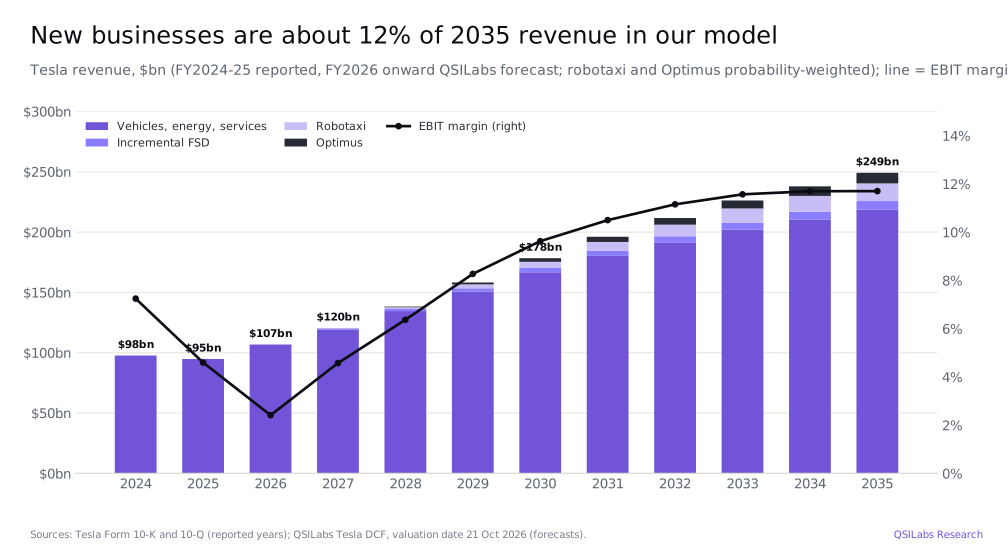
The problem for the valuation is timing. Heavy capex means free cash flow stays negative until 2031, so 98% of our enterprise value sits in the terminal value, and the sum of discounted free cash flow over the ten forecast years is only $2.5bn. About $9.65 of our $35.85 per share is net cash, investments, the SpaceX stake and bitcoin, not the operating business.
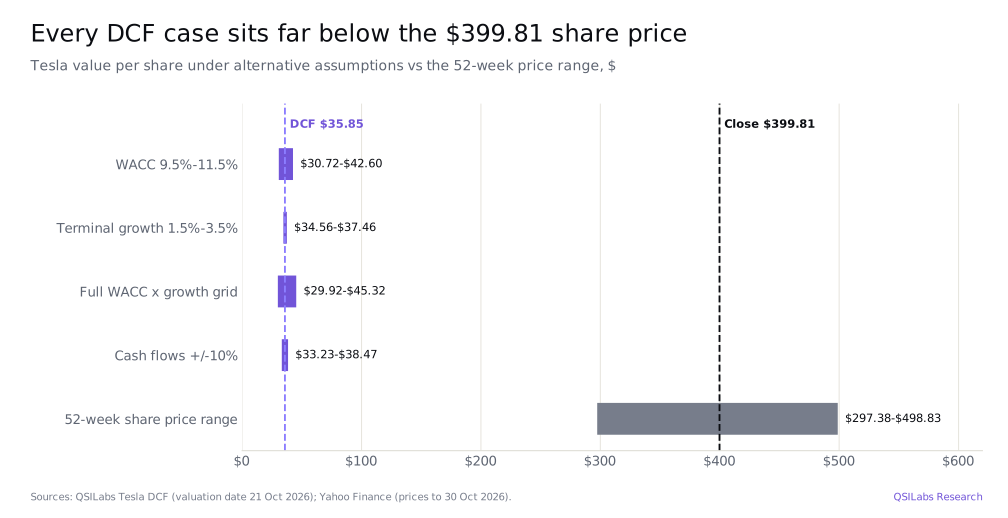
The value range is narrow relative to the gap with the price. Moving the WACC between 9.5% and 11.5% gives $30.72 to $42.60; moving terminal growth between 1.5% and 3.5% gives $34.56 to $37.46; and the full grid spans $29.92 to $45.32. Cash flows 10% higher or lower in every year move the value to between $33.23 and $38.47. Excluding the shares under Musk's unearned performance award, the value is $40.14.
What would you have to believe to pay $399.81 for Tesla stock?
You would have to believe that Tesla's long-run free cash flow will be around 15 times what we forecast. Backing out net cash, a $399.81 share price implies an enterprise value of about $1.55 trillion, nearly 15 times our $103.9bn. Because almost all of our value sits in the terminal year, that implies terminal free cash flow near $290bn a year, against our $19.2bn for 2035 and more than our entire 2035 revenue forecast of $249bn.
That outcome would need robotaxis, Optimus or both to become businesses far larger than any car company has ever been, at software-like margins, and to need much less capital than Tesla is spending now. Tesla's own targets point in that direction: one milestone in Musk's 2025 performance award is $400bn of adjusted EBITDA, roughly 25 times Tesla's annualised Q3 2026 level of about $15.6bn (Form 10-Q; our calculation). The share price treats that kind of outcome as likely. Our model treats it as possible but unproven, and the Q3 accounts give little evidence either way yet.
Risks: what could change our view of Tesla?
- Upside: robotaxi economics. If driverless miles scale to hundreds of billions a year at $1 per mile or more with low capital per vehicle, our robotaxi assumptions will prove far too low. This is the single largest source of upside.
- Upside: Optimus. Humanoid robots sold at scale for industrial work would open a market our 40%-weighted forecast only starts to capture.
- Upside: SpaceX. A combination on favourable terms could give Tesla holders a share of a larger, faster-growing business.
- Downside: regulation. NHTSA's Cybercab inquiry, or state rules, could slow deployment and sales of vehicles without manual controls.
- Downside: car margins. With regulatory credits almost gone and tariff refunds one-off, automotive margins depend on volume growth and battery supply.
- Downside: capital intensity. If capex runs above $30bn a year for longer, free cash flow stays negative into the 2030s.
- Governance. Related-party dealings with SpaceX and Musk's dual roles require close scrutiny of any transaction terms.
How we value Tesla
We value Tesla with a ten-year unlevered free cash flow model built by segment: vehicles, energy, services, FSD subscriptions, robotaxis, Optimus and Terafab. Robotaxis and Optimus are probability-weighted at 60% and 40%. We discount at a 10.5% WACC, built from Damodaran's Auto and Truck industry cost of capital with a 5.12% risk-free rate, apply an 18% cash tax rate, and calculate the terminal value with 2.5% growth and a 15% return on new invested capital. To enterprise value we add cash and investments of $45.4bn, the SpaceX stake at market value and digital assets, and subtract debt of $9.5bn and minority interests. Reported figures are from Tesla's Q3 2026 Form 10-Q and Update; the valuation date is 21 October 2026 and the price comparison uses the 30 October 2026 close.
For other Q3 2026 company analysis, see our research on NVIDIA, Broadcom, Alphabet, Microsoft and SpaceX, or browse the research index.
FAQ
What is Tesla stock worth after Q3 2026?
Our discounted cash flow model values Tesla (TSLA) at $35.85 a share as of Q3 2026, with a sensitivity range of $29.92 to $45.32. That is about 91% below the $399.81 close on 30 October 2026. The market price implies long-run free cash flow about 15 times our forecast.
Did Tesla beat earnings in Q3 2026?
Tesla's non-GAAP EPS was $0.48 in Q3 2026, against $0.50 a year earlier, and revenue was $28.05bn, roughly flat. GAAP EPS was $0.22 against $0.39, and operating income fell 56% to $718m because R&D rose 69% (8-K Ex 99.1).
How many cars did Tesla deliver in Q3 2026?
Tesla delivered 486,532 vehicles in Q3 2026, down 2% from 497,099 a year earlier, and produced 464,391. It says its order backlog is the largest in four years and that battery supply limits production.
Is the Tesla robotaxi live?
Yes. Cybercab rides began in Austin on 3 September 2026, and Tesla's robotaxi network had about 2m cumulative unsupervised miles by the end of Q3. NHTSA is reviewing how Tesla certified the Cybercab under federal safety standards; Tesla's response was due on 30 October 2026.
How much is Tesla spending on capex in 2026?
About $20bn, according to Tesla's CFO on the Q3 2026 call, down from earlier guidance of more than $25bn. Capex was $13.0bn in the first nine months, including $4.7bn in Q3. We forecast $24.2bn in 2027 and $26.8bn in 2028.
Is Tesla merging with SpaceX?
Not yet. Tesla's board has formed a special committee of disinterested directors to explore a closer relationship with SpaceX, which could include a business combination, and SpaceX has formed one too. No terms have been agreed, and a deal would need the committee's recommendation and any required shareholder approval (Form 10-Q).
When will Optimus robots be sold?
Tesla started early Optimus production on a Fremont line designed for 20,000 robots a week and expects external deliveries around the end of 2027. Management said reaching the full rate will take at least a year.
When does Tesla report Q4 2026 earnings?
Tesla usually reports fourth-quarter results in late January. Q4 2026 and full-year results are expected in late January 2027; our model expects about $28.1bn of Q4 revenue and about $106.8bn for 2026.
Sources
- Tesla, Q3 2026 Update (Form 8-K, Exhibit 99.1, 21 Oct 2026)
- Tesla, Form 10-Q for the quarter ended 30 Sep 2026 (filed 22 Oct 2026)
- Tesla Q3 2026 earnings call transcript (21 Oct 2026)
- CNBC: Tesla Q3 2026 earnings report (21 Oct 2026)
- Tesla Investor Relations: Q3 2026 earnings consensus
- NHTSA, Special Order in Audit Query AQ26002, Tesla Cybercab FMVSS certification (10 Sep 2026)
- TechCrunch: SpaceX and Tesla boards form special committees to review merger (20 Oct 2026)
- Yahoo Finance: Tesla and SpaceX confirm special committees; Terafab plans (22 Oct 2026)
- Yahoo Finance: TSLA price history and 30 Oct 2026 close
- Damodaran Online: cost of capital by industry (Auto and Truck)
- QSILabs Tesla discounted cash flow model (internal, valuation date 21 Oct 2026)
More from QSI Labs
Read our white paper, QSI Labs: An AI-Native Trading Firm Built on a Training Loop (October 2026), available on request, or browse the research index.