Research / Earnings and valuation

Microsoft stock Q3 2026:Azure up 48%, a $677bn backlog and $45bn of capex
Microsoft stock goes into the end of 2026 priced for an AI boom that is clearly happening. In Q3 2026, Microsoft's fiscal first quarter of 2027 (July to September 2026), revenue rose 19% to $92.3bn, Azure grew 48%, and contracted but unrecognised revenue reached $677bn. The catch is the bill: $45.2bn of capital spending in a single quarter, and more to come. All figures in this article are as of Microsoft's Q3 2026 results, reported on 28 October 2026, and share prices are as of the 30 October 2026 close of $521.91.
Key takeaways
- Fair value: the QSILabs fair value for Microsoft (MSFT) is $310.87 per share as of Q3 2026 results, against a $521.91 close on 30 October 2026, about 40% lower.
- Growth: Microsoft (MSFT) revenue rose 19% to $92.3bn in Q3 2026 (fiscal Q1 2027, July to September 2026), and Azure revenue grew 48% to $33.2bn (Form 8-K, 28 October 2026).
- Backlog: Microsoft's commercial remaining performance obligation reached $677bn at 30 September 2026, up 73% year on year (Form 10-Q).
- Capex: Microsoft (MSFT) spent $45.2bn on capital expenditure including finance leases in Q3 2026 and expects more than $50bn in the December 2026 quarter (earnings call, 28 October 2026).
- OpenAI: OpenAI provided $10.0bn, about 11%, of Microsoft's Q3 2026 revenue, and Microsoft owns about 24% of OpenAI on an as-converted basis (Form 10-Q).
Microsoft stock Q3 2026 in brief
Short answer: Microsoft's quarter was excellent, but the share price already assumes it stays that way for a decade. Our discounted cash flow fair value is $310.87 per share (a QSILabs estimate), about 40% below the $521.91 close, because roughly $212bn of capex this fiscal year pushes free cash flow below zero before the AI build pays back.
| Key number, Q3 2026 | Value | Year on year | Source |
|---|---|---|---|
| Revenue | $92,279m | +19% | 8-K Ex 99.1 |
| Operating income | $45,915m | +21% | 8-K Ex 99.1 |
| Diluted EPS (GAAP / non-GAAP) | $4.92 / $4.89 | +32% / +18% | 8-K Ex 99.1 |
| Microsoft Cloud revenue | $63.9bn | +30% | Earnings call |
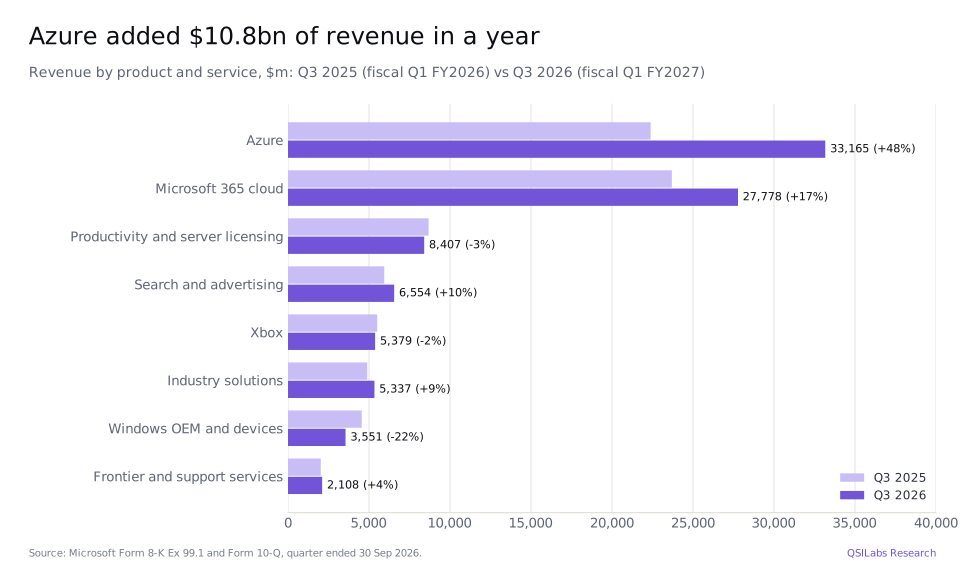
| Azure and other cloud services | $33,165m | +48% | 8-K Ex 99.1 |
| Commercial RPO | $677bn | +73% | 10-Q; earnings call |
| Operating cash flow | $58,000m | +29% | 8-K Ex 99.1 |
| Capex incl. finance leases | $45.2bn | n/a | Earnings call |
| QSILabs fair value per share | $310.87 | vs $521.91 price | QSILabs estimate |
How did Microsoft do in Q3 2026 compared with a year ago?
Microsoft (MSFT) grew revenue 19% to $92.3bn and operating income 21% to $45.9bn in Q3 2026 (fiscal Q1 2027) compared with a year earlier. According to the Microsoft Q1 FY2027 earnings release filed as Form 8-K, revenue for the three months to 30 September 2026 was $92,279m, against $77,673m a year earlier, an increase of 19%. Service and other revenue, which includes Azure and Microsoft 365, was $77,648m of that, and product revenue $14,631m.
Gross margin was $62,559m, or 67.8% of revenue. Operating expenses stayed tight: research and development of $9,047m, sales and marketing of $5,716m and general and administrative costs of $1,881m. Operating income rose 21% to $45,915m, from $37,961m, so the operating margin widened to 49.8% from 48.9%. Revenue grew faster than costs, even with the depreciation from the data centre build flowing through cost of revenue.
Below the operating line, the comparison flatters this year. Other income was $38m, against a loss of $3,660m a year earlier, most of which was Microsoft's share of losses at OpenAI. Net income rose 32% to $36,629m and diluted earnings per share to $4.92 from $3.72. Excluding the OpenAI effect, which added $0.03 a share this year and cost $0.41 last year, non-GAAP earnings per share were $4.89, up 18% (8-K Ex 99.1). That 18% is the cleaner measure of how the business grew.
Diluted shares fell to 7,446m from 7,466m. Microsoft returned $10.2bn to shareholders in the quarter through dividends and buybacks (earnings call).
- 25 Jun 202652-week closing low of $352.83Yahoo Finance
- 30 Jun 2026Fiscal 2026 ends; revenue $331.8bnMicrosoft 8-K
- Jul 2026Q4 FY2026 results: over 30m paid Microsoft 365 Copilot seatsUC Today
- 13 Oct 202652-week closing high of $543.45Yahoo Finance
- 28 Oct 2026Q3 2026 results (fiscal Q1 2027), Form 10-Q filedSEC EDGAR
- 30 Oct 2026Close of $521.91, a market value of about $3.9tnYahoo Finance
- 1 Dec 2026Usage-based billing on by default for new Copilot Business CSP licencesUC Today
Which Microsoft segments and products grew fastest?
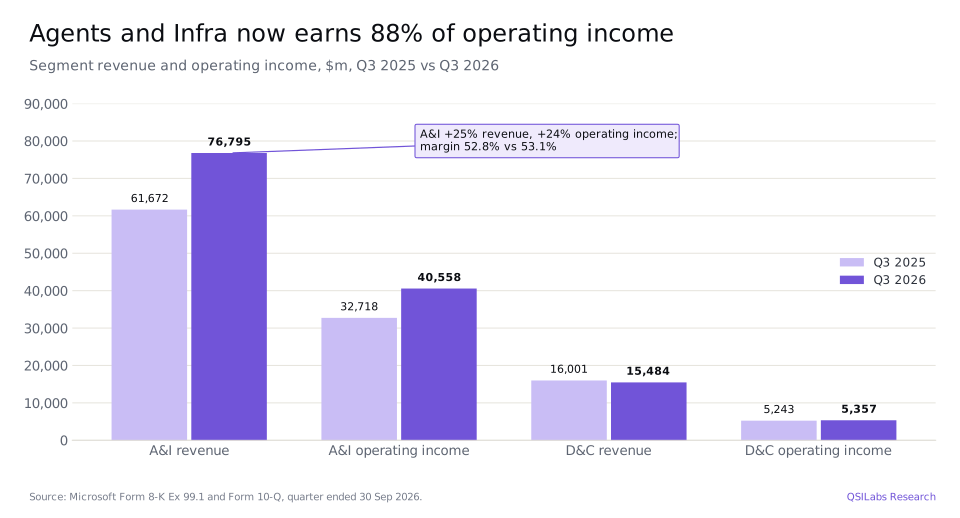
Agents and Infra, the Microsoft segment that holds Azure and Microsoft 365, grew fastest in Q3 2026, with revenue up 25% to $76.8bn, while Devices and Consumer revenue fell 3%. Microsoft now reports two segments. Agents and Infra (A&I) holds Azure, Microsoft 365, Dynamics, GitHub, LinkedIn and the server business. Devices and Consumer (D&C) holds Windows OEM, Surface, Xbox and search advertising.
Agents and Infra: the engine
Agents and Infra (A&I) revenue was $76,795m, up 25% from $61,672m, and operating income $40,558m, up from $32,718m. The segment margin slipped slightly, to 52.8% from 53.1%, which is what you would expect when the fastest-growing product (Azure) is also the one carrying the new depreciation. A&I earned 88% of Microsoft's operating income.
- Azure and other cloud services: $33,165m, up 48% (8-K Ex 99.1). Management said growth beat its own expectations, helped by Foundry and better CPU monetisation, even though some third-party capacity arrived late (earnings call).
- Microsoft 365 commercial cloud: up 17%, or 18% adjusted for a prior-year revenue recognition benefit. Paid commercial seats grew 5%, mainly in small business and frontline offerings.
- Microsoft Cloud in total, which spans Azure, Microsoft 365 commercial, Dynamics and LinkedIn commercial, was $63.9bn, up 30% (31% in constant currency), or 69% of revenue.
- Productivity and server licensing, the old on-premises business, fell 3% to $8,407m.
- Industry solutions rose 9% to $5,337m.
Devices and Consumer: the drag
Devices and Consumer (D&C) revenue fell 3% to $15,484m, but operating income edged up to $5,357m, a 34.6% margin. Windows OEM and devices revenue fell 22% to $3,551m, with Windows OEM alone down 27% as PC makers ran down inventory. Xbox content and services fell 2%. Search and news advertising excluding traffic acquisition costs grew 12%, the bright spot (earnings call).
How much is Microsoft spending on AI capex?
Microsoft (MSFT) spent $45.2bn on capital expenditure, including finance leases, in Q3 2026 (fiscal Q1 2027), about 49% of revenue, and expects more than $50bn in the following quarter. The cash flow statement in the Form 10-Q for the quarter ended 30 September 2026 shows operating cash flow of $58,000m, up 29%, against additions to property and equipment of $39,367m, double the $19,394m of a year earlier.
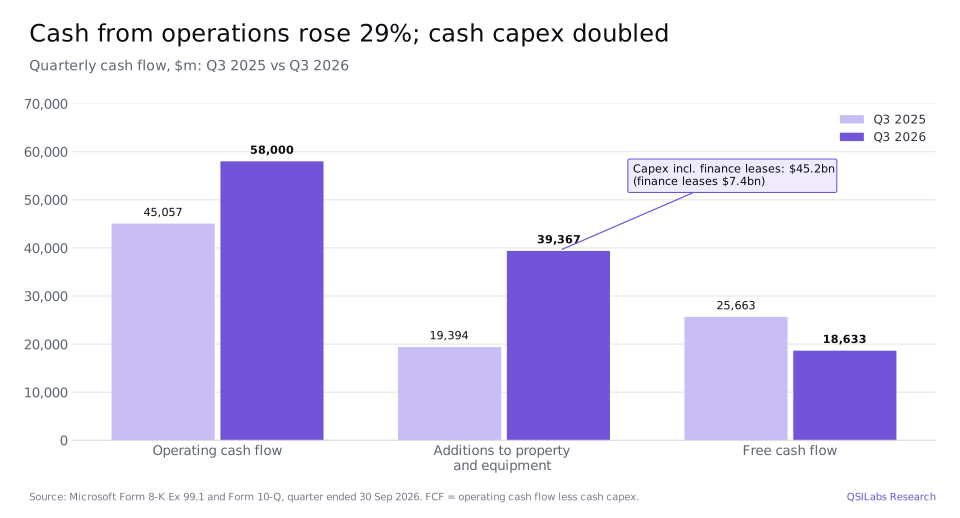
Free cash flow, as Microsoft defines it, was $18.6bn, down from $25.7bn. Including assets acquired under finance leases ($7.4bn), total capex was $45.2bn, or 49% of revenue. Chief financial officer Amy Hood said about 75% went on short-lived assets, mainly GPUs and CPUs, and the rest on long-lived sites and buildings (earnings call). Short-lived assets matter for valuation: they wear out faster and need replacing sooner.
Balance sheet: still strong, but leases are growing
At 30 September 2026 Microsoft held $20,281m of cash and $44,228m of short-term investments, $64.5bn in total, plus $37,808m of equity and other investments (10-Q). Borrowings were small: $4,391m due within a year and $31,090m of long-term debt. The bigger obligation is leases. Finance lease liabilities were $70,973m, and the 10-Q lists a further $364.6bn of leases that have been signed but have not yet started, beginning between fiscal 2027 and fiscal 2034 with terms of 1 to 20 years.
Net property and equipment rose to $346.8bn from $313.1bn at 30 June. Total assets were $779.4bn and shareholders' equity $470.5bn. Microsoft repaid $4,850m of debt in the quarter, paid $6,757m of dividends and bought back $4,379m of shares (10-Q). Hood said the company may "tap the financing markets when they make sense and they're attractive", pointing to leases, debt and other options (earnings call).
Azure, Copilot and OpenAI: is Microsoft's AI bet paying off?
Microsoft's AI bet is paying off in demand, with Azure up 48% and a $677bn commercial backlog in Q3 2026, but not yet in free cash flow, which fell 27% as capex doubled. This is the question the share price really turns on.
Azure and AI capacity: demand is ahead of supply
Microsoft Azure revenue grew 48% in Q3 2026 and Microsoft guided to 49-50% in constant currency for the December quarter (earnings call). Demand still exceeds supply: some third-party GPU deliveries expected in the quarter slipped into the second half of the fiscal year. Microsoft added 24 new data centres, cut the time from equipment delivery to live capacity by 20%, and began installing Nvidia Vera Rubin systems. Its own Maia 200 chip delivers 1.7 times more tokens per watt in Teams and Copilot than previous systems, according to chief executive Satya Nadella.
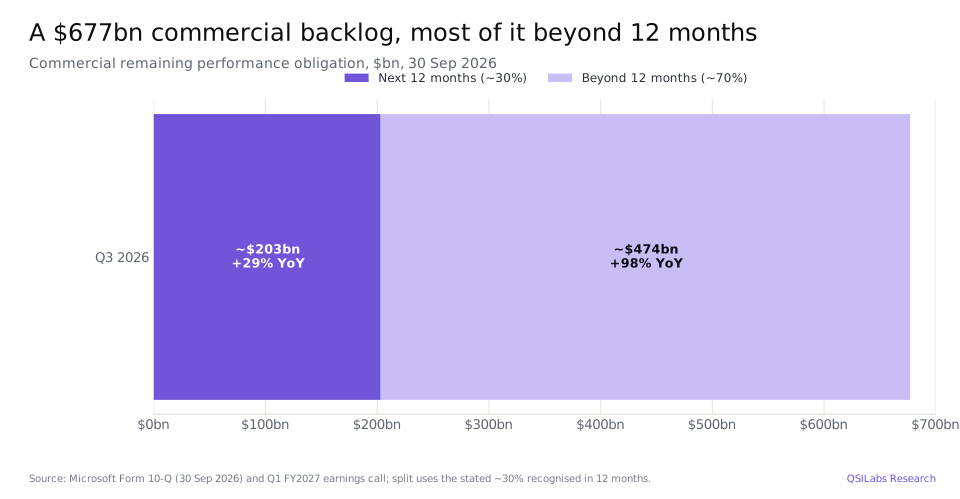
The strongest evidence of future demand is the backlog. Commercial remaining performance obligation, contracted revenue not yet recognised, was $677bn, up 73%, with a weighted average duration of 2.3 years. About 30% will be recognised over the next 12 months, and that portion grew 29%. The portion beyond 12 months grew 98% (earnings call; 10-Q).
The AI platform is broadening beyond OpenAI. Foundry, Microsoft's service for building with many AI models, has 120,000 customers, and its revenue more than tripled. Customers using more than one model grew fivefold, and revenue from open-source models grew tenfold (earnings call). Fabric, the data platform, has 44,000 paid customers, up more than 50%.
Copilot monetisation: usage up, seat count gone
Microsoft no longer publishes a paid seat count for Microsoft 365 Copilot. The last figure, given with fiscal 2026 fourth-quarter results in July, was more than 30 million paid seats, according to UC Today's report on the missing Copilot seat count. Asked directly on the call, Hood said: "We did not disclose ... an update on the Copilot number this quarter."
What Microsoft gave instead was usage. Copilot daily users rose nearly 50% from the previous quarter and more than fivefold from a year earlier, and automated tasks nearly doubled since July. Customers with more than 50,000 seats grew more than eightfold, Volkswagen alone has 330,000 seats, and the new top-tier E7 suite has "already reached millions of paid seats". Customers consuming Copilot credits through usage-based billing grew more than 75% in the quarter. On GitHub, agents now open more than a third of pull requests (earnings call).
Our reading: Copilot is moving from a per-seat add-on to a metered product, which makes revenue harder to forecast but potentially larger. The weak spot is the base suite. Hood flagged "weaker sales execution in our M365 E3 and standalone SKUs".
The OpenAI relationship: partner, customer and investment
OpenAI is at once a roughly 24%-owned investment, a customer that provided $10.0bn of Microsoft revenue in Q3 2026, and a source of AI models to which Microsoft holds rights. It is an equity-method investment, about 24% on an as-converted basis. It is a customer: revenue from OpenAI was $10.0bn in the quarter including revenue share, about 11% of the group total, and receivables from OpenAI were $7.2bn. And it is a source of intellectual property, since Microsoft holds rights to OpenAI's models and receives a revenue share. Microsoft has funded $12.0bn of $13.0bn of committed funding (10-Q).
The accounting swing is large. Other income included $272m of net gains from OpenAI this quarter, against $4.1bn of losses a year earlier (10-Q). In our valuation, the stake adds $135.6bn, or $18.21 a share, above its book value (a QSILabs estimate). Without it, our fair value would be $292.66.
The risk is concentration. One customer providing about a tenth of revenue, and a large share of the backlog, is unusual for Microsoft. Nadella stressed choice of models, including Microsoft's own MAI models, which reduces that dependence over time. It is also the same race we described in our Anthropic IPO analysis of the AI lab economics: labs need ever more compute, and the hyperscalers fund it.
What does Microsoft's guidance say for the next quarter?
Microsoft (MSFT) guided for fiscal Q2 2027 (October to December 2026) revenue of $96.0-97.1bn. For that quarter, Microsoft guided to revenue of $96.0-97.1bn, growth of 18-19%. A&I is guided to $80.1-80.7bn (up 24-25%), and D&C to $15.9-16.4bn, with Windows OEM down in the mid-30s per cent (earnings call).
- Margins: the Microsoft Cloud gross margin falls to about 65%, from 66% in Q1, as AI capacity grows. Operating expenses of $18.5-18.6bn include the cost of a voluntary exit offer, so the operating margin dips slightly.
- Capex: more than $50bn in the December quarter, about $170bn for calendar 2026, and faster growth in the second half of the fiscal year.
- Cash: management still expects positive free cash flow for fiscal 2027.
- Other: a tax rate of about 20% and other income of about minus $300m.
The guidance tells you the shape of the year. Growth holds near 19%, margins ease, and capex keeps climbing. Our model assumes fiscal 2027 revenue of $394.1bn, up 19%, close to the $391.6bn analyst consensus on MarketScreener's Microsoft estimates page plus the first-quarter beat and the guidance above the pre-results consensus.
What is Microsoft's fair value? MSFT valuation and price target
The QSILabs fair value for Microsoft (MSFT) stock is $310.87 per share as of 30 October 2026, about 40% below the $521.91 close. That is not a 12-month price target. It is what we think the future cash flows are worth today, and at $521.91 the shares trade about 68% above it.
Method
QSILabs values Microsoft with a discounted cash flow model. We discount unlevered free cash flow (operating profit after tax, plus depreciation, less capex and working capital) for fiscal 2027 to 2035, then add a terminal value. The discount rate is 10.5%, the Damodaran cost of capital for US system and application software (January 2026), built from a 5.12% Treasury yield, an industry beta of 1.28 and a 4.46% equity risk premium. Terminal growth is 2.5%, with reinvestment set by a 15% return on new capital. We then add cash, deduct debt and finance leases, and add the OpenAI stake.
Our forecast
QSILabs forecasts Microsoft revenue of $394.1bn in fiscal 2027 and $549.7bn in fiscal 2029, within 4% of analyst consensus.
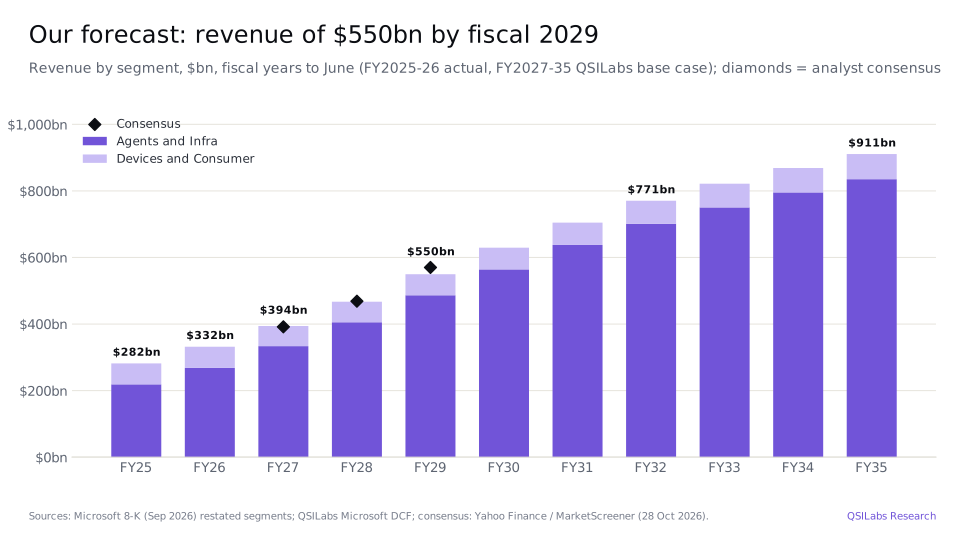
Agents and Infra revenue grows 21.5% in fiscal 2028 and 20% in fiscal 2029, then fades to 16%, 13% and 10% over fiscal 2030-32 and to 5% by 2035. Devices and Consumer grows 2-3% a year, so group revenue grows 18.5% in fiscal 2028 and 17.7% in fiscal 2029. We test that top-down: Gartner forecasts worldwide public cloud spending of about $850bn in 2026, up 21.3%, rising to $1.48tn by 2029 (Gartner public cloud forecast). Microsoft Cloud runs at about $256bn a year, roughly 30% of that market. Our A&I forecast grows roughly in line with Gartner's forecast to 2029, so Microsoft roughly holds its share rather than gaining it.
The operating margin stays near 47%, a little below today's 49.8%, as depreciation catches up with the build. Capex is the swing factor. We assume $212bn in fiscal 2027 and $230bn in fiscal 2028 including finance leases, 54% and 49% of revenue, falling to 22% by 2035.
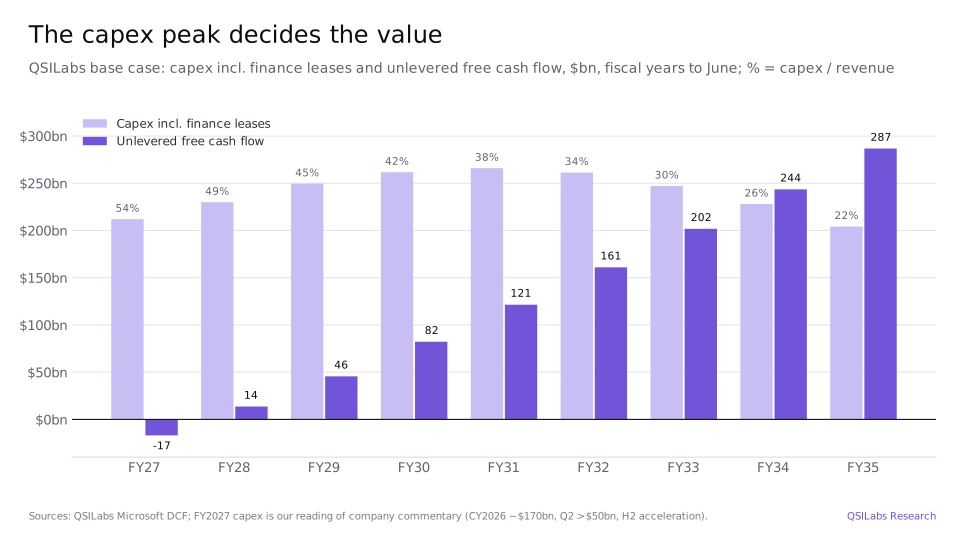
Why negative, when Microsoft guides to positive free cash flow? Its definition counts only cash capex. Ours also counts equipment taken on finance leases, because the obligation is real, and deducts tax on operating profit rather than tax paid.
Football field
Every QSILabs valuation method for Microsoft gives a value below the $521.91 share price, from $263 to $386 a share.
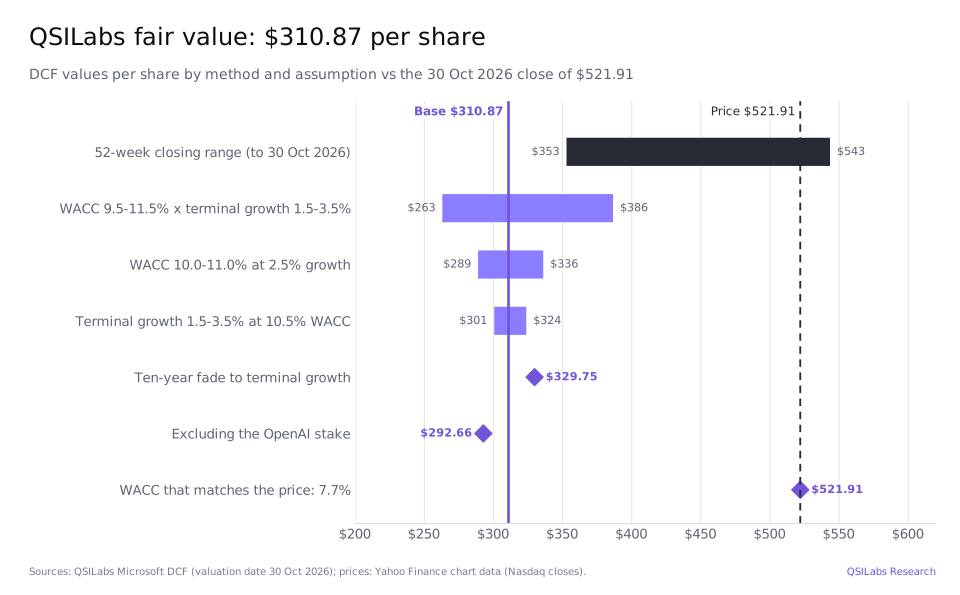
Terminal value is 71% of our enterprise value, so the long run matters. A ten-year fade from our 2035 growth rate (about 5%) down to 2.5% gives $329.75. Using the bottom-up cost of capital from Microsoft's own beta and capital structure, about 10.0%, gives $336.
Sensitivity
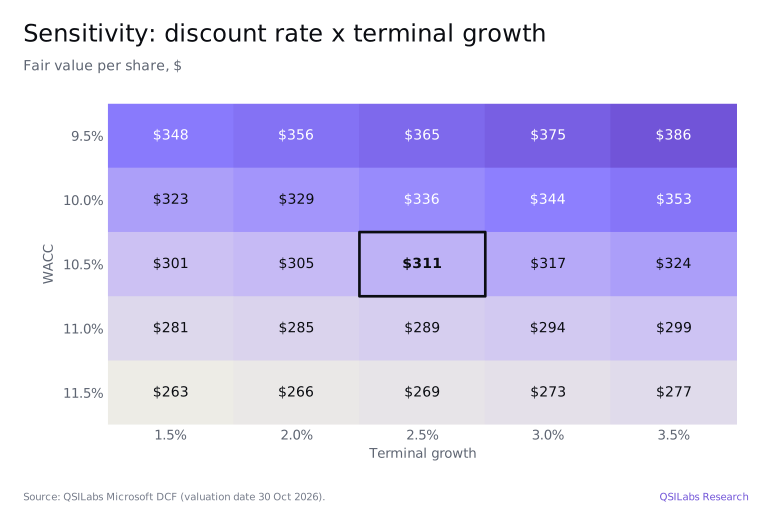
Microsoft's fair value is most sensitive to the discount rate: each half-point of WACC moves it by about $22-25 a share.
Is Microsoft stock undervalued after Q3 2026?
Microsoft (MSFT) stock does not look undervalued after Q3 2026: at $521.91 it trades about 68% above the QSILabs fair value of $310.87 per share. It looks expensive, even though the business is doing better than almost any company of its size. At $521.91 the market value is about $3.9tn. To justify that with our cash flows, investors have to accept a 7.7% return, almost three points below the software industry's cost of capital. Alternatively, they have to believe AI capex earns far more, or falls far faster, than we assume.
The case for paying up is real: a $677bn backlog, Azure growth that is accelerating at a $130bn-plus run rate, and an OpenAI stake that could be worth much more. The case against is the capital intensity. In our view, Microsoft is turning from a software company with free cash flow margins of about 25% (fiscal 2025) into a utility-like builder of AI infrastructure, at least for the next three years. We see the same tension in our SpaceX Q3 2026 valuation and its Terafab capex plan.
What are the biggest risks for Microsoft stock?
The biggest risks for Microsoft (MSFT) stock are AI capex that fails to earn its cost of capital, dependence on OpenAI, and lease commitments that behave like debt.
- Capex without returns. If AI pricing falls faster than costs, $45bn-plus quarters would lower returns on capital for years. Short-lived GPUs and CPUs, about 75% of the spend, need replacing sooner than buildings.
- OpenAI concentration. About 11% of revenue and a large share of the backlog come from one customer that is itself loss-making and needs outside funding.
- Lease commitments. $71bn of finance leases on the balance sheet plus $364.6bn not yet commenced (10-Q) behave much like debt.
- Core software softness. Weaker E3 and standalone sales, and paid seat growth of only 5%, show the per-seat business slowing as AI shifts to usage-based billing.
- Supply. Late third-party GPU deliveries already shifted capacity into the second half; further delays would cap Azure growth.
- Upside risk to our view. Capex could peak sooner, or the OpenAI stake could be revalued sharply higher. A one-point lower discount rate adds about $54 to our fair value.
Microsoft stock FAQ
What is Microsoft's fair value after Q3 2026?
The QSILabs fair value for Microsoft (MSFT) is $310.87 per share as of Q3 2026 results, against a $521.91 close on 30 October 2026. It comes from a discounted cash flow model with a 10.5% discount rate and 2.5% terminal growth; reasonable alternatives give $263 to $386 a share.
Is Microsoft stock a buy after Q3 2026 earnings?
On QSILabs numbers, Microsoft (MSFT) stock looks expensive after Q3 2026, trading about 68% above our $310.87 fair value at the 30 October 2026 close of $521.91. The quarter itself was strong, with revenue up 19% and Azure up 48%. This is not investment advice.
How fast did Microsoft Azure grow in Q3 2026?
Microsoft Azure and other cloud services revenue grew 48% to $33.2bn in Q3 2026, the quarter to 30 September 2026. Microsoft guided to 49-50% growth in constant currency for the December 2026 quarter.
Why is Microsoft's Q3 2026 called fiscal Q1 2027?
Microsoft's fiscal year runs from July to June, so its first quarter of fiscal 2027 covers July to September 2026, which is calendar Q3 2026. Its results were reported on 28 October 2026.
How much is Microsoft spending on AI data centres?
Microsoft spent $45.2bn on capex including finance leases in the September 2026 quarter. It expects more than $50bn in the December 2026 quarter and about $170bn for calendar 2026.
How much of Microsoft's revenue comes from OpenAI?
OpenAI provided $10.0bn of Microsoft's revenue in Q3 2026, including revenue share, about 11% of the total, according to Microsoft's Form 10-Q. Microsoft also owns about 24% of OpenAI on an as-converted basis.
How many paid Microsoft 365 Copilot seats does Microsoft have?
Microsoft did not update its paid Microsoft 365 Copilot seat count with its Q3 2026 results; the last figure, from July 2026, was more than 30 million paid seats. Daily Copilot users rose nearly 50% from the previous quarter.
How big is Microsoft's backlog after Q3 2026?
Microsoft's commercial remaining performance obligation was $677bn at 30 September 2026, up 73% year on year. About 30% is expected to be recognised as revenue within 12 months.
Sources
- Microsoft, Q1 FY2027 earnings release (Form 8-K, Exhibit 99.1, 28 Oct 2026) www.sec.gov
- Microsoft, Form 10-Q for the quarter ended 30 September 2026 www.sec.gov
- Microsoft Investor Relations, FY2027 Q1 press release and webcast www.microsoft.com
- Microsoft Investor Relations, FY2027 first quarter earnings conference call transcript (28 Oct 2026) www.microsoft.com
- The Motley Fool, Microsoft (MSFT) Q1 2027 earnings call transcript (29 Oct 2026) www.fool.com
- UC Today, Microsoft Q1: Copilot usage jumps, seat count goes missing (Oct 2026) uctoday.com
- CNBC, Microsoft Q1 earnings report 2027 (28 Oct 2026) www.cnbc.com
- Gartner, Forecast: public cloud services, worldwide (3Q25 update) www.gartner.com
- MarketScreener, Microsoft consensus revenue estimates (28 Oct 2026) www.marketscreener.com
- Yahoo Finance chart data: MSFT daily closes (to 30 Oct 2026) query1.finance.yahoo.com
- Aswath Damodaran, cost of capital by industry (NYU Stern, January 2026 update) pages.stern.nyu.edu
- QSILabs Microsoft discounted cash flow model (internal, valuation date 30 Oct 2026)
Disclaimer
This article is for information only and is not investment advice or a recommendation to buy or sell any security. Fair values, forecasts and scenarios are QSILabs estimates based on public information and our own assumptions, and they may be wrong. Reported figures come from Microsoft's filings and earnings call; prices are as of the 30 October 2026 close. QSI Labs may hold positions in securities mentioned. For more of our work, see the QSI Labs research index.
More from QSI Labs
Read our white paper, QSI Labs: An AI-Native Trading Firm Built on a Training Loop (October 2026), available on request, or browse the research index.