Research / Earnings and valuation

SpaceX Q3 2026:Rockets, Starlink, Terafab and a Tesla-sized question
In short: SpaceX Q3 2026 earnings were a record: revenue rose 161% to $14.58bn and net income was $4.40bn. The problem is the bill, with $35-40bn of Q4 capex guidance and a Terafab chip fab of up to $119bn. Our fair value is $92.35 a share, about 31% below the $134.72 close.
Key takeaways
- Fair value. $92.35 a share from our sum-of-the-parts DCF as of 30 October 2026, about 31% below the $134.72 close (Nasdaq: SPCX). Range: $55 to $145.
- Q3 2026 results. Revenue $14.58bn, up 161%; net income $4.40bn, or $0.35 per diluted share.
- Super Intelligence. $7.56bn of revenue, 52% of the group, mostly compute sold to other AI companies.
- Capex. $19.6bn in Q3 and $35-40bn guided for Q4.
- Terafab. Texas filings describe up to $119bn of investment; first test chip targeted for mid-2027.
Figures as of 30 October 2026. Published 31 October 2026, updated 2 November 2026, by QSI Labs Research.
SpaceX reported its third quarter as a public company on 20 October 2026. Revenue more than doubled, the company made a $4.4bn profit, and the shares rose about 8% the next day. Ten days later they had given all of it back and more. At the 30 October close of $134.72, SpaceX had lost more than $500bn of market value since its 6 October peak (Yahoo Finance).
What changed in between was not the quarter. It was the bill. Management guided to $35-40bn of capex in Q4 alone, laid out a 10-13 GW compute build for 2027, confirmed a chip fab that Texas filings put at up to $119bn, and confirmed that special committees at SpaceX and Tesla are talking about "deepening the relationship". In this article we go through the numbers, the plans, an illustrative Tesla deal, and what we think the shares are worth.
Executive summary
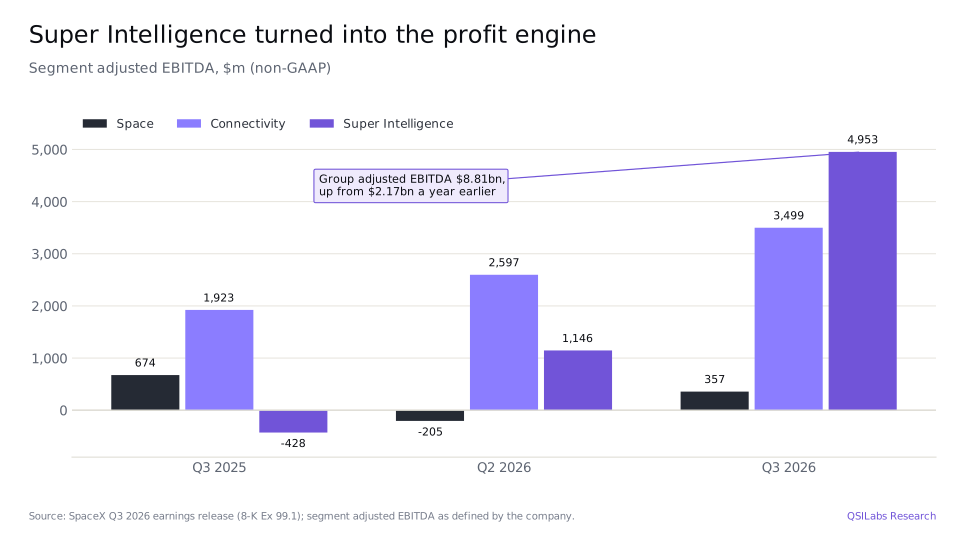
- A record quarter. Revenue was $14.58bn, up 161% year on year, and adjusted EBITDA $8.81bn, up from $2.17bn. Net income was $4.40bn, or $0.35 per diluted share, against a $1.1bn loss a year earlier (8-K Ex 99.1).
- Super Intelligence is now the biggest segment. The xAI side of the business (compute, Grok, Cursor and X) brought in $7.56bn, 52% of the group, and $4.95bn of adjusted EBITDA. Most of it is compute sold to other AI companies.
- Starlink keeps compounding. Subscribers reached 13.6m, from 7.2m a year earlier. Connectivity revenue rose 69% and operating income 99%. Revenue per consumer user fell to $69 a month from $83, as growth shifts to cheaper markets.
- Rockets were the soft spot. Space revenue rose 6%, but launches fell to 35 from 44, and the segment broke even at the operating line. The first orbital Starship flight carried 26 Starlink V3 satellites.
- The cash goes into the ground. Capex was $19.6bn in the quarter and $48.1bn in nine months, against $13.1bn of operating cash flow. Q4 guidance is $35-40bn.
- Terafab is real, but early. Texas incentive filings describe up to $119bn of investment in four phases, led by SpaceX, Tesla and xAI. The first test chip is targeted for mid-2027 and volume production for around Q3 2028. Ownership and economics are not yet disclosed.
- A Tesla deal would be expensive for SpaceX holders. No terms exist. In our illustrative scenario, cash plus shares at a 25% premium dilutes SpaceX's adjusted EPS by 20-33% a year through FY2029.
- Our fair value is $92.35 a share, about 31% below the $134.72 close. The range is wide: $55 to $145 on single assumptions, mostly how fast compute comes online and what it rents for.
SpaceX Q3 2026 earnings at a glance
- Feb 2026SpaceX and xAI combine; xAI, Grok and X become the Super Intelligence segmentCNBC
- Jun 2026IPO on Nasdaq as SPCX, priced at $135SpaceX pricing release
- 6 Aug 2026Texas announces Terafab in Grimes CountyENR
- 14 Aug 2026Cursor acquisition closes (implied equity value $60bn)8-K Ex 99.1
- 6 Oct 2026Share price peaks; market value above $2.3tnYahoo Finance
- 8 Oct 2026Agreement to buy 800 MHz spectrum licences; closing expected H1 20278-K Ex 99.1
- 20 Oct 2026Q3 results; SpaceX and Tesla boards confirm special committees8-K; TechCrunch
- 22 Oct 2026About 1.3bn shares released from lock-upYahoo Finance
- 30 Oct 2026Close of $134.72, about $1.8tn of market valueMarketBeat; Yahoo Finance
The headline numbers were stronger than the share price reaction suggests. Group operating income was $2.79bn, a 19% margin, against an operating loss of $273m a year earlier. Below the line, $873m of interest income more than covered $675m of interest expense, and a $390m tax benefit took net income to $4.40bn.
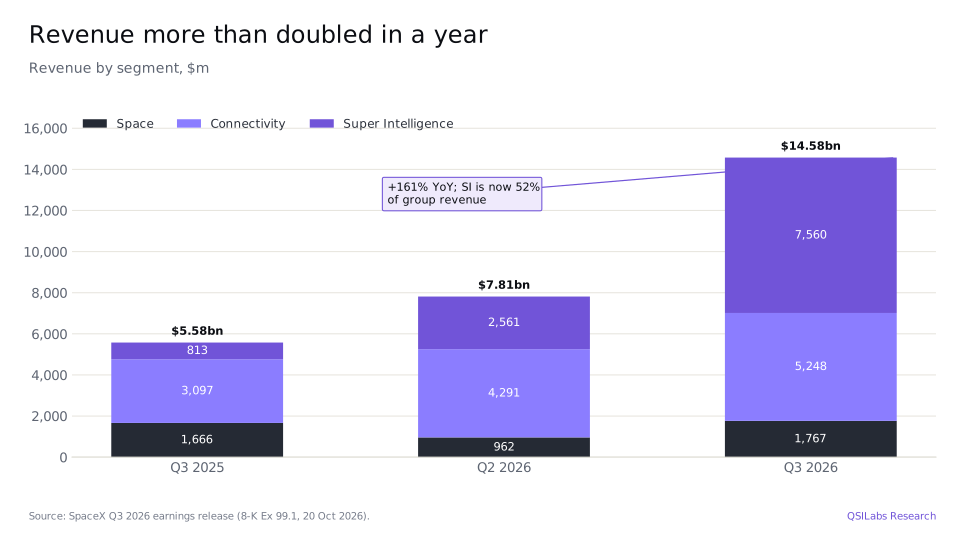
Management gave two numbers for what comes next: Q1 2027 revenue of $33-37bn, and a $63bn backlog, of which $42bn is expected to be recognised within twelve months (Q3 2026 earnings call).
SpaceX segments: how did each business perform?
Space: fewer launches, a bigger rocket
Space revenue was $1.77bn, up 6%: $1.13bn from launch services and $637m from launch and development work. The segment lost $7m at the operating line and made $357m of adjusted EBITDA, down from $674m.
- Launches. 35 in the quarter, 12 of them for customers, against 44 a year earlier. Nine-month launches were 113, against 128. Mass to orbit was 476 tonnes.
- Starship. Flight 14 was the first orbital Starship flight. It carried 26 Starlink V3 satellites, about ten times what a Falcon 9 Starlink launch delivers, or 26 Tbps of capacity. Flight 15, next month, will try to catch both the booster and the ship.
- Cadence. Management is aiming for weekly Starship flights in the first half of 2027 and twice weekly by the end of the year. A new launch site, Starbase Louisiana, is planned for a first launch in 2029.
- Government. The quarter included three NASA crew missions and 18 National Security Space Launch missions.
Connectivity: Starlink at 13.6m
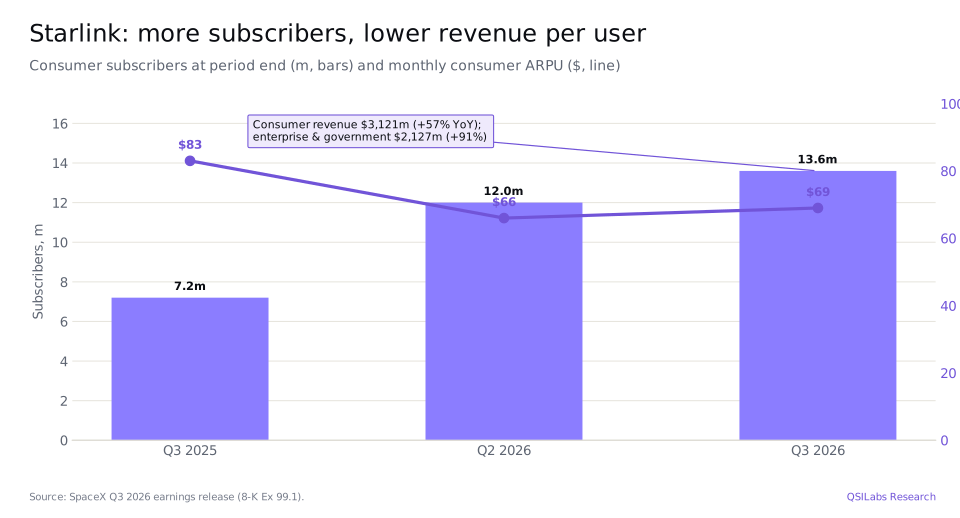
Connectivity revenue was $5.25bn, up 22% on Q2 and 69% on Q3 2025. Consumer revenue was $3.12bn (+57%) and enterprise and government $2.13bn (+91%). Operating income was $2.37bn, a 45% margin, and adjusted EBITDA $3.50bn.
- Aviation. Starlink is on about 3,800 aircraft.
- Mobile. Starlink Mobile, the direct-to-phone service, reached 22m monthly users, up 37% on the quarter.
- Spectrum. On 8 October SpaceX agreed to buy 800 MHz licences (up to 14 MHz paired), with closing expected in the first half of 2027. The price has not been disclosed.
Super Intelligence: compute is the business
Super Intelligence revenue was $7.56bn, of which $7.02bn was "solutions and infrastructure", mostly compute capacity sold to other AI developers (Anthropic among them, as our Anthropic IPO analysis notes), and $538m advertising, mostly X. Operating income was $431m, after $2.47bn of depreciation and amortisation and $1.2bn of share-based compensation from the Cursor acquisition. Adjusted EBITDA was $4.95bn, a 66% margin.
- Capacity. Nameplate compute reached 1.7 GW at quarter end, from 0.6 GW a year earlier. Management said it was at nearly 2.2 GW by the end of October and expects 2.5-3 GW by year end, adding about 200,000 GB300 chips a month.
- Cursor. The acquisition closed on 14 August at an implied equity value of $60bn ($42.5bn of GAAP consideration plus $23.4bn of post-acquisition awards) and contributed $608m of revenue in the quarter.
- 2027. Management is "fairly confident" of adding another 10 GW next year and would be "surprised if less than 13 gigawatts" are online by the end of 2027.
Cash flow and the balance sheet
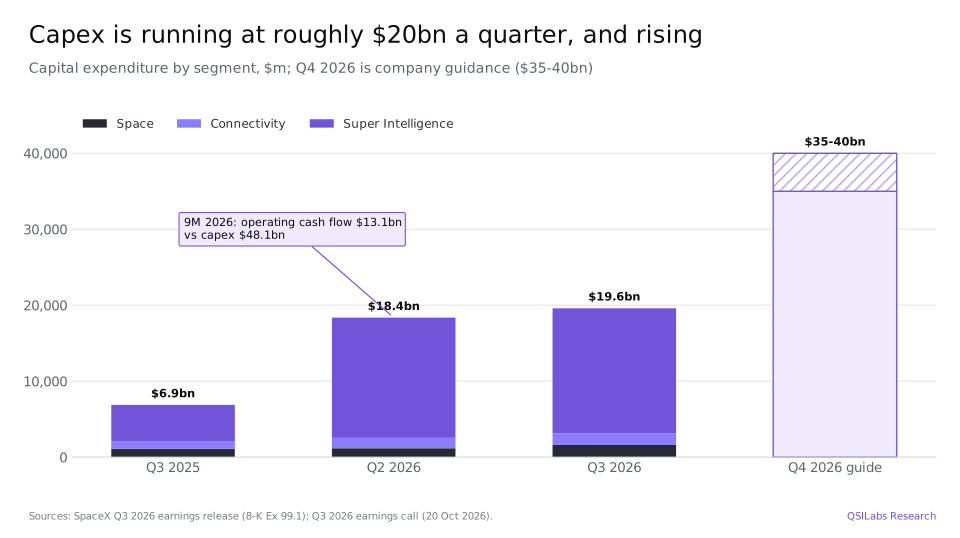
The business produces cash, but nowhere near enough for what it is building. Over the first nine months of 2026:
- Operating cash flow was $13.1bn, up from $4.1bn.
- Capex was $48.1bn, of which $40.0bn was Super Intelligence.
- Investing outflows were $84.6bn in total.
- Financing inflows were $99.8bn, mostly the June IPO.
At 30 September SpaceX held $51.3bn of cash and $38.6bn of marketable securities, against $38.8bn of debt, or about $51.0bn of net cash. Total assets were $254.0bn, including $89.5bn of property and equipment and $48.4bn of goodwill. Deferred revenue was $17.5bn, a sign of customers paying ahead for capacity.
With $35-40bn of capex planned for Q4 and a much larger 2027 programme, the net cash will not last long. In our base case SpaceX needs about $223bn of external funding over the build (QSILabs estimate).
How things look
The company's own outlook, from the earnings call:
- Compute. 2.5-3 GW by the end of 2026. At least 10 GW more in 2027, plans for 20 GW of additional power and cooling, and a "non-zero" chance of more than 20 GW.
- Capex. $35-40bn in Q4 2026.
- Revenue. $33-37bn in Q1 2027, with $42bn of the $63bn backlog due within twelve months.
- Starship. Weekly flights in H1 2027, twice weekly by the end of 2027.
- Chips. A first Terafab test chip in mid-2027 and volume production from around Q3 2028.
The market is less sure. After the lock-up release on 22 October freed about 1.3bn shares, the stock fell back. It closed at $134.72 on 30 October, down 6.4% on the day (MarketBeat). Analyst targets still average $244.97, with JPMorgan at $500, Barclays at $300 and Needham at $250 (MarketBeat).
Terafab
Terafab is the plan to make AI chips in Texas, at a scale only TSMC operates at today. Musk described it on 7 October as a fab SpaceX would "build and run", with TSMC possibly subleasing part of it (ENR).
What the filings and the company say:
- Where. Grimes County, about 20 miles east of College Station, announced by Texas on 6 August. Up to 100m square feet and 3,000 jobs (ENR).
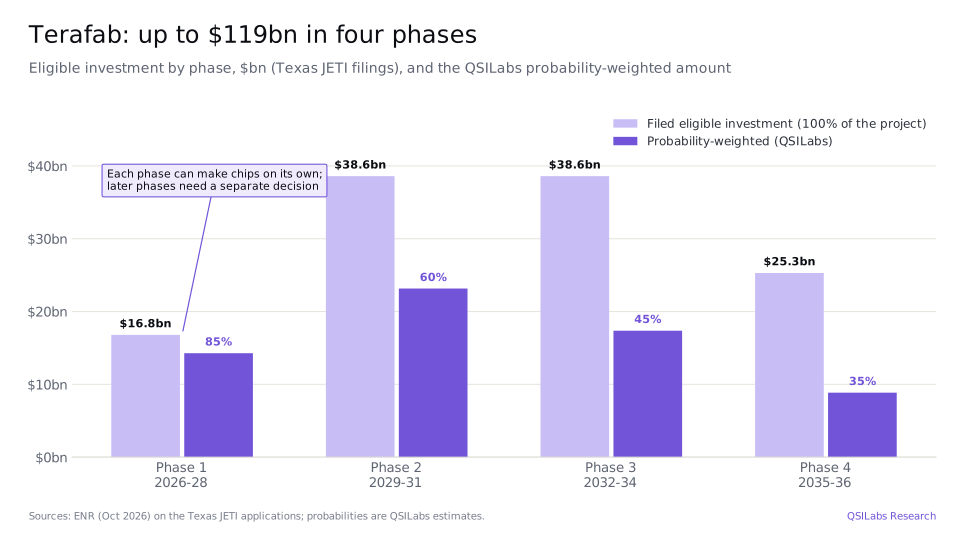
- How much. Up to $119bn across four phases under the Texas JETI programme: $16.8bn in 2026-28, $38.6bn in 2029-31, $38.6bn in 2032-34 and $25.3bn in 2035-36 (ENR).
- Incentives. A $30m Texas Enterprise Fund grant, and a Grimes County abatement of 100% for ten years in exchange for $20m a year in lieu of taxes plus $10m upfront, conditional on $5bn of capex and 1,800 jobs (ENR).
- Who. SpaceX, Tesla and xAI are named as the affiliates leading the project. The prospectus describes a "general framework" whose terms and IP arrangements are not final, and neither Tesla nor Intel is obliged to stay in it (Wikipedia, citing the 424B4).
- Technology. Processes at the 2nm class through partnerships, starting at 100,000 wafer starts a month, with a long-term aim of 1m. A research fab at Giga Texas, about $3bn, comes first (Wikipedia).
- When. A first SRAM test chip from the Austin research fab in about May-June 2027, and volume production at Gibbons Creek from around Q3 2028 (Q3 2026 earnings call). Phase 1 construction is scheduled from 1 December 2026 to 31 December 2028 (Wikipedia).
- Ambition. Management talks about "a terawatt of super intelligence chips per year".
How we model it. We give SpaceX 50% of the project and weight the four phases at 85%, 60%, 45% and 35%. Production starts in 2029 at 30% utilisation and ramps over three years. Each dollar of plant produces $0.80 of revenue a year (TSMC: $1.03), at an EBITDA margin rising to 55% (TSMC's 2025 gross margin: 59.9%). All of these are QSILabs estimates. On that basis SpaceX's share of the probability-weighted capex is about $29.5bn to 2040, and Terafab is worth $29.2bn, or $2.15 a share. If all four phases are built, it rises to $50.7bn; phase 1 alone is worth $8.6bn.
Terafab matters for the valuation less as a profit centre than as insurance on chip supply. That value is not in our model.
A Tesla merger: an illustrative scenario
On 20 October both boards confirmed special committees to "explore deepening the relationship", which could include a business combination. They "have not reached agreement on the terms of any transaction", there is "no guarantee" of one, and Musk is not taking part in the discussions (TechCrunch; Yahoo Finance). Tesla already holds less than 1% of SpaceX, bought for $2.0bn and now worth $2.9bn, and SpaceX bought $480m of Megapacks from Tesla in the first nine months (Yahoo Finance).
There are no terms. What follows is an illustrative QSILabs scenario with hypothetical terms, to show the scale of what a deal would mean for SpaceX holders.
| Illustrative terms | |
|---|---|
| Structure | SpaceX acquires Tesla; closing assumed 30 June 2027 |
| Consideration per Tesla share | $40 cash plus SpaceX shares worth $427.11, collared at 95-105% of a $147.79 reference price |
| Offer value | $468.08 a share, a 25.3% premium to an unaffected $373.71 |
| Equity value | $1.72tn: $147.3bn cash and $1.58tn in about 10.1bn new SpaceX shares |
| Former Tesla holders' ownership | 42.8% |
| Financing | $60bn term loan, $60bn of notes, a $20bn revolver and $26.2bn of balance-sheet cash |
| Synergies | $12bn a year at run-rate, phased in at 20%, 60% and 100% |
| Implied multiples | 16.3x revenue, 166x EBITDA, 535x earnings |
What the scenario shows:
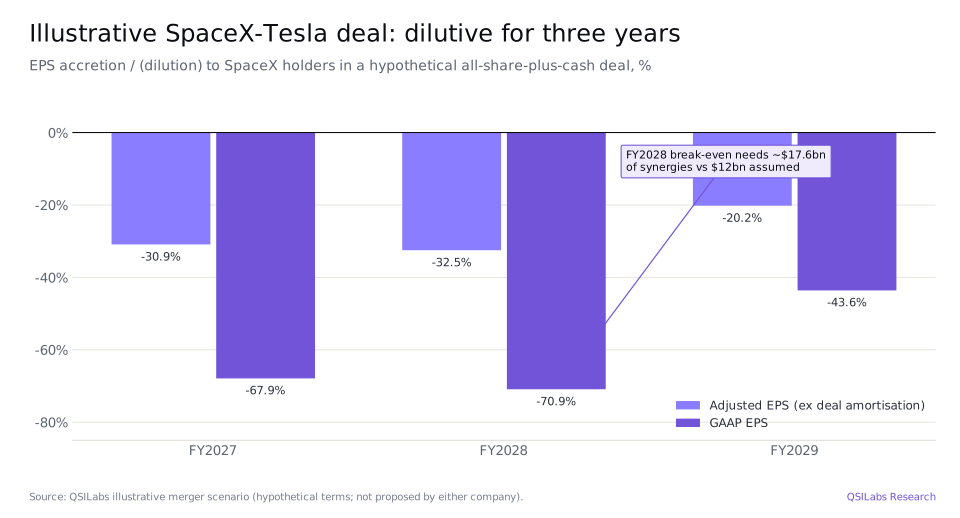
- Dilutive for years. Adjusted EPS falls 30.9% in FY2027, 32.5% in FY2028 and 20.2% in FY2029. Breaking even in FY2028 would need about $17.6bn of synergies, against the $12bn assumed.
- Manageable debt. Debt would be 2.8x EBITDA, with interest covered 6.0 times, within a 3.5x leverage threshold.
- At today's prices the terms look different. At $134.72, SpaceX trades below the bottom of the collar, so Tesla holders would receive 3.04 shares instead of 2.75. Against Tesla's $399.81 close on 30 October, the offer would be worth about $449.83, a 12.5% premium, paid with about 11.2bn new shares, or about 45% of the combined company (QSILabs estimates).
- The vote is the hurdle. Tesla would need approval from 50% of all its shares, with Musk conflicted on both sides (Q3 2026 earnings call).
Valuation
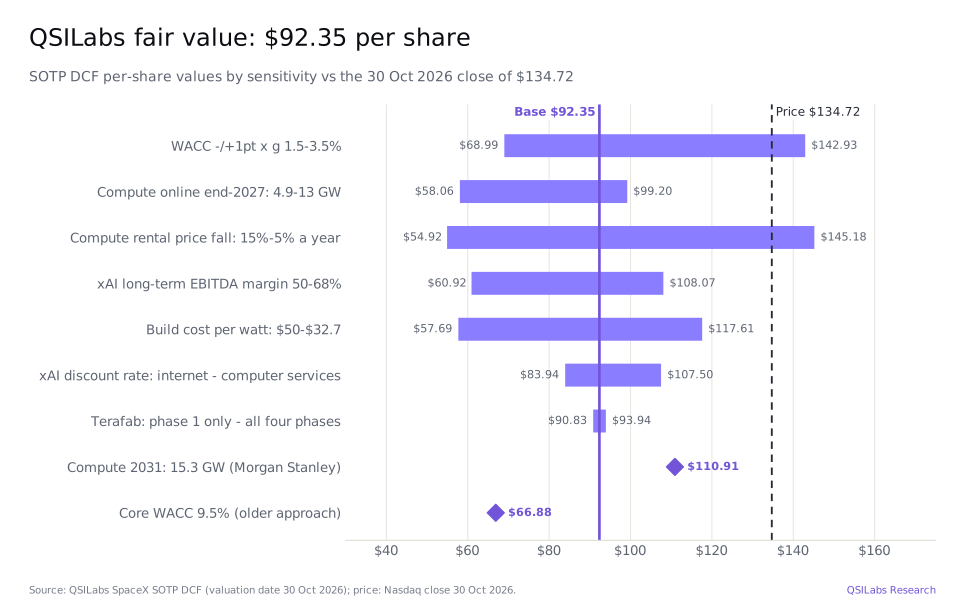
Our number is $92.35 a share, or $1.25tn of equity, against a market value of about $1.8tn.
Method
We value SpaceX as the sum of four discounted cash flows, each at its own cost of capital, all with 2.5% terminal growth:
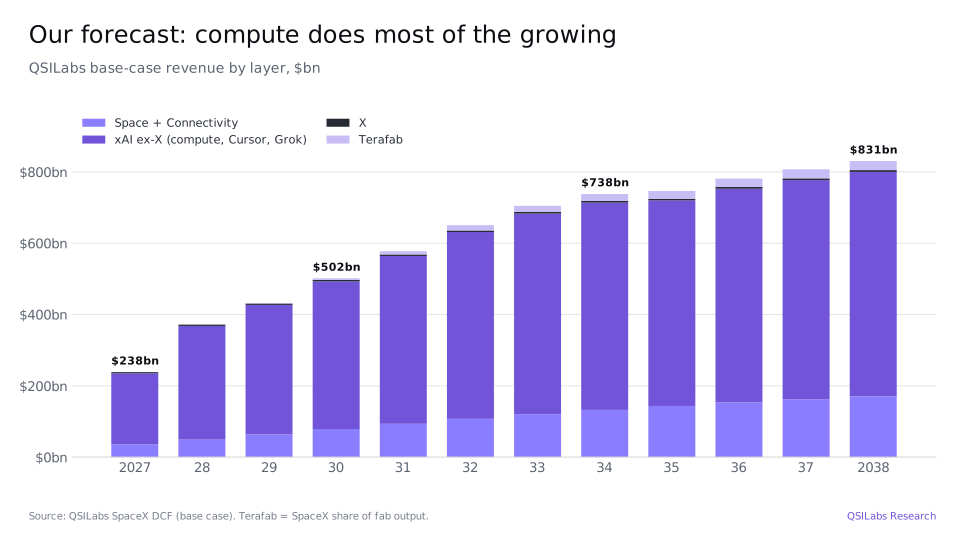
- Space and Connectivity, at a 6.90% WACC. Q3 actuals, then Starlink net additions of 7.0m in 2027 fading to 2.0m by 2040, consumer ARPU drifting from $67 to $51, Starlink Mobile from 2028, and Space growth fading from 18% to 3.5%.
- xAI excluding X, at 10.50%. Compute at 11 GW by the end of 2027 and 25 GW by 2031, built at $40 per watt, with rental prices falling 10% a year to 2035 and a long-term EBITDA margin of 62%.
- Terafab, at 11.71%. As described above.
- X, at 9.61%. A 45% EBITDA margin.
The discount rates use Damodaran industry data at a 5.12% risk-free rate. Taxes are 21%, less the company's tax losses. Terminal value is 72% of enterprise value. All forecasts are QSILabs estimates.
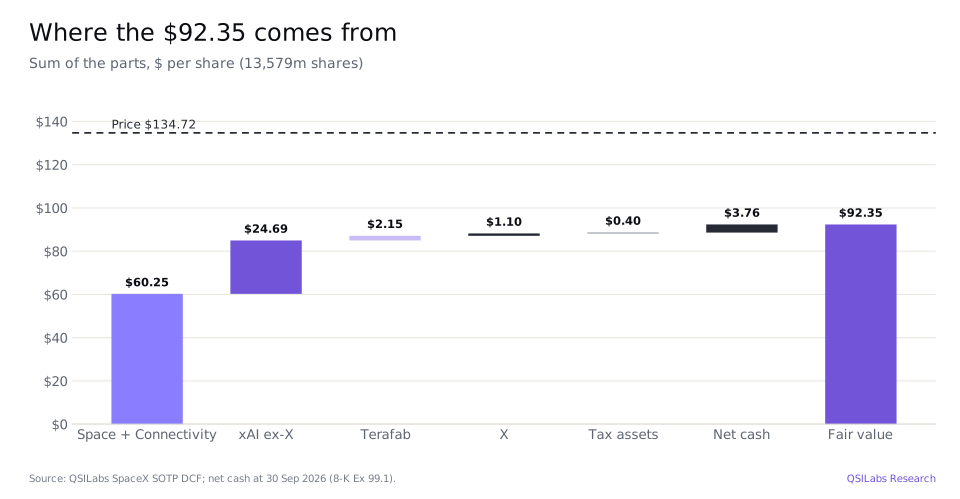
| From enterprise value to fair value | $bn |
|---|---|
| Space and Connectivity | 818.2 |
| + xAI excluding X | 335.3 |
| + Terafab (SpaceX share) | 29.2 |
| + X | 15.0 |
| = Enterprise value | 1,203.0 |
| + Net cash (30 Sep 2026) | 51.0 |
| = Equity value (including $5.4bn of tax assets) | 1,254.1 |
| / Shares, m | 13,579 |
| = Fair value per share | $92.35 |
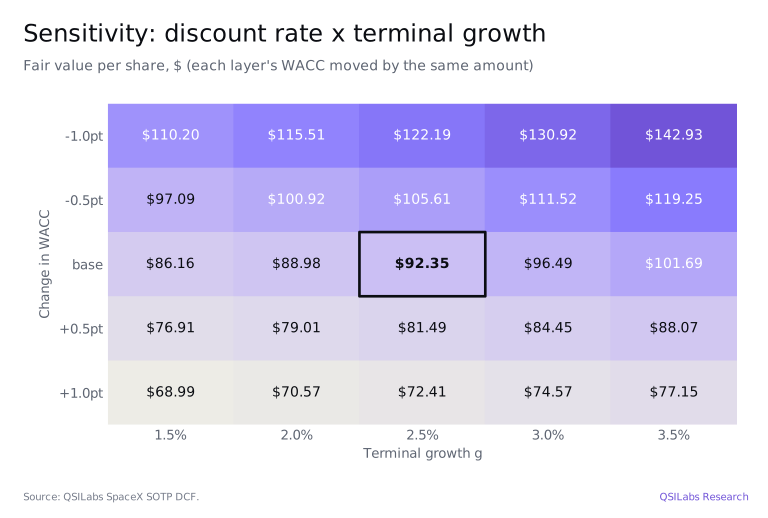
How the number moves if you argue with us:
- Compute online by end-2027. Management's 13 GW gives $99.20. Morgan Stanley's 4.9 GW gives $58.06. Morgan Stanley's 15.3 GW by 2031 gives $110.91.
- Rental prices. If prices fall 5% a year instead of 10%, fair value is $145.18. At 15% a year it is $54.92. This is the single biggest lever.
- Cost per watt. At the $32.7 per watt implied by Q4 guidance, fair value rises to $117.61; at Morgan Stanley's $50 it falls to $57.69.
- Margins. A 50% long-term xAI margin gives $60.92; 68% gives $108.07.
- Terafab. Phase 1 only gives $90.83; all four phases $93.94.
- Dilution. If the funding need is met with equity at today's price, fair value is $96.95, because new shares are issued above our value.
What are the risks for SpaceX stock?
- Funding. About $223bn of external capital in our base case, raised in a market that has just taken more than a fifth off the share price.
- Compute prices. New chip generations and rivals' capacity can push rental prices down faster than we assume.
- Customer concentration. Compute is sold to a small number of AI developers on large contracts.
- Execution. Starship cadence, 10+ GW of data centres in a year and a first-of-its-kind fab are all happening at once.
- Governance. A Tesla deal would be negotiated by committees of two companies run by the same person.
- Supply. Lock-up releases and new issuance add supply to the stock.
FAQ
How did SpaceX do in Q3 2026 earnings?
Revenue was $14.58bn, up 161%, adjusted EBITDA $8.81bn, and net income $4.40bn, or $0.35 per diluted share. Super Intelligence brought in $7.56bn, Connectivity $5.25bn and Space $1.77bn (8-K Ex 99.1).
How many Starlink subscribers does SpaceX have?
13.6m at 30 September 2026, up from 12.0m in June and 7.2m a year earlier. Average consumer revenue was $69 a month (8-K Ex 99.1).
What is Terafab?
A planned AI chip fab in Grimes County, Texas, led by SpaceX, Tesla and xAI. Texas incentive filings describe up to $119bn of investment in four phases from 2026 to 2036. A first test chip is targeted for mid-2027 and volume production for around Q3 2028. Ownership and economics are not yet disclosed.
Are SpaceX and Tesla going to merge?
Nobody knows yet. Both boards have formed special committees to explore a closer relationship, which could include a combination, but they have not agreed any terms and say there is no guarantee of a deal. A deal would need 50% of all Tesla shares to vote in favour.
What would a Tesla merger mean for SpaceX shareholders?
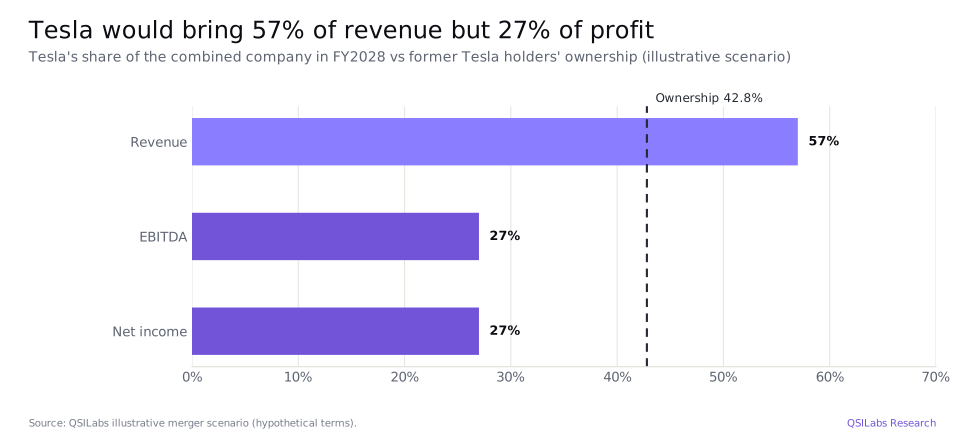
In our illustrative scenario, with hypothetical terms of $40 cash plus shares at a 25% premium, it would dilute SpaceX's adjusted EPS by 20-33% a year through FY2029. Tesla would bring 57% of the combined revenue but 27% of the profit, for 42.8% of the shares.
What is SpaceX's fair value?
$92.35 a share, from a sum-of-the-parts DCF, about 31% below the 30 October close of $134.72. Most of the value is Space and Connectivity ($60.26) and xAI compute and software ($24.69). On single assumptions the range is $55 to $145.
Why is SpaceX's fair value below its share price?
Because the build is expensive and the price of compute is falling. Our base case assumes rental prices fall 10% a year to 2035. At 5% a year, fair value would be $145.18, above the share price.
Sources
- SpaceX, Q3 2026 earnings release (Form 8-K, Exhibit 99.1, 20 Oct 2026) www.sec.gov
- SpaceX, prospectus (Form 424B4, June 2026) www.sec.gov
- SpaceX, IPO pricing announcement content.spacex.com
- SpaceX Q3 2026 earnings call transcript (StockAnalysis, 20 Oct 2026) stockanalysis.com
- SpaceX Q3 2026 earnings call transcript (The Motley Fool, 20 Oct 2026) www.fool.com
- ENR: SpaceX records fight exposes $119B Terafab buildout plans (Oct 2026) www.enr.com
- Wikipedia: Terafab en.wikipedia.org
- TechCrunch: SpaceX and Tesla boards form special committees to review merger (20 Oct 2026) techcrunch.com
- Yahoo Finance: Tesla and SpaceX boards confirm special committees (22 Oct 2026) finance.yahoo.com
- Yahoo Finance: SpaceX has lost more than $500 billion in market value in less than a month (30 Oct 2026) finance.yahoo.com
- MarketBeat: SpaceX (NASDAQ:SPCX) stock price down 6.4% (30 Oct 2026) www.marketbeat.com
- BigGo Finance (citing Morgan Stanley): SpaceX and Tesla physical AI synergy, compute estimates finance.biggo.com
- CNBC: Musk's xAI and SpaceX combine (3 Feb 2026) www.cnbc.com
- TSMC, 4Q25 Management Report (margins and asset turnover benchmark) investor.tsmc.com
- Yahoo Finance chart data: SPCX and TSLA closing prices (30 Oct 2026) query1.finance.yahoo.com
- QSILabs SpaceX sum-of-the-parts DCF model (internal, valuation date 30 Oct 2026)
- QSILabs illustrative SpaceX-Tesla merger model (internal; hypothetical terms)
Disclaimer
This article is for information only and is not investment advice. The merger analysis is an illustrative scenario with hypothetical terms; neither company has proposed it. Names and logos of third parties are the trademarks of their respective owners and are used solely for identification. Such use does not imply any affiliation with, sponsorship by, or endorsement of, QSI Labs.
More from QSI Labs
Read our white paper, QSI Labs: An AI-Native Trading Firm Built on a Training Loop (October 2026), available on request, read our Anthropic IPO analysis: the S-1, compute bet and valuation, or browse the research index.