Research / Earnings and valuation
Caterpillar Stock Q3 2026:Sales Up 17%, Backlog at $78bn
As of: Figures are as of Caterpillar Inc.'s results for the quarter ended 30 September 2026 (Q3 2026; Caterpillar's fiscal year is the calendar year), reported on 29 October 2026 in the earnings release and retail sales statistics (Form 8-K, Exhibits 99.1 and 99.2) and discussed on the earnings call the same day. The Form 10-Q for the quarter had not been filed when we wrote this. The share price is the NYSE close of CAT on 30 October 2026, $622.75. Published 2 November 2026.
The short answer. Caterpillar stock Q3 2026 results, for the July to September quarter, showed a company selling more of almost everything, led by engines and turbines for data centres. Sales and revenues rose 17% to $20.7bn, operating profit rose 38% to $4.2bn and adjusted profit per share rose 45% to $7.20. Power Generation sales grew 30%, and the backlog reached $78bn, about twice its level a year earlier. Our discounted cash flow model puts Caterpillar Inc. at $319.71 per share, about 49% below the $622.75 close on 30 October 2026. The business is strong. The share price implies high margins and growth for much longer than our model assumes.
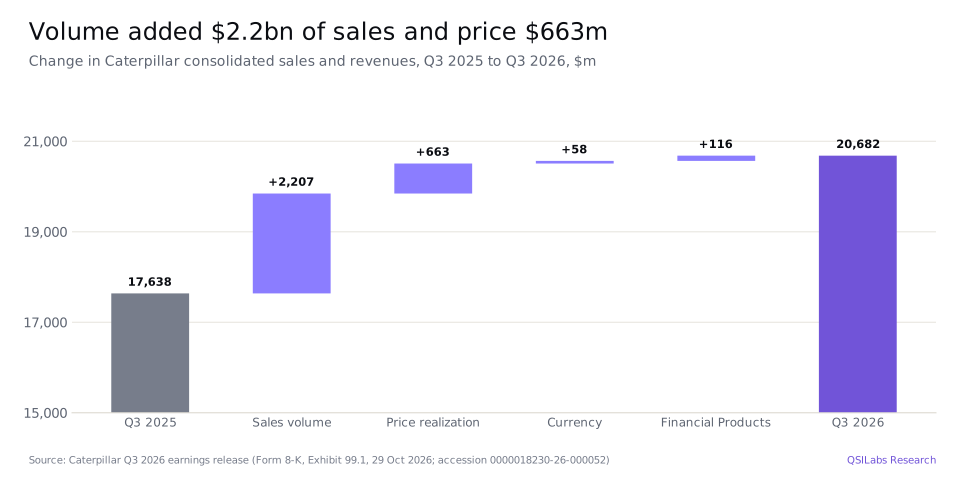
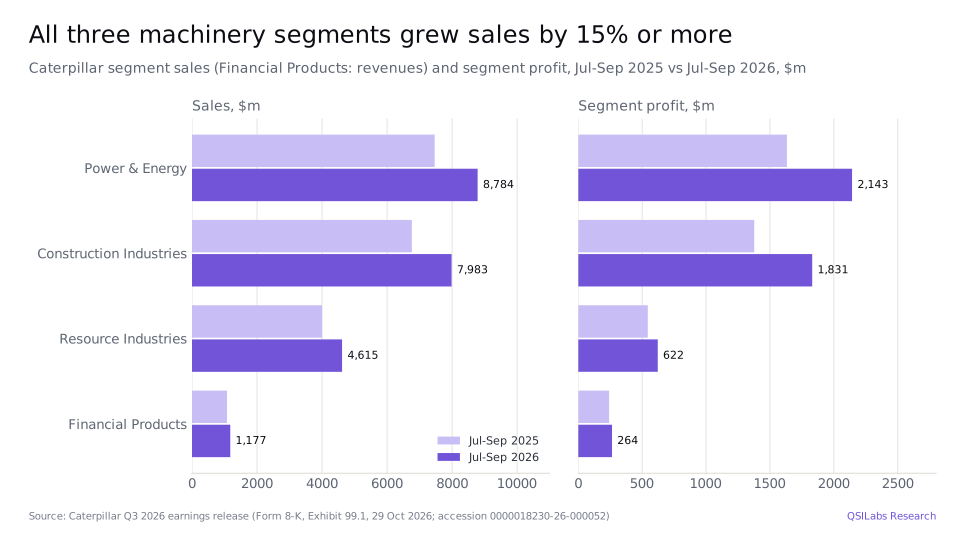
Caterpillar's quarter to 30 September 2026 was driven by volume. Higher sales volume added $2.2bn of sales and price realization another $663m, and all three machinery segments grew sales by 15% or more (Caterpillar Q3 2026 earnings release). Profit was $3.29bn, or $7.13 a diluted share, against $2.30bn, or $4.88, a year earlier. The shares still fell 9.2% on results day, from $713.38 to $647.39, and closed at $622.75 on 30 October, 9.1% above their level a year earlier but 42% below their 52-week high of $1,073.46 (Yahoo Finance).
In this article we go through Caterpillar's Q3 2026 numbers against a year earlier, segment by segment, explain what is driving power generation, set out the outlook for the fourth quarter and full year, cover cash flow, buybacks and the balance sheet, and then value CAT stock, with every assumption laid out so you can argue with it.
Key takeaways
- Valuation: QSILabs values Caterpillar Inc. (NYSE: CAT) at $319.71 per share as of results for the quarter ended 30 September 2026, against a $622.75 close on 30 October 2026, about 49% below the market price. Our sensitivity range is about $278-378 a share.
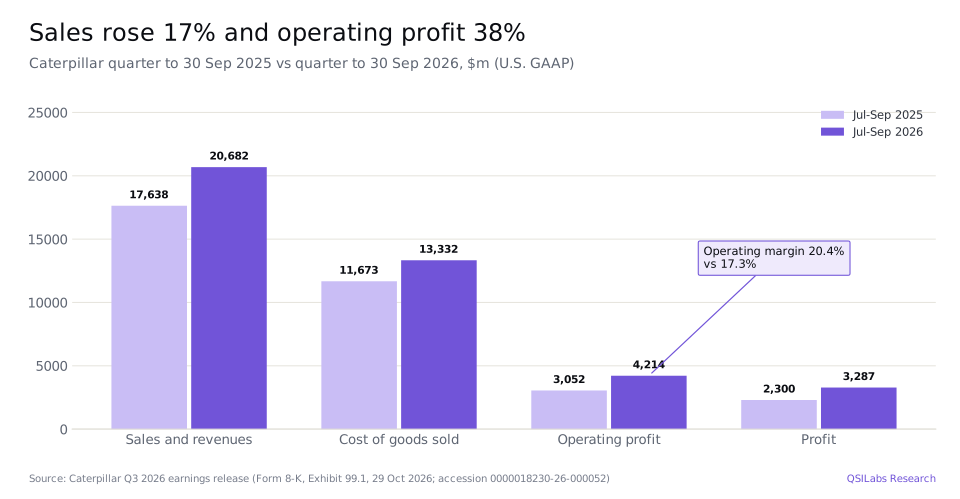
- Q3 2026 results: sales and revenues were $20,682m in the quarter ended 30 September 2026, up 17% from $17,638m; operating profit was $4,214m, up 38%, a 20.4% margin against 17.3%; diluted profit per share was $7.13 and adjusted profit per share $7.20, up 45%.
- Power: Power & Energy sales rose 18% to $8.8bn and its profit 31% to $2.1bn. Power Generation sales rose 30% to $3.4bn, and Power Generation sales to end users rose 75%.
- Backlog: the backlog was $78bn at the end of the quarter, up about $38bn or 96% from a year earlier, and some large engine and turbine orders now run into 2029 and 2030 (earnings call).
- Outlook kept: Caterpillar still expects 2026 sales and revenues to grow in the mid to high teens, with moderate growth in the fourth quarter, and MP&E free cash flow in the top half of its $6-15bn target range.
- Cash and returns: MP&E free cash flow was $3.8bn in the quarter; Caterpillar spent $1.2bn on buybacks and $0.7bn on dividends. The quarterly dividend of $1.63 is a 1.0% yield at $622.75.
Key numbers from Caterpillar's Q3 2026 earnings
| July-September, $m | 2025 | 2026 | Change |
|---|---|---|---|
| Sales of Machinery, Power & Energy | 16,726 | 19,654 | +18% |
| Revenues of Financial Products | 912 | 1,028 | +13% |
| Total sales and revenues | 17,638 | 20,682 | +17% |
| Cost of goods sold | 11,673 | 13,332 | +14% |
| Selling, general and administrative expenses | 1,822 | 1,797 | -1% |
| Research and development expenses | 555 | 596 | +7% |
| Operating profit | 3,052 | 4,214 | +38% |
| Consolidated profit before taxes | 3,127 | 4,220 | +35% |
| Profit attributable to common shareholders | 2,300 | 3,287 | +43% |
| Diluted profit per share ($) | 4.88 | 7.13 | +46% |
| Adjusted profit per share ($, non-GAAP) | 4.95 | 7.20 | +45% |
| Diluted weighted average shares (m) | 470.8 | 460.9 | -2% |
Source: Caterpillar Q3 2026 earnings release, consolidated results of operations (Form 8-K, Exhibit 99.1, accession 0000018230-26-000052). Operating margin was 20.4% against 17.3% a year earlier and the effective tax rate was 22.9% against 26.7%.
Caterpillar Q3 2026 earnings: what happened
Caterpillar grew sales and profit strongly in Q3 2026. Sales and revenues rose $3,044m to $20,682m, while cost of goods sold rose only $1,659m, so most of the extra sales fell through to profit. Selling, general and administrative expenses fell slightly to $1,797m and research and development rose 7% to $596m. Operating profit rose $1,162m to $4,214m, a margin of 20.4% against 17.3% (earnings release).
The operating profit included $128m of recoveries of tariffs paid under the International Emergency Economic Powers Act (IEEPA), most of which sits in corporate items. Adjusted operating profit, which excludes restructuring costs, was $4,255m, a 20.6% margin against 17.5% a year earlier. Excluding the IEEPA recoveries, the company said the margin was in line with its expectations. Tariff costs for tariffs introduced since the start of 2025 were about $600m in the quarter, roughly the same as a year earlier (earnings call).
Below operating profit, other income fell to $135m from $208m because of losses on total return swaps, and interest expense outside Financial Products was $129m. Profit before taxes was $4,220m, up 35%. The tax rate fell to 22.9% from 26.7%, because the prior year included charges to raise the estimated annual rate, so profit grew faster than pre-tax profit, rising 43% to $3,287m. Share buybacks cut the diluted share count by 2.1% to 460.9m, and diluted profit per share rose 46% to $7.13.
Almost all of the growth came from selling more. Of the $3,044m increase in sales and revenues, $2,207m came from higher sales volume, mainly more equipment sold to end users, and $663m from price realization. Currency added $58m and Financial Products revenues $116m.
By region, North American sales and revenues rose 24% to $12.0bn, Latin America 15% to $2.1bn and Europe, Africa, the Middle East and Eurasia (EAME) 15% to $3.7bn, while Asia/Pacific fell 2% to $2.8bn. For the first nine months of 2026, sales and revenues were $58,640m, up 21%, operating profit was $11,594m, up 37%, and diluted profit per share was $20.36, against $13.69.
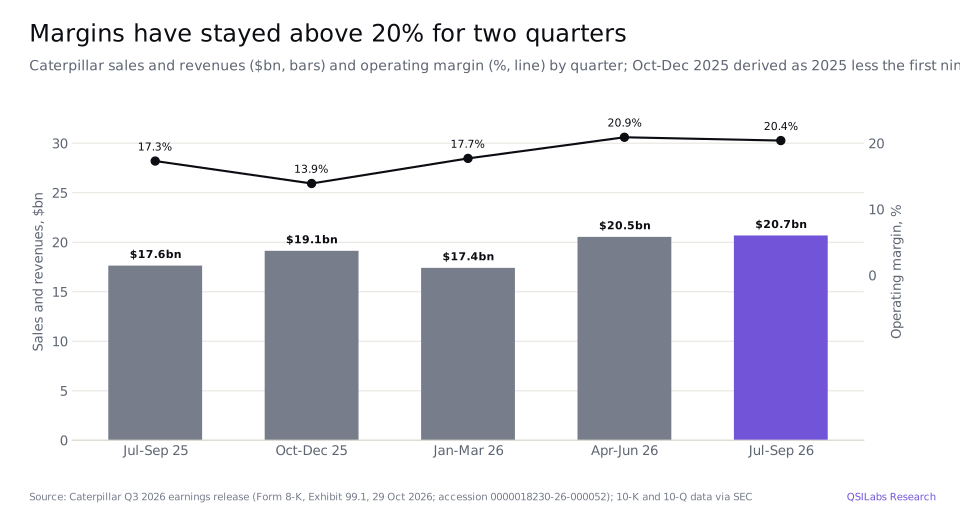
Over the past five quarters, Caterpillar's sales have moved from $17.6bn to $20.7bn, and its operating margin from 17.3% to 20.4%. The October-December 2025 quarter, derived as full-year 2025 less the first nine months, had a margin of only 13.9%, and the fourth quarter is usually weaker for Construction Industries, so the next quarter matters for the full-year margin.
- 27 Aug 2026Caterpillar, Cat Financial and other group borrowers renew their bank credit lines: a new $3.5bn 364-day facility and extended $3.0bn three-year and $5.0bn five-year facilities8-K, Aug 2026
- 30 Sep 2026Quarter ends; enterprise cash $7.9bn, inventories $22.2bn and customer advances $5.3bn8-K Ex 99.1
- 15 Oct 2026Caterpillar announces that Derrick York will succeed Denise Johnson as group president of Resource Industries from 1 November8-K, 15 Oct 2026
- 26 Oct 2026Shares go ex-dividend for the $1.63 quarterly dividend, up from $1.51Yahoo Finance
- 29 Oct 2026Q3 2026 results: sales up 17%, adjusted EPS $7.20, backlog $78bn; CAT closes at $647.39, down 9.2% on the day8-K Ex 99.1; earnings call; Yahoo Finance
- 30 Oct 2026CAT closes at $622.75, the price used in this articleYahoo Finance
- 2 Nov 2026CAT closes at $613.62Yahoo Finance
How did each Caterpillar segment do in Q3 2026?
All three Caterpillar machinery segments grew sales in Q3 2026, by between 15% and 18%, and all three grew profit. Power & Energy is now the largest segment by sales and profit. Financial Products, which includes Cat Financial, grew revenues 9%.
Power & Energy
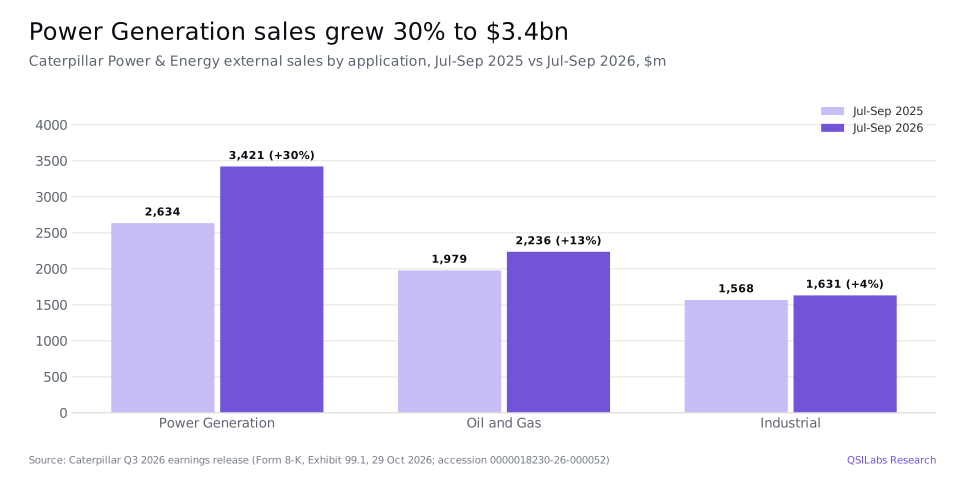
Power & Energy sales rose 18% to $8,784m, from higher sales volume of $879m and price realization of $216m. Segment profit rose 31% to $2,143m and the margin to 24.4% from 21.9%. Price gains were mostly offset by higher manufacturing costs, including depreciation and other spending on new capacity, freight and materials, so the margin gain came mainly from volume. Power Generation sales rose 30% to $3,421m, mainly from turbines, turbine-related services and large reciprocating engines for data centres. Oil and Gas rose 13% to $2,236m on aftermarket parts, gas compression engines and turbines, and Industrial rose 4% to $1,631m (earnings release).
Construction Industries
Construction Industries sales rose 18% to $7,983m, from volume of $874m and price realization of $349m. North America rose 23% to $4,796m, Latin America 26% to $825m and EAME 12% to $1,366m, while Asia/Pacific rose 2% to $925m. Segment profit rose 33% to $1,831m and the margin to 22.9% from 20.4%: volume added $356m and price $349m, offset by $252m of higher manufacturing costs, including freight and tariffs. Dealers added $300m of inventory in the quarter, against $600m a year earlier. Sales to end users grew 20% worldwide and 27% in North America, helped by dealers loading rental fleets, including for Major Projects, a new joint venture of Cat dealers that rents large equipment for infrastructure, energy, manufacturing and data centre projects (earnings call).
Resource Industries
Resource Industries sales rose 15% to $4,615m, from volume of $478m and price realization of $96m. Mining, heavy construction and quarry and aggregates sales rose 22% to $3,697m, mainly because dealers added inventory, while Rail fell 5% to $832m on fewer international locomotive deliveries. Segment profit rose 14% to $622m, but the margin was 13.5% against 13.6%, because higher material costs, including tariffs, cost $208m. Sales to end users rose only 4%, below Caterpillar's own expectations, because of shipping and commissioning delays at mines, which the company expects to catch up in the fourth quarter. From 1 November 2026, Derrick York succeeds Denise Johnson as group president of the segment (8-K, 15 October 2026).
Financial Products
Financial Products revenues rose 9% to $1,177m on higher average earning assets, and segment profit rose 10% to $264m, despite a $34m higher provision for credit losses at Cat Financial. Past dues were 1.31%, against 1.47% a year earlier, which the company said was the lowest level it has recorded since 1998. The allowance for credit losses was $332m, or 0.91% of finance receivables.
Why is Caterpillar's power generation business growing so fast?
Caterpillar's power generation business is growing because data centres need electricity faster than grids can supply it. Caterpillar sells reciprocating engine generator sets, used for backup power and more and more for prime power, and Solar Turbines gas turbines. Power Generation sales to end users rose 75% in the third quarter, after 72% in the second quarter, 48% in the first quarter and 44% in the fourth quarter of 2025, "driven by continued very strong demand for turbines and large reciprocating engines used in data center applications", chief executive Joe Creed said (earnings call; retail sales statistics).
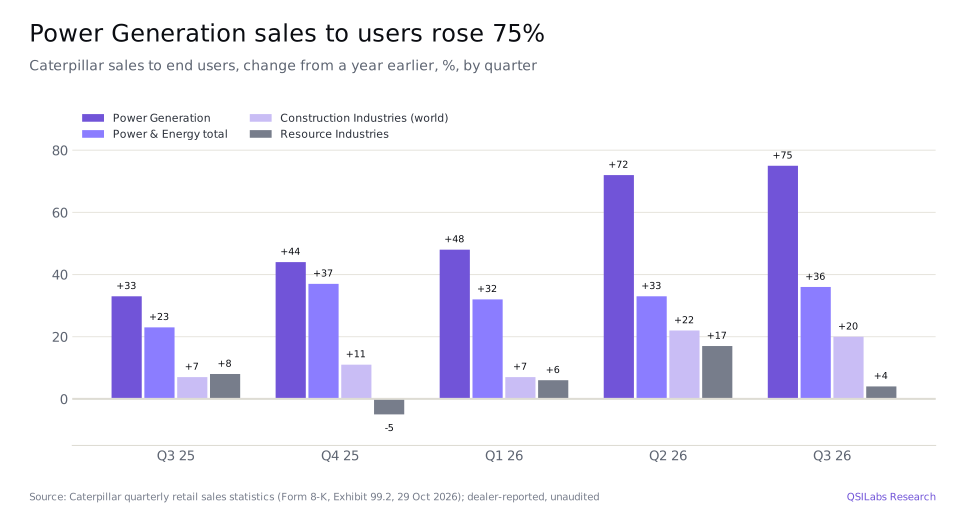
Sales to users are measured at dealers and are a guide to demand, not reported revenue. Caterpillar's reported Power Generation sales grew less, 30%, because output is limited by capacity. Mr Creed said new capacity is "still the top pacing factor for growth in Power & Energy". Caterpillar plans to raise large reciprocating engine capacity to nearly three times its 2024 level by 2030, and will use part of its Winston-Salem, North Carolina locomotive engine plant as a second assembly and test site for the 3600 Series engine, which it aims at gas compression for oil and gas customers.
Orders are running well ahead of output. Backlog rose to $78bn at the end of September, up about $38bn or 96% in a year, and grew from the previous quarter in all three machinery segments for the fourth quarter in a row. Some large reciprocating engine orders now run to 2029 and turbine orders to 2030. Asked whether 2028 was sold out, Mr Creed said "we are not completely full", but that frame agreements convert into orders over time and customers "still want more from us if we can get them more power" (earnings call).
The backlog gives Caterpillar unusual visibility for a cyclical company: $78bn is close to the $79.5bn of sales analysts expect for all of 2026. But it also shows where the risk lies. Much of the growth in Power & Energy depends on spending on data centres for cloud computing and generative AI. If that spending slows, orders could be cancelled or delayed, although Caterpillar has not reported that.
What is Caterpillar's guidance for 2026?
Caterpillar kept its 2026 guidance on 29 October. It expects sales and revenues to grow in the mid to high teens for the year, against $67.6bn in 2025, and an adjusted operating margin higher than in 2025, but, excluding IEEPA tariff recoveries, near the bottom of its target range. It expects MP&E free cash flow in the top half of its $6-15bn annual target range (earnings call).
For the fourth quarter, Caterpillar expects:
- Sales: moderate growth from a year earlier, against a strong fourth quarter of 2025. Power & Energy should grow moderately, Construction Industries should be similar to a year earlier and Resource Industries should grow strongly.
- Dealer inventory: a seasonal reduction in Construction Industries of about $1.6bn, against $600m a year earlier, a headwind of about $1bn to sales volume. Caterpillar expects dealer inventories to end the year higher than a year earlier, ahead of strong sales to users in 2027.
- Margin: a higher adjusted operating margin than a year earlier, with Construction Industries stepping down from the third quarter by a little more than usual because of lower volume, higher technology spending and freight.
- Tariffs: about $2.2bn of tariff costs for 2026, excluding about $520m of IEEPA recoveries so far this year; the outlook assumes no further recoveries in the fourth quarter.
- Other items: restructuring costs of about $300m for the year, an estimated annual tax rate of about 23% excluding discrete items, and capital spending of about $3.3bn, down from about $3.5bn expected earlier.
Analysts' numbers are consistent with that. The S&P Global consensus has 2026 sales and revenues of $79.5bn, up 17.6%, which implies $20.9bn in the fourth quarter, up 9% from $19.1bn, and 2026 EPS of $27.50. For 2027 it expects $88.3bn of sales, up 11.1%, and EPS of $32.22 (StockAnalysis).
Caterpillar cash flow, buybacks and balance sheet in Q3 2026
Cash flow and shareholder returns
Caterpillar generated $4.4bn of enterprise operating cash flow in the third quarter, and MP&E free cash flow, its measure for the machinery business after capital spending, was $3.8bn, up about $600m on a year earlier. Capital spending was about $700m. In the first nine months, MP&E operating cash flow was $11.5bn and capital spending, excluding equipment leased to others, $2.0bn.
Growth is tying up working capital. In nine months, inventories rose $4.1bn to $22.2bn and trade receivables $2.5bn to $13.4bn, but customer advances rose $2.0bn to $5.3bn and accounts payable $1.6bn to $10.6bn.
Caterpillar returns most of its machinery cash to shareholders. In the quarter it bought back $1.2bn of shares and paid $0.7bn of dividends; in nine months it bought back $7.7bn and paid $2.1bn. The quarterly dividend is $1.63 a share, up from $1.51, or $6.52 a year, a 1.0% yield at $622.75. It went ex-dividend on 26 October 2026. Caterpillar says 2026 will be its 33rd consecutive year of higher annual dividends.
Balance sheet and Cat Financial
At 30 September 2026 Caterpillar had $7.9bn of enterprise cash and $1.6bn of longer-dated marketable securities. Machinery, Power & Energy debt was $10.65bn against machinery cash of about $7.1bn, so the machinery business had net debt of about $3.5bn, small against nine-month operating profit of $11.6bn. Financial Products had $34.6bn of debt, which funds Cat Financial's $25.5bn of finance receivables and leased equipment. Shareholders' equity was $21.5bn, low relative to profit after treasury stock purchases that total $56.7bn at cost. In August, Caterpillar, Cat Financial and other group borrowers renewed $11.5bn of bank credit lines (8-K, August 2026).
Caterpillar stock Q3 2026: is CAT overvalued?
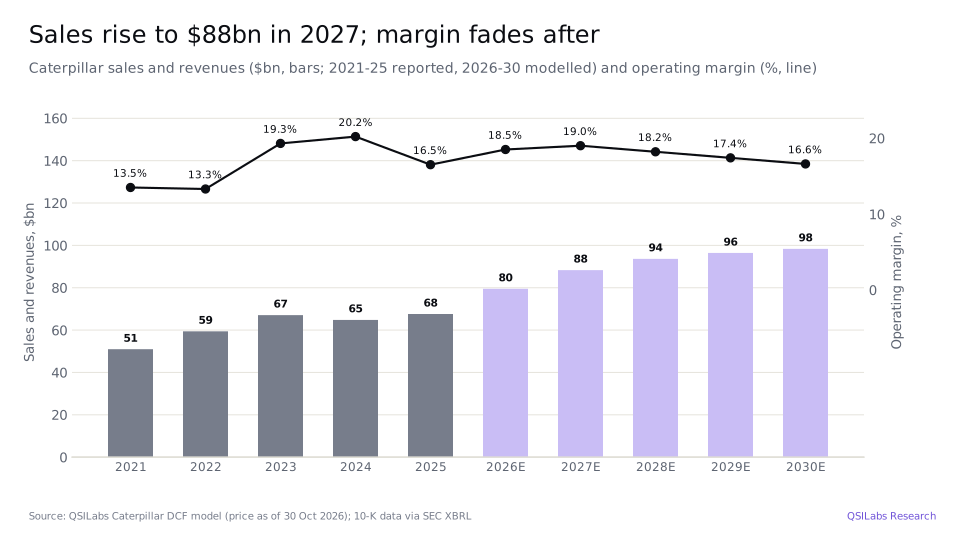
On our numbers, yes. We value Caterpillar at $319.71 a share, against a $622.75 close on 30 October 2026: the price is 95% above our value. At $622.75 Caterpillar's market value is about $287bn, or about 22.6 times consensus 2026 EPS of $27.50 and 19.3 times 2027 EPS of $32.22, and its enterprise value is about 17 times our 2027 operating profit estimate of $16.8bn.
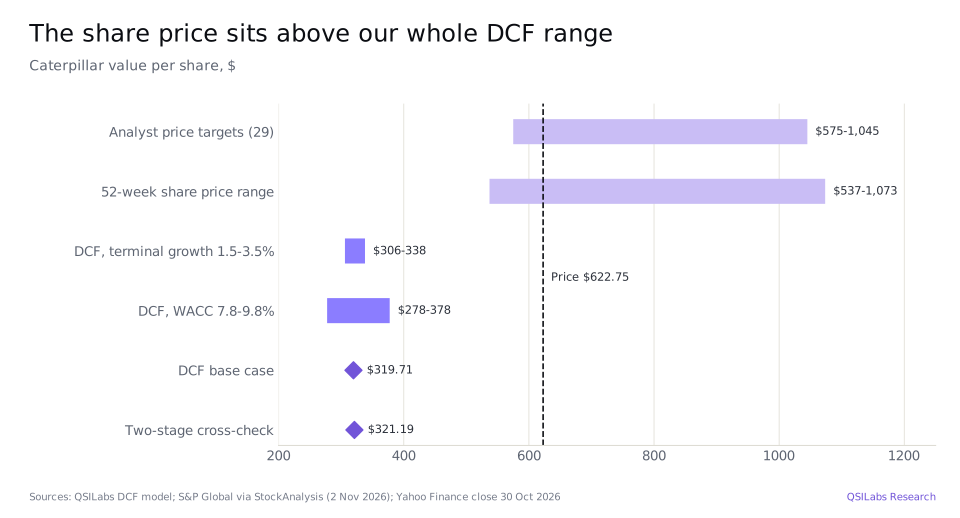
The gap is not about the quarter, which was strong. It is about how long the current boom lasts. Caterpillar's operating margin was 13.5% in 2021, 13.3% in 2022, 19.3% in 2023, 20.2% in 2024 and 16.5% in 2025, and averaged 15.6% from 2019 to 2025 (SEC XBRL data). Our model takes margins to 19.0% in 2027, then fades them back to about 15.1% by 2032, close to that average, because Caterpillar's markets have always been cyclical. The market price assumes a much longer period of high margins and growth. For the price to be right with our forecast, investors would need to accept a cost of capital of about 5.7%, against our 8.83%, or expect cash flow to grow by more than 7% a year forever.
Analysts are much more positive. The 29 analysts in the S&P Global consensus rate CAT a Buy, with 15 Strong Buy, 2 Buy, 11 Hold and 1 Strong Sell ratings, and an average price target of $838.38, a median of $827.50 and a range of $575 to $1,045. Several cut their targets after the results, including J.P. Morgan from $1,100 to $1,000, Citi from $950 to $800, Wells Fargo from $840 to $805 and D.A. Davidson from $882 to $685 (StockAnalysis).
Method
We forecast Caterpillar's sales, operating margin, tax, capital spending and working capital for 2026 to 2035, discount the unlevered free cash flow at an 8.83% weighted average cost of capital and add a terminal value with 2.5% growth. The cost of capital is Aswath Damodaran's January 2026 figure for the US machinery industry, with a 5.12% risk-free rate; a bottom-up check with Caterpillar's own beta gives 9.94%. The terminal value is 53.9% of the enterprise value of $152.5bn.
Because Cat Financial borrows to lend to customers, we treat its debt as part of its business: its profit after interest is already in operating profit, so we leave out its debt and cash. We add machinery cash of $7.1bn and subtract $10.65bn of machinery debt and $1.73bn for the pension and other post-retirement benefit deficit after tax. We then add $0.14bn for the month between 30 September and the 30 October valuation date: a month of free cash flow less the $0.75bn dividend that went ex on 26 October and a month of interest. That gives equity value of $147.4bn, or $319.71 across 460.9m diluted shares. A two-stage cross-check, in which returns on new investment fade over ten years, gives $321.19.
The main forecast inputs are:
- 2026 sales: $79.5bn, up 17.6%, the S&P Global consensus and inside the mid to high teens guidance; that implies $20.9bn in the fourth quarter.
- 2026 operating profit: $14.7bn, an 18.5% margin, made up of $11.6bn reported in nine months and our estimate of $3.1bn in the fourth quarter, a 15.0% margin against 13.9% a year earlier, as guided.
- 2027: sales of $88.3bn, up 11.1%, in line with consensus, and an operating margin of 19.0%.
- After 2027: sales growth of 6.0% in 2028, 3.0% in 2029 and 2.0% in 2030, then about 3% a year to $114.0bn in 2035; operating margin fades from 18.2% in 2028 to about 15.1% from 2032.
- Tax: 23%, the company's estimate of its 2026 rate.
- Capital spending: $3.3bn in 2026, the company's guide, and $3.3bn in 2027, rising to about 4.7% of sales by 2035 so that terminal growth is paid for by reinvestment.
- Working capital: about 15 cents of extra working capital for each extra dollar of sales.
How the number moves if you argue with us
| Value per share, $ | g = 1.5% | g = 2.0% | g = 2.5% | g = 3.0% | g = 3.5% |
|---|---|---|---|---|---|
| WACC 7.83% | 354.68 | 365.20 | 377.60 | 392.47 | 410.66 |
| WACC 8.33% | 328.59 | 336.73 | 346.18 | 357.32 | 370.66 |
| WACC 8.83% | 306.09 | 312.44 | 319.71 | 328.17 | 338.12 |
| WACC 9.33% | 286.49 | 291.47 | 297.12 | 303.60 | 311.11 |
| WACC 9.83% | 269.27 | 273.20 | 277.61 | 282.61 | 288.33 |
Source: QSILabs Caterpillar DCF model. Even a 7.83% cost of capital with 3.5% growth forever gives $410.66, still 34% below the share price. The biggest single question is the margin: if Caterpillar kept a 19% operating margin from 2028 onwards instead of fading to about 15%, with everything else unchanged, our value would be about $390 a share, roughly a fifth higher and still well below the price.
Risks to the Caterpillar investment case
The risks cut both ways. On the upside for the shares:
- A longer power cycle. If data centre and prime power demand keeps growing into the 2030s, and Caterpillar fills its new engine and turbine capacity at today's prices, Power & Energy margins of about 24% could hold for years and lift the group margin above our forecast.
- A $78bn backlog. Orders already cover about a year of sales, which makes a sharp fall in revenue in 2027 less likely.
- Construction and mining. North American construction is strong, Caterpillar says mining demand is supported by copper and gold, and it expects strong sales to users in 2027.
On the downside:
- Cyclicality. Caterpillar's margin fell from 20.2% in 2024 to 16.5% in 2025. Construction and mining demand has fallen sharply before, and dealers can cut inventories quickly, as the $1.6bn reduction expected in the fourth quarter shows.
- Data centre spending. Power Generation is the fastest-growing business, and its growth depends on the pace of data centre construction.
- Costs. Tariffs cost about $2.2bn in 2026, and capacity expansion, freight and material costs are offsetting much of the benefit of higher prices.
- Valuation. At about 23 times 2026 earnings for a cyclical company, the shares need the boom to last; they fell 9.2% on a quarter that was in line with the company's own expectations.
FAQ
What is QSILabs' value for Caterpillar stock after Q3 2026 earnings?
QSILabs values Caterpillar Inc. (CAT) at $319.71 per share as of results for the quarter ended 30 September 2026, based on a discounted cash flow model with an 8.83% cost of capital and 2.5% terminal growth. The shares closed at $622.75 on 30 October 2026, about 95% above that value. Our sensitivity range is roughly $278-378 a share.
Is Caterpillar stock a buy after its Q3 2026 results?
On our valuation, Caterpillar stock is expensive: the $622.75 price sits above our whole DCF range of about $278-378. The 29 analysts in the S&P Global consensus disagree, rating CAT a Buy with an average target of $838.38. This is analysis, not investment advice.
How much did Caterpillar earn in Q3 2026?
Caterpillar earned $3.29bn, or $7.13 a diluted share, in the quarter ended 30 September 2026, against $2.30bn, or $4.88, a year earlier. Adjusted profit per share was $7.20, up 45%. Sales and revenues were $20.7bn, up 17%, and operating profit was $4.2bn, up 38%.
How big is Caterpillar's backlog?
Caterpillar's backlog was $78bn at 30 September 2026, up about $38bn, or 96%, from a year earlier. It grew from the previous quarter in all three machinery segments for the fourth quarter in a row, and some large engine and turbine orders run into 2029 and 2030.
What happened to Caterpillar shares after the Q3 2026 results?
Caterpillar shares fell 9.2% on 29 October 2026, to $647.39, and closed at $622.75 the next day. The company did not change its 2026 outlook. The call flagged a $1.6bn fourth-quarter dealer inventory reduction in Construction Industries, an adjusted margin near the bottom of the target range excluding tariff recoveries, and rising costs from capacity expansion, and several analysts cut their price targets.
How much of Caterpillar's sales come from power generation?
Power Generation sales were $3.4bn in Q3 2026, up 30%: about 47% of Power & Energy's external sales and about 17% of Caterpillar's machinery sales. Power & Energy as a whole had sales of $8.8bn and profit of $2.1bn, the largest of Caterpillar's segments.
What does Caterpillar expect for the fourth quarter of 2026?
Caterpillar expects moderate sales growth in the fourth quarter of 2026 from a year earlier, a higher adjusted operating margin than a year earlier, and a dealer inventory reduction in Construction Industries of about $1.6bn, against $600m in the fourth quarter of 2025. Construction Industries sales should be similar to a year earlier and Resource Industries sales should grow strongly.
What is Caterpillar's dividend yield?
Caterpillar pays a quarterly dividend of $1.63 a share, or $6.52 a year, a yield of about 1.0% at the 30 October 2026 price of $622.75. The dividend rose from $1.51, and Caterpillar says 2026 is its 33rd consecutive year of higher annual dividends.
Sources
- Caterpillar Inc., Q3 2026 earnings release (Form 8-K, Exhibit 99.1, 29 Oct 2026; accession 0000018230-26-000052) www.sec.gov
- Caterpillar Inc., quarterly retail sales statistics (Form 8-K, Exhibit 99.2, 29 Oct 2026; accession 0000018230-26-000052) www.sec.gov
- Caterpillar Inc., Q3 2026 earnings call, 29 Oct 2026 (transcript via StockAnalysis)
- Caterpillar Inc., Form 8-K on Resource Industries leadership (15 Oct 2026; accession 0001104659-26-116198) www.sec.gov
- Caterpillar Inc., Form 8-K on credit facilities (August 2026; accession 0001104659-26-104197) www.sec.gov
- SEC EDGAR XBRL company facts for Caterpillar Inc. (CIK 18230): 10-K sales and revenues, operating profit and EPS, 2019-2025, and 2026 10-Q quarters data.sec.gov
- StockAnalysis: Caterpillar forecast and analyst ratings, S&P Global data (accessed 2 Nov 2026) stockanalysis.com
- Yahoo Finance chart data: CAT closing prices and dividends (November 2025 to November 2026) query1.finance.yahoo.com
- Damodaran Online: cost of capital by industry (Machinery) pages.stern.nyu.edu
- QSILabs Caterpillar discounted cash flow model (internal; price as of 30 Oct 2026)
Disclaimer
This article is for information only and is not investment advice or a recommendation to buy or sell any security. QSILabs estimates are opinions based on public information and our own model, and they may be wrong. Figures are as of the dates stated. Do your own research or consult a licensed adviser before investing.
More from QSI Labs
Related analysis: Chevron stock Q3 2026: refining and Venezuela, ExxonMobil stock Q3 2026, Oracle stock Q3 2026: cloud infrastructure and capex and Home Depot stock Q3 2026.
Read our white paper, QSI Labs: An AI-Native Trading Firm Built on a Training Loop (October 2026), available on request, or browse the research index.