Research / Earnings and valuation
Home Depot Stock Q3 2026:Sales Up 5.7% to $47.9bn as SRS Pro Distribution Grows
As of: Figures are as of Home Depot's fiscal second-quarter 2026 results (13 weeks ended 2 August 2026, reported 18 August 2026 in a Form 8-K) and its Form 10-Q for that quarter (filed 25 August 2026), updated for the company's August 2026 leadership filings. Home Depot's fiscal year ends on the Sunday nearest 31 January, so fiscal 2026 runs to 31 January 2027; its fiscal third quarter ended on 1 November 2026 and had not been reported at publication, so fiscal Q2 is the latest quarter in our Q3 2026 earnings coverage. The share price is the NYSE close of HD on 30 October 2026, $329.20. Published 2 November 2026.
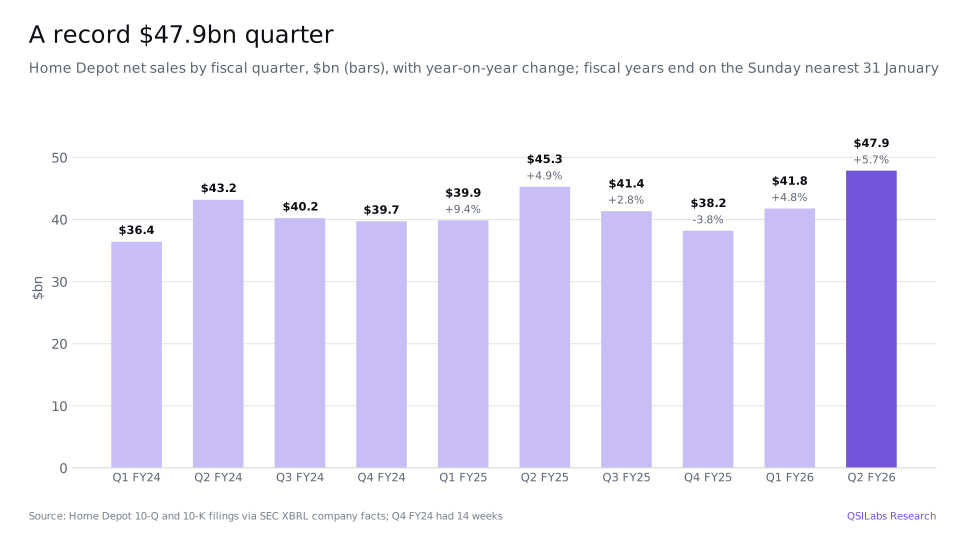
The short answer. Home Depot stock Q3 2026 coverage means Home Depot's latest reported quarter, fiscal Q2 2026, the 13 weeks to 2 August 2026. Net sales rose 5.7% to a record $47.9bn, but most of the growth was bought: the GMS and Mingledorff's acquisitions lifted the SRS distribution business by 62%, while comparable sales, the like-for-like measure, rose only 1.7% as shoppers made fewer trips and spent more per visit. GAAP operating margin slipped to 14.3% even with about $685m of tariff refunds, and management reaffirmed fiscal 2026 guidance for sales growth of 2.5% to 4.5%. Our discounted cash flow model puts Home Depot at $151.01 a share, against a $329.20 close on 30 October 2026. The business is steady and highly profitable; the question is how much growth and how low a cost of capital the share price already assumes.
Key takeaways
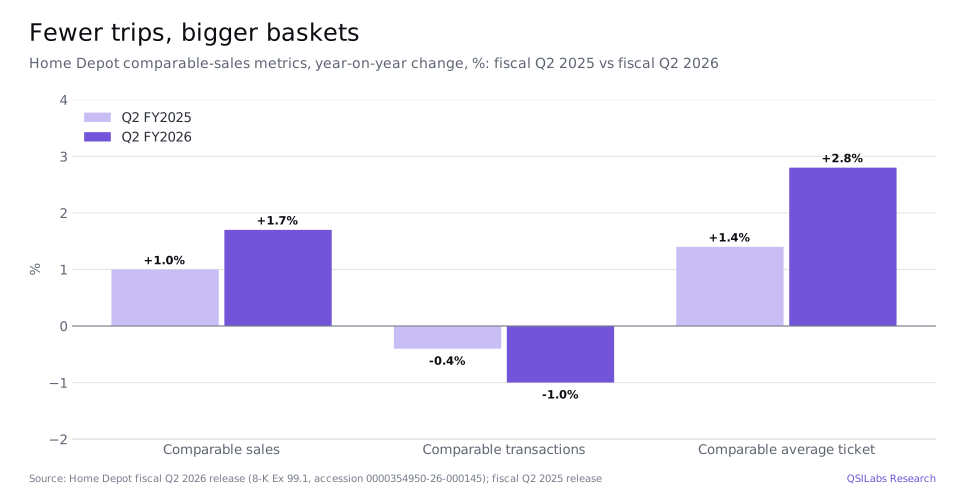
- Record sales, slow comps. Fiscal Q2 2026 net sales were $47,861m, up 5.7% from $45,277m. Comparable sales rose 1.7% (1.3% in the US), with comparable transactions down 1.0% and average ticket up 2.8% to $92.50.
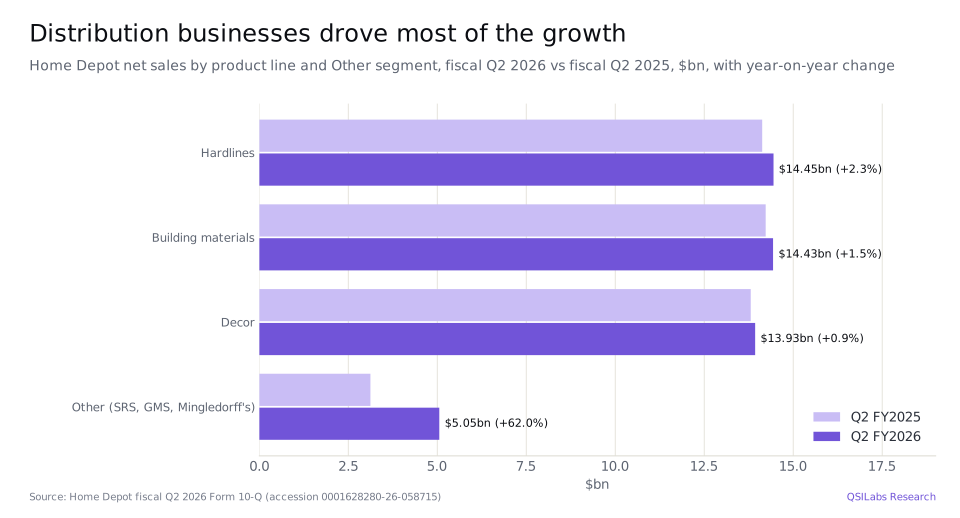
- Distribution did the heavy lifting. Other net sales, the SRS businesses including GMS and Mingledorff's, rose 62% to $5,055m. GMS alone added $1.4bn of sales in the quarter. The store-based Primary segment grew 1.5% to $42,806m.
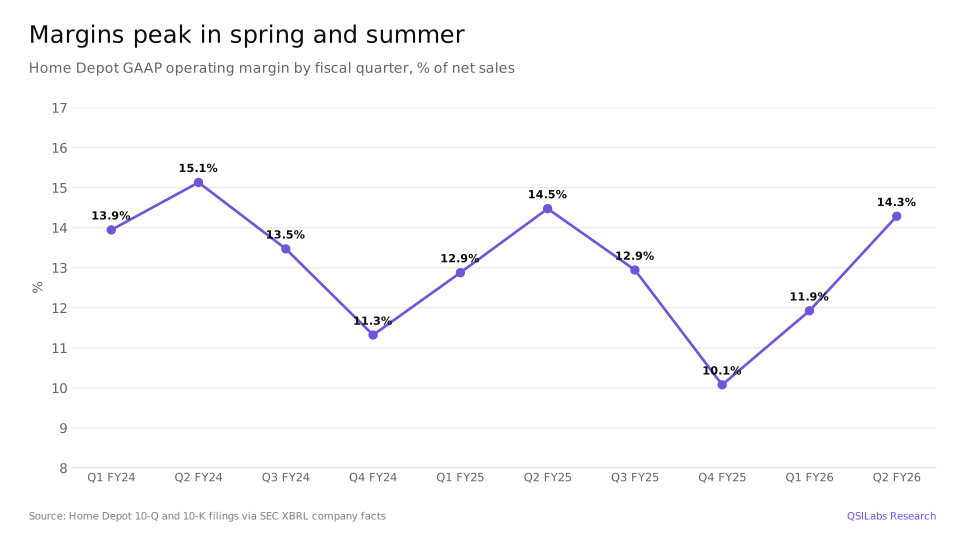
- Margins edged down. GAAP operating income rose 4.3% to $6,839m, a 14.3% margin against 14.5%. Adjusted operating margin was 14.7% against 14.8%. About $685m of IEEPA tariff refunds lowered cost of goods sold, offset by fuel, energy and input costs and lower-margin GMS sales.
- EPS up 4.6%. Diluted EPS was $4.79, up from $4.58; adjusted EPS was $4.92, up from $4.68.
- Guidance reaffirmed. For fiscal 2026 (the year to 31 January 2027) Home Depot expects sales growth of 2.5% to 4.5%, comparable sales flat to up 2%, an operating margin of 12.4% to 12.6% and diluted EPS flat to up 4% from $14.23.
- Cash goes to dividends and debt. First-half free cash flow was $9.7bn. Home Depot paid $4.6bn of dividends, repaid $3.0bn of long-term debt and has no plans to resume buybacks in fiscal 2026.
- Our value: $151.01 a share, about 54% below the $329.20 close on 30 October 2026, as of 2 November 2026. A two-stage cross-check gives $155.78; analysts' average price target is $379.
Key numbers from Home Depot's Q3 2026 earnings
| Metric | Fiscal Q2 2026 | Fiscal Q2 2025 | Change |
|---|---|---|---|
| Net sales | $47,861m | $45,277m | +5.7% |
| Comparable sales | +1.7% | +1.0% | +0.7pt |
| Primary segment net sales | $42,806m | $42,157m | +1.5% |
| Other (SRS) net sales | $5,055m | $3,120m | +62.0% |
| Gross margin | 33.7% | 33.4% | +0.3pt |
| GAAP operating income | $6,839m | $6,555m | +4.3% |
| GAAP operating margin | 14.3% | 14.5% | -0.2pt |
| Net earnings | $4,766m | $4,551m | +4.7% |
| Diluted EPS | $4.79 | $4.58 | +4.6% |
| Adjusted diluted EPS | $4.92 | $4.68 | +5.1% |
What did Home Depot report in its Q3 2026 earnings season?
Home Depot reported its fiscal second quarter of 2026 on 18 August 2026. Because its fiscal year ends on the Sunday nearest 31 January, that quarter covers May, June and July 2026, the peak spring and summer selling season, and it is the most recent quarter the company had reported when we published on 2 November 2026. Fiscal Q3 2026 ended on 1 November 2026 and has not yet been reported.
The headline numbers were solid. Net sales of $47.9bn were the highest of any quarter in the company's history, up 5.7% from $45.3bn. Gross profit rose 6.5% to $16.1bn. Selling, general and administrative costs rose faster, by 8.5% to $8.4bn, as acquired businesses with their own branch networks came into the cost base. Operating income rose 4.3% to $6.8bn and net earnings rose 4.7% to $4.8bn, or $4.79 a diluted share. Excluding the amortisation of acquired intangibles, adjusted EPS was $4.92.
Over the first half of fiscal 2026, net sales rose 5.3% to $89.6bn, operating income rose 1.1% to $11.8bn, a 13.2% margin, and diluted EPS rose 0.7% to $8.09. "Our second quarter results exceeded our expectations," chief financial officer Richard McPhail said in the release, pointing to "broad based demand across the business as customers continued to engage in smaller projects."
- 1 Feb 2026Fiscal 2025 ends: net sales $164.7bn, operating income $20.9bn, diluted EPS $14.23Form 10-K (SEC XBRL)
- 11 May 2026SRS completes the acquisition of HVAC distributor Mingledorff's for about $1.1bn in cashForm 10-Q
- 2 Aug 2026Fiscal Q2 2026 ends; about $730m of IEEPA tariff refunds received to dateForm 10-Q
- 12 Aug 2026CEO Ted Decker takes temporary medical leave; Ann-Marie Campbell and Richard McPhail oversee the office of the CEOForm 8-K
- 18 Aug 2026Fiscal Q2 results: sales $47.9bn (+5.7%), comparable sales +1.7%, diluted EPS $4.79; fiscal 2026 guidance reaffirmed8-K Ex 99.1
- 20 Aug 2026Expanded executive portfolios; $500,000 restricted stock grants to three executivesForm 8-K
- 3 Sep 2026Shares go ex-dividend for the $2.33 quarterly dividendYahoo Finance
- 30 Oct 2026HD closes at $329.20 on the NYSE, the price used in our valuationYahoo Finance
- 1 Nov 2026Fiscal Q3 2026 ends (13 weeks); results not yet reported at publicationForm 10-Q fiscal calendar
Why are Home Depot's comparable sales growing so slowly?
Comparable sales measure sales at stores and businesses open for more than a year, so they strip out acquisitions and new stores. In fiscal Q2 2026 they rose 1.7%, after 1.0% a year earlier; for the first half they rose 1.2%. Foreign exchange added about 25 basis points to the quarter.
The make-up of that growth matters. Comparable customer transactions fell 1.0%, to 443.2 million in the quarter, while the comparable average ticket rose 2.8% to $92.50. Customers are visiting a little less often and spending more each time, partly because prices are higher. Home Depot's 10-Q describes "customer engagement with smaller repair and maintenance projects, despite the impact of consumer uncertainty and housing affordability pressure on home improvement demand."
That is the core of the story. Large discretionary projects such as kitchen and bath remodels tend to follow home sales and home equity borrowing, and both have been held back by high mortgage rates. Home Depot's comparable sales fell in both fiscal 2023 and fiscal 2024, and the modest recovery since has come from repair, maintenance and smaller jobs rather than a return of big-ticket remodelling.
Online sales were a bright spot. They rose 11.0% and made up 16.6% of net sales in the quarter.
How big is Home Depot's Pro distribution business now?
Home Depot has spent heavily to reach the professional contractor beyond its stores. It bought SRS Distribution, a roofing, landscaping and pool supply distributor, in June 2024, then GMS, a distributor of wallboard, ceilings and other interior building products, on 4 September 2025, and finally Mingledorff's, a heating, ventilation and air conditioning (HVAC) distributor in the southeastern US, on 11 May 2026 for about $1.1bn in cash. SRS now has five lines of business: roofing and building products, interior and construction products, landscape, pool and HVAC.
These businesses are reported as "Other" and they now matter. Other net sales rose 62% to $5,055m in fiscal Q2 2026, about 11% of the total. GMS contributed $1.4bn of incremental sales in the quarter and $2.8bn in the first half. Roofing fell from about 62% of Other sales to about 39%, which shows how much the mix has broadened. By contrast, the store-based Primary segment, which sells building materials, decor and hardlines, grew 1.5% to $42,806m.
The distribution businesses earn lower margins than the stores. Other operating income was $247m in the quarter, a 4.9% margin, against 15.4% in the Primary segment, and the Other figure is after $236m of depreciation and amortisation. Over the first half, Other earned $263m on $9.1bn of sales. Home Depot is betting that cross-selling to contractors, a broader product range and better delivery will lift both sales and returns over time, but for now the acquisitions add revenue faster than they add profit.
What is happening to Home Depot's margins?
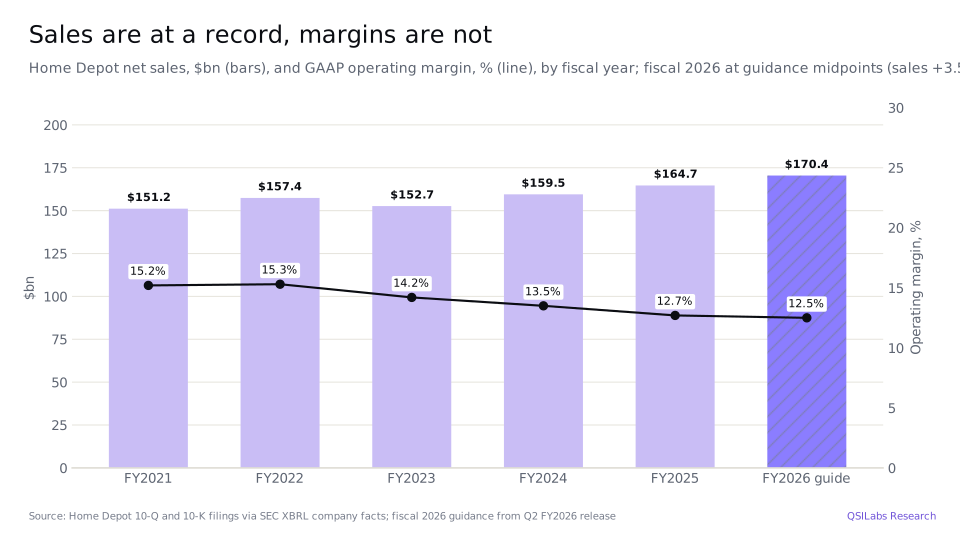
Home Depot's operating margin has fallen for four years in a row: from 15.3% in fiscal 2022 to 14.2% in fiscal 2023, 13.5% in fiscal 2024 and 12.7% in fiscal 2025. Guidance points to 12.4% to 12.6% in fiscal 2026. The causes are flat like-for-like sales against rising wage, occupancy and technology costs, the lower-margin distribution acquisitions, and the amortisation of the intangible assets that came with them.
Fiscal Q2 2026 had an unusual helper. After the US Supreme Court invalidated tariffs imposed under the International Emergency Economic Powers Act (IEEPA), Home Depot began receiving refunds. By 2 August 2026 it had received about $730m, which it describes as the vast majority of what it expects. About $685m was recorded as a reduction in cost of goods sold, nearly all in the Primary segment, and the rest reduced inventory cost. The company also earned interest on the refunds.
Even so, gross margin rose only 0.3 points to 33.7%, because the refunds were "largely offset by incremental cost pressures related to fuel, energy, and other product input costs, as well as the inclusion of GMS." The refunds were worth about 1.6% of Primary-segment sales in the quarter. Without them, the Primary segment's operating margin of 15.4% would have been roughly 13.8%, below the 15.1% of a year earlier. For the first half, gross margin fell to 33.4% from 33.6%. Home Depot's guidance includes the refunds, which it expects to partly offset unplanned fuel, energy and other input costs over the year. These refunds are a one-off, so they flatter fiscal 2026 margins rather than raise the long-run level.
What is Home Depot's fiscal 2026 guidance?
Home Depot reaffirmed its fiscal 2026 guidance with the second-quarter results. Fiscal 2026 is the 52-week year ending 31 January 2027. The company expects:
- total sales growth of about 2.5% to 4.5%, and comparable sales flat to up 2%;
- about 15 new stores;
- a gross margin of about 33.1%;
- a GAAP operating margin of about 12.4% to 12.6%, or 12.8% to 13.0% adjusted;
- an effective tax rate of about 24.3% and net interest expense of about $2.3bn;
- diluted EPS flat to up 4% from $14.23, and adjusted EPS flat to up 4% from $14.69;
- capital spending of about 2.5% of sales.
At the midpoint that means sales of about $170.4bn, against $164.7bn in fiscal 2025. Analysts expect a little more: the S&P Global consensus compiled by StockAnalysis is $171.5bn of revenue and EPS of $15.02 for the year, rising to $177.3bn and $15.97 in fiscal 2027.
The first half already delivered EPS of $8.09. The low end of guidance therefore needs second-half EPS of about $6.14, against $6.20 in the second half of fiscal 2025, while the top end needs about $6.71. The second half is seasonally smaller than the first.
How much cash does Home Depot generate, and where does it go?
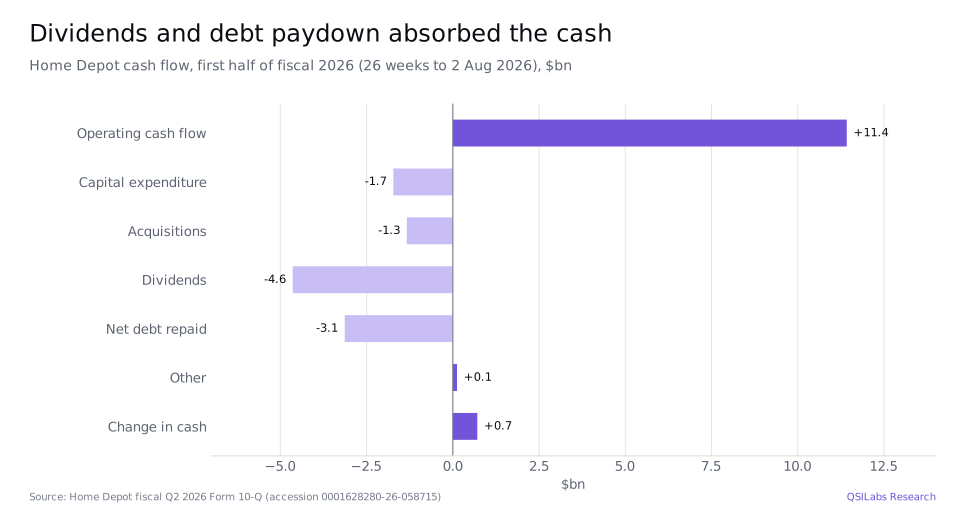
Home Depot is a strong cash generator. In the first half of fiscal 2026 operating cash flow was $11.4bn, up from $9.0bn, and capital spending was $1.7bn, leaving free cash flow of about $9.7bn. In fiscal 2025 free cash flow was $12.6bn: $16.3bn of operating cash flow less $3.7bn of capital spending.
The uses of that cash have changed since the SRS deal. Home Depot paused share buybacks in March 2024 and says it does not plan to resume them in fiscal 2026 as it reduces debt; $11.7bn of its $15bn authorisation remains. In the first half it paid $4.6bn of dividends, spent $1.3bn on acquisitions, mainly Mingledorff's, and repaid $3.0bn of long-term debt.
The quarterly dividend is $2.33 a share, up 1.3% from $2.30, for an annual rate of $9.32 and a yield of about 2.8% at $329.20. The most recent ex-dividend date was 3 September 2026. The dividend takes about half of free cash flow.
Debt remains high after the acquisitions. At 2 August 2026 Home Depot had $52.9bn of debt, including $4.2bn of commercial paper, against $2.1bn of cash, so net debt was about $50.8bn, or about 2.4 times trailing operating income of about $21bn. It has an $11bn commercial paper programme backed by $11bn of credit lines, including a new 364-day $4.5bn facility. Return on invested capital was 24.8% over the trailing twelve months, down from 27.2%, which Home Depot attributes mainly to higher average equity during the buyback pause.
Who is running Home Depot during Ted Decker's medical leave?
On 12 August 2026 Home Depot announced that Ted Decker, its chair, president and chief executive, would take a temporary medical leave. The board, in line with Decker's recommendation, asked two long-serving executives to oversee the office of the CEO: Ann-Marie Campbell, senior executive vice president, oversees day-to-day operations, while Richard McPhail, executive vice president and chief financial officer, oversees financial management and the Pro subsidiaries. McPhail signed the fiscal Q2 10-Q as interim principal executive officer.
On 20 August 2026 the company also described expanded responsibilities for several executives, including merchandising head William Bastek and interconnected retail head Jordan Broggi, and granted Bastek, Broggi and McPhail $500,000 each of restricted stock vesting over two years. No return date for Decker has been announced in the filings we reviewed. The fiscal Q2 results were delivered on plan under the interim arrangement, but a prolonged absence would add uncertainty while the company integrates three large acquisitions.
Home Depot stock Q3 2026: is HD stock overvalued?
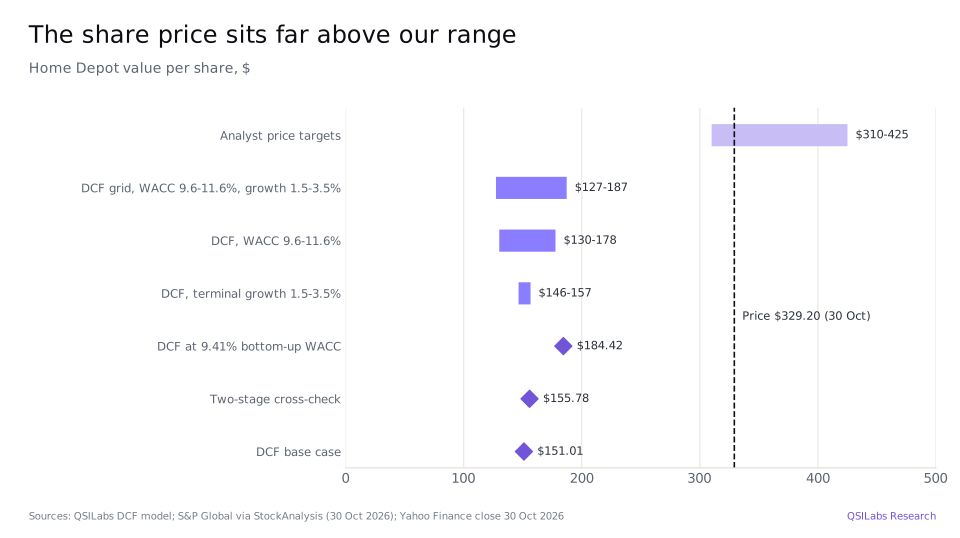
On our numbers, yes, by a wide margin. Our discounted cash flow model values Home Depot at $151.01 a share, against a close of $329.20 on 30 October 2026. That is about 54% below the share price. The stock closed at $341.15 on 2 November 2026. A two-stage cross-check gives $155.78. Analysts are far more positive: analysts tracked by S&P Global have an average price target of $379, with a range of $310 to $425, and their average rating is Buy.
The gap is not about the quality of the business. Home Depot earns a return on invested capital of about 25% and generates more than $12bn of free cash flow a year. It is about price. At $329.20 the shares are valued at about $329bn, plus about $51bn of net debt, and trade at about 22 times analysts' fiscal 2026 EPS estimate of $15.02, with a free cash flow yield of about 5.2% on analysts' fiscal 2026 estimate of $17.0bn, or 3.8% on fiscal 2025's $12.6bn.
Method
We forecast ten fiscal years, fiscal 2026 to fiscal 2035, and value the cash flows after that with a terminal value.
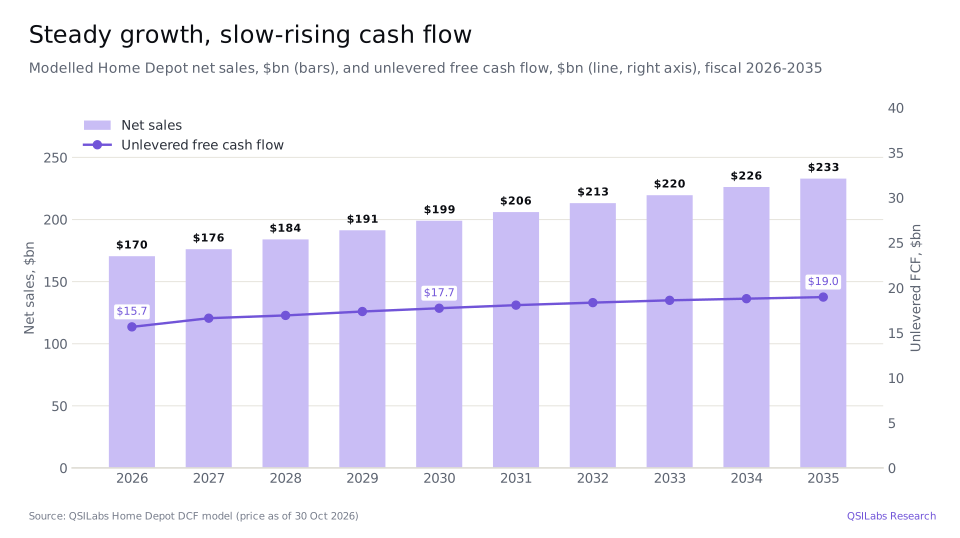
- Sales. Growth of 3.5% in fiscal 2026, the midpoint of guidance, 3.3% in fiscal 2027, in line with consensus, 4.5% in fiscal 2028 on the assumption that housing turnover recovers, 4.0% in fiscal 2029 and 2030, and then 3.5% fading to 3.0%. Sales reach $233bn in fiscal 2035.
- Operating margin. 12.5% in fiscal 2026, in line with guidance, rising to about 12.9% by fiscal 2027 and about 13.0% by the end of the forecast. We do not assume a return to the 15% margins of fiscal 2021 and 2022.
- Tax. 24.3%, in line with guidance.
- Capital spending. About 2.5% of sales in the next two years, rising to about 3.9% of sales by fiscal 2035, closer to the level needed to maintain stores, supply chain and the distribution network over time.
- Cost of capital. A weighted average cost of capital (WACC) of 10.62%. A bottom-up estimate gives 9.41%, which we show as a sensitivity.
- Terminal value. Growth of 2.5% a year after fiscal 2035 with a 15% return on new invested capital. The terminal value is 47.1% of enterprise value.
Unlevered free cash flow is $15.7bn in fiscal 2026 and rises to $19.0bn by fiscal 2035. Discounted, the explicit cash flows are worth $106.1bn and the terminal value $94.4bn, for an enterprise value of $200.5bn. From that we deduct $52.9bn of debt and add $2.1bn of cash and $1.1bn of other adjustments for cash generated since 2 August, net of the September dividend. That leaves $150.8bn of equity, or $151.01 across 998.7 million diluted shares.
How the number moves if you argue with us
The cost of capital matters most. Each half-point of WACC moves the value by about $10 to $14 a share, while terminal growth matters less, because the terminal value is under half of the total.
| WACC / terminal growth | 1.5% | 2.0% | 2.5% | 3.0% | 3.5% |
|---|---|---|---|---|---|
| 9.62% | $170.46 | $173.89 | $177.75 | $182.15 | $187.22 |
| 10.12% | $157.77 | $160.48 | $163.50 | $166.91 | $170.78 |
| 10.62% | $146.49 | $148.64 | $151.01 | $153.65 | $156.63 |
| 11.12% | $136.41 | $138.11 | $139.97 | $142.03 | $144.31 |
| 11.62% | $127.34 | $128.68 | $130.14 | $131.74 | $133.50 |
At the 9.41% bottom-up WACC, the same cash flows give $184.42. To reach the $329.20 share price with our cash flows, the discount rate would have to fall to about 6.7% with 2.5% terminal growth, or about 7.2% with 3.5% growth. Put another way, the market is pricing Home Depot either as a much lower-risk asset than our cost of capital implies, or as a business whose growth and margins will be meaningfully better than our forecast, for example through a housing recovery that lifts comparable sales and margins back toward fiscal 2021 and 2022 levels.
What are the main risks for Home Depot stock?
The risks run in both directions.
- Housing stays frozen. Big projects follow home sales and home equity. If mortgage rates stay high, comparable sales could stay near flat for longer, and our 4.5% growth in fiscal 2028 would be too high.
- A housing recovery. The upside case. Home Depot has the store network, supply chain and Pro distribution to benefit quickly if housing turnover rises; operating leverage on a recovery could lift margins back toward 14% to 15%, which our model does not assume.
- Acquisition integration. SRS, GMS and Mingledorff's have brought more than 1,340 branch locations and a lower-margin, more cyclical business. Integration missteps, or a downturn in new construction, would hit the Other segment first.
- One-off tailwinds. The $730m of IEEPA tariff refunds help fiscal 2026 margins but will not repeat. New tariffs on imported goods could also raise costs again.
- Leadership. The CEO is on medical leave and an interim office of the CEO is in place.
- Balance sheet. Net debt of about $51bn limits flexibility, and buybacks remain paused while Home Depot pays it down.
- Valuation. The share price implies a low cost of capital. If interest rates rise or investors demand a higher return from steady retailers, the valuation is exposed even if results are fine.
FAQ
What is the Home Depot share price compared with the QSILabs DCF value after Q3 2026?
Our discounted cash flow model values Home Depot at $151.01 a share, against a close of $329.20 on 30 October 2026, about 54% lower. The value assumes sales growth of about 3% to 4.5% a year, an operating margin of about 12.5% to 13%, a 10.62% cost of capital and 2.5% terminal growth. Analysts' average price target is $379.
Is Home Depot stock a buy after Q3 2026?
We do not make buy or sell recommendations. On our assumptions the share price is well above the value of Home Depot's expected cash flows, and it would take a cost of capital of about 6.7%, or much faster growth than we forecast, to justify $329.20. Most analysts rate the shares Buy, with an average target of $379.
Why does Q3 2026 for Home Depot mean its fiscal second quarter?
Home Depot's fiscal year ends on the Sunday nearest 31 January, so fiscal 2026 runs from 2 February 2026 to 31 January 2027. Its fiscal second quarter covers the 13 weeks to 2 August 2026 and was reported on 18 August 2026, making it the latest quarter available in our Q3 2026 earnings coverage. Fiscal Q3 ended on 1 November 2026 and had not been reported when we published.
How much revenue did Home Depot make in its latest quarter?
Home Depot's net sales were $47,861m in fiscal Q2 2026, the 13 weeks to 2 August 2026, up 5.7% from $45,277m a year earlier and a quarterly record. Comparable sales rose 1.7%, and the GMS acquisition added $1.4bn of sales.
What does Home Depot expect for fiscal 2026?
Home Depot expects fiscal 2026 sales growth of about 2.5% to 4.5%, comparable sales flat to up 2%, a gross margin of about 33.1%, an operating margin of 12.4% to 12.6% and diluted EPS flat to up 4% from $14.23. It reaffirmed that guidance on 18 August 2026, and it includes the benefit of IEEPA tariff refunds.
What are SRS, GMS and Mingledorff's?
They are Home Depot's specialty trade distribution businesses for professional contractors. SRS Distribution supplies roofing, landscape and pool products; GMS, bought in September 2025, supplies wallboard, ceilings and interior construction products; and Mingledorff's, bought in May 2026 for about $1.1bn, distributes HVAC equipment. Together they had $5,055m of sales in fiscal Q2 2026, up 62%.
How did tariff refunds affect Home Depot's results?
After the US Supreme Court struck down IEEPA tariffs, Home Depot received about $730m of refunds by 2 August 2026. About $685m reduced cost of goods sold in fiscal Q2 2026, but fuel, energy and input costs and lower-margin GMS sales largely offset the benefit, so gross margin rose only 0.3 points to 33.7%.
Does Home Depot pay a dividend?
Yes. Home Depot pays a quarterly dividend of $2.33 a share, up from $2.30, or $9.32 a year, a yield of about 2.8% at the 30 October 2026 price of $329.20. It paid $4.6bn of dividends in the first half of fiscal 2026. Share buybacks have been paused since March 2024.
Is Home Depot buying back shares?
No. Home Depot paused share repurchases in March 2024, when it agreed to buy SRS, and says it does not plan to resume them in fiscal 2026 as it reduces debt. About $11.7bn of its $15bn repurchase authorisation remains available.
Sources
- The Home Depot, Inc., fiscal Q2 2026 earnings release (Form 8-K, Exhibit 99.1, 18 Aug 2026; accession 0000354950-26-000145) www.sec.gov
- The Home Depot, Inc., Form 10-Q for the quarter ended 2 Aug 2026 (filed 25 Aug 2026; accession 0001628280-26-058715) www.sec.gov
- The Home Depot, Inc., Form 8-K on the CEO's temporary medical leave (12 Aug 2026; accession 0000354950-26-000141) www.sec.gov
- The Home Depot, Inc., Form 8-K on executive portfolio expansions and restricted stock grants (21 Aug 2026; accession 0000354950-26-000148) www.sec.gov
- The Home Depot, Inc., Forms 10-K and 10-Q (EDGAR filing index, CIK 354950) www.sec.gov
- SEC XBRL company facts for Home Depot (CIK 354950): quarterly and annual net sales, operating income, EPS and cash flow data.sec.gov
- StockAnalysis: Home Depot forecast and analyst ratings, S&P Global data (last updated 30 Oct 2026; accessed 2 Nov 2026) stockanalysis.com
- Yahoo Finance chart data: HD closing prices and dividend history (one year to 2 Nov 2026) query1.finance.yahoo.com
- Damodaran Online: cost of capital by industry (US), January 2026 pages.stern.nyu.edu
- QSILabs Home Depot discounted cash flow model (internal; price as of 30 Oct 2026)
Disclaimer
This article is for information only and is not investment advice, a recommendation or an offer to buy or sell any security. QSI Labs and its authors may hold positions in the securities discussed. Forecasts and valuations are estimates that depend on assumptions that may prove wrong. Figures are taken from company filings and third-party sources believed to be reliable, but we do not guarantee their accuracy. Do your own research or consult a licensed adviser before investing.
More from QSI Labs
Related analysis: Costco stock Q3 2026: membership fees, Amazon stock Q3 2026, Coca-Cola stock Q3 2026 and JPMorgan stock Q3 2026: net interest income and buybacks.
Read our white paper, QSI Labs: An AI-Native Trading Firm Built on a Training Loop (October 2026), available on request, or browse the research index.