Research / Earnings and valuation
Texas Instruments Stock Q3 2026:Revenue Up 28% to $6.1bn on Industrial and Data Center Demand
As of: Figures are as of Texas Instruments' third-quarter 2026 results (the quarter ended 30 September 2026, reported 21 October 2026 in a Form 8-K) and its Form 10-Q for that quarter, filed 23 October 2026. TI's fiscal year is the calendar year, so its Q3 2026 covers July to September 2026. The share price used in our valuation is the Nasdaq close of TXN on 30 October 2026, $300.84; analyst data were accessed on 2 November 2026. Published 2 November 2026.
The short answer. Texas Instruments stock Q3 2026 rests on a quarter in which the analog chipmaker's recovery turned into strong growth. Revenue for the three months to 30 September 2026 rose 28% to $6.06bn, operating margin reached 47.5% against 35.1% a year earlier, and diluted EPS rose 77% to $2.62. Industrial revenue grew more than 40% and data center revenue about 95%, management said. TI guided fourth-quarter revenue to $5.80bn to $6.30bn, roughly flat on the third quarter. Our discounted cash flow model values TXN at $113.69 a share, against a $300.84 close on 30 October 2026. The business is doing very well; the price assumes it keeps growing faster, and for longer, than we expect from a cyclical chipmaker.
Key takeaways
- Revenue up 28%. Q3 2026 revenue was $6,055m, up from $4,742m a year earlier and 11% above the $5,463m of the June quarter. Analog revenue rose 32% to $4,911m and Embedded Processing 21% to $858m.
- Margins widened sharply. Gross margin was 64.2%, against 57.4% a year earlier and 61.4% in the June quarter. Operating profit rose 73% to $2,874m, a 47.5% margin. Net income rose 78% to $2,425m.
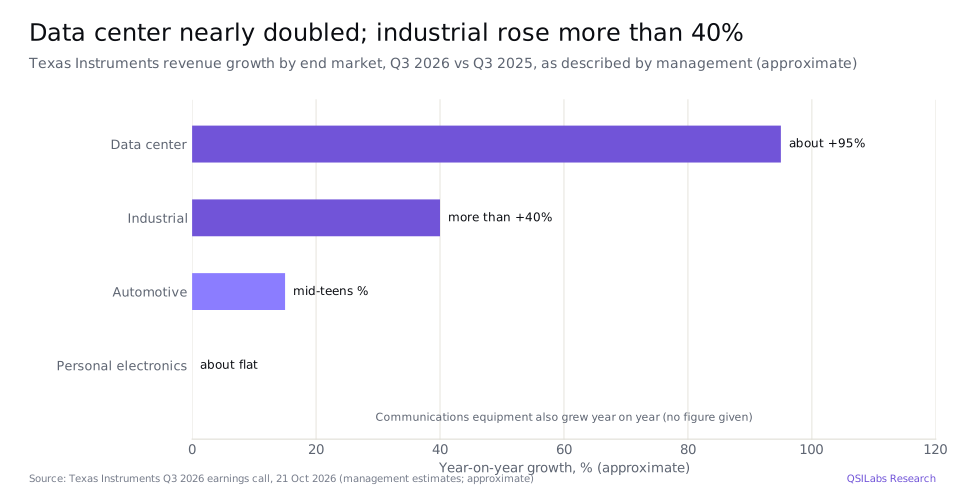
- Broad demand. Industrial revenue rose more than 40% from a year earlier, automotive in the mid-teens and data center about 95%, according to chief executive Haviv Ilan. Data center was about 13% of revenue.
- Cash flow jumped. Cash flow from operations was $3,419m in the quarter and $9,896m over 12 months. TI's free cash flow measure, which adds CHIPS Act incentives, was $8,422m over 12 months, against $2,415m a year earlier.
- Guidance. For Q4 2026 TI expects revenue of $5.80bn to $6.30bn and EPS of $2.45 to $2.79. The $6.05bn midpoint would be 37% above Q4 2025.
- Dividend raised. The quarterly dividend rises 7% to $1.52 from the payment on 10 November 2026, TI's 23rd consecutive yearly increase.
- Our value: $113.69 a share, about 62% below the $300.84 close on 30 October 2026. A two-stage cross-check gives $116.85; analysts' average target is $336.86.
- What to watch. Whether industrial and data center demand holds up into 2027, how much 2027 pricing TI wins in its annual talks, and how the planned Silicon Labs acquisition is financed and absorbed.
Key numbers from Texas Instruments' Q3 2026 earnings
| Metric | Q3 2026 | Q3 2025 | Change |
|---|---|---|---|
| Revenue | $6,055m | $4,742m | +28% |
| Analog revenue | $4,911m | $3,729m | +32% |
| Embedded Processing revenue | $858m | $709m | +21% |
| Gross margin | 64.2% | 57.4% | +6.8 pts |
| Operating profit | $2,874m | $1,663m | +73% |
| Operating margin | 47.5% | 35.1% | +12.4 pts |
| Net income | $2,425m | $1,364m | +78% |
| Diluted EPS | $2.62 | $1.48 | +77% |
| Cash flow from operations | $3,419m | $2,190m | +56% |
| Capital expenditures | $463m | $1,197m | -61% |
| Free cash flow, trailing 12 months (TI measure) | $8,422m | $2,415m | +249% |
| Cash and short-term investments (period end) | $8,142m | $5,186m | +57% |
Texas Instruments Q3 2026 earnings: what happened
Texas Instruments, the Dallas-based maker of analog and embedded processing chips, reported results for the third quarter of 2026, the three months to 30 September, on 21 October, and filed its Form 10-Q two days later. TI's fiscal year is the calendar year, so its Q3 is calendar Q3.
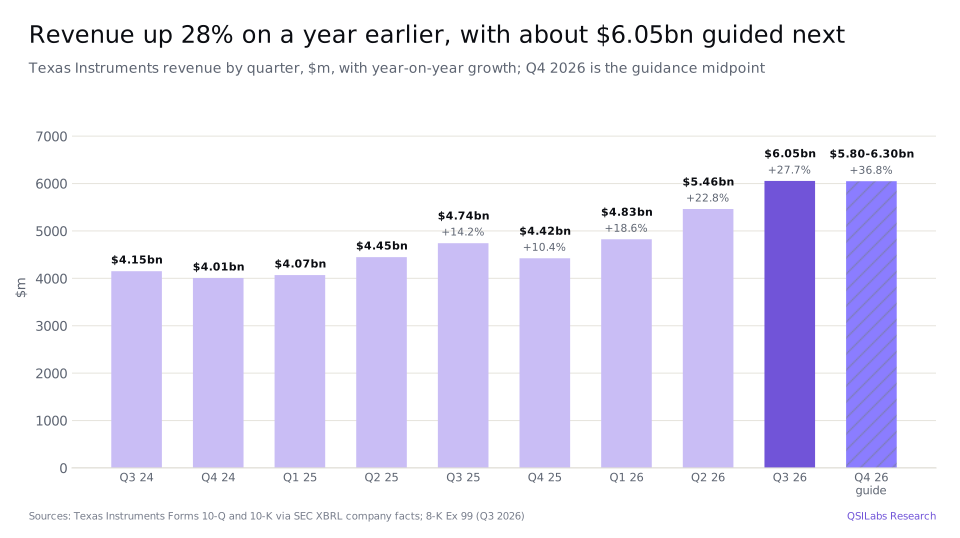
Revenue was $6,055m, up 11% from $5,463m in the June quarter and 28% from $4,742m a year earlier. Year-on-year growth, which had been 14.2%, 10.4%, 18.6% and 22.8% over the previous four quarters, accelerated to 27.7%. "Revenue increased 11% sequentially and 28% from the same quarter a year ago with continued broad growth in industrial, automotive and data center," Mr Ilan said in the results release. On the call he added that "secular growth of semiconductor content is continuing alongside a strong cyclical recovery".
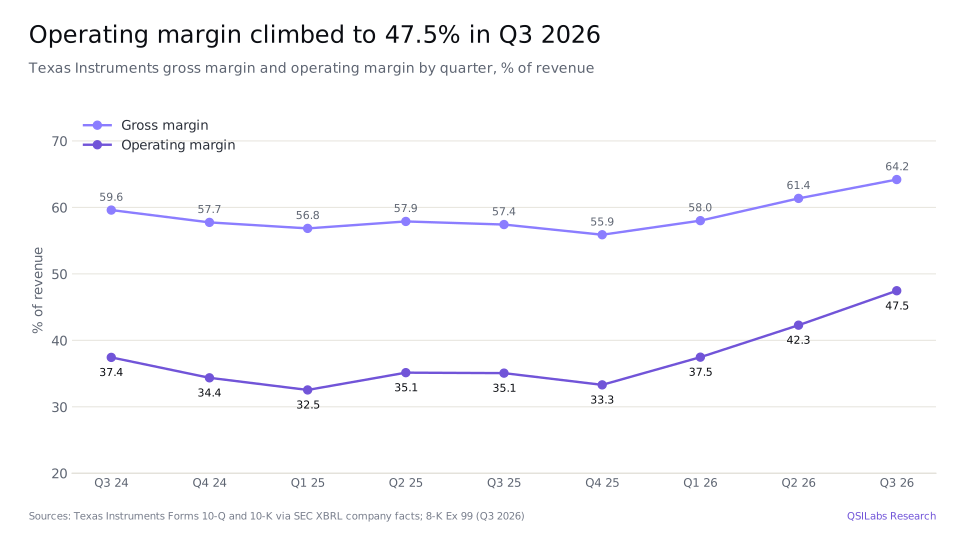
Profit grew much faster than revenue, which is typical of TI's business: it runs its own wafer factories, so much of its cost is fixed and each extra dollar of sales carries a high margin. Gross profit was $3,887m, or 64.2% of revenue, against 57.4% a year earlier; chief financial officer Julie Knecht said the gross margin rose 280 basis points from the June quarter. The cost of revenue rose only 7% to $2,168m while revenue rose 28%. Research and development spending was $530m and selling, general and administrative costs $476m, together about $1bn, almost unchanged from a year earlier. Operating profit was $2,874m, up 73%, a margin of 47.5%. Put another way, operating profit rose by $1,211m on $1,313m of extra revenue, helped by the absence of the $85m of restructuring charges booked a year earlier.
Net income was $2,425m, or $2.62 a diluted share, against $1,364m, or $1.48. The effective tax rate was 13.5%. Ms Knecht said EPS included a one-cent reduction, not in TI's original guidance, due to discrete tax items. Diluted shares averaged 921m, up from 914m, as share buybacks slowed to $48m in the quarter.
- 20 Nov 2025TXN closes at $153.33, its 52-week closing lowYahoo Finance
- 4 Feb 2026TI agrees to buy Silicon Labs for $231.00 a share in cash, an enterprise value of about $7.5bnForm 10-Q
- 23 Apr 2026TXN rises 19.4% to $282.23, its largest one-day gain in the 12 months to November 2026Yahoo Finance
- Jun 2026TI signs a 364-day delayed-draw term loan of up to $5bn to help fund the Silicon Labs dealForm 10-Q
- 22 Jun 2026TXN closes at $332.28, its 52-week closing highYahoo Finance
- 17 Sep 2026TI raises its quarterly dividend 7% to $1.52, its 23rd consecutive yearly increase8-K Ex 99 (17 Sep 2026)
- Sep 2026TI repays $500m of maturing debt, leaving $13.65bn outstandingForm 10-Q; earnings call
- 30 Sep 2026Q3 2026 ends: revenue $6,055m (+28%), operating margin 47.5%8-K Ex 99
- 21 Oct 2026Q3 results and Q4 guidance of $5.80-6.30bn; TXN closes at $284.658-K Ex 99; Yahoo Finance
- 23 Oct 2026Form 10-Q for the September quarter filedForm 10-Q
- 29 Oct 2026TXN closes at $312.94, up 9.9% from the results-day closeYahoo Finance
- 30 Oct 2026Shares go ex-dividend for $1.52 and close at $300.84, the price used in our valuationYahoo Finance
- 10 Nov 2026The $1.52 dividend is payable to holders of record on 30 October8-K Ex 99 (17 Sep 2026)
Which end markets drove Texas Instruments' growth?
TI does not report revenue by end market in its filings, but management gives approximate growth rates on each earnings call. In the third quarter, according to Mr Ilan:
- Industrial revenue increased more than 40% from a year earlier and about 10% from the June quarter.
- Automotive increased by a mid-teens percentage from a year earlier and about 10% from the June quarter.
- Data center rose about 95% from a year earlier and about 20% from the June quarter, and was about 13% of revenue.
- Personal electronics was about flat from a year earlier and grew by an upper-single-digit percentage from the June quarter.
- Communications equipment grew both from a year earlier and from the June quarter.
Industrial is one of the three markets TI focuses on for the long term, with automotive and data center, and the call made clear how far it has come back. "Only now in Q3 2026, it reached the same level of revenue we had in Q3 2022," Mr Ilan said. "This is the first time we created a new peak in industrial after four years." He put the growth down partly to more chip content in each piece of equipment and pointed to aerospace and defense, energy infrastructure and test and measurement as strong sectors. Some industrial sectors, he said, had not yet reached their previous peak.
Data center is now a meaningful business on its own. At about 13% of revenue, it would have been roughly $0.8bn in the quarter. Mr Ilan said he did not think the market is "influenced by seasonality", which helps explain why TI is guiding the fourth quarter roughly flat rather than down, as it often is. In automotive, head of investor relations Mike Beckman said the hybrid electric and powertrain systems sector grew about twice as fast as the overall automotive market, and that China and the United States were again growing faster than the average.
How fast is Texas Instruments' Analog business growing?
TI reports two main segments. Analog chips, such as power management and signal chain parts, convert and control real-world signals like voltage, temperature and sound. Embedded Processing covers microcontrollers and processors that run the logic in cars, factory equipment and appliances. A small Other segment includes calculators and other smaller product lines.
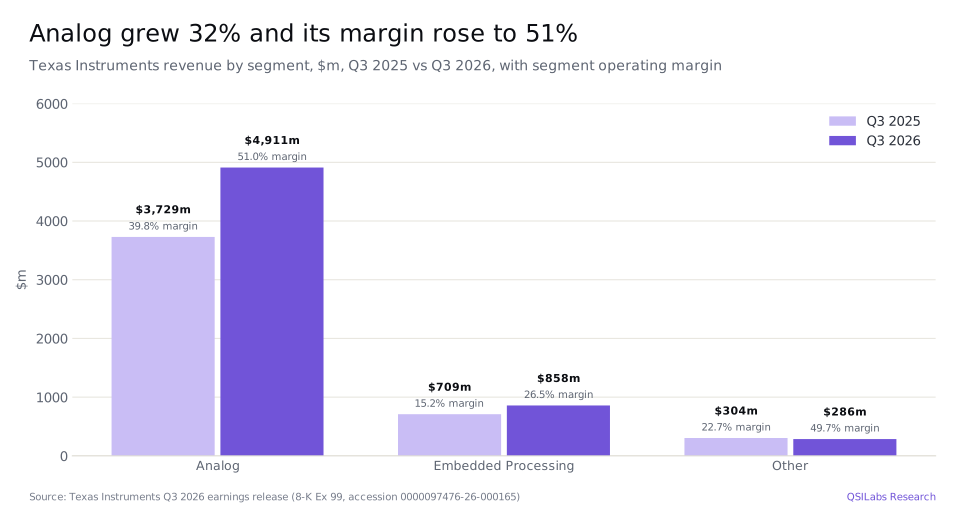
Analog revenue was $4,911m in the quarter, up 32% from $3,729m, and 81% of TI's revenue. Its operating profit rose 69% to $2,505m, a margin of 51.0% against 39.8% a year earlier. Embedded Processing revenue was $858m, up 21% from $709m, and its operating profit more than doubled to $227m, a 26.5% margin against 15.2%. Other revenue fell 6% to $286m.
Mr Ilan said the recovery in embedded processing was running "maybe a year later than Analog", noting that TI's embedded business peaked in 2023 while analog peaked in 2022. He also said the supply-demand mismatch is higher in analog, because some analog capacity across the industry has gone offline in recent years. For embedded processing, TI is moving production that now runs at outside foundries into its own factory in Lehi, Utah; asked about the segment's gross margin, Ms Knecht agreed it had been rising by a couple of points a quarter, and Mr Ilan put the gain at "about 10 points year-over-year or something".
Over the first nine months of 2026, Analog revenue was $13,200m and Embedded Processing $2,369m, out of total revenue of $16,343m.
Why are Texas Instruments' margins rising?
The main reason is volume. "Our margin in the third quarter were really driven by higher revenue. That is the largest reason for that increase," Ms Knecht said on the call. "We also did have some benefit from pricing, loadings, and some product and end market mix." Loadings refers to how fully TI's factories are used: a fab that runs closer to capacity spreads its fixed costs over more chips.
TI spent heavily on new 300mm wafer factories in Sherman, Texas, and Lehi, Utah, over the past four years. Depreciation, a non-cash charge for that equipment, was $555m in the quarter against $497m a year earlier. While revenue was falling in 2023 and 2024, that rising cost squeezed margins; now that revenue is climbing, the same factories are generating more profit. For modelling, Ms Knecht repeated TI's long-term guide that 75% to 85% of extra revenue should fall through to gross profit, excluding depreciation, measured year on year.
Pricing is starting to help. Mr Ilan said that after a flat pricing environment in the first half of 2026, TI saw "some price movement, I would say mainly on the Analog side" in the second half, as some customers wanted more supply quickly. He called the uptick "not very significant for this year". TI sets most prices once a year, and those talks for 2027 are under way; he said the company would say more about them with its January guidance.
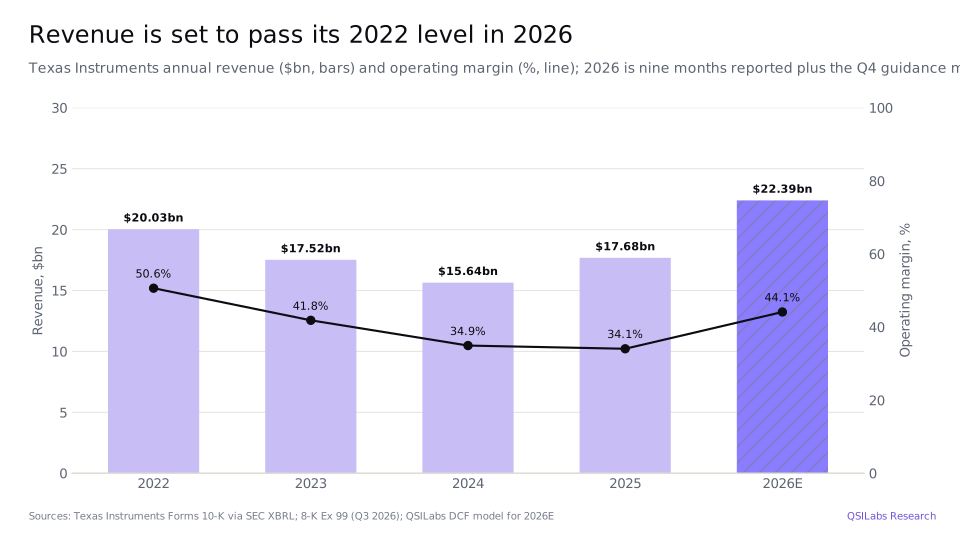
The longer view shows why the margin matters to the valuation. TI earned a 50.6% operating margin in 2022, when revenue was $20.03bn. As revenue fell to $15.64bn in 2024 the margin dropped to 34.9%, and it was 34.1% in 2025. Adding nine months of 2026 results to the midpoint of fourth-quarter guidance gives 2026 revenue of about $22.39bn and an operating margin of about 44%.
How much free cash flow does Texas Instruments generate?
A lot more than a year ago. Cash flow from operations was $3,419m in the quarter, up 56%, and $9,896m over the 12 months to September, 47.7% of revenue. Capital expenditures fell to $463m in the quarter from $1,197m a year earlier, and to $2,578m over 12 months, because the big wave of factory building is largely complete.
TI defines free cash flow as cash flow from operations less capital expenditures, plus proceeds from US CHIPS and Science Act incentives. On that basis free cash flow was $2,956m in the quarter and $8,422m over 12 months, 40.6% of revenue, up from $2,415m, or 14.0% of revenue, a year earlier. Ms Knecht said the 12-month figure includes $1.6bn of CHIPS Act incentives: the 35% investment tax credit on qualifying manufacturing investment, which reduces the tax TI pays, and direct grants. The 10-Q says TI is eligible for up to $1.6bn of direct funding for its Sherman and Lehi fabs, of which it has received $630m. In the first nine months of 2026 TI received $1,104m of CHIPS Act proceeds and used $380m of tax credits.
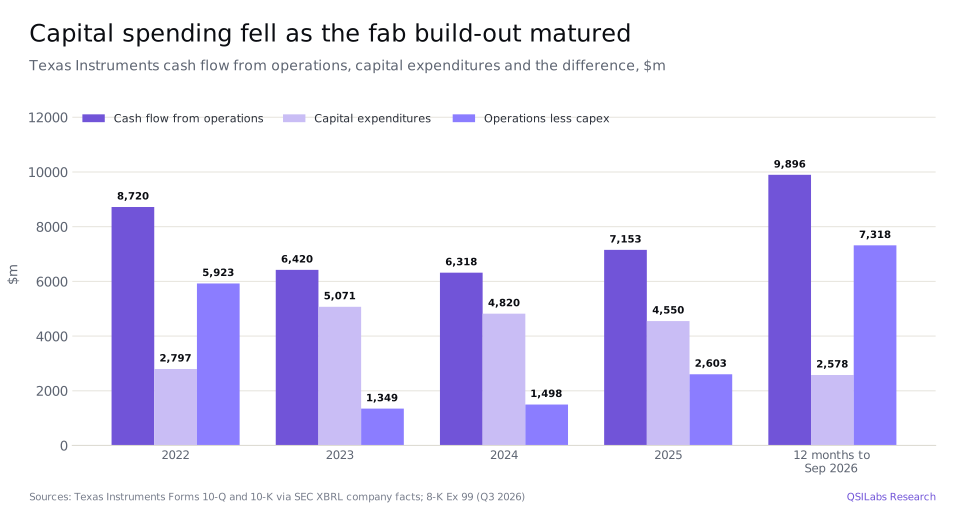
TI says it aims to return all free cash flow to owners over time. Over the past 12 months it paid $5,174m in dividends and bought back $636m of stock, a total of $5,810m. In the third quarter it paid $1,298m of dividends, bought back $48m of shares and repaid $500m of maturing debt.
The balance sheet is solid. At 30 September TI held $4,211m of cash and $3,931m of short-term investments, $8.14bn in all. Its debt was $13.65bn, with a weighted average coupon of 4.11%; it had no commercial paper outstanding and its $1bn revolving credit facility was undrawn. That leaves net debt of about $5.5bn, less than a year of operating cash flow. Inventory was $4.67bn, up $67m from June, and 194 days of sales, down two days, according to Ms Knecht. Accounts receivable were $2.62bn.
What did Texas Instruments guide for Q4 2026?
TI expects fourth-quarter revenue of $5.80bn to $6.30bn and EPS of $2.45 to $2.79. The revenue midpoint, $6.05bn, is almost exactly the third quarter's $6.06bn and 37% above the $4.42bn of Q4 2025; the EPS midpoint, $2.62, matches the third quarter and is about double the $1.27 of a year earlier. TI expects an effective tax rate of about 13% in the fourth quarter and 13% to 14% in 2027, and operating expenses roughly flat to slightly up on the third quarter.
A flat fourth quarter would be unusually strong for TI. On the call, Bernstein analyst Stacy Rasgon noted that the fourth quarter is usually down by a mid- to high-single-digit percentage, and said the guide would be one of TI's stronger fourth quarters since the COVID cycle. Management did not guide by market, but pointed to data center, which it does not regard as seasonal, and industrial momentum.
On spending, TI expects 2026 capital expenditures of $2bn to $3bn, perhaps toward the higher end if suppliers deliver tools on time; it spent $1,653m in the first nine months. Mr Ilan said lead times on tools were extending, especially for back-end assembly and test equipment, and that TI's new assembly and test site in Malaysia, its largest, was ramping quickly. He declined to give 2027 capital spending, saying it would depend on demand and the growth rate TI plans for.
Adding the guidance midpoint to nine months of results gives 2026 revenue of about $22.39bn, up 27% from $17.68bn in 2025, in line with the $22.40bn consensus forecast compiled by S&P Global. For 2027, analysts expect revenue of $26.24bn, up 17%, and EPS of $11.52, against $9.10 for 2026.
What does the Silicon Labs deal mean for Texas Instruments?
On 4 February 2026 TI agreed to buy Silicon Laboratories, a maker of wireless microcontrollers for connected devices, for $231.00 a share in cash, an enterprise value of about $7.5bn. The 10-Q says the deal is expected to close in the first half of 2027, subject to regulatory approvals and other conditions, and that TI expects to fund it with a combination of cash on hand and debt. In June 2026 TI signed a 364-day delayed-draw term loan of up to $5bn for the purpose; nothing had been drawn at 30 September. TI booked $7m of acquisition charges in the third quarter and $41m in the first nine months.
The deal adds to Embedded Processing. Mr Ilan described it as bringing "another clean room that will serve the transitioning of the portfolio that right now is running in foundries, again, into Lehi", meaning TI plans to move Silicon Labs' chips, now made by outside foundries, into its own factory over time.
For investors the financing matters as much as the strategy. Drawing the full $5bn term loan would take TI's debt to about $18.7bn on September's figures. With $9.9bn of annual operating cash flow and more than $5bn a year of dividends, TI can carry that, but it leaves less room for buybacks until the debt is paid down. Our valuation does not yet include Silicon Labs, because the deal has not closed.
How has TXN stock performed over the past year?
Very well. TXN closed at $300.84 on 30 October 2026, the day it went ex-dividend, up 86% from $161.46 on 3 November 2025 and 96% from its 52-week closing low of $153.33 on 20 November 2025. It was 9.5% below its closing high of $332.28 on 22 June 2026. On 2 November it closed at $302.02.
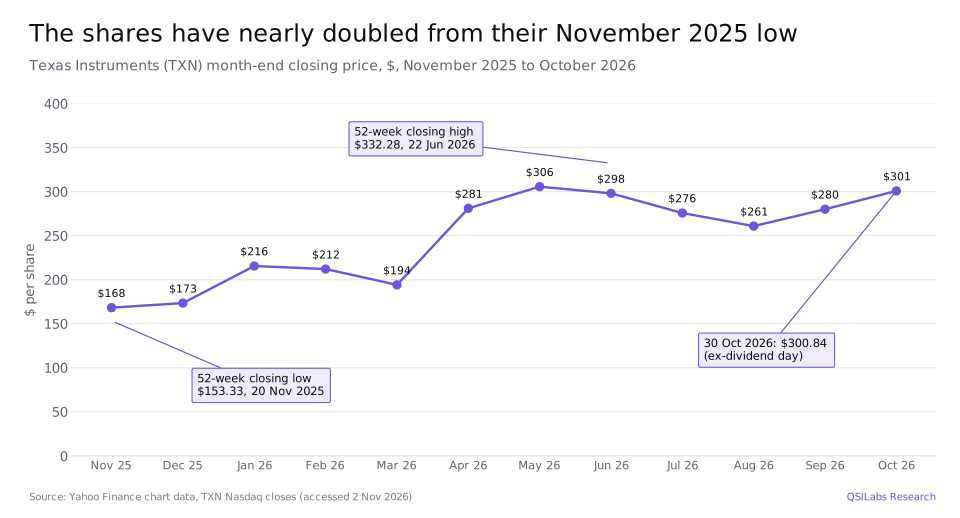
The biggest move came on 23 April 2026, when the shares rose 19.4% to $282.23. The reaction to the third-quarter results was milder: the shares closed at $284.65 on results day, slipped 1.8% to $279.50 the next day and then climbed to $312.94 on 29 October before falling back as they went ex-dividend. At $300.84 the shares yield about 2.0% on the new $6.08 annual dividend.
Texas Instruments stock Q3 2026: is TXN overvalued?
On our numbers, yes. Our discounted cash flow model values Texas Instruments at $113.69 a share, against a $300.84 close on 30 October 2026, about 62% lower. At that price TI's equity was worth about $277bn, on 921m diluted shares, and its enterprise value, after net debt of about $5.5bn, about $283bn. That is 10.8 times consensus 2027 revenue, 33.1 times consensus 2026 EPS of $9.10 and 26.1 times consensus 2027 EPS of $11.52.
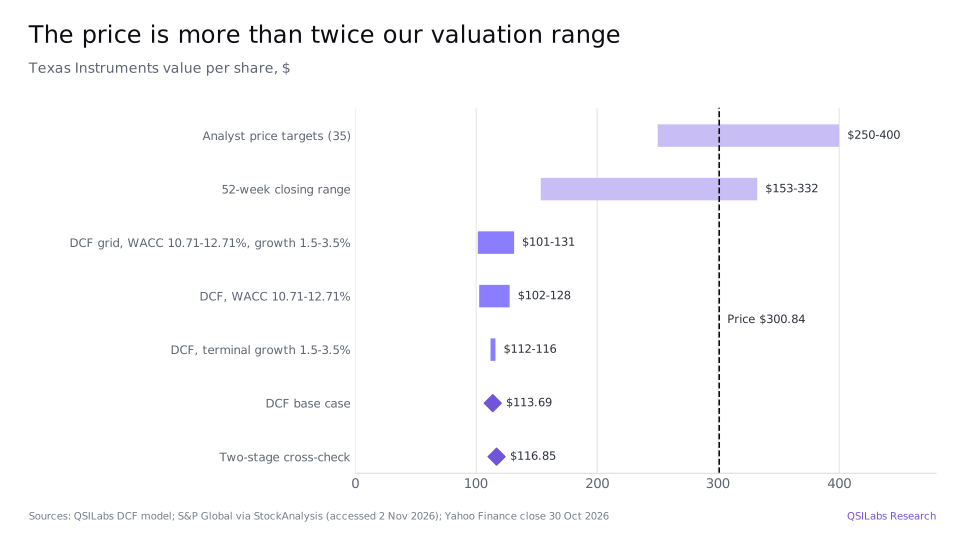
We are not saying the business is weak. TI is growing revenue at 28%, earns a 47.5% operating margin, has stopped spending heavily on new factories and is turning more than 40% of its revenue into free cash flow. We are saying the price assumes far more than our forecast: that revenue keeps growing well above the industry's long-run rate after 2027, that margins stay near today's level through the next downturn, or that investors should discount TI's cash flows at a much lower rate than we use.
Analysts are much more optimistic than we are, though less uniformly than for some chip stocks. The 35 analysts tracked by S&P Global rate TI a Buy on average, with an average price target of $336.86, a median of $340 and a range from $250 to $400; in October, 18 rated it a Strong Buy, two a Buy, 13 a Hold and two a Strong Sell. After the results Bank of America kept a Buy rating and a $370 target, Bernstein kept a Hold and raised its target to $310 from $290, Wells Fargo kept a Hold at $300 and Freedom Capital Markets upgraded the stock to Buy with a $330 target.
Method
We forecast revenue and operating margin year by year to 2035, apply a 13.9% tax rate, close to TI's guidance of 13% to 14% for 2027, and deduct capital spending and working capital to reach unlevered free cash flow. We discount those cash flows at an 11.71% weighted average cost of capital, taken from Damodaran's January 2026 data for 66 US semiconductor companies: a beta of 1.52, a cost of equity of 11.89% and debt of about 2.5% of capital, with a 5.12% risk-free rate. After 2035 we assume growth of 2.5% a year and a 15% return on new investment; that terminal value is 43.5% of our enterprise value of $111.0bn. Deducting net debt of $5.5bn and $0.8bn for the dividend that went ex on 30 October, net of a month of cash generation, gives equity value of $104.7bn, or $113.69 a share on 921m shares.
For 2026 we use nine months of reported results plus the midpoint of fourth-quarter guidance: revenue of $22.39bn and operating profit of $9.88bn, a 44.1% margin. For 2027 we use the consensus revenue forecast of $26.24bn, up 17.2%, and a 48.0% operating margin, which is consistent with consensus EPS of $11.52 at a tax rate of about 13.5%. Growth then slows to 7% in 2028, 6% in 2029, 5% in 2030 and 2.5% by 2035, and the margin eases to 45% from 2031, above TI's 2024 and 2025 margins but below its 2022 level of 50.6%. That reflects our view that analog chip demand moves in cycles and that today's growth is partly a recovery from the 2023-24 downturn.
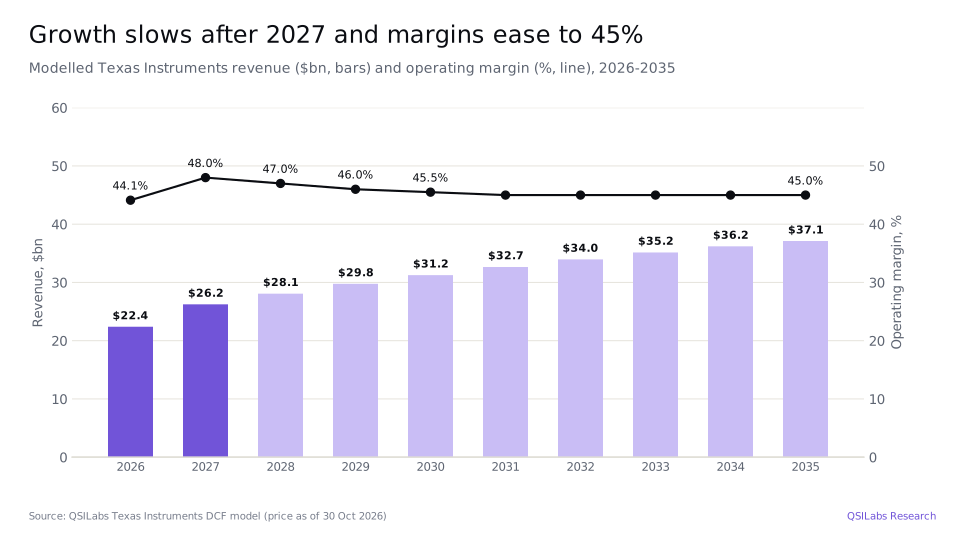
We forecast unlevered free cash flow of $9.8bn in 2027, rising to $10.8bn in 2028 and about $12.0bn by 2035. We assume capital spending of $2.2bn in 2026 and $2.5bn in 2027, then rising toward 12% of revenue by 2032 as TI adds capacity for growth, and that working capital rises with revenue.
How the number moves if you argue with us
The table shows our value per share at different costs of capital and terminal growth rates. Even at a 10.71% cost of capital and 3.5% terminal growth, the model reaches $131.33, well under half the share price.
| Cost of capital | Growth 1.5% | Growth 2.0% | Growth 2.5% | Growth 3.0% | Growth 3.5% |
|---|---|---|---|---|---|
| 10.71% | $124.66 | $126.08 | $127.64 | $129.38 | $131.33 |
| 11.21% | $117.92 | $119.04 | $120.26 | $121.62 | $123.12 |
| 11.71% | $111.84 | $112.73 | $113.69 | $114.74 | $115.89 |
| 12.21% | $106.34 | $107.04 | $107.79 | $108.60 | $109.49 |
| 12.71% | $101.34 | $101.89 | $102.47 | $103.10 | $103.77 |
The bigger levers are how long the upcycle lasts and how much TI's new capacity earns. Our base case already uses consensus revenue for 2026 and 2027 and a margin near the third quarter's 47.5%. A bottom-up cost of capital using a beta of 1.0 instead of the industry beta is 9.91%, below the range in the table, and would raise our value. Even so, matching the share price would need revenue to keep compounding much faster, or margins to stay higher, for much longer than our forecast assumes.
Risks to the Texas Instruments investment case
- Cyclical risk. Analog chip demand rises and falls with industrial and automotive spending and with customers' inventory decisions. TI's revenue fell 22% from 2022 to 2024; some of today's growth is customers rebuilding inventory, which can reverse.
- Margin risk. TI's high fixed costs work in both directions. Its operating margin fell from 50.6% in 2022 to 34.1% in 2025 as revenue dropped and depreciation rose, and depreciation is still rising.
- Acquisition risk. The Silicon Labs deal costs about $7.5bn and may add up to $5bn of debt. Regulatory delays, integration costs or a weaker wireless market could reduce its value to TI.
- China and trade. TI sells around the world. Tariffs, export controls and Chinese competition in mature-node analog chips could hurt pricing and volumes, and the company's own risk factors list global trade policies.
- Valuation risk. At about 26 times consensus 2027 EPS and 10.8 times 2027 revenue, the shares already price in strong growth. Analysts' targets range from $250 to $400, so even the Street disagrees widely on what the shares are worth.
- Policy risk. CHIPS Act incentives contributed $1.6bn to 12-month free cash flow. Changes to the investment tax credit or delays to grant payments would reduce TI's cash flow.
- Upside risk. If industrial and data center demand keep growing for several more years, 2027 price increases stick and TI fills its new factories, revenue and margins could beat our forecast and our value would rise.
FAQ
What value does QSILabs put on Texas Instruments stock?
QSILabs values Texas Instruments at $113.69 a share, based on a discounted cash flow model updated with Q3 2026 results and the Form 10-Q. That is about 62% below the $300.84 close on 30 October 2026. A two-stage cross-check gives $116.85; analysts' average price target is $336.86.
Is Texas Instruments stock a buy after its Q3 2026 results?
Our model says TXN trades well above what its cash flows justify, because the price assumes faster growth and steadier margins after 2027 than we forecast for a cyclical chipmaker. The business is strong: revenue up 28% in the September quarter, a 47.5% operating margin and free cash flow of $8.4bn over 12 months. This is not investment advice.
How much revenue did Texas Instruments make in its latest quarter?
Texas Instruments' revenue for Q3 2026, the quarter to 30 September 2026, was $6,055m, up 28% from $4,742m a year earlier and 11% from $5,463m in the June quarter. Analog revenue was $4,911m and Embedded Processing $858m. Revenue for the first nine months of 2026 was $16,343m.
What does Texas Instruments make?
Texas Instruments designs and manufactures analog chips, such as power management and signal chain parts, and embedded processors, such as microcontrollers. It sells them to makers of industrial equipment, cars, data center hardware, personal electronics and communications equipment, and manufactures them in its own factories, including 300mm wafer fabs in Sherman, Texas, and Lehi, Utah, as well as through outside foundries.
Does Texas Instruments pay a dividend?
Yes. TI is raising its quarterly dividend 7% to $1.52 a share, or $6.08 a year, payable on 10 November 2026 to holders of record on 30 October. That is its 23rd consecutive yearly increase and a yield of about 2.0% at the 30 October 2026 price. TI paid $5,174m of dividends over the 12 months to September.
When does Texas Instruments report its next earnings?
TI's fourth quarter ends on 31 December 2026, and it usually reports fourth-quarter results in late January; management said it would say more about 2027 pricing on that January call. It had not confirmed a date when we published. Guidance for Q4 2026 is revenue of $5.80bn to $6.30bn and EPS of $2.45 to $2.79.
What price target do analysts have for TXN?
The 35 analysts tracked by S&P Global, as reported by StockAnalysis on 2 November 2026, have an average price target for Texas Instruments of $336.86, a median of $340, a low of $250 and a high of $400, with a consensus rating of Buy. Our DCF value of $113.69 is well below even the lowest target.
How much money does TI get from the CHIPS Act?
TI is eligible for up to $1.6bn of direct CHIPS Act funding for its fabs in Sherman, Texas, and Lehi, Utah, of which it had received $630m by 30 September 2026, plus a 35% investment tax credit on qualifying manufacturing investment. CHIPS Act incentives contributed $1.6bn to TI's $8.4bn of free cash flow over the 12 months to September.
How much debt does Texas Instruments have?
TI had $13.65bn of debt at 30 September 2026, with a weighted average coupon of 4.11%, against $8.14bn of cash and short-term investments, leaving net debt of about $5.5bn. It also has an undrawn $5bn term loan arranged for the Silicon Labs acquisition and an undrawn $1bn revolving credit facility.
Sources
- Texas Instruments Incorporated, third-quarter 2026 results (Form 8-K, Exhibit 99, 21 Oct 2026; accession 0000097476-26-000165) www.sec.gov
- Texas Instruments Incorporated, Form 10-Q for the quarter ended 30 Sep 2026 (filed 23 Oct 2026; accession 0000097476-26-000169) www.sec.gov
- Texas Instruments Incorporated, dividend increase release (Form 8-K, Exhibit 99, 17 Sep 2026; accession 0000950103-26-014118) www.sec.gov
- SEC XBRL company facts for Texas Instruments (CIK 97476): quarterly and annual revenue, gross profit, operating profit and cash flow from Forms 10-Q and 10-K data.sec.gov
- Texas Instruments Q3 2026 earnings call transcript, 21 Oct 2026, via StockAnalysis (accessed 2 Nov 2026) stockanalysis.com
- StockAnalysis: Texas Instruments forecast and analyst ratings, S&P Global data (accessed 2 Nov 2026) stockanalysis.com
- StockAnalysis: Texas Instruments statistics (accessed 2 Nov 2026) stockanalysis.com
- Yahoo Finance chart data: TXN closing prices and dividends (November 2025 to November 2026) query1.finance.yahoo.com
- Damodaran Online: cost of capital by industry (US), January 2026 pages.stern.nyu.edu
- QSILabs Texas Instruments discounted cash flow model (internal; price as of 30 Oct 2026)
Disclaimer
This article is for information only and is not investment advice, a recommendation or an offer to buy or sell any security. QSI Labs and its authors may hold positions in the securities discussed. Forecasts and valuations are estimates that depend on assumptions that may prove wrong. Figures are taken from company filings and third-party sources believed to be reliable, but we do not guarantee their accuracy. Do your own research or consult a licensed adviser before investing.
More from QSI Labs
Related analysis: Intel stock Q3 2026: data center and foundry, Broadcom stock Q3 2026: custom AI chips, NVIDIA stock Q3 2026: Vera Rubin and Lam Research stock Q3 2026: China and memory.
Read our white paper, QSI Labs: An AI-Native Trading Firm Built on a Training Loop (October 2026), available on request, or browse the research index.