Research / Earnings and valuation
Intel Stock Q3 2026:Data Center Sales Jump 78% but a Weak Q4 Guide Sinks the Shares
As of: Figures are as of Intel Corporation's Q3 2026 results (quarter ended 26 September 2026), reported on 29 October 2026 in its earnings release (Form 8-K, Exhibit 99.1) and in its Form 10-Q filed on 30 October 2026. The share price is the Nasdaq close of INTC on 2 November 2026, $59.97. Published 2 November 2026.
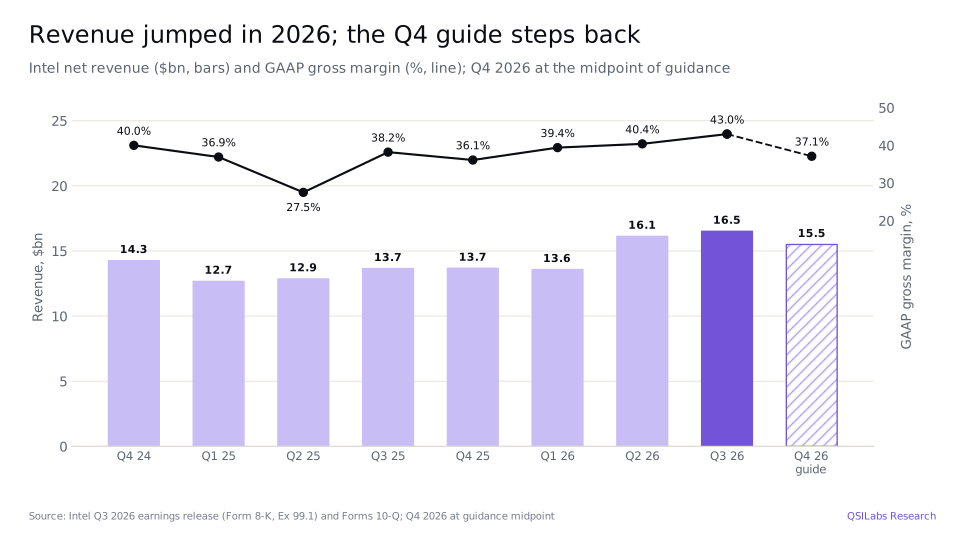
The short answer. Intel stock Q3 2026 results were the best in years for its servers and the worst possible news for its share price. Revenue rose 21% to $16.5bn, Data Center and AI revenue rose 78% to $7.3bn and GAAP gross margin reached 43.0%, but Intel guided Q4 revenue to $15.0-16.0bn, well below the roughly $17.1bn analysts expected, and warned that PC demand will stay weak at least through the first half of 2027. The shares fell 29% in a day, from $92.07 to $65.76, and closed at $59.97 on 2 November 2026. Our discounted cash flow model puts Intel at $17.55 per share, about 71% below that price: the market is paying for a foundry turnaround and a server boom that we think the cash flows do not yet show.
Intel reported its third quarter of 2026, which ended on 26 September, on 29 October and filed its 10-Q the next day (Intel Q3 2026 10-Q). GAAP earnings per share were $0.60, down from $0.90 a year earlier, which had been flattered by gains on the Altera and Mobileye stakes; non-GAAP EPS more than doubled to $0.52 from $0.23. Operating income was $2.5bn, against $683m a year earlier. The problem was not the quarter. It was the outlook: a Q4 revenue midpoint of $15.5bn, down from $16.5bn in Q3, a gross margin guide of 37.1% and GAAP EPS of just $0.10.
In this article we go through Intel's Q3 2026 numbers segment by segment, the Data Center and AI surge, the client slowdown, Intel Foundry and the 18A and 14A process nodes, cash flow and the balance sheet after the government stake, the Q4 guide and why the stock fell, and our valuation of INTC, with every assumption laid out so you can argue with it.
Key takeaways
- Valuation: QSILabs values Intel Corporation (NASDAQ: INTC) at $17.55 per share as of Q3 2026, against a $59.97 close on 2 November 2026, about 71% below the market price. Our value was $17.56 at our 29 October update, when the shares were at $92.07.
- Q3 2026 results: revenue was $16.51bn in the quarter ended 26 September 2026, up 21% from $13.65bn; GAAP gross margin was 43.0% against 38.2%, and operating income was $2.52bn against $683m.
- Data center: Data Center and AI (DCAI) revenue rose 78% to $7.32bn and its operating income more than tripled to $3.04bn, a 42% margin, as server CPU prices rose 54% and volumes rose 10%.
- Client PCs: Client Computing Group (CCPG) revenue fell 5% to $8.10bn on 14% lower volumes; Intel expects the PC slowdown to last at least through the first half of 2027.
- Foundry: Intel Foundry revenue rose 58% to $6.70bn, almost all of it from Intel's own products, and its operating loss narrowed to $1.85bn from $2.32bn. External foundry revenue was $411m.
- Guidance and the share price: Q4 revenue is guided to $15.0-16.0bn with non-GAAP EPS of $0.25, against consensus of about $17.06bn and $0.44. The shares fell 29% the next day and closed at $59.97 on 2 November.
- Cash: adjusted free cash flow was $1.64bn in Q3. Cash and investments were $62.8bn against $50.1bn of debt, helped by a $22.6bn share sale in August.
Key numbers from Intel's Q3 2026 earnings
| Q3 2026 vs Q3 2025, $m | Q3 2025 | Q3 2026 | Change |
|---|---|---|---|
| Net revenue | 13,653 | 16,513 | +21% |
| Gross margin, GAAP | 38.2% | 43.0% | +4.8 pts |
| Gross margin, non-GAAP | 40.0% | 44.1% | +4.1 pts |
| Research and development | 3,231 | 3,490 | +8% |
| Marketing, general and administrative | 1,129 | 1,030 | -9% |
| Restructuring and other charges | 175 | 54 | -69% |
| Operating income | 683 | 2,522 | +269% |
| Net income attributable to Intel | 4,063 | 3,320 | -18% |
| Earnings per share, diluted ($) | 0.90 | 0.60 | -33% |
| Non-GAAP earnings per share ($) | 0.23 | 0.52 | +126% |
| Weighted-average diluted shares (m) | 4,531 | 5,307 | +17% |
| Adjusted free cash flow | 896 | 1,639 | +83% |
Source: Intel Q3 2026 10-Q and Q3 2026 earnings release (accessions 0000050863-26-000191 and 0000050863-26-000188). Non-GAAP figures and adjusted free cash flow are Intel's own definitions.
Intel Q3 2026 earnings: what happened
Intel beat on almost every line in Q3 and then disappointed on the one line that mattered most to the market. Revenue of $16.5bn rose 2% from Q2's $16.1bn and 21% from a year earlier, after 25% growth in Q2. The gross margin of 43.0% was the highest of the last eight quarters, helped by higher server prices and lower charges on the Intel 3 and Intel 4 process nodes.
"Our immediate priority is to unlock additional supply to meet extraordinary demand for our Xeon family," said chief executive Lip-Bu Tan. Chief financial officer David Zinsner described "the strongest data center revenue growth in 15 years", but added: "we see the PC slowdown continuing at least through the first half of next year" (Q3 2026 earnings release).
Below the operating line, other income of $1.13bn included a gain of about $1.0bn on the escrow derivative tied to the US government's stake, which is why GAAP EPS of $0.60 was higher than non-GAAP EPS of $0.52. The tax rate was 11.6%. A year earlier, GAAP net income of $4.06bn had been lifted by the gain on selling a majority stake in Altera, so the fall in GAAP EPS says little about the business.
- 22 Jun 2026INTC closes at $140.94, its high for the yearYahoo Finance
- 12 Aug 2026Public offering of about 242 million shares at $95; net proceeds $22.6bn10-Q
- Q3 2026Multiyear Xeon collaboration with Oracle Cloud Infrastructure; Intel GPU D-series details at OCP Global Summit8-K Ex 99.1
- October 2026Intel 14A 0.9 process design kit released; agreement to buy quantum software company Classiq for about $1.9bn8-K Ex 99.1; 10-Q
- Mid-October 2026Accident at the Kiryat Gat fab in Israel halts production for about two weeks10-Q
- 29 Oct 2026Q3 2026 results and Q4 guidance; INTC had closed at $92.078-K Ex 99.1; Yahoo Finance
- 30 Oct 202610-Q filed; INTC falls 28.6% to $65.76SEC EDGAR; Yahoo Finance
- 2 Nov 2026INTC closes at $59.97Yahoo Finance
How did each Intel segment do in Q3 2026?
Data Center and AI did all the work. DCAI revenue rose $3.2bn from a year earlier, while client revenue fell $0.4bn and the "all other" line fell $0.3bn after Altera left the group in September 2025. Intel Foundry's revenue, which is mostly wafers sold to Intel's own product groups, rose 58% but is eliminated on consolidation.
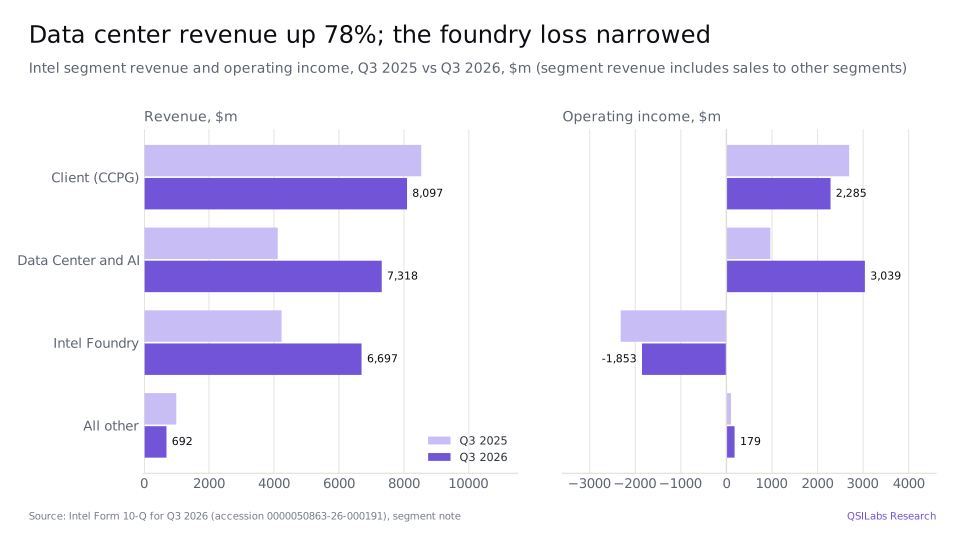
| Segment, $m | Revenue Q3 2025 | Revenue Q3 2026 | Operating income Q3 2025 | Operating income Q3 2026 |
|---|---|---|---|---|
| Client Computing Group (CCPG) | 8,535 | 8,097 | 2,694 | 2,285 |
| Data Center and AI (DCAI) | 4,117 | 7,318 | 964 | 3,039 |
| Intel Foundry | 4,235 | 6,697 | -2,321 | -1,853 |
| All other | 993 | 692 | 100 | 179 |
| Corporate unallocated | - | - | -782 | -1,058 |
| Intersegment eliminations | -4,227 | -6,291 | 28 | -70 |
| Total | 13,653 | 16,513 | 683 | 2,522 |
Source: Intel Q3 2026 10-Q, Note 2: Operating Segments. Eliminations in operating income are the balancing item to the reported total.
Client Computing Group: prices up, volumes down
Client revenue fell 5% to $8.10bn. Client platform revenue was $6.9bn, with unit volumes down 14% and average selling prices up 9%; other client revenue was $1.2bn. Operating income fell to $2.29bn, a 28% margin, from $2.69bn, partly because of $763m of higher inventory charges. Intel says substrate and memory shortages will last into next year, and it expects client demand to get worse in Q4 and into 2027.
Data Center and AI: the best quarter in 15 years
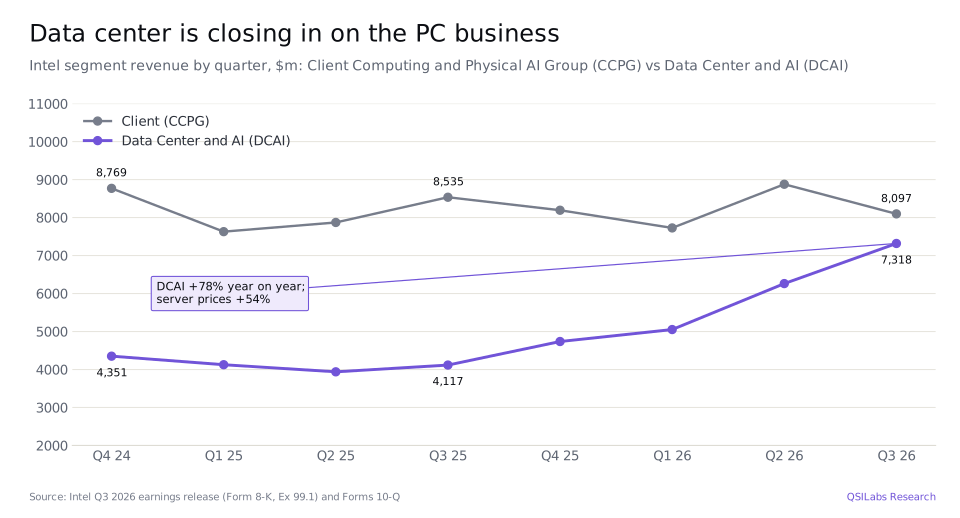
DCAI revenue of $7.32bn was up 78% from a year earlier and 17% from Q2. Server revenue rose by $2.5bn, with average selling prices up 54% and volumes up 10%, as demand for Xeon processors ran ahead of supply. Other DCAI revenue, which includes purpose-built silicon for large customers, rose $743m to $1.4bn. Operating income was $3.04bn, a 42% margin, against $964m and 23% a year earlier. DCAI earned more than the client business in the quarter.
Intel Foundry: still losing money, but less
Intel Foundry revenue was $6.70bn, up 58%. Intersegment revenue, the wafers and packaging Intel sells to its own product groups, was $6.3bn, up $2.1bn on higher volumes of Intel 18A, Intel 3 and Intel 4 wafers at higher prices. External revenue was $411m, up $379m, mostly from a non-recurring contract. The operating loss narrowed to $1.85bn, a margin of -28% against -55% a year earlier, helped by $793m of lower period charges. In nine months Foundry lost $6.38bn on revenue of $17.88bn, against a loss of $7.81bn a year earlier.
All other and corporate costs
The all other line, mainly Mobileye and Intel's remaining smaller businesses, had revenue of $692m and operating income of $179m. Revenue fell 30% because Altera was deconsolidated on 12 September 2025. Corporate unallocated expenses rose to $1.06bn from $782m, which mainly cover share-based pay, restructuring and acquisition-related costs.
Why did Intel stock fall after Q3 2026 earnings?
Intel stock fell because the fourth-quarter guide was far below what investors had paid for. Intel guided Q4 revenue to $15.0-16.0bn, a midpoint of $15.5bn that is 6% below Q3 and about 9% below the roughly $17.06bn consensus before the results (Equibles, 27 October 2026). It guided GAAP gross margin to 37.1% and non-GAAP to 38.0%, down from 43.0% and 44.1% in Q3, and EPS of $0.10 GAAP and $0.25 non-GAAP, against a consensus of about $0.44. The GAAP tax rate is guided to 31%.
Three things drive the weaker quarter. First, client demand: Intel expects PC sales to soften further as memory and substrate costs push up PC prices, and it does not expect a recovery before the second half of 2027. Second, supply: Intel says it cannot make enough Xeon processors to meet demand, so DCAI growth is capped by its factories rather than its customers. Third, Kiryat Gat: an accident in mid-October at Intel's fab in Kiryat Gat, Israel, which makes Intel 7 wafers, caused casualties and injuries among employees and halted production for about two weeks. Intel says the related Q4 charges and the costs that run into the first half of 2027 cannot yet be estimated.
The stock had also run a long way. Intel closed at $39.50 on 3 November 2025 and at a low of $33.62 on 20 November 2025, then rose to a high close of $140.94 on 22 June 2026 on the US government stake, the Terafab project and the server recovery. It closed at $92.07 on 29 October, before results, fell 28.6% to $65.76 on 30 October and closed at $59.97 on 2 November 2026 (Yahoo Finance). That is still 52% above where it was a year earlier.
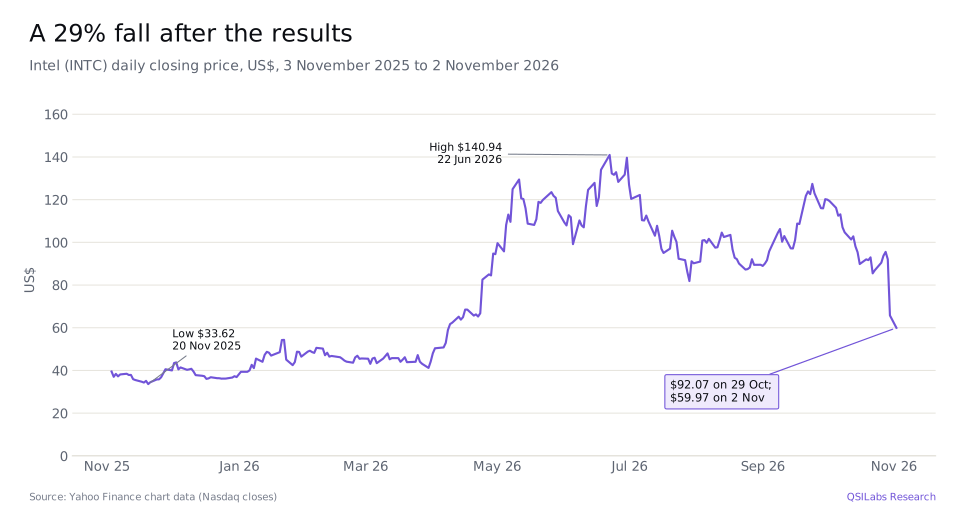
Analysts cut their targets but mostly stayed neutral. Barclays cut its target to $75 from $100, Citi to $100 from $130, JPMorgan to $80 from $85 and Northland to $93 from $120, and Freedom Capital downgraded the stock with a target of $90, down from $100. Across 49 analysts the consensus rating is Hold, with an average target of $93.88, a median of $90 and a range of $70 to $160 (StockAnalysis, 2 November 2026).
How did Intel's data center business grow 78%?
Intel's data center business grew 78% because it sold more server processors at much higher prices. Server revenue rose by $2.5bn from a year earlier, with average selling prices up 54% and unit volumes up 10%. That is a price-led recovery: server processors have been in short supply as AI data centers expand, and Intel has been able to charge more for them.
Three deals support the story. Oracle will use Intel's next-generation Xeon processors, code-named Diamond Rapids, in its cloud. Intel has announced a data center GPU, the D-series code-named Crescent Island, for AI inference. And the purpose-built silicon that Intel makes for specific large customers added $743m of revenue in Q3. Intel also agreed to buy Classiq, a quantum software company, for about $1.9bn plus up to $350m of contingent payments, in cash or shares, with closing expected in the first half of 2027.
The limit is supply. Intel says demand exceeds what it can build, and its own factories are full with Intel 7, Intel 3 and Intel 18A wafers. Competition has not gone away either: AMD had about 34.5% of server CPU units in mid-2026, according to industry data reported by The Register in August, and Arm-based chips from the cloud providers keep growing. If Intel cannot add capacity quickly, customers who cannot get Xeons will buy alternatives.
What does Q3 2026 mean for Intel Foundry and 18A?
Intel Foundry is improving, but it is still a business that loses about $2bn a quarter and depends almost entirely on Intel itself. Its operating loss narrowed to $1.85bn in Q3 from $2.32bn a year earlier, and its margin improved to -28% from -55%. Intel's process roadmap is on track: Intel 18A has been in high-volume production since the start of 2026, Intel 18A-P entered risk production in June 2026, and Intel has committed to its next node, 14A, and released version 0.9 of the 14A process design kit to customers.
What is missing is external revenue at scale. External foundry revenue was $411m in Q3 and $878m in nine months, much of it from Altera, which became an outside customer after its deconsolidation, and one non-recurring contract. Intel's target is to reach operating break-even in Foundry in 2027. We are more cautious: our model assumes Foundry margins of -12% in 2027 and -3% in 2028, reaching break-even only in 2029.
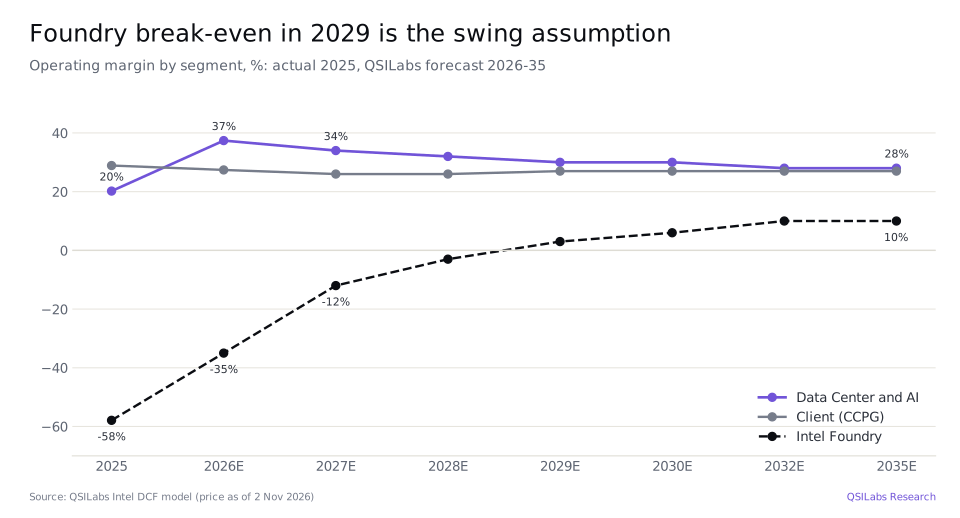
Terafab is the wild card. Intel joined the Terafab chipmaking project led by Elon Musk on 7 April 2026, and Tesla plans to use Intel 14A (Reuters). We include Terafab-related revenue at a 50% probability, rising from $150m in 2027 to about $1.3bn in 2035, which adds little to our value. Our separate SpaceX and Terafab analysis covers the project itself.
Intel cash flow, capex and the balance sheet
Intel generated $5.08bn of operating cash flow in Q3 and spent $4.22bn on gross capital expenditure. After partner contributions and government incentives, adjusted free cash flow, Intel's own measure, was $1.64bn, against $896m a year earlier. In nine months operating cash flow was $13.18bn, up from $5.41bn, against additions to property and equipment of $10.22bn plus $1.62bn of other capital additions; partners contributed $5.03bn.
The balance sheet is far stronger than a year ago. Intel held $62.8bn of cash, short-term investments and other liquid investments at 26 September 2026, against $50.1bn of short- and long-term debt, so it has net cash of about $12.7bn. The biggest single reason was a sale of 242 million new shares at $95 on 12 August 2026, about 211 million in the base deal plus the underwriters' option, which raised $22.6bn net (8-K, 12 August 2026; Q3 2026 10-Q). Intel does not pay a dividend.
The cost is dilution. Diluted shares averaged 5,307 million in Q3, up 17% from 4,531 million a year earlier, after the shares issued to the US government, SoftBank and Nvidia in 2025 and the August offering. Intel had 5,315 million shares outstanding on 23 October 2026. Another 132 million shares sit in escrow for the US government under the Secure Enclave programme, of which 66 million are contingent, and the government holds warrants for 241 million shares at $20 that it can exercise only if Intel's ownership of its foundry falls below 51%. Intel records the escrow arrangement as a derivative liability of $13.7bn; changes in its value run through other income each quarter.
Intel stock Q3 2026: is INTC overvalued?
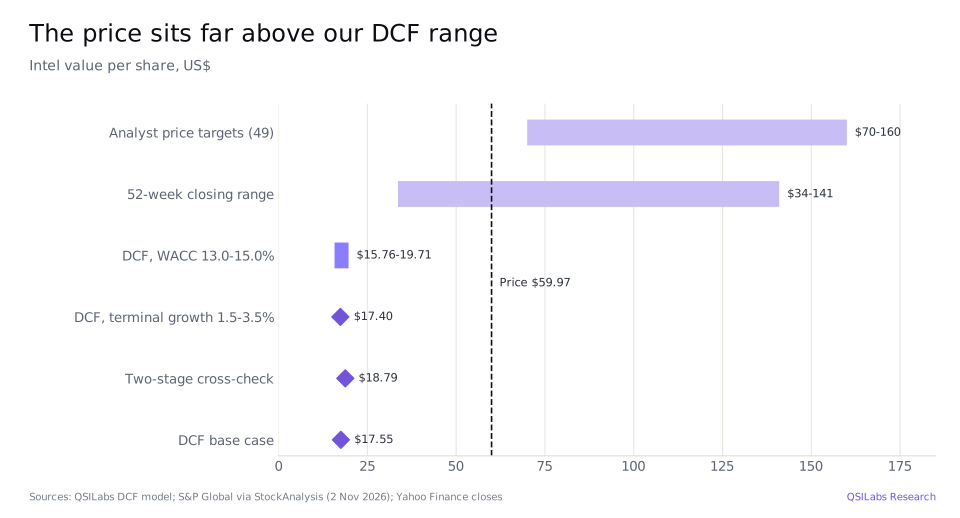
On our numbers, yes, by a wide margin. We value Intel at $17.55 a share, about 71% below the $59.97 close on 2 November 2026; put the other way, the stock trades at about 3.4 times our value, even after falling 35% since the results. A simpler two-stage cross-check gives $18.79. Analysts are far more positive: their average target is $93.88 and the lowest is $70. At $59.97, Intel's market value is about $330bn on 5,505 million diluted shares, or 40 times the 2026 consensus EPS of $1.49 and 33 times the 2027 consensus of $1.82 (StockAnalysis).
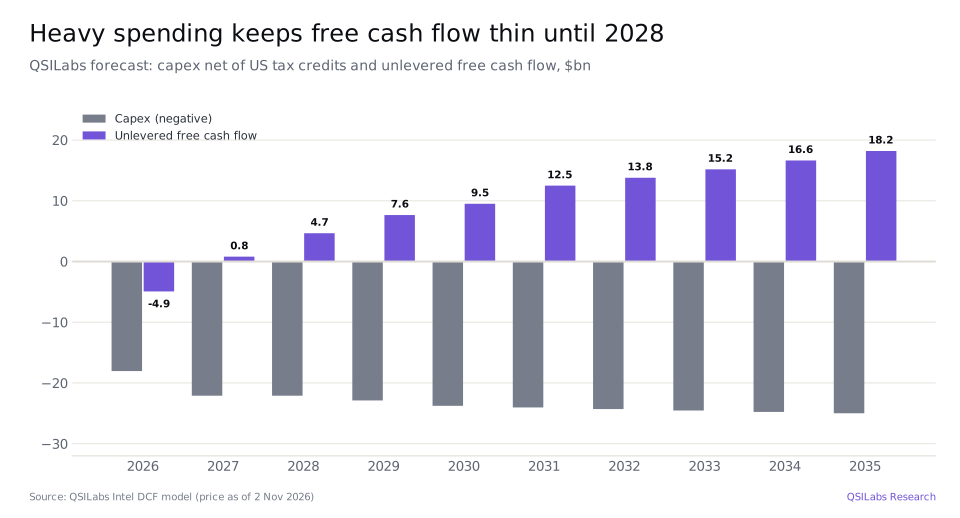
The gap comes down to two things: how much Intel will spend, and how much of that spending will earn a return. Intel's free cash flow is small because it is building factories for a foundry business that has not yet found enough outside customers. We forecast capital spending net of tax credits of $22.1bn a year in 2027 and 2028, about 30% of revenue, and assume Intel Foundry only breaks even in 2029. The market price implies that 18A and 14A win large external customers, that server prices stay high and that Intel's operating margin returns to the levels of the late 2010s.
Method
We value Intel with a discounted cash flow model. Revenue and operating margin are forecast by segment, then tax, capital spending, depreciation and working capital year by year to 2035, and free cash flow is discounted at a WACC of 14.0%. That is high for a company of Intel's size, and it is the main reason our value is low. It comes from a beta of 2.03, Damodaran's unlevered beta for global semiconductor companies of 1.82 relevered for Intel's debt, a 5.09% equity risk premium weighted by where Intel earns its revenue and a 5.12% risk-free rate, giving a cost of equity of 15.4%; debt costs 4.85% after tax and is 13.2% of capital. Terminal growth is 2.5%, and the terminal value is 52.5% of enterprise value. From enterprise value we add cash and investments and the cash still due from the US government for escrowed shares, subtract debt and minority interests, and divide by 5,505 million diluted shares.
Our main assumptions:
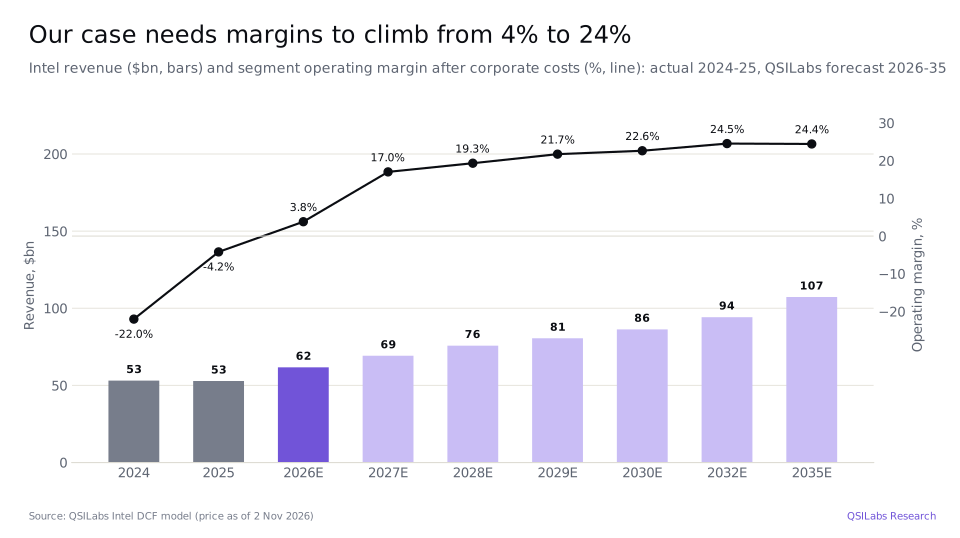
- 2026: revenue of $61.7bn, $46.2bn booked in nine months plus $15.5bn for Q4 at the midpoint of the guide. Operating margin of 3.8%, held down by $4.3bn of restructuring and other charges in the first nine months, most of it a $3.9bn goodwill impairment in Q1.
- 2027: revenue up 12% to $69.2bn, in line with the $69.28bn consensus, at an operating margin of 17.0%. Client revenue is flat at $32.3bn because of the PC slowdown; DCAI grows 25% to $31.9bn after about 51% in 2026.
- 2028-2030: revenue of $75.7bn in 2028 and $86.3bn in 2030, with operating margin rising to 22.6% as Foundry losses shrink. DCAI growth slows to 12% in 2028, and its margin eases from 37% in 2026 to 30% and then 28% as AMD, Arm-based chips and new capacity compete prices down.
- Intel Foundry: total revenue, mostly internal, rises from $24.2bn in 2026 to $47.0bn in 2035. External foundry revenue grows from $1.2bn in 2026 to $3.5bn in 2028, $7.0bn in 2030 and $11.2bn in 2035, and the Foundry margin moves from -35% in 2026 to -12% in 2027, +3% in 2029 and +10% from 2032.
- Capital spending: gross capex of $20.5bn in 2026 and $26bn in each of 2027 and 2028, or $18.0bn, $22.1bn and $22.1bn after US tax credits, rising to $25.0bn by 2035. Depreciation is 20.5% of revenue and the tax rate is 15%.
Unlevered free cash flow is -$4.9bn in 2026, $0.8bn in 2027, $4.7bn in 2028, $9.5bn in 2030 and $18.2bn in 2035.
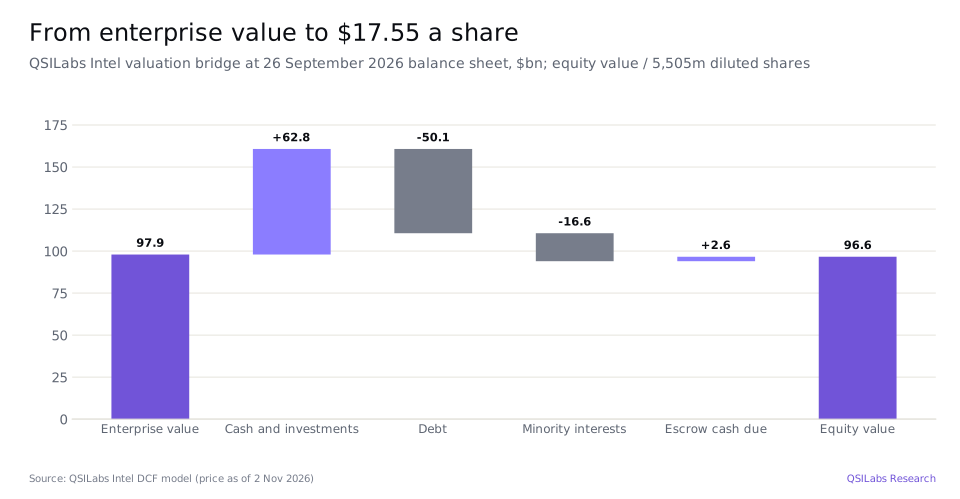
| Value bridge | $bn | Per share ($) |
|---|---|---|
| Present value of free cash flow, 2026-2035 | 46.5 | 8.45 |
| Present value of terminal value | 51.4 | 9.34 |
| Enterprise value | 97.9 | 17.79 |
| Plus cash, short-term and other liquid investments | 62.8 | 11.41 |
| Less short- and long-term debt | -50.1 | -9.11 |
| Less minority interests (Mobileye, Arizona and Ireland fab partners) | -16.6 | -3.02 |
| Plus cash due from the US government for escrowed shares | 2.6 | 0.48 |
| Equity value | 96.6 | 17.55 |
Source: QSILabs DCF model; balance sheet from the Q3 2026 10-Q; 5,505 million diluted shares (5,315 million outstanding, 132 million in escrow and 58 million from share awards).
Two items in the bridge need explaining. We do not subtract the $13.7bn escrow derivative liability, because the 132 million escrowed shares are already in our share count; instead we add the roughly $2.6bn, $20 a share, that the government still has to pay for them. And minority interests are large because outside investors own stakes in Mobileye and in Intel's fabs in Arizona and Ireland, and take a share of the cash those assets produce.
Our value barely moved after the 10-Q. It was $17.56 at our 29 October update, when the shares were at $92.07, and is $17.55 now. Our forecast already reflected the Q4 guide, and a lower share price affects a cash flow valuation only through the weights in the discount rate.
How the number moves if you argue with us
The discount rate moves the value most, but none of our sensitivities comes close to the share price. A WACC half a point lower, 13.54%, gives $18.58 a share; half a point higher, 14.54%, gives $16.61. At our 14.04% WACC, terminal growth of 1.5% gives $17.40 and 3.5% gives $17.71. Terminal growth matters little because the long-run cash flows are discounted so heavily.
| WACC \ terminal growth | 1.5% | 2.0% | 2.5% | 3.0% | 3.5% |
|---|---|---|---|---|---|
| 13.05% | 19.45 | 19.58 | 19.71 | 19.85 | 20.00 |
| 13.54% | 18.38 | 18.48 | 18.58 | 18.68 | 18.80 |
| 14.04% | 17.40 | 17.48 | 17.55 | 17.63 | 17.71 |
| 14.54% | 16.51 | 16.56 | 16.61 | 16.67 | 16.73 |
| 15.05% | 15.68 | 15.72 | 15.76 | 15.80 | 15.83 |
Value per share, $. Source: QSILabs DCF model.
Even the most generous corner of the grid, a 13.05% WACC and 3.5% terminal growth, gives $20.00. To justify $59.97 an investor needs much more cash, not a lower discount rate: an operating margin above 30%, as Intel earned in 2018, and capital spending falling well below 20% of revenue once 18A and 14A are built. That is possible if Intel Foundry wins large outside customers such as Terafab and DCAI keeps its pricing, but it is not what Intel's results show today.
Risks to the Intel investment case
- Israel and the Middle East: Intel makes Intel 7 wafers in Israel, and Intel says it does not have insurance against war damage there. The conflict with Iran is a direct risk to that capacity.
- Kiryat Gat: the October accident halted the fab for about two weeks. Intel cannot yet estimate the Q4 charges or the cost of lower output through the first half of 2027; our model does not include a separate charge.
- PC demand: client is still Intel's largest business. Volumes fell 14% in Q3 and Intel expects weakness at least through the first half of 2027 as memory and substrate shortages raise PC prices.
- Supply: Intel cannot build enough Xeon processors. If shortages last, customers may move more work to AMD or to Arm-based chips made by the cloud providers.
- Foundry: Intel Foundry lost $6.4bn in nine months. Without large outside customers for 18A and 14A, the capital spending will not earn a return.
- Dilution and the government stake: diluted shares rose 17% in a year. The escrow derivative makes GAAP earnings swing with the share price, the government warrants could add 241 million shares if Intel sells control of its foundry, and the Classiq deal may be paid in shares.
- Upside risk: if 14A wins Terafab and other outside customers, server prices stay high and Foundry breaks even in 2027 as Intel targets, cash flow would arrive years earlier than we assume, and our value would be higher.
FAQ
What is QSILabs' value for Intel stock after Q3 2026 earnings?
QSILabs values Intel at $17.55 per share, based on a discounted cash flow model updated for Q3 2026 results. That is about 71% below the $59.97 close on 2 November 2026. A two-stage cross-check gives $18.79; analysts' average price target is $93.88.
Is Intel stock a buy after Q3 2026?
Our model says INTC trades at about 3.4 times our value, because the price assumes a foundry turnaround and server margins that the cash flows do not yet show. The data center business is strong, with revenue up 78% and a 42% margin, and Intel has net cash of about $12.7bn. This is not investment advice.
How much did Intel earn in Q3 2026?
Intel had revenue of $16.51bn in Q3 2026, up 21% from a year earlier. Operating income was $2.52bn, net income attributable to Intel was $3.32bn and diluted EPS was $0.60. Non-GAAP EPS was $0.52, up from $0.23.
Why did Intel stock drop after Q3 2026 earnings?
Intel stock fell 28.6% on 30 October 2026 because Intel guided Q4 revenue to $15.0-16.0bn, below the roughly $17.06bn analysts expected, with non-GAAP EPS of $0.25 against about $0.44. It also said the PC slowdown would last at least through the first half of 2027 and that it cannot yet estimate the cost of the Kiryat Gat fab accident.
What is Intel's Q4 2026 guidance?
Intel guided Q4 2026 revenue to $15.0-16.0bn, GAAP gross margin to 37.1% and non-GAAP gross margin to 38.0%. It expects GAAP EPS of $0.10 and non-GAAP EPS of $0.25, with tax rates of 31% and 11%.
How fast is Intel's data center business growing?
Intel's Data Center and AI revenue rose 78% to $7.32bn in Q3 2026, the fastest growth in 15 years according to Intel. Server prices rose 54% and volumes 10%, and operating income more than tripled to $3.04bn, a 42% margin.
Is Intel Foundry profitable?
No. Intel Foundry lost $1.85bn in Q3 2026 on revenue of $6.70bn, most of it from Intel's own product groups, and $6.38bn in nine months. External foundry revenue was $411m in the quarter. Intel targets break-even in 2027; our model assumes 2029.
How much of Intel does the US government own?
The US government became Intel's largest shareholder in 2025. A further 132 million shares are held in escrow for it under the Secure Enclave programme, and it holds warrants for 241 million shares at $20 that can be exercised only if Intel's ownership of its foundry falls below 51%. Intel had 5,315 million shares outstanding on 23 October 2026.
Sources
- Intel Corporation, Form 10-Q for the quarter ended 26 Sep 2026 (filed 30 Oct 2026; accession 0000050863-26-000191) www.sec.gov
- Intel Corporation, Q3 2026 earnings release (Form 8-K, Exhibit 99.1, 29 Oct 2026; accession 0000050863-26-000188) www.sec.gov
- Intel Corporation, Form 10-Q for the quarter ended 27 Jun 2026 (accession 0000050863-26-000157) www.sec.gov
- Intel Corporation, Annual Report on Form 10-K for fiscal 2025 (accession 0000050863-26-000011) www.sec.gov
- StockAnalysis: Intel forecast and analyst ratings, S&P Global data (updated 2 Nov 2026) stockanalysis.com
- Equibles: Intel analyst estimates (captured 27 Oct 2026, before the results) equibles.com
- Yahoo Finance chart data: INTC closing prices (November 2025 to November 2026) query1.finance.yahoo.com
- Reuters: 'Intel to join Musk's Terafab mega AI chip project' (7 Apr 2026) www.reuters.com
- Damodaran Online: cost of capital by industry and country risk data (January 2026) pages.stern.nyu.edu
- QSILabs Intel discounted cash flow model (internal; price as of 2 Nov 2026)
Disclaimer
This article is for information only and is not investment advice, a recommendation or an offer to buy or sell any security. QSI Labs and its authors may hold positions in the securities discussed. Forecasts and valuations are estimates that depend on assumptions that may prove wrong. Figures are taken from company filings and third-party sources believed to be reliable, but we do not guarantee their accuracy. Do your own research or consult a licensed adviser before investing.
More from QSI Labs
Related analysis: NVIDIA stock Q3 2026: Rubin and earnings, Broadcom stock Q3 2026: AI XPUs, Micron stock Q3 2026: HBM and SpaceX Q3 2026 and Terafab.
Read our white paper, QSI Labs: An AI-Native Trading Firm Built on a Training Loop (October 2026), available on request, or browse the research index.