Research / Earnings and valuation
Netflix Stock Q3 2026:Margin 34.6%, Ad Outlook Trimmed
As of: Figures are as of Netflix's results for the quarter ended 30 September 2026 (Q3 2026; Netflix's fiscal year is the calendar year), reported on 20 October 2026 in the shareholder letter (Form 8-K, Exhibit 99.1) and the Form 10-Q filed on 21 October 2026, and discussed in the earnings interview on 20 October. Free cash flow and F/X-neutral growth are Netflix's non-GAAP measures. Share data reflect the ten-for-one stock split of November 2025. The share price is the Nasdaq close of NFLX on 30 October 2026, $62.08. Published 2 November 2026.
The short answer. Netflix stock Q3 2026 results, for the July to September quarter, showed a business that is still growing at double digits and earning more on every dollar, but not quite as fast as investors had hoped. Revenue rose 12% to $12.87bn, operating income rose 37% to $4.46bn, a 34.6% margin, and diluted earnings per share rose to $0.87 from $0.59. Netflix kept its 2026 forecast of $51.1bn of revenue and a 31.5% operating margin, but cut its 2026 ad revenue forecast to about $2.7bn from about $3bn and its free cash flow forecast to about $12.0bn from $12.5bn. Our discounted cash flow model puts Netflix at $69.49 per share, about 12% above the $62.08 close on 30 October 2026. After a fall of about 44% in a year, the shares price in slower growth than the company is delivering.
The quarter to 30 September 2026 was driven by subscriptions. Netflix said revenue growth came mainly from more memberships and higher prices, with help from advertising and currency, and that churn improved year on year, both globally and in the US, and was better than its forecast (Netflix Q3 2026 shareholder letter). Operating income came in ahead of Netflix's own forecast, mainly because some expenses moved into later quarters. Netflix bought back 63.9m shares for $4.8bn, which it called its largest quarter of repurchases ever. The shares fell 5.3% the day after the results, from $68.69 to $65.04, and closed at $62.08 on 30 October, 44% below their level a year earlier and 46% below their closing high of $115.75 on 12 November 2025 (Yahoo Finance).
In this article we go through Netflix's Q3 2026 numbers against a year earlier, region by region, explain why the ad revenue forecast came down, set out the guidance for the fourth quarter and what management has said about 2027, cover cash flow, content spending, buybacks and the abandoned Warner Bros. Discovery deal, and then value NFLX stock, with every assumption laid out so you can argue with it.
Key takeaways
- Valuation: QSILabs values Netflix (Nasdaq: NFLX) at $69.49 per share as of results for the quarter ended 30 September 2026, against a $62.08 close on 30 October 2026, about 12% above the market price. Our sensitivity range is about $59-85 a share.
- Q3 2026 results: revenue was $12,874m in the quarter ended 30 September 2026, up 11.8% from $11,510m (11% excluding currency moves); operating income was $4,459m, up 37%, a 34.6% margin against 28.2%; net income was $3,664m and diluted EPS $0.87, against $0.59.
- Regions: revenue grew 11% in the US and Canada, 11% in Europe, the Middle East and Africa, 17% in Latin America and 12% in Asia-Pacific. In India view hours rose 24% and revenue about 18% excluding currency moves.
- Guidance: for the fourth quarter Netflix expects revenue of $13.44bn, up about 12%, and a 26.0% operating margin, including about 1.2 percentage points of costs for job cuts. For 2026 it expects revenue of $51.1bn, up 13%, and a 31.5% margin against 29.5% in 2025, with ad revenue of about $2.7bn.
- Cash and returns: free cash flow was $2.88bn in the quarter and $9.50bn in the first nine months; Netflix bought back 130.3m shares for $10.7bn in the nine months and had $22.3bn of authorization left. Gross debt was $15.3bn and cash $8.2bn at 30 September.
- What comes next: Netflix will give 2027 guidance in January. Its stated aims are unchanged: double-digit revenue growth, wider margins and more free cash flow. The ad tier launches in 15 more countries in 2027, starting in March.
Key numbers from Netflix's Q3 2026 earnings
| July-September, $m | 2025 | 2026 | Change |
|---|---|---|---|
| Revenue | 11,510 | 12,874 | +11.8% |
| Cost of revenues | 6,164 | 6,079 | -1.4% |
| Sales and marketing | 786 | 837 | +6% |
| Technology and development | 854 | 1,033 | +21% |
| General and administrative | 458 | 466 | +2% |
| Operating income | 3,248 | 4,459 | +37% |
| Operating margin | 28.2% | 34.6% | +6.4 pts |
| Net income | 2,547 | 3,664 | +44% |
| Diluted EPS ($) | 0.59 | 0.87 | +49% |
| Cash from operating activities | 2,825 | 3,162 | +12% |
| Free cash flow (non-GAAP) | 2,660 | 2,884 | +8% |
| Diluted weighted shares (m) | 4,340 | 4,195 | -3.3% |
Source: Netflix Q3 2026 shareholder letter (Form 8-K, Exhibit 99.1, accession 0001065280-26-000290) and the Q3 2026 Form 10-Q. EPS growth is Netflix's figure, calculated before rounding. Per-share figures reflect the ten-for-one stock split of November 2025.
Netflix Q3 2026 earnings: what happened
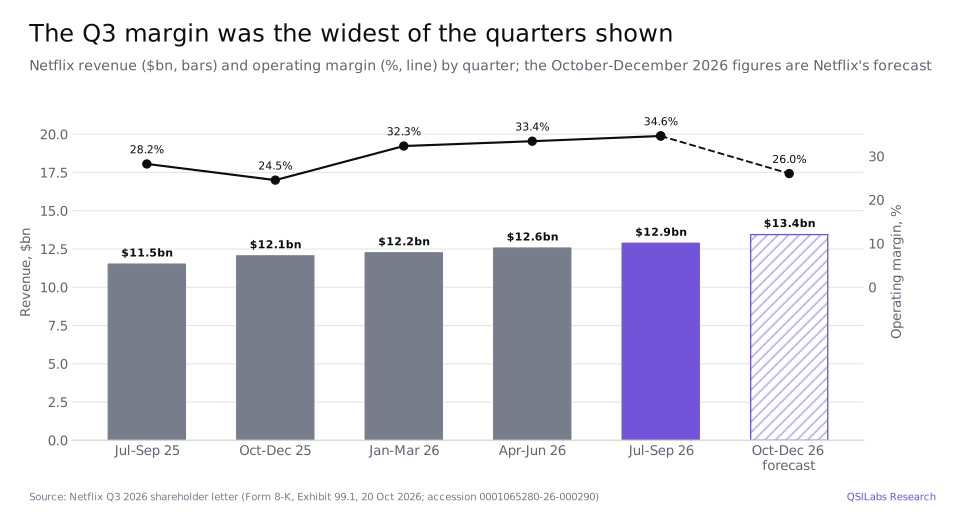
Netflix grew revenue and profit strongly in Q3 2026. Revenue rose $1,364m to $12,874m, in line with the company's forecast. Total operating costs rose only 1.8%, so operating income rose $1,210m to $4,459m and the operating margin rose 6.4 percentage points to 34.6%, the widest of the last five quarters (Q3 letter).
Part of that margin gain is a quirk of the comparison. Cost of revenues fell 1.4% to $6,079m because the July-September 2025 quarter included a $619m expense for non-income tax assessments in Brazil. Content amortization, the biggest cost, rose $233m (Form 10-Q). Without the Brazil charge, the year-earlier margin would have been about 33.6%, so the underlying improvement was about one percentage point, not six. Technology and development costs rose 21% to $1,033m, sales and marketing rose 6% and general and administrative costs 2%.
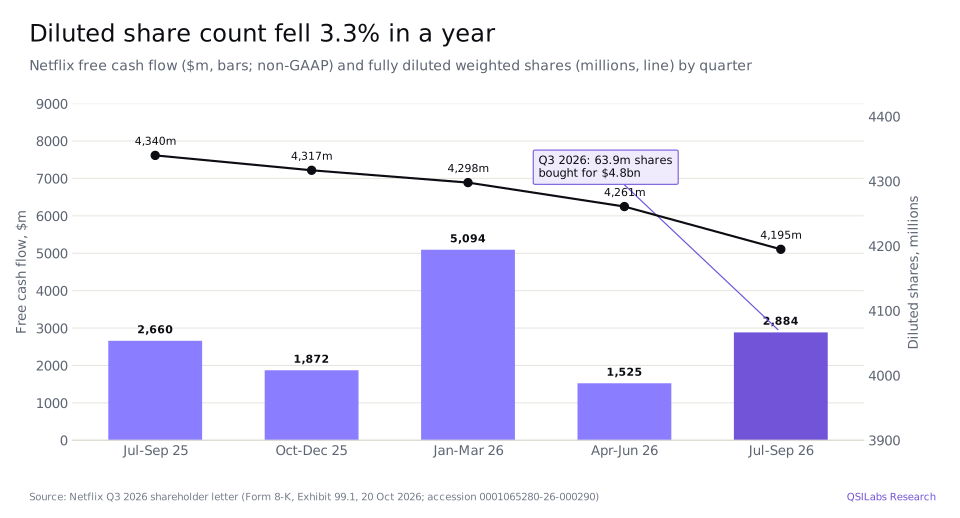
Below operating income, interest expense was $185m and interest and other income $43m. The tax charge was $653m, a 15.1% rate. Net income rose 44% to $3,664m and diluted EPS rose to $0.87, 49% higher on Netflix's unrounded figures. The diluted share count fell 3.3% from a year earlier to 4,195m, which added to the growth in earnings per share.
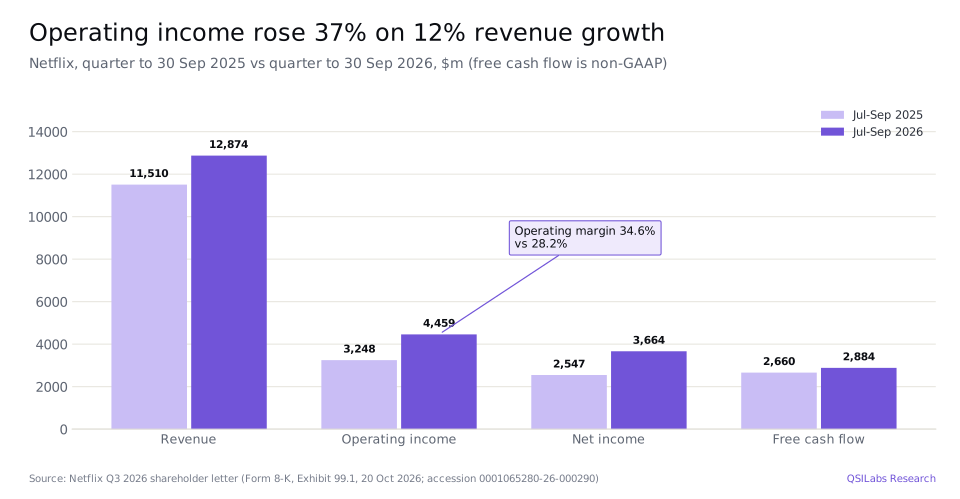
For the first nine months of 2026, revenue was $37,684m, up 13.7%, operating income was $12,608m, up 22%, a 33.5% margin, and net income was $12,348m, up 44%. That net income includes the $2.8bn termination fee Netflix received in the first quarter when Warner Bros. Discovery walked away from their merger agreement; it is booked in interest and other income, below operating income. Diluted EPS for the nine months was $2.90, against $1.97.
Over the past five quarters revenue has risen from $11.5bn to $12.9bn, and the operating margin has ranged from 24.5% to 34.6%. The fourth quarter is usually Netflix's lowest-margin quarter because of the timing of content and marketing spending: the margin was 24.5% in October-December 2025, and Netflix forecasts 26.0% for October-December 2026.
- Nov 2025Ten-for-one stock split takes effectQ3 2026 letter
- 4 Dec 2025Agreement to buy Warner Bros. Discovery's studios and streaming businesses, including HBO Max; amended on 19 January 2026Form 10-Q
- 27 Feb 2026Warner Bros. Discovery ends the agreement to merge with Paramount Skydance, which pays Netflix a $2.8bn termination feeForm 10-Q
- Mar 2026Netflix completes an acquisition for about $587m in cashForm 10-Q
- 22 Jul 2026$1bn of 5.250% notes due 2036 issued to fund a $1bn note maturing in November 2026Form 8-K; Q3 letter
- Jul-Sep 202663.9m shares bought back for $4.8bn, which Netflix called its largest quarter of repurchasesQ3 letter; 10-Q
- 20 Oct 2026Q3 2026 results: revenue up 12%, a 34.6% operating margin, 2026 ad revenue forecast cut to about $2.7bn; Peter Rice named Chief Content OfficerQ3 letter; earnings interview
- 21 Oct 2026NFLX closes at $65.04, down 5.3% from $68.69; Form 10-Q filedYahoo Finance; SEC EDGAR
- 28 Oct 2026NFLX closes at $61.99, its lowest close of the past yearYahoo Finance
- 30 Oct 2026NFLX closes at $62.08, the price used in this articleYahoo Finance
- Jan 2027Q4 2026 results and 2027 guidance dueEarnings interview
How did Netflix's regions do in Q3 2026?
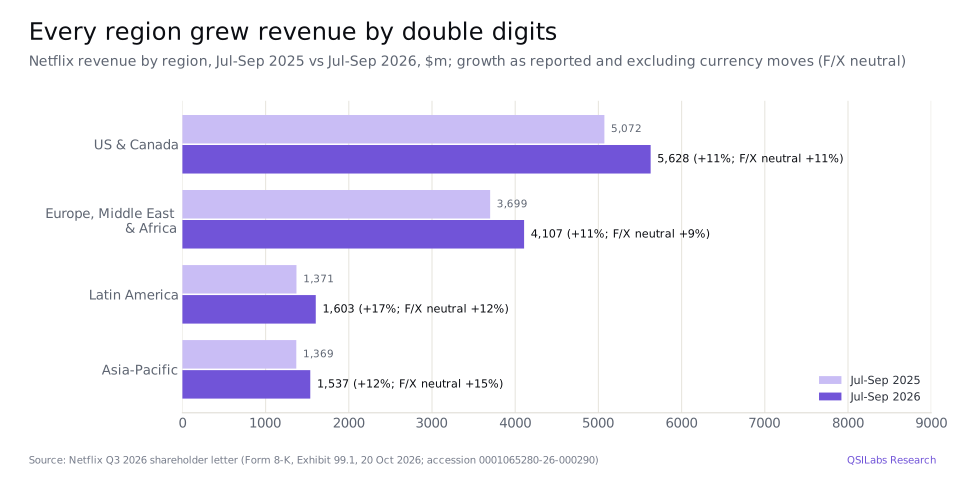
All four of Netflix's regions grew revenue by double digits in the quarter. Excluding currency moves, growth slowed from a year earlier in each of them; on reported figures it slowed everywhere except Latin America, where it rose from 10% to 17% as currencies swung. Netflix no longer reports membership numbers each quarter, so regional revenue is the best guide to where growth is coming from.
- US and Canada (UCAN): revenue of $5,628m, up 11%, with no currency effect. Growth was 17% a year earlier and 10% in April-June 2026. UCAN is 44% of revenue. Management said engagement in the US is "solid" but that it can do better with its US slate.
- Europe, Middle East and Africa (EMEA): revenue of $4,107m, up 11%, or 9% excluding currency moves. Netflix highlighted series from the UK, France and Sweden, and its TF1 partnership in France, which brings third-party French programming onto the service.
- Latin America (LATAM): revenue of $1,603m, up 17%, or 12% excluding currency moves. Netflix and Globo have just announced their largest content licensing agreement ever, which Netflix called its most meaningful licensing deal in Brazil.
- Asia-Pacific (APAC): revenue of $1,537m, up 12%, or 15% excluding currency moves, the fastest underlying growth of the four regions. India view hours grew 24%, Netflix had its largest quarter of paid net additions there, and India revenue grew about 18% excluding currency moves.
India is the example management keeps returning to. A strong local slate was led by Lock Upp, Netflix's first daily reality series, which Netflix says drove the most viewing of any title ever on Netflix in India, and a loyalty bundle with Flipkart helped sign up members. The co-CEOs' argument is that this shows the model working: better programming drives viewing, viewing drives membership and revenue. The question investors keep asking is whether the same can happen in the US. Management said it wants view hours to grow faster and is "not satisfied", and US growth relies heavily on price rises and advertising.
Management addressed that directly. Netflix said members responded to its 2026 price increases as expected, in line with earlier rounds, and that US members pay less per hour of viewing than for other subscription video services. It has also hired Peter Rice, formerly of Disney, as Chief Content Officer in place of Bela Bajaria. Co-CEO Ted Sarandos said the strategy does not need a "fundamental shift" but that Netflix needs "better execution in the U.S."
Why did Netflix cut its 2026 ad revenue forecast?
Netflix now expects about $2.7bn of advertising revenue in 2026, against about $3bn before. It blamed a "slightly slower than expected rollout of some ad product capabilities". In the earnings interview, co-CEO Greg Peters said Netflix had set an aggressive product roadmap and was "a bit behind" it, because some new ad products and partner integrations took longer than planned. He said the ads business is still growing by more than 80% this year, that demand remains strong and that the number of advertisers continues to widen.
Advertising is small in Netflix's revenue, about 5% of the 2026 total on the new forecast, but it is one of the three levers management counts on for growth, with membership and pricing. Mr Peters said there is still a gap between average revenue per membership on the ad tier and on the standard plan without ads, that the gap is narrowing, and that closing it is an opportunity rather than a problem. Netflix is building its own ad technology, the Netflix Ads Suite, and in the quarter added programmatic access through connected-TV marketplace deals and partnerships with MercadoLibre in Latin America and AdForm in EMEA.
The bigger change will come next year. Netflix will introduce its ad-supported plan in 15 more countries in 2027. The first group launches in March 2027: nine countries in EMEA, plus Colombia, Peru and New Zealand. More ad markets mean more ad-plan members and more inventory to sell, which should help ad revenue grow even if prices per ad stay low for a while.
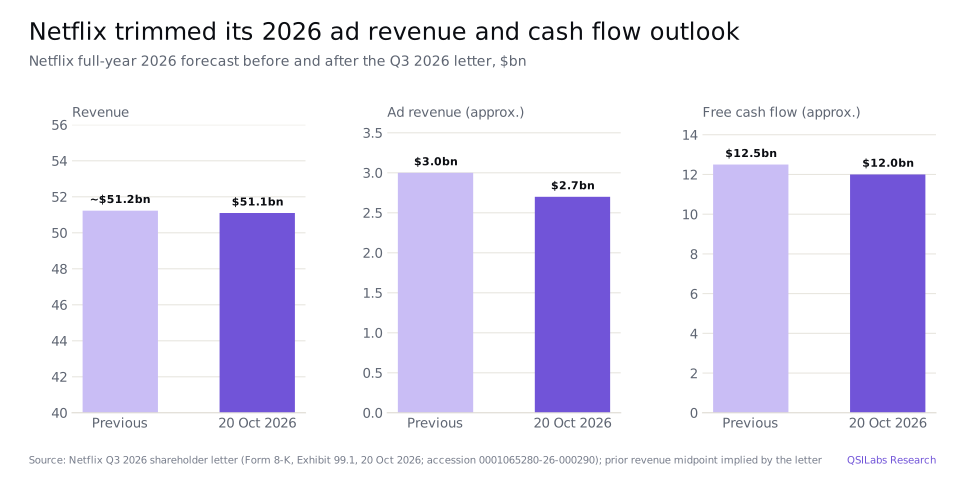
Subscription revenue has done better than Netflix expected, which is why the total revenue forecast moved by only 0.2%. Netflix said the new $51.1bn figure is 0.2% below the midpoint of its previous range, which implies a previous midpoint of about $51.2bn.
What is Netflix's guidance for Q4 and 2026?
For the fourth quarter of 2026 Netflix forecasts:
- Revenue: $13,442m, up 11.5%, or 11% excluding currency moves, driven by membership growth, pricing and ad revenue.
- Operating income: $3,500m, a 26.0% margin, against 24.5% a year earlier. The margin includes about 1.2 percentage points of costs from the job cuts Netflix announced in October, which on our arithmetic is about $160m.
- Net income and EPS: $2,787m and $0.67 a diluted share, against $0.56 a year earlier.
For the full year 2026 that means revenue of $51.1bn, up 13% (12% excluding currency moves), and an operating margin of 31.5% (31.4% at the exchange rates of 1 January 2026), against 29.5% in 2025. The margin guide includes about 0.3 percentage points of job-cut costs. Netflix said its forecast implies operating income growth of more than 20%. Adding the fourth-quarter forecast to the nine months gives 2026 operating income of about $16.1bn, net income of about $15.1bn and diluted EPS of about $3.57, including the termination fee.
Netflix also expects free cash flow of about $12.0bn, down from $12.5bn, mainly because it expects to close a real estate transaction in the fourth quarter, and it still expects cash spending on content to be about 1.1 times content amortization for the year.
What about 2027? Chief financial officer Spence Neumann said it was "premature" to give guidance, which will come with the fourth-quarter results in January. He said all three revenue levers, membership growth, pricing and ads, are working, that Netflix expects "strong revenue growth into 2027", and that its financial objectives are unchanged: "We look to sustain double-digit revenue growth, we look to expand margins, and we look to increase free cash flow." He would not say how much the job cuts will save in 2027. The S&P Global consensus, compiled by StockAnalysis, has 2026 revenue of $51.12bn and 2027 revenue of $56.60bn, up 10.7%, with EPS of $3.57 and $3.77.
Netflix free cash flow, content spending and buybacks
Netflix generated $3,162m of cash from operations in the quarter and spent $279m on property and equipment, leaving free cash flow of $2,884m, up 8%. In the first nine months free cash flow was $9,503m, up from $7,589m, even though Netflix made $729m of one-off payments for Brazilian tax assessments covering earlier years (Form 10-Q).
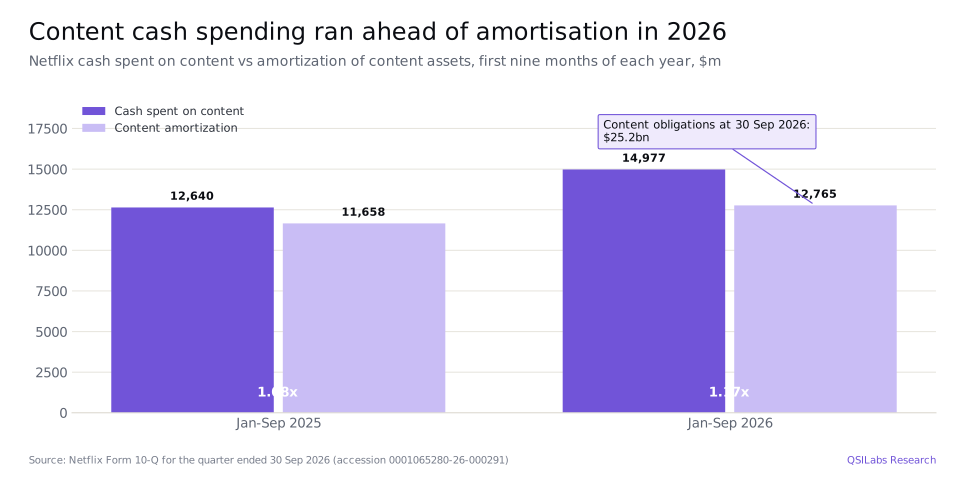
The biggest call on Netflix's cash is content. In the first nine months Netflix added $14,934m of content assets and its content liabilities fell by $43m, so it spent about $14,977m in cash on content, against content amortization of $12,765m, a ratio of 1.17 times. A year earlier the ratio was 1.08 times. Content assets on the balance sheet rose to $34.6bn from $32.8bn at the end of 2025, and content obligations, including commitments not yet on the balance sheet, were $25.2bn at 30 September. Netflix expects the full-year ratio to come down to about 1.1 times, which implies lighter content cash spending in the fourth quarter.
Netflix returns its spare cash through buybacks; it pays no dividend. In the quarter it bought 63,917,979 shares for $4.8bn and in the nine months 130,349,765 shares for $10.7bn, more than its free cash flow over the period. It had $22.3bn of authorization left at 30 September. Shares outstanding were 4,106m at 30 September 2026, and the diluted share count used for EPS has fallen from 4,340m to 4,195m over the past year.
The balance sheet carries $15.1bn of debt, $2.5bn of it due within a year, against $8.2bn of cash and short-term investments. Netflix put gross debt at $15.3bn and said it was about $1bn higher than at the end of June because it issued $1bn of 5.250% notes due 2036 in July to repay a $1bn note due in November 2026. It has an undrawn $3bn revolving credit facility and an unused $3bn commercial paper program. Netflix also paid about $587m in cash for an acquisition in March 2026.
What happened with Warner Bros. Discovery?
In December 2025 Netflix agreed to buy Warner Bros. Discovery's film and television studios and its streaming business, including HBO Max and HBO, and the parties amended the deal in January 2026. On 27 February 2026 Warner Bros. Discovery terminated the agreement to merge with Paramount Skydance instead, and Paramount Skydance paid Netflix the $2.8bn termination fee on its behalf (Form 10-Q). The fee boosted Netflix's first-quarter net income but not its operating income,. Netflix is now back to a strategy of licensing and partnerships: in the quarter it signed a licensing deal with Disney that brought all five Ice Age films to the service, and its Globo deal in Brazil.
Netflix stock Q3 2026: is NFLX undervalued?
On our numbers, modestly. We value Netflix at $69.49 a share, against a $62.08 close on 30 October 2026: our value is 12% above the price. At $62.08 Netflix's market value is about $259bn on our 4,167m diluted shares, or about 17 times consensus 2026 EPS of $3.57 and 16 times 2027 EPS of $3.77, and about 22 times the 2026 free cash flow forecast.
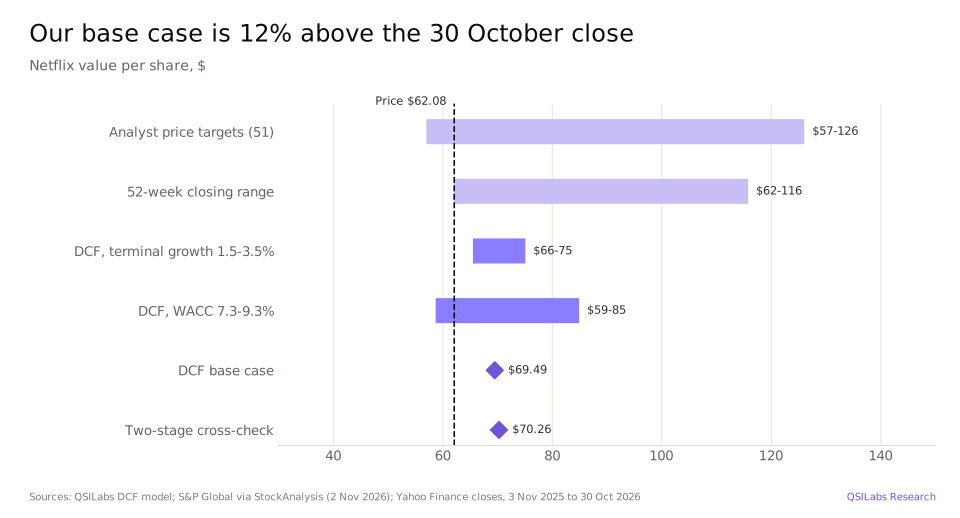
The shares have fallen from $110.01 on 3 November 2025 to $62.08, a drop of 44%, while revenue and operating income have kept growing at double-digit rates. On our forecast, which does not assume the margin rises beyond the 2026 level, the price implies a cost of capital of about 8.9%, against our 8.26%, or cash flow growth forever of under 1% a year, against our 2.5%. That is a modest discount, not a deep one: Netflix is a growing, highly profitable business, but our value already assumes revenue growth slows from 13% this year to 4% by 2035.
Analysts are more positive than we are. The 51 analysts in the S&P Global consensus rate Netflix a Buy, with 26 Strong Buy, 7 Buy, 16 Hold and 2 Strong Sell ratings in October, and an average price target of $84.76, a median of $82 and a range of $57 to $126 (StockAnalysis). After the results Phillip Securities cut its target from $110 to $100 and Argus from $120 to $95, TD Cowen kept $100, and Wolfe Research downgraded the stock to Hold.
Method
We forecast Netflix's revenue, operating income, tax, capital spending and working capital for 2026 to 2035, discount the unlevered free cash flow at an 8.26% weighted average cost of capital and add a terminal value with 2.5% growth and a 15% return on new investment. The cost of capital uses Aswath Damodaran's data for the US entertainment industry, with a 5.12% risk-free rate. The terminal value is 63.3% of the enterprise value of $295.6bn.
Operating income is Netflix's GAAP operating income, which is after content amortization, so the cost of content is in the forecast through the margin. We add cash and short-term investments of $8.22bn and subtract $15.13bn of debt, the short-term debt of $2.47bn plus long-term debt of $12.66bn. We add $0.89bn so that free cash flow from 30 September to the 30 October valuation date matches the fourth quarter implied by Netflix's $12.0bn free cash flow forecast. That gives equity value of $289.6bn, or $69.49 across 4,167m diluted shares: the 4,106m shares outstanding at 30 September plus 61m of dilution from options, the gap between diluted and basic shares in the quarter. A two-stage cross-check, in which returns on new investment fade over ten years, gives $70.26.
The main forecast inputs are:
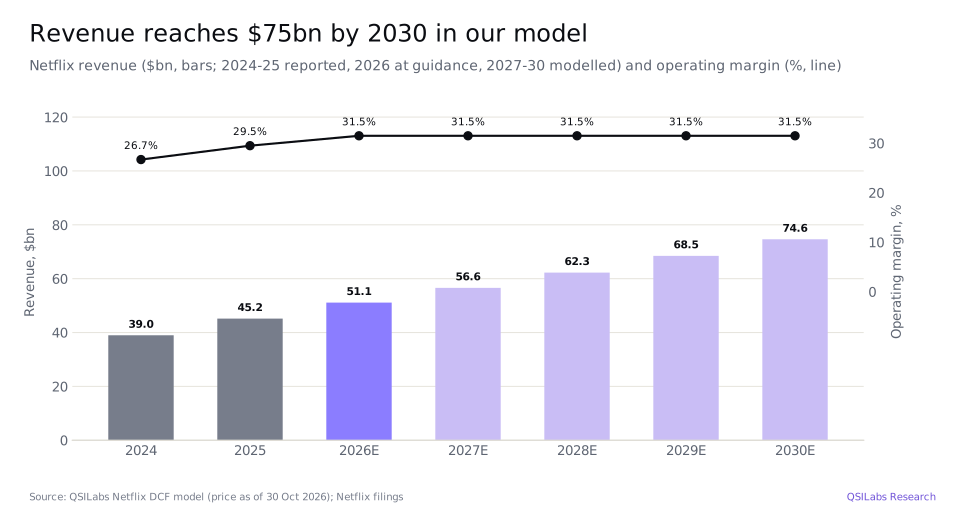
- 2026 revenue: $51.1bn, up 13.2%, in line with guidance and the $51.12bn consensus: $37.7bn reported in nine months and the $13.4bn fourth-quarter forecast.
- 2026 operating income: $16.1bn, a 31.5% margin, in line with guidance.
- 2027: revenue of $56.6bn, up 10.7%, in line with consensus and with management's aim of double-digit growth.
- After 2027: revenue growth of 10% in 2028 and 2029, 9% in 2030, then one point less each year to 4% in 2035, when revenue reaches $99.8bn.
- Operating margin: held at 31.5% from 2027 onward. Netflix aims to widen its margin every year, but we do not build that in; the house rule for companies already well above their peers' margins is to hold the last guided margin flat.
- Tax: 17%, close to the 17.3% rate of the first nine months.
- Capital spending: $3.5bn in 2026, allowing for the real estate transaction in Netflix's free cash flow guide, $2.9bn in 2027 and about 5% of revenue after that, so that terminal growth is paid for by reinvestment.
How the number moves if you argue with us
| Value per share, $ | g = 1.5% | g = 2.0% | g = 2.5% | g = 3.0% | g = 3.5% |
|---|---|---|---|---|---|
| WACC 7.26% | 78.00 | 81.13 | 84.89 | 89.50 | 95.32 |
| WACC 7.76% | 71.24 | 73.63 | 76.45 | 79.84 | 84.00 |
| WACC 8.26% | 65.50 | 67.34 | 69.49 | 72.02 | 75.07 |
| WACC 8.76% | 60.57 | 62.00 | 63.65 | 65.57 | 67.84 |
| WACC 9.26% | 56.28 | 57.41 | 58.69 | 60.16 | 61.87 |
Source: QSILabs Netflix DCF model. The biggest single question is the margin. If Netflix delivered on its aim of wider margins and the operating margin rose steadily to 35% by 2030 and stayed there, with everything else unchanged, our value would be about $77 a share; at 37% it would be about $82. If instead the margin fell back to 2025's 29.5% and stayed there, our value would be about $65. The cost of capital matters as much: each half-point on the WACC moves the value by roughly $6-7 a share.
Risks to the Netflix investment case
The risks cut both ways. On the upside for the shares:
- Wider margins. Netflix has raised its operating margin from 26.7% in 2024 to 29.5% in 2025 and a guided 31.5% in 2026, and says it wants to keep widening it. Our model holds it flat; each extra percentage point is worth roughly $2 a share.
- Advertising. Ads are about 5% of revenue and growing by more than 80% this year. The launch in 15 new countries in 2027 and a narrowing gap between ad-tier and standard-plan revenue per member could make ads a much bigger growth driver.
- Buybacks at a lower price. Netflix has $22.3bn of authorization left, about 9% of its market value at $62.08, and bought back more stock in the first nine months than it generated in free cash flow.
On the downside:
- US engagement. Management says it is not satisfied with view hour growth and needs better execution in the US, where growth leans on price rises and ads. If members start to push back on prices, revenue growth could fall below 10%.
- Content spending. Cash spent on content ran at 1.17 times amortization in the first nine months, and Netflix has $25.2bn of content obligations. Spending more than it amortizes for longer would hold back free cash flow, and live sports rights can be expensive.
- Execution and leadership change. A new Chief Content Officer, the largest job cuts since 2022 according to one analyst, and a slower ad product rollout all add execution risk at a time when competition for viewers' time is intense.
- Currency. About 56% of revenue comes from outside the US and Canada, and 57% of nine-month revenue was in currencies other than the US dollar (Form 10-Q), so a stronger dollar reduces reported growth; growth excluding currency moves was 11% in the quarter, against 12% reported.
FAQ
What is QSILabs' value for Netflix stock after Q3 2026 earnings?
QSILabs values Netflix (NFLX) at $69.49 per share as of results for the quarter ended 30 September 2026, based on a discounted cash flow model with an 8.26% cost of capital and 2.5% terminal growth. The shares closed at $62.08 on 30 October 2026, about 11% below that value. Our sensitivity range is roughly $59-85 a share.
Is Netflix stock a buy after its Q3 2026 results?
On our valuation, Netflix stock looks modestly cheap: our $69.49 value is 12% above the $62.08 price, and the price is near the bottom of our DCF range of about $59-85. The 51 analysts in the S&P Global consensus rate Netflix a Buy with an average target of $84.76. This is analysis, not investment advice.
How much did Netflix earn in Q3 2026?
Netflix earned $0.87 a diluted share in the quarter ended 30 September 2026, against $0.59 a year earlier, on net income of $3.66bn. Revenue was $12.87bn, up 12%, and operating income was $4.46bn, up 37%, a 34.6% operating margin.
Why did Netflix stock fall after its Q3 2026 earnings?
NFLX fell 5.3% on 21 October 2026, the first trading day after the results, to $65.04, and kept falling to $61.99 by 28 October. Netflix cut its 2026 ad revenue forecast to about $2.7bn from about $3bn and its free cash flow forecast to about $12.0bn, said US engagement could be better, and gave no 2027 guidance.
How big is Netflix's advertising business?
Netflix expects about $2.7bn of advertising revenue in 2026, about 5% of its forecast $51.1bn of revenue, and says ad revenue is growing by more than 80% this year. It will launch its ad-supported plan in 15 more countries in 2027, starting in March with nine EMEA countries, Colombia, Peru and New Zealand.
How many subscribers does Netflix have?
Netflix no longer reports subscriber numbers every quarter. In its Q3 2026 letter it said it serves an audience "approaching one billion people", counting everyone who watches, not just paying accounts. It said churn improved year on year and that India had its largest quarter of paid net additions.
Does Netflix pay a dividend?
No. Netflix returns cash through share buybacks instead. It bought back 63.9m shares for $4.8bn in Q3 2026 and $10.7bn of stock in the first nine months of the year, and had $22.3bn of buyback authorization left at 30 September 2026.
When will Netflix give 2027 guidance?
Netflix said it will give 2027 guidance with its fourth-quarter results in January 2027. Management's stated objectives are to sustain double-digit revenue growth, widen margins and grow free cash flow. Consensus expects 2027 revenue of $56.60bn, up 10.7%, and EPS of $3.77.
Did Netflix get paid when the Warner Bros. Discovery deal fell through?
Yes. Paramount Skydance paid Netflix a $2.8bn termination fee on behalf of Warner Bros. Discovery on 27 February 2026, when Warner Bros. Discovery ended its agreement with Netflix to merge with Paramount Skydance. Netflix recorded the fee in interest and other income in the first quarter of 2026.
Sources
- Netflix, Q3 2026 shareholder letter (Form 8-K, Exhibit 99.1, 20 Oct 2026; accession 0001065280-26-000290) www.sec.gov
- Netflix, Form 10-Q for the quarter ended 30 September 2026 (21 Oct 2026; accession 0001065280-26-000291) www.sec.gov
- Netflix, Q3 2026 earnings interview, 20 Oct 2026 (transcript via StockAnalysis, from Quartr) stockanalysis.com
- Netflix, Form 8-K on the issue of senior notes (22 Jul 2026; accession 0001193125-26-312575) www.sec.gov
- StockAnalysis: Netflix forecast and analyst ratings, S&P Global data (accessed 2 Nov 2026; last updated 22 Oct 2026) stockanalysis.com
- StockAnalysis: Netflix statistics and annual financials (accessed 2 Nov 2026) stockanalysis.com
- Yahoo Finance chart data: NFLX closing prices and split history (November 2025 to November 2026) query1.finance.yahoo.com
- Damodaran Online: cost of capital by industry (Entertainment) pages.stern.nyu.edu
- QSILabs Netflix discounted cash flow model (internal; price as of 30 Oct 2026)
Disclaimer
This article is for information only and is not investment advice or a recommendation to buy or sell any security. QSILabs estimates are opinions based on public information and our own model, and they may be wrong. Figures are as of the dates stated. Do your own research or consult a licensed adviser before investing.
More from QSI Labs
Related analysis: Alphabet stock Q3 2026: YouTube, cloud and valuation, Meta stock Q3 2026: ads and AI capex, Amazon stock Q3 2026 and Apple Q3 2026 earnings.
Read our white paper, QSI Labs: An AI-Native Trading Firm Built on a Training Loop (October 2026), available on request, or browse the research index.