Research / Earnings and valuation
Meta Stock Q3 2026:Revenue +26%, Muse AI and the Capex Bill
As of: Figures are as of Meta Platforms' Q3 2026 results (quarter ended 30 September 2026, reported 21 October 2026) and the October 2026 equity offerings. The share price is the Nasdaq close of META on 30 October 2026, $614.99. Published 2 November 2026.
The short answer. Meta stock in Q3 2026 rests on two facts: the advertising business is growing 26% a year, and the AI build is now consuming all of the cash it makes. Meta Platforms grew revenue 26% to $64.6bn, yet free cash flow was negative $2.1bn after $34.9bn of capex, and Meta raised about $37bn of new equity in late October. Our discounted cash flow puts Meta at $520.34 per share, about 15% below the $614.99 close on 30 October 2026.
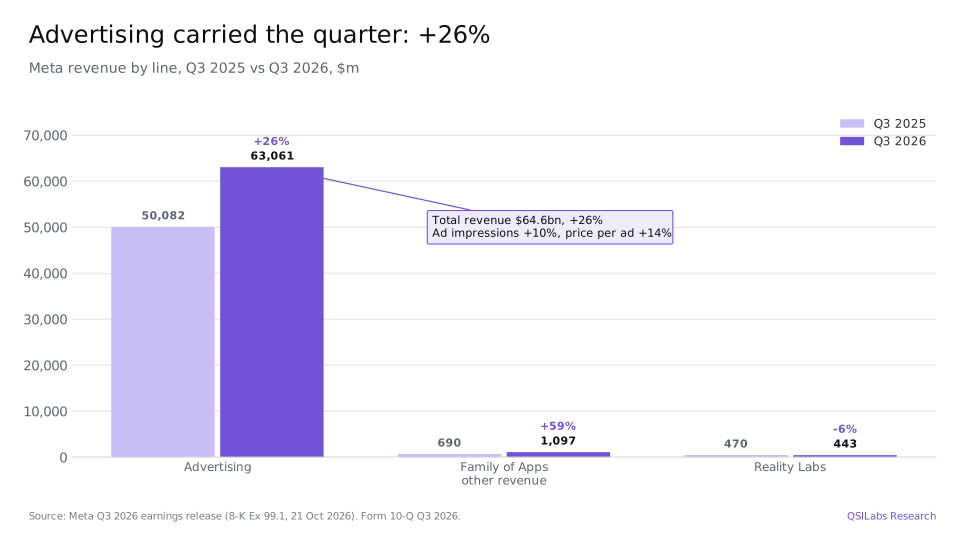
Meta stock Q3 2026 was a story of two numbers. Revenue of $64.60bn beat the year-earlier $51.24bn by 26%, with ad impressions up 10% and the average price per ad up 14% (Meta Q3 2026 earnings release). But income from operations fell 37% to $12.99bn, because costs included a $9.89bn charge for the agreement with 52 state attorneys general, and capital expenditures nearly doubled. The shares fell from $697.52 on 21 October to $648.85 the next day and kept falling, to $614.99 on 30 October (Yahoo Finance), as Meta launched a share sale, a mandatory convertible preferred and plans for a $60bn at-the-market programme.
In this article we go through Meta Platforms' Q3 2026 numbers against a year earlier, the Family of Apps and Reality Labs segments, cash flow and the balance sheet, guidance, Meta's AI strategy from Muse to its gigawatt superclusters and how it is paying for them, and our valuation of META, with the assumptions laid out so you can argue with them.
Key takeaways
- Valuation: QSILabs values Meta Platforms, Inc. (Nasdaq: META) at $520.34 per share as of Q3 2026, against a $614.99 close on 30 October 2026, about 15% below the market price.
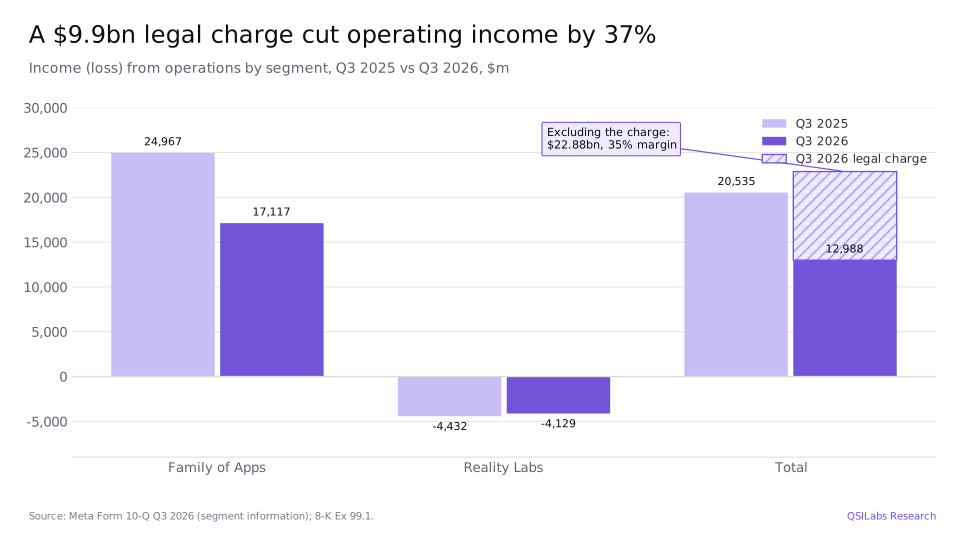
- Q3 2026 results: Meta's revenue rose 26% to $64.60bn in the quarter ended 30 September 2026; operating income fell 37% to $12.99bn, or $22.88bn excluding a $9.89bn legal charge; diluted EPS was $3.83 ($7.40 excluding the charge).
- Capex and cash: Meta spent $34.91bn on capex in Q3 2026, guides to $135-145bn for 2026, and had free cash flow of negative $2.12bn in the quarter.
- Funding the AI build: In October 2026 Meta sold 40 million Class A shares at $625 through forward sales (about $24.9bn net) and $12.5bn of 6.50% mandatory convertible preferred stock, and plans a $60bn at-the-market programme once its Class C stock trades.
- AI products: Meta says Muse reached more than 10 million users in the US and Canada in its first weeks and that more than 2 million businesses use its Business Agent each week (Meta, 26 October 2026).
Key numbers from Meta's Q3 2026 earnings
| Q3 2026 vs Q3 2025, $m | Q3 2025 | Q3 2026 | Change |
|---|---|---|---|
| Revenue | 51,242 | 64,601 | +26% |
| Advertising revenue | 50,082 | 63,061 | +26% |
| Costs and expenses | 30,707 | 51,613 | +68% |
| Income from operations | 20,535 | 12,988 | -37% |
| Operating margin | 40% | 20% | -20pt |
| Provision for income taxes | 18,954 | 3,141 | -83% |
| Net income | 2,709 | 9,860 | +264% |
| Diluted EPS | $1.05 | $3.83 | +265% |
| Capex, incl. finance-lease principal | 19,374 | 34,906 | +80% |
| Free cash flow | 10,625 | (2,120) | swing of $12.7bn |
Sources: Meta Q3 2026 earnings release (8-K Ex 99.1) and Form 10-Q. Free cash flow is operating cash flow less purchases of property and equipment and principal payments on finance leases, as defined by Meta.
Meta Q3 2026 earnings: what happened
Meta's Q3 2026 earnings showed a core business growing faster than a year ago, profit hit by a one-off legal charge, and net income flattered by a weak comparison. The prior-year quarter carried an 87% effective tax rate, which Meta attributes mostly to the effects of the One Big Beautiful Bill Act enacted in Q3 2025, so net income more than tripled to $9.86bn even though operating income fell (Form 10-Q).
The legal charge is the agreement Meta announced in August 2026 with 52 attorneys general to resolve litigation related to teen mental health and social media. It provides for payments of up to about $18.59bn; Meta recognised $9.89bn in Q3, and about $12.7bn is payable to participating states in annual instalments over ten years. Meta has not recognised a liability for $5.3bn of contingent amounts and says it may recognise more expense later (Form 10-Q). Excluding the charge, Q3 operating income would have been $22.88bn and the effective tax rate 17%.
Mark Zuckerberg, Meta's founder and chief executive, framed the quarter around AI: "We hit major milestones this quarter toward delivering personal superintelligence for everyone - including launching Muse and Muse Wonder, our first frontier model... Our investments are paying off, the core business is strong, and we're seeing velocity across the board" (earnings release).
- Aug 2026Agreement with 52 state attorneys general on teen mental health litigation, payments up to ~$18.59bn8-K Ex 99.1
- 21 Oct 2026Q3 2026 results: revenue $64.6bn (+26%); Class C stock dividend announced8-K Ex 99.1
- 22 Oct 2026Form 10-Q filed; META closes at $648.85, from $697.52 the day beforeSEC; Yahoo Finance
- 26 Oct 2026~$35bn equity offerings launched as part of a financing plan with a planned ~$60bn ATMFWP
- 27 Oct 2026Priced: 40m Class A shares at $625 (forward sale) and $12.5bn of 6.50% mandatory convertible preferredFWP
- 29 Oct 2026Preferred offering closes; depositary shares list as METAM8-K
- 30 Oct 2026META closes at $614.99Yahoo Finance
- 19 Jan 2027Planned effective date of the non-voting Class C common stock8-K Ex 99.1
Over nine months, revenue was $181.71bn, up 29% on $141.07bn, while income from operations was $54.64bn, down 7% from $58.53bn because of the legal charge and higher infrastructure costs. Net income for the nine months was $52.48bn, helped by an $8.03bn discrete tax benefit in Q1 2026 related to the Corporate Alternative Minimum Tax (Form 10-Q).
How did Meta's segments do? Family of Apps and Reality Labs
Meta's Family of Apps segment (Facebook, Instagram, Messenger, WhatsApp and Threads) earned $17.12bn of operating income in Q3 2026, down 31%, while Reality Labs cut its loss to $4.13bn from $4.43bn (Form 10-Q). Family of Apps revenue was $64.16bn, up 26% from $50.77bn; Reality Labs revenue was $443m against $470m.
Family of Apps: ads, users and pricing
Meta's ad growth in Q3 2026 came from both volume and price: ad impressions across the Family of Apps rose 10% and the average price per ad rose 14% (earnings release). Family daily active people (DAP), the number of people using at least one Meta app each day, averaged 3.64bn in September 2026, up 3%. With user growth that slow, almost all of the revenue growth is monetisation, which Meta credits in part to AI-powered improvements in recommendations, engagement and ad performance. It has now delivered six consecutive quarters of more than 20% year-over-year revenue growth (Meta, 26 October 2026).
Costs rose much faster than revenue. Total costs and expenses rose 68% to $51.61bn, driven by legal costs including the settlement charge, infrastructure expense for data centres, technical infrastructure and third-party cloud services, and other items (Form 10-Q). General and administrative expense alone was $14.86bn against $3.51bn a year earlier. Headcount, by contrast, was 66,775 at 30 September 2026, down 15% year on year (earnings release).
Reality Labs: losses narrowing
Meta's Reality Labs, the virtual and augmented reality and AI glasses unit, lost $4.13bn in Q3 2026 and $12.78bn in nine months, slightly less than a year earlier. Meta now expects 2026 Reality Labs losses of $18-19bn, down from 2025, and "losses to narrow next year to around $15 billion as we reallocate investment toward other priority areas, primarily AI" (earnings release).
Where Meta's revenue comes from
Meta's Q3 2026 revenue by user geography was $26.22bn from the US and Canada, $14.02bn from Europe, $16.99bn from Asia-Pacific and $7.37bn from the rest of the world (Form 10-Q). The US and Canada are about 41% of revenue. Foreign exchange added about $113m to Q3 revenue; on a constant-currency basis growth was also 26%.
How much is Meta spending? Capex, cash flow and the balance sheet
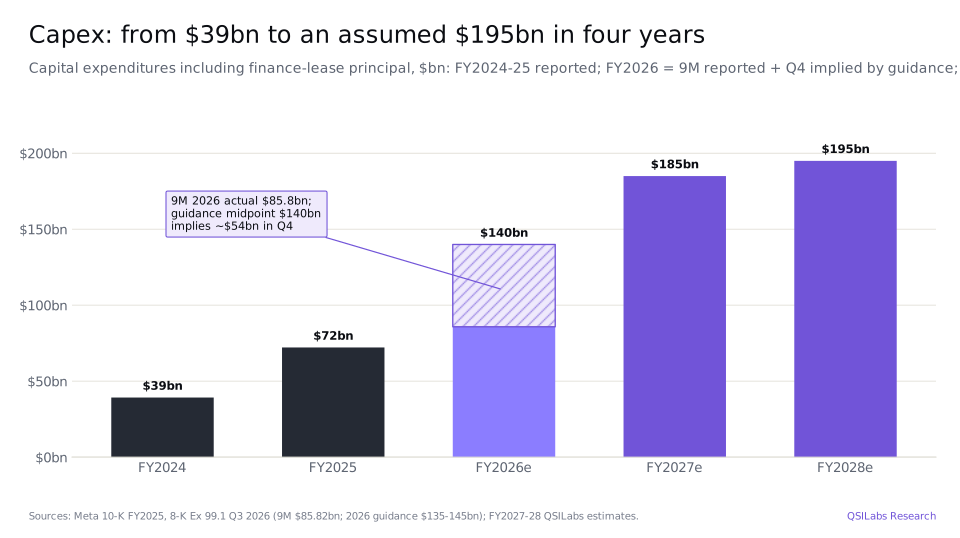
Meta spent $34.91bn on capital expenditures, including principal payments on finance leases, in Q3 2026, up 80% from $19.37bn, and $85.82bn in the first nine months (earnings release). For the full year it guides to $135-145bn, narrowed from $130-145bn, which implies roughly $49-59bn in Q4 alone.
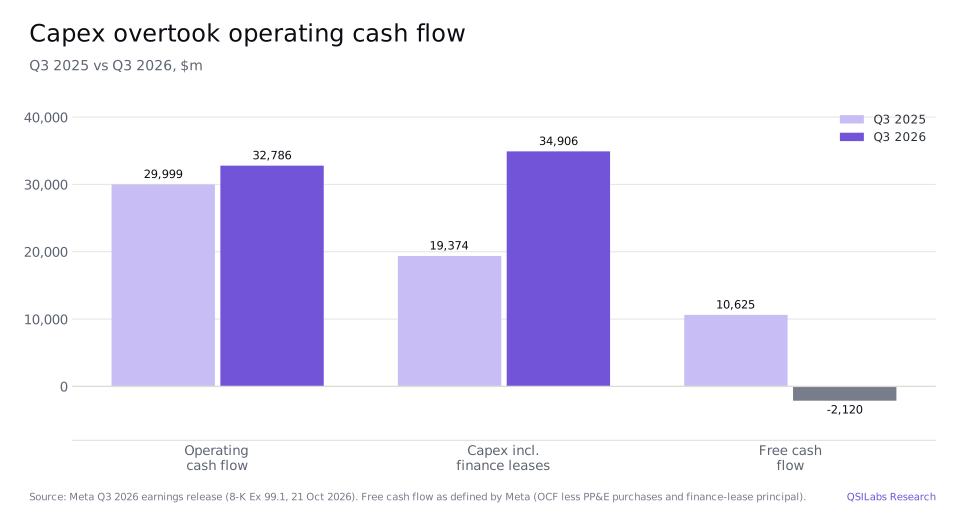
That spending has overtaken operating cash flow. Meta generated $32.79bn of cash from operations in Q3 2026, up from $30.00bn, but after $33.94bn of property and equipment purchases and $0.96bn of finance-lease principal, free cash flow was negative $2.12bn, against positive $10.63bn a year earlier. Over nine months, free cash flow was $11.05bn, down from $29.51bn.
Depreciation and amortisation were $19.51bn in nine months and share-based compensation $21.05bn (Form 10-Q). As the assets now being bought come into service, depreciation will rise quickly, and that is the main reason our model has operating margins lower in 2026-27 than in 2025.
The balance sheet and commitments
Meta Platforms ended Q3 2026 with $82.45bn of cash, cash equivalents and marketable securities ($11.22bn of cash and $71.23bn of marketable securities) and $83.67bn of debt: $80.92bn long-term plus $2.75bn current (Form 10-Q). It issued $24.91bn of long-term debt in the first nine months, paid $4.06bn of dividends and dividend equivalents, and bought back no stock, against $26.25bn of repurchases in the same period of 2025.
Three items sit outside the headline cash figure. First, $12.83bn of restricted cash equivalents, including $10.80bn held in escrow under infrastructure purchase agreements and due to be released between 2028 and 2030. Second, $454.52bn of non-cancellable contractual commitments, mostly for infrastructure. Third, Meta's maximum exposure under residual value guarantees to data-centre variable interest entities, $41.49bn (all Form 10-Q). Meta's credit ratings are Aa3/AA- (Meta, 26 October 2026).
Meta guidance for Q4 2026 and 2027
Meta guides to Q4 2026 revenue of $73-76bn, which is 22-27% growth on the $59.89bn it reported in Q4 2025, and to full-year 2026 total expenses of $175-179bn, raised to include the legal charge (earnings release). Excluding that charge, it still expects 2026 operating income to be above 2025. It expects a Q4 tax rate of 15-17%.
For 2027 Meta is not giving a revenue outlook, but says the benefits of its AI investments "position us to sustain strong overall revenue growth throughout 2027". On spending, it is "still developing our budget and capacity plans for next year, but we expect to continue investing aggressively to support both our core business and emerging AI initiatives" (earnings release).
Analyst consensus after the results, from S&P Global data on StockAnalysis (updated 28 October 2026), has revenue of $256.88bn in 2026 and $312.41bn in 2027 (+21.6%), and EPS of $29.79 and $35.43. The 62 analysts covering the stock have an average 12-month price target of $848.38, with a range of $629.06 to $1,050.
What is Meta's AI strategy? Muse, Muse Wonder and superclusters
Meta's AI strategy is to build what it calls "personal superintelligence" for billions of people and businesses, and to own the compute to run it: frontier models, consumer and business agents, enterprise products and AI glasses, on infrastructure it designs and largely owns (Meta, 26 October 2026). In its offering documents Meta set out the evidence that the spending is already paying back, and the plan to fund the rest.
- MuseMore than 10 million users in the US and Canada in the first weeks; shopping is the top use case, for over 25% of weekly usersFWP 26 Oct 2026
- Muse WonderMeta's first frontier model; also behind its API, Muse Code and enterprise offeringsFWP; 8-K Ex 99.1
- Business AgentMore than 2 million businesses a week; over 30 million conversations a weekFWP 26 Oct 2026
- InfrastructureData centers in 23 US states; four superclusters of more than 1 GW each; capacity nearly doubling in 2026FWP 26 Oct 2026
- SiliconCustom silicon and optimisation aimed at reducing the cost of computeFWP 26 Oct 2026
The consumer product is Muse. Meta says it onboarded more than 10 million Muse users in the US and Canada in the first weeks after launch, that shopping is the leading use case, with over 25% of Muse weekly active users engaging in it, and that partners are reporting strong usage in payments and productivity, "demonstrating meaningful commercial intent and future monetization opportunities". Meta also integrated Muse into its glasses and says it expects to cut serving costs through off-peak capacity, more efficient models and inference optimisation.
The model behind it is Muse Wonder, which Meta calls its first frontier model. Meta sees "an opportunity to serve high-margin inference demand" through the Meta Enterprise Platform, with Muse Wonder supporting its API, Muse Code and other enterprise services. On the business side, Meta estimates that at least 500 million self-identified small businesses use its apps; more than 2 million use the Business Agent weekly and people have over 30 million conversations with Business Agents each week.
The infrastructure is the expensive part. Meta owns data centres in 23 US states, is building four superclusters with more than one gigawatt of capacity each, and is on track to nearly double its total infrastructure capacity in 2026. It is investing in custom silicon to cut the cost of compute (Meta, 26 October 2026).
The market context matters for how far this can go. WPP Media forecasts global advertising revenue of about $1.3 trillion in 2026, up 8.9%, with social media at $465.2bn (+12.8%), slowing to 8.4% growth in 2027; Alphabet, Meta and Amazon take 57.6% of ad revenue outside China (WPP Media, June 2026). Meta's Family of Apps is already about a fifth of global advertising, so its AI products need to grow the market or open new revenue, not just take share.
How Meta is paying for it: up to $97.5bn of new equity
Meta's financing plan, announced on 26 October 2026, combines about $35bn of underwritten equity offerings with a planned $60bn at-the-market (ATM) programme, on top of operating cash flow and investment-grade debt (Meta, 26 October 2026). The final terms, priced on 27 October:
- Class A common stock: 40 million shares at $625, upsized to $25.0bn, sold under forward sale agreements with Morgan Stanley and Goldman Sachs. Meta expects about $24.9bn of net proceeds when it settles the forwards, on or before 19 November 2027. NVIDIA, Advanced Micro Devices and Broadcom indicated interest in buying up to $5.0bn of the shares.
- Mandatory convertible preferred: 250 million depositary shares at $50 each ($12.5bn), each a 1/20th interest in 6.50% Series A Mandatory Convertible Preferred Stock, listed as METAM. They convert on or about 15 August 2029 into 0.0681-0.0800 Class A shares per depositary share, depending on the price; the initial price is $625 and the threshold appreciation price $734.2144 (pricing term sheet). The offering closed on 29 October 2026 (Form 8-K).
- At-the-market programme: up to $60bn of Class C stock, not expected to start until Q1 2027, after Class C trading begins; Meta has not yet signed an agreement for it.
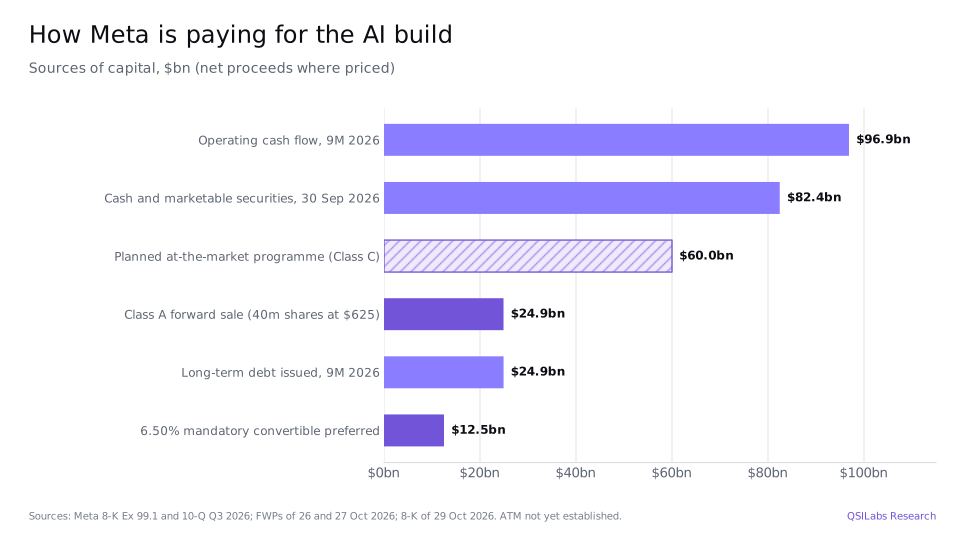
Meta generated $97bn of operating cash flow in the first three quarters of 2026, so this is not a company short of cash. It is a company whose planned spending is larger than its cash generation, and which has chosen equity, rather than only debt, to keep its balance sheet and Aa3/AA- ratings intact.
What the Class C stock means for Meta shareholders
Meta plans a one-time stock dividend of one share of new, non-voting Class C common stock for each Class A and Class B share, with the new certificate of incorporation effective on 19 January 2027 (earnings release). After the payment date Meta expects the Class A price to reflect the effect of a two-for-one stock split, and the dividend does not change anyone's voting power. Meta's special committee concluded that Mark Zuckerberg "is best suited to lead Meta into its next era", and Meta has signed a Founder Alignment Agreement with him covering sales of his Class C shares. The Class C shares also become the currency for the ATM programme and, after the Class C trigger event, for settling the preferred and the forwards.
Meta stock Q3 2026: is META overvalued?
On our numbers, Meta stock after Q3 2026 is priced above its discounted cash flow value: we get $520.34 per share against a $614.99 close on 30 October 2026, about 15% lower. The gap is not about the core business, which we model growing strongly. It is about how much capex Meta needs and how long it takes for that capex to produce cash.
Method
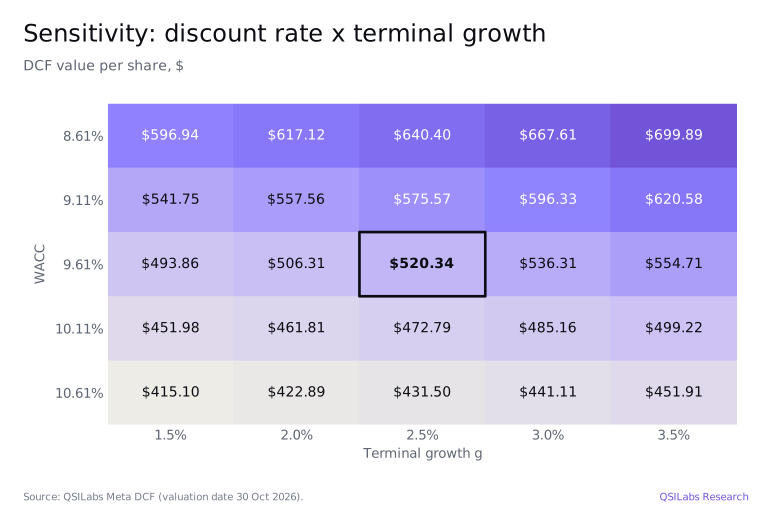
We value Meta Platforms with a ten-year discounted cash flow of unlevered free cash flow from 2026 to 2035 plus a terminal value, discounted at a 9.61% weighted average cost of capital (WACC, from Damodaran's US industry data) with 2.5% terminal growth. Revenue is built by segment from reported data. All forecasts are QSILabs estimates.
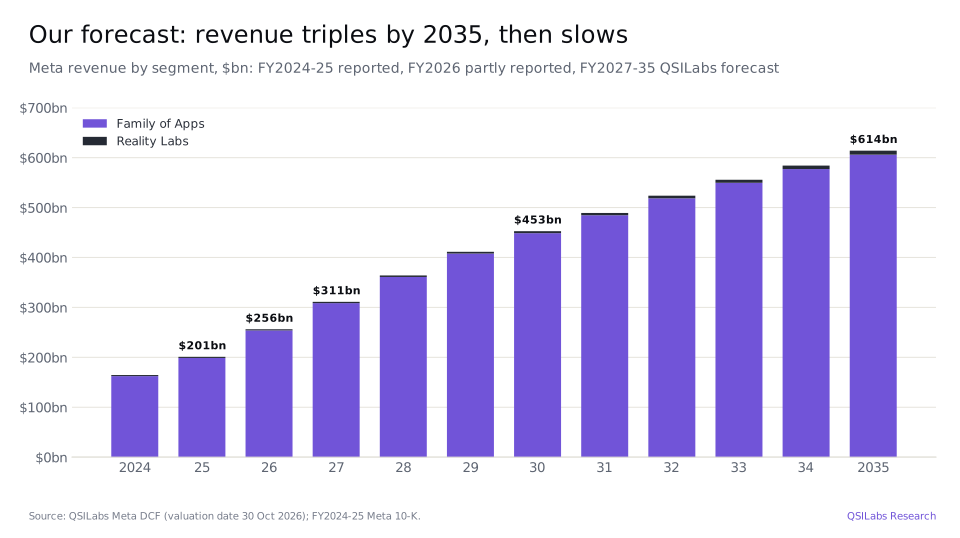
- Family of Apps revenue grows about 28% in 2026 (nine months reported plus a Q4 in line with guidance), 21.5% in 2027, in line with post-results consensus of $312.41bn for the group, then 17%, 13%, 10% and 8%, fading to 5% by 2034. Group revenue reaches $311.2bn in 2027, $452.7bn in 2030 and $614.0bn in 2035.
- Top-down check: Family of Apps revenue of about $254bn in 2026 is about 19.5% of WPP Media's $1.3 trillion global ad market. If that market grows about 7% a year (our assumption, below WPP's 2026-27 rates), our 2035 Family of Apps revenue of about $606bn would be about 25% of a $2.4 trillion market.
- Margins: operating margin of 34.8% in 2026 (including the legal charge) and 2027, rising to about 40% by 2030 and 42% by 2035 as depreciation growth slows and Reality Labs losses narrow to $15bn in 2027 and keep falling.
- Capex: $140bn in 2026 (guidance midpoint), then $185bn in 2027 and $195bn in 2028, peaking at about $201bn in 2029 and declining to $128bn by 2035. On these numbers our unlevered free cash flow stays negative through 2029 and turns positive in 2030.
- Bridge to equity: we add cash and marketable securities, the $10.80bn of escrowed cash, and the cash from the October offerings; subtract debt and finance leases, the remaining settlement payments, cash burn between 30 September and the valuation date and preferred dividends; and divide by 2,633m diluted shares, including the 40m forward-sale shares and the maximum 20m shares from the preferred.
| QSILabs DCF, $bn unless stated | Value |
|---|---|
| Enterprise value (PV of cash flows to 2035 + terminal value) | 1,338.9 |
| + Cash and marketable securities (30 Sep 2026) | 82.4 |
| + Escrowed infrastructure cash (10-Q) | 10.8 |
| + October 2026 offerings (preferred $12.5bn, forward sale $24.9bn) | 37.4 |
| - Debt, including finance leases | (84.9) |
| - Remaining settlement payments, September-October cash burn and preferred dividends | (14.6) |
| = Equity value | 1,370.0 |
| / Diluted shares, m | 2,633 |
| = Value per share | $520.34 |
Terminal value is 83.4% of enterprise value, which is high but typical for a company in the middle of a capex peak: most of the cash comes after 2030.
How the number moves if you argue with us
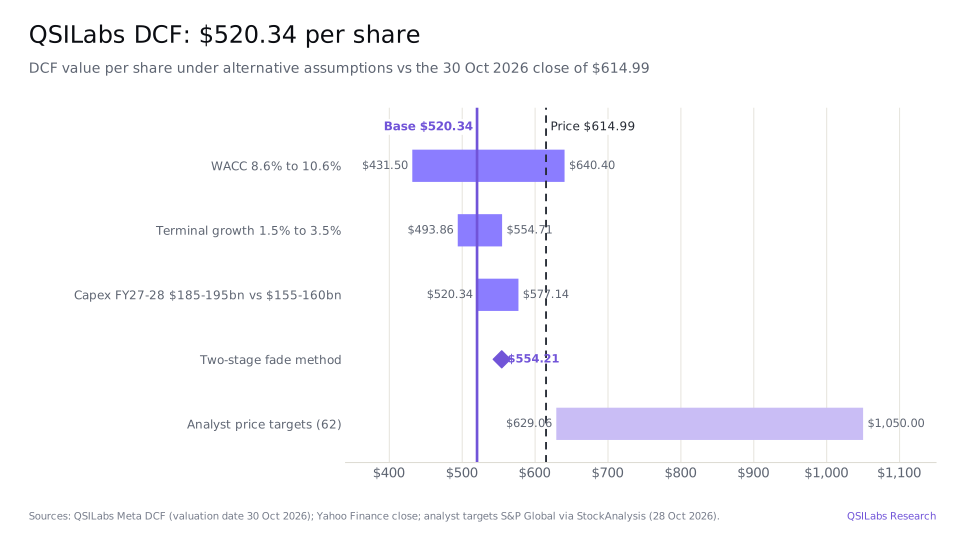
- Discount rate. At an 8.61% WACC the value is $640.40, above the share price; at 10.61% it is $431.50.
- Terminal growth. 1.5% gives $493.86 and 3.5% gives $554.71.
- Capex. If 2027-28 capex stays at $155bn and $160bn instead of $185bn and $195bn, the value rises to $577.14.
- Method. A two-stage version, with a longer fade in growth and returns after 2035, gives $554.21.
To justify $614.99 you need a discount rate close to 8.6%, or capex that peaks much lower than our assumption, or AI revenue (Muse, the Meta Enterprise Platform, Business Agents) that adds materially to our forecast. The analysts' average target of $848.38 assumes much more of the last.
Risks to the Meta investment case
The main risks to Meta Platforms (META) are capex that runs ahead of revenue, dilution from the equity programme, legal and regulatory costs and slowing ad-market growth; the main upside risk is faster monetisation of Muse and business AI.
- Capex without returns. Meta has $454.52bn of non-cancellable commitments and up to $41.49bn of residual value guarantees on data-centre arrangements. If AI demand or ad pricing slows, depreciation stays and revenue does not.
- Dilution. The forward sale adds 40m shares, the preferred up to 20m more by 2029, and a $60bn ATM would equal about 100m of today's shares at $600, around 4% of the current count. There have been no buybacks in 2026.
- Legal and regulatory. The attorneys general agreement leaves $5.3bn of contingent payments unrecognised, and Meta continues to face youth-safety, privacy and competition cases in the US and Europe (Form 10-Q).
- Ad-market cycle. WPP Media expects social advertising growth to slow from 12.8% in 2026 to 8.4% in 2027. Meta's Q4 guidance assumes about a 1% currency headwind.
- Upside risk: AI monetisation. More than 10m Muse users, a shopping-led use case and 30m weekly Business Agent conversations are early signs of revenue we barely model. Enterprise inference on Muse Wonder could add a high-margin business.
- Competition in AI. Alphabet, Microsoft and the AI labs are also spending heavily on AI models and compute. For comparison, see our Alphabet stock Q3 2026 analysis, our Microsoft stock Q3 2026 analysis and our NVIDIA stock Q3 2026 analysis.
FAQ
What is Meta stock worth after Q3 2026 earnings?
QSILabs values Meta Platforms (META) at $520.34 per share after Q3 2026, from a discounted cash flow at a 9.61% WACC and 2.5% terminal growth, valued as of 30 October 2026. Reasonable changes in assumptions give $431-$640, against a $614.99 close on 30 October 2026.
Is Meta stock a buy after Q3 2026 earnings?
On QSILabs' valuation, Meta (META) stock looks about 15% overvalued after Q3 2026: our DCF value is $520.34 a share against a $614.99 close on 30 October 2026. The ad business is growing 26%, but the price already assumes capex of $135-145bn this year and more in 2027 pays off. Analysts' average target is $848.38. This is not investment advice.
Why did Meta stock fall after Q3 2026 earnings?
Meta stock fell after its Q3 2026 earnings because a $9.89bn legal charge cut operating income by 37%, capex rose 80% to $34.91bn, free cash flow turned negative ($2.12bn), and Meta then announced about $35bn of equity offerings and a planned $60bn ATM. META fell from $697.52 on 21 October 2026 to $614.99 on 30 October.
How much will Meta spend on capex in 2026 and 2027?
Meta guides to $135-145bn of capex, including finance-lease principal, in 2026, after $85.82bn in the first nine months. It has not given a 2027 figure but expects "to continue investing aggressively". QSILabs assumes $185bn in 2027 and $195bn in 2028.
What is Meta Muse?
Muse is Meta's consumer AI service, launched in Q3 2026 and built on Muse Wonder, Meta's first frontier model. Meta says Muse onboarded more than 10 million users in the US and Canada in its first weeks, with shopping the leading use case for over 25% of weekly active users, and has been integrated into Meta's glasses.
What is Meta's Class C stock?
Meta's Class C stock is a new non-voting class to be distributed as a one-time dividend of one Class C share for each Class A and Class B share, with an effective date of 19 January 2027. Meta expects the Class A price to reflect a two-for-one split after the payment date; voting power does not change. Our per-share values are before that dividend.
How much did Meta raise in October 2026?
Meta priced about $37.5bn of equity in October 2026: 40 million Class A shares at $625 ($25.0bn, about $24.9bn net, delivered through forward sales by 19 November 2027) and $12.5bn of 6.50% mandatory convertible preferred stock (METAM) that converts around 15 August 2029. It also plans a $60bn at-the-market programme for Class C stock from Q1 2027.
Does Meta pay a dividend?
Yes, Meta Platforms pays a quarterly cash dividend on its Class A and Class B stock; dividend and dividend-equivalent payments were $1.36bn in Q3 2026 and $4.06bn in the first nine months. Meta has not repurchased shares in 2026, after $26.25bn in the first nine months of 2025.
Sources
- Meta Platforms, Q3 2026 earnings release (Form 8-K, Exhibit 99.1, 21 Oct 2026) www.sec.gov
- Meta Platforms, Form 10-Q for the quarter ended 30 Sep 2026 (filed 22 Oct 2026) www.sec.gov
- Meta Platforms, free writing prospectus: launch of offerings and financing plan (26 Oct 2026) www.sec.gov
- Meta Platforms, free writing prospectus: pricing term sheet (27 Oct 2026) www.sec.gov
- Meta Platforms, Form 8-K: closing of the Series A mandatory convertible preferred offering (29 Oct 2026) www.sec.gov
- Meta Platforms, preliminary information statement on Class C common stock (Schedule 14C, 21 Oct 2026) www.sec.gov
- WPP Media: This Year Next Year, global midyear forecast (June 2026) www.wppmedia.com
- StockAnalysis: Meta Platforms forecast and analyst ratings, S&P Global data (updated 28 Oct 2026) stockanalysis.com
- Yahoo Finance chart data: META closing prices (21-30 Oct 2026) query1.finance.yahoo.com
- Damodaran Online: cost of capital by industry (US) pages.stern.nyu.edu
- QSILabs Meta Platforms discounted cash flow model (internal, valuation date 30 Oct 2026)
Disclaimer
This article is for information only and is not investment advice. Forecasts and valuations are QSILabs estimates and may be wrong. Names and logos of third parties are the trademarks of their respective owners and are used solely for identification; such use does not imply any affiliation with, sponsorship by, or endorsement of, QSI Labs.
More from QSI Labs
Related analysis: Alphabet stock Q3 2026: Google Cloud and Project Suncatcher, Microsoft stock Q3 2026: Azure and AI capacity and Anthropic IPO: the good, the bad and the end of the world.
Read our white paper, QSI Labs: An AI-Native Trading Firm Built on a Training Loop (October 2026), available on request, or browse the research index.