Research / Earnings and valuation
Eli Lilly Stock Q3 2026:Revenue +39% on Mounjaro and Zepbound
As of: Figures are as of Eli Lilly and Company's Q3 2026 results (quarter ended 30 September 2026, reported 29 October 2026) and its Form 10-Q for the quarter. The share price is the NYSE close of LLY on 30 October 2026, $1,417.54. Published 2 November 2026.
The short answer. Eli Lilly stock in Q3 2026 rests on one molecule. Tirzepatide, sold as Mounjaro and Zepbound, brought in $16.1bn of Lilly's $24.4bn of quarterly revenue, and total revenue grew 39% as volume rose 53% while prices fell 15%. Lilly raised its 2026 revenue guidance to $91-92bn. Our risk-adjusted NPV puts Lilly at $565.79 per share, about 60% below the $1,417.54 close on 30 October 2026: the market is paying for a franchise that lasts well beyond tirzepatide's patents, and our model does not.
Eli Lilly stock Q3 2026 was the quarter the obesity franchise went global. Revenue rose 39% to $24.40bn from $17.60bn a year earlier, with Mounjaro up 65% to $10.72bn and Zepbound up 49% to $5.35bn (Lilly Q3 2026 earnings release). Outside the US, Mounjaro revenue rose 93% after its listing on China's National Reimbursement Drug List. Reported EPS rose 16% to $7.22 even after $4.57 a share of acquired in-process R&D charges. The shares rose 6.6% on results day, from $1,288.30 to $1,373.70, and closed at $1,417.54 on 30 October (Yahoo Finance).
In this article we go through Lilly's Q3 2026 numbers against a year earlier, product by product, volume against price, cash flow and the balance sheet, the raised 2026 guidance, the late-stage pipeline from retatrutide to eloralintide, and our valuation of LLY, with the assumptions laid out so you can argue with them.
Key takeaways
- Valuation: QSILabs values Eli Lilly and Company (NYSE: LLY) at $565.79 per share as of Q3 2026, against a $1,417.54 close on 30 October 2026, about 60% below the market price. Our bear and bull cases are $421.11 and $709.31.
- Q3 2026 results: Lilly's revenue rose 39% to $24.40bn in the quarter ended 30 September 2026; net income rose 16% to $6.45bn and diluted EPS rose 16% to $7.22, or $7.48 on a non-GAAP basis.
- Tirzepatide: Mounjaro ($10.72bn, +65%) and Zepbound ($5.35bn, +49%) made up 66% of Q3 revenue.
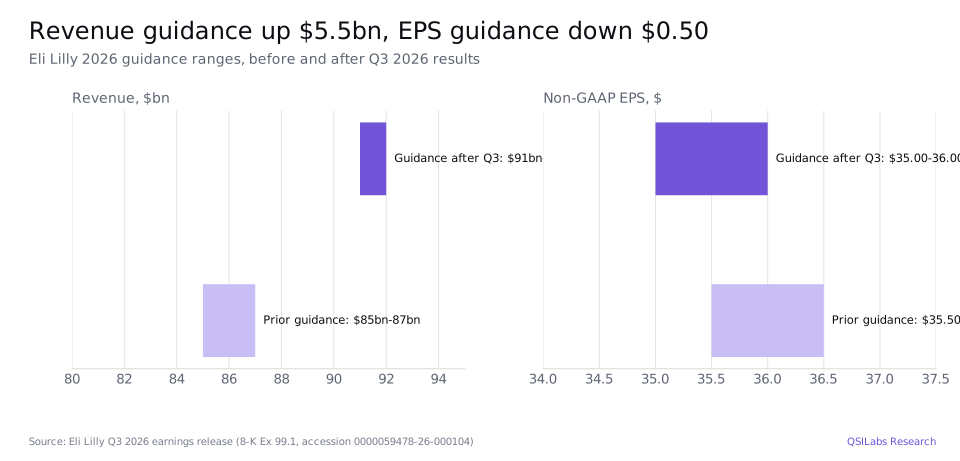
- Guidance: Lilly now expects 2026 revenue of $91-92bn (previously $85-87bn) and non-GAAP EPS of $35.00-36.00 (previously $35.50-36.50), the cut reflecting $4.57 of acquired IPR&D charges.
- Quality of the beat: about $900m of Q3 revenue came from one-off benefits, mainly $410m of Jardiance milestones, with no further milestones to come.
- Cash and deals: Lilly generated $27.4bn of operating cash flow in the first nine months of 2026 and spent $18.2bn on business development; total debt rose $7.0bn to $49.5bn.
Key numbers from Eli Lilly's Q3 2026 earnings
| Q3 2026 vs Q3 2025, $m | Q3 2025 | Q3 2026 | Change |
|---|---|---|---|
| Revenue | 17,601 | 24,397 | +39% |
| Mounjaro | 6,515 | 10,723 | +65% |
| Zepbound | 3,588 | 5,352 | +49% |
| Research and development | 3,466 | 4,247 | +23% |
| Marketing, selling and administrative | 2,741 | 3,125 | +14% |
| Acquired IPR&D | 656 | 4,181 | +537% |
| Income before tax | 7,233 | 8,406 | +16% |
| Net income | 5,583 | 6,451 | +16% |
| Diluted EPS ($) | 6.21 | 7.22 | +16% |
| Gross margin | 82.9% | 83.9% | +1.0pt |
Source: Eli Lilly Q3 2026 earnings release (accession 0000059478-26-000104).
Eli Lilly Q3 2026 earnings: what happened
Lilly's quarter beat its own plan. Chair and CEO David A. Ricks said: "Lilly had another strong quarter, exceeding our prior expectations and allowing us to raise our full-year outlook. Revenue growth was driven by broad global consumer demand for Mounjaro and Zepbound, the global launches of Foundayo, expanded U.S. coverage for obesity care and a doubling in our newest products in oncology, immunology and neuroscience."
The numbers back him up. Revenue of $24.40bn was 39% higher than a year earlier, and the first nine months reached $67.17bn, against $45.89bn in the same period of 2025. Lilly's key products in immunology, oncology and neuroscience (Ebglyss, Jaypirca, Kisunla, Omvoh and Inluriyo) grew 100% in the quarter. Gross margin rose a point to 83.9% on product mix and lower production costs, even as realised prices fell.
Profit grew more slowly than revenue for one reason: deals. Acquired IPR&D charges were $4.18bn, mostly from buying AtaiBeckley ($2.61bn, for the depression candidate BPL-003) and Curevo ($954m). Those charges cost $4.57 of EPS, against $0.71 a year earlier. Underlying spending was steady: R&D rose 23% to $4.25bn and marketing, selling and administrative costs rose 14% to $3.13bn, both well below revenue growth.
- Jul 2026Acquisition of Curevo closes; $954m charged to acquired IPR&DForm 10-Q
- Q3 2026FDA approves Onswik (efsitora alfa), Mounjaro for cardiovascular risk reduction in type 2 diabetes and Jaypirca in first-line CLL/SLL8-K Ex 99.1
- Sep 2026AtaiBeckley acquisition closes; $2,610m charged to acquired IPR&D for BPL-003Form 10-Q
- Sep 2026Appeals court denies en banc rehearing in the Emgality patent case with TevaForm 10-Q
- Oct 2026Agreement to acquire Merida Biosciences for up to $2.9bnForm 10-Q
- 29 Oct 2026Q3 2026 results; 2026 revenue guidance raised to $91-92bn; LLY closes at $1,373.70, up 6.6%8-K Ex 99.1; Yahoo Finance
- 30 Oct 2026LLY closes at $1,417.54Yahoo Finance
- 10 Dec 2026Q4 dividend of $1.73 a share payable8-K Ex 99.1
How did Mounjaro, Zepbound and Lilly's other products do?
Mounjaro and Zepbound
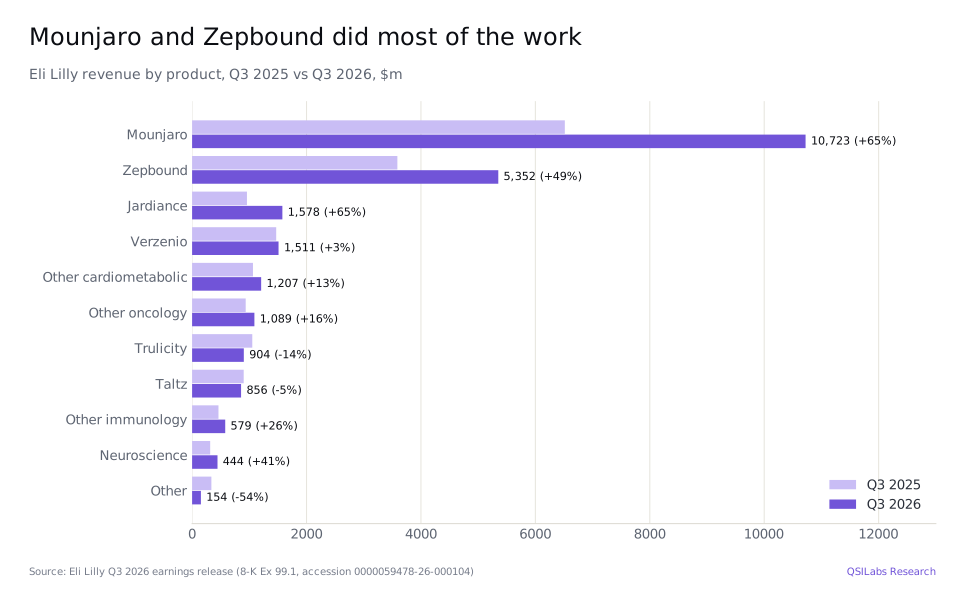
Mounjaro revenue rose 65% to $10.72bn. US Mounjaro revenue was $5.00bn (+41%) and revenue outside the US rose 93% to $5.73bn, driven by volume, partly offset by lower prices after Mounjaro joined China's reimbursement list in Q1 2026. Outside the US, Mounjaro is now larger than in the US. Zepbound, tirzepatide's US obesity brand, grew 49% to $5.35bn, with US revenue up 48% to $5.3bn on strong demand and lower realised prices. Together the two brands were 66% of Lilly's revenue in the quarter.
Foundayo and the newer launches
Foundayo (orforglipron), Lilly's oral GLP-1, brought in $184m in Q3 and $281m in the first nine months as it launches around the world. Lilly has submitted it for type 2 diabetes in the US and Japan, and the EU's CHMP has recommended approval for obesity and type 2 diabetes. The other newer brands added up: Jaypirca $228m, Ebglyss $202m, Kisunla $193m, Omvoh $114m and Inluriyo $73m.
The older portfolio
Jardiance revenue rose 65% to $1.58bn, but that includes $410m of sales-based milestones from Boehringer Ingelheim, and Lilly says no further milestones remain. Trulicity fell 14% to $904m as patients switch to tirzepatide. Verzenio grew 3% to $1.51bn and Taltz fell 5% to $856m.
Volume up, price down
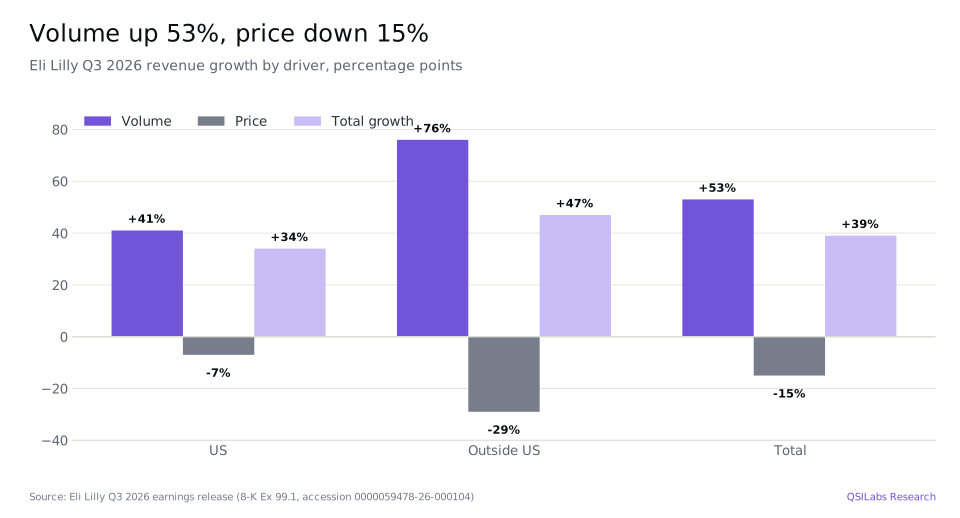
Lilly is selling far more medicine at lower prices. In the US, revenue rose 34% to $15.14bn on 41% higher volume and 7% lower realised prices, the decline driven mainly by Zepbound. Outside the US, revenue rose 47% to $9.26bn on 76% higher volume and 29% lower prices. Across the company, volume added 53 points and price took away 15. About $900m of the quarter's revenue came from one-off benefits: the Jardiance milestones and favourable adjustments to rebate and discount estimates.
How much cash does Eli Lilly make? Cash flow and the balance sheet
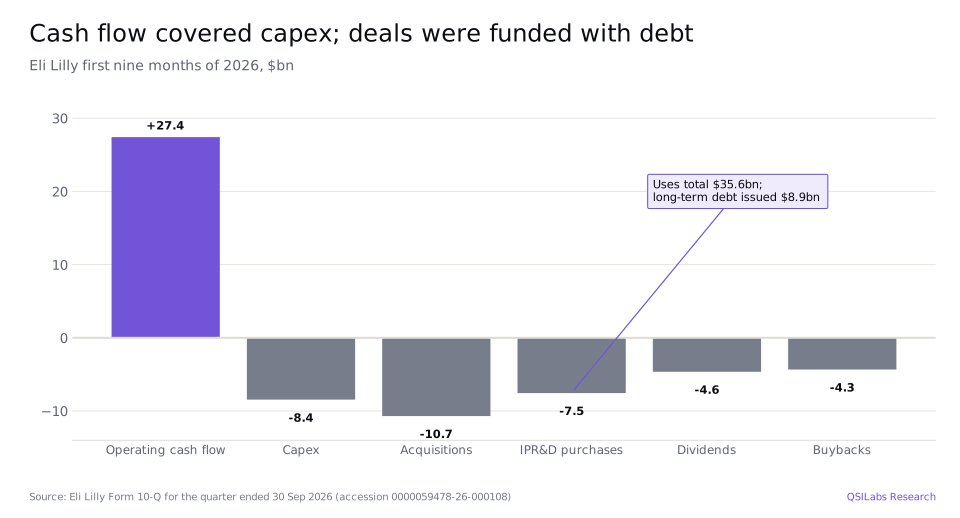
Lilly generated $27.42bn of operating cash in the first nine months of 2026 and spent $8.44bn on property and equipment, leaving free cash flow of about $19.0bn (Form 10-Q, accession 0000059478-26-000108). It paid $10.69bn for acquisitions and $7.55bn for acquired IPR&D, $18.2bn in total on business development, including Centessa, Kelonia, AtaiBeckley, Orna, Ventyx, Curevo and Ajax. It paid $4.64bn of dividends ($5.19 a share) and bought back $4.33bn of stock, leaving $6.6bn on its $15bn authorisation.
The gap was filled with debt. Lilly issued $8.94bn of long-term debt in the period, and total debt reached $49.5bn at 30 September, up $7.0bn since the start of the year, against cash and investments of about $8.9bn. Shareholders' equity was $40.3bn on total assets of $148.1bn. In October Lilly bought Merida Biosciences for up to $2.9bn and declared a Q4 dividend of $1.73 a share, payable on 10 December. It also broke ground in Houston, one of ten US manufacturing sites announced since 2020.
Lilly's share count
Lilly's balance sheet counts about 941 million shares outstanding, but about 49 million of those sit in an employee benefit trust and are not counted as outstanding for earnings per share. The diluted share count was 893.4 million in Q3, and Lilly's guidance assumes about 894 million. We use 893.4 million.
Eli Lilly guidance for 2026
| 2026 guidance | Prior | Updated |
|---|---|---|
| Revenue | $85-87bn | $91-92bn |
| Performance margin (non-GAAP) | 49.0-50.5% | 52.0-52.5% |
| Tax rate (non-GAAP) | 18-19% | 19-20% |
| EPS (non-GAAP) | $35.50-36.50 | $35.00-36.00 |
Source: Eli Lilly Q3 2026 earnings release. EPS guidance excludes IPR&D charges after 30 September 2026 and assumes about 894 million shares.
With $67.17bn booked in nine months, the $91.5bn midpoint implies about $24.3bn of Q4 revenue, roughly flat on Q3 even though Q3 carried about $900m of one-off benefits. That is a guide that leaves room for another beat. Performance margin, Lilly's measure of gross margin less R&D and marketing costs, rises to 52.0-52.5%, which says operating leverage is still building.
What is in Eli Lilly's pipeline? Retatrutide, Foundayo and eloralintide
- RetatrutidePhase 3 trials in obesity and in type 2 diabetes met their primary endpoints; head-to-head, it beat Ozempic 2 mg on A1C and weight lossForm 10-Q; 8-K Ex 99.1
- FoundayoOral GLP-1 (orforglipron) approved for obesity and launching globally; $184m of Q3 revenue; submitted for type 2 diabetes in the US and Japan8-K Ex 99.1; Form 10-Q
- EloralintideAmylin agonist; Phase 3 trials started in incretin add-on for obesity, obstructive sleep apnea and osteoarthritis pain; EloraTZP beat tirzepatide 15 mg on weight loss and A1CForm 10-Q; 8-K Ex 99.1
- OnswikOnce-weekly basal insulin (efsitora alfa) approved by the FDA for type 2 diabetes; positive CHMP opinion in the EU8-K Ex 99.1; Form 10-Q
- Sofetabart mipitecanPhase 3 started in platinum-sensitive ovarian cancer; FDA Breakthrough Therapy designation in platinum-resistant diseaseForm 10-Q
- BrenipatidePhase 3 started in major depressive disorderForm 10-Q
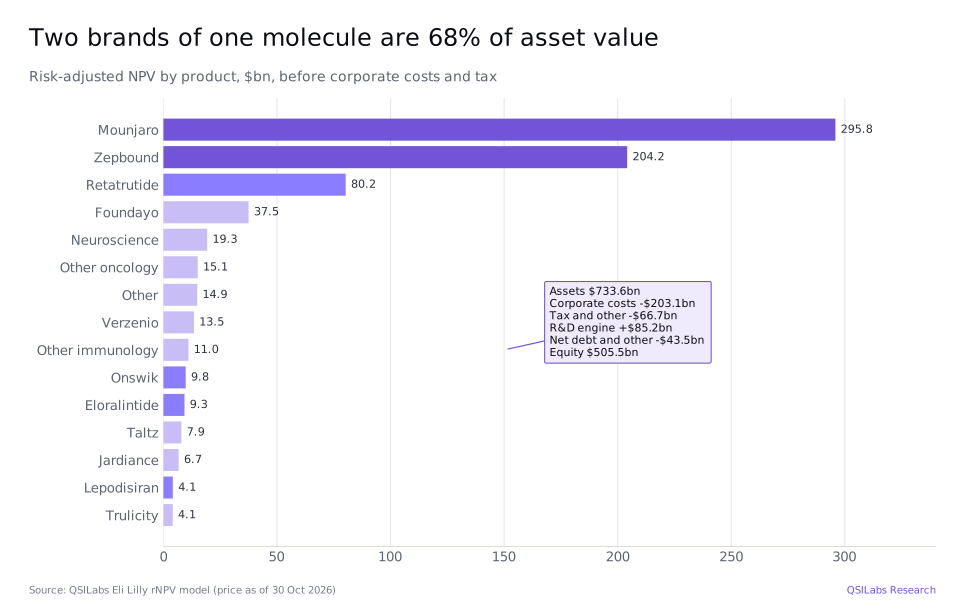
Retatrutide is the asset that matters most after tirzepatide. A triple agonist of the GIP, GLP-1 and glucagon receptors, it met its primary endpoints in Phase 3 trials in obesity and in type 2 diabetes, and in a head-to-head trial in type 2 diabetes it delivered greater A1C reduction and more than double the weight loss of Ozempic's highest approved dose. We give it a 90.6% probability of approval and a peak of $25bn of annual sales, which makes it worth $80.2bn on a risk-adjusted basis, or about $90 a share.
Behind it, eloralintide, an amylin agonist, has started Phase 3 trials as an add-on to incretins in obesity, in obstructive sleep apnea and in osteoarthritis pain, and its combination with tirzepatide (EloraTZP) beat tirzepatide 15 mg on weight loss and A1C. Onswik, a once-weekly basal insulin, won FDA approval in Q3. Outside metabolism, Lilly started Phase 3 trials of brenipatide in major depression and of sofetabart mipitecan, an antibody-drug conjugate, in ovarian cancer.
Eli Lilly stock Q3 2026: is LLY overvalued?
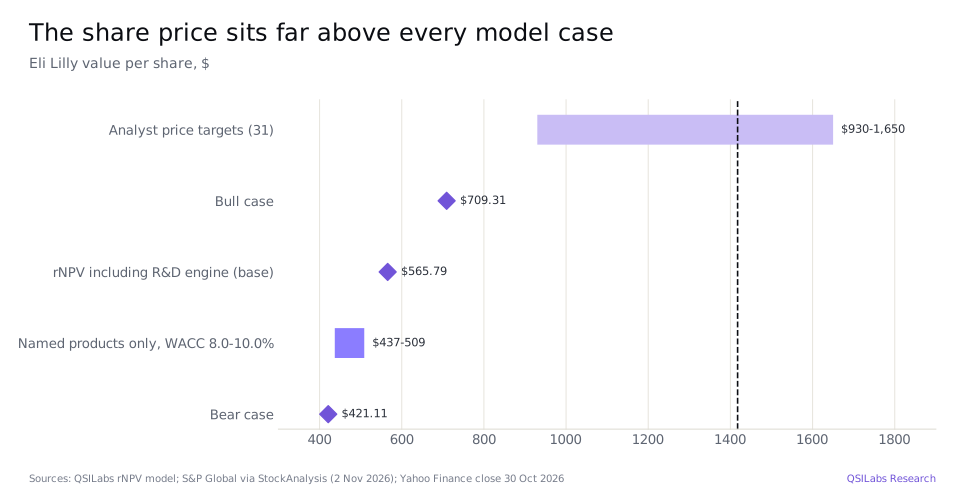
On our numbers, yes. We value Lilly at $565.79 a share, about 60% below the $1,417.54 close on 30 October 2026. Our bear case is $421.11 and our bull case $709.31. Analysts are far more positive: 31 analysts have an average price target of $1,427 and a median of $1,497, with a range of $930 to $1,650 and a consensus rating of Buy (S&P Global via StockAnalysis, 2 November 2026).
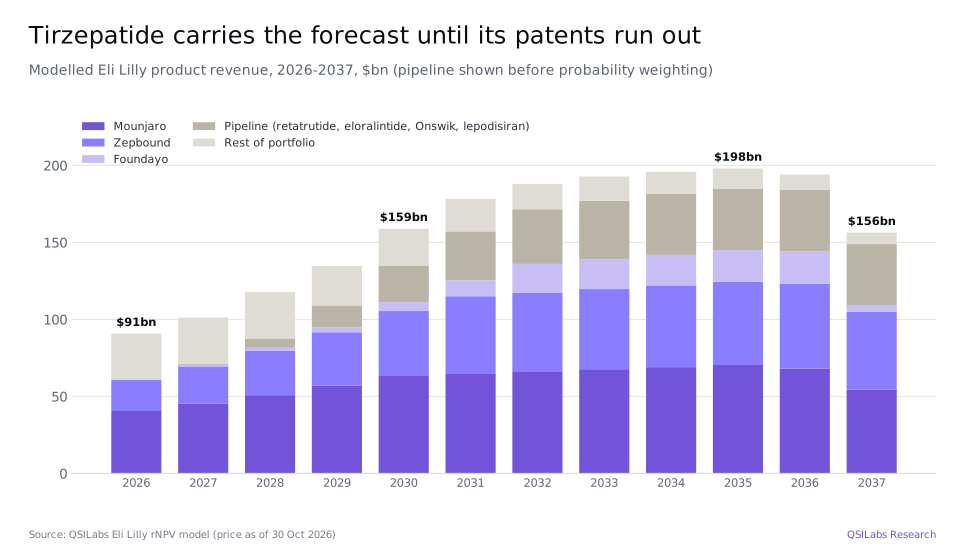
The gap is about time. At $1,417.54 a share, Lilly's market value is about $1.27 trillion. Our model forecasts every product to its loss of exclusivity: tirzepatide's US patents and exclusivities run to 2036-2037 (FDA Orange Book listing), and after that we assume Mounjaro and Zepbound face generic-style erosion. Lilly's next products have to replace a franchise heading for $124bn of annual sales, and the market is assuming they will.
Method
We value Lilly with a risk-adjusted net present value. Each marketed product and late-stage candidate is forecast year by year to 2045, with launch curves, peak sales, patent expiry and post-expiry erosion; candidates are weighted by their probability of approval, using industry phase-success rates from BIO, Informa and QLS. Unallocated R&D, corporate costs, tax, capex and working capital turn product contribution into free cash flow, discounted at a WACC of 8.98% (Damodaran's cost of capital for US drug makers). We add the value of Lilly's future R&D output, the "R&D engine", based on its spending and the industry's historical return on R&D. The terminal value is only 4.9% of enterprise value.
Our main assumptions:
- Mounjaro: $40.5bn of revenue in 2026, growing 12% a year to $63.7bn in 2030 and peaking at about $70.4bn in 2035.
- Zepbound: $20.1bn in 2026, growing 20% a year to $50.0bn in 2031.
- Foundayo: $550m in 2026, rising to $18.7bn in 2032.
- Retatrutide: launch in 2027 and $25bn of peak sales, with a 90.6% probability of approval.
- Jardiance: $4.1bn of recurring revenue in 2026, excluding milestones, ending after 2028 with the Boehringer Ingelheim collaboration in Lilly's most significant markets.
- Older brands: Trulicity declines; Verzenio and Taltz stay flat until they lose exclusivity in 2030-2031.
Total modelled revenue is $90.7bn in 2026 (the guidance midpoint less the one-off milestones), $158.8bn in 2030 and $197.9bn at the 2035 peak.
| Value bridge | $bn | Per share ($) |
|---|---|---|
| Marketed products (risk-adjusted NPV) | 630.1 | 705.29 |
| Pipeline: retatrutide, eloralintide, Onswik, lepodisiran | 103.5 | 115.84 |
| Unallocated corporate costs | -203.1 | -227.35 |
| Tax, capex, working capital and other | -66.7 | -74.66 |
| Enterprise value of named products | 463.8 | 519.12 |
| Future R&D output (R&D engine) | 85.2 | 95.35 |
| Debt less cash, and contingent consideration | -43.5 | -48.68 |
| Equity value | 505.5 | 565.79 |
Source: QSILabs rNPV model; balance sheet from the Q3 2026 Form 10-Q; 893.4 million diluted shares.
How the number moves if you argue with us
The discount rate matters less than you would think, because so little of the value sits in the terminal year. On the named products alone, a WACC of 7.98% gives $508.80 a share and 9.98% gives $437.06. At our 8.98% WACC, the R&D engine adds $95.35 to the $470.44 named-product value. Changing terminal growth from -1% to +1% moves the value by less than $6.
| WACC | Named products only, $ per share |
|---|---|
| 7.98% | 508.80 |
| 8.48% | 488.91 |
| 8.98% | 470.44 |
| 9.48% | 453.21 |
| 9.98% | 437.06 |
What does move the number is how long the franchise lasts. A conventional cash-flow DCF that treats Lilly as a going concern, with a terminal value worth 36% of enterprise value, gives $788.08 a share, still 44% below the price. To justify $1,417.54, an investor has to believe that Lilly's next generation, retatrutide, Foundayo, eloralintide and whatever it buys or discovers, fully replaces tirzepatide in the late 2030s and keeps growing.
Risks to the Eli Lilly investment case
- Concentration: 66% of Q3 revenue came from one molecule. Any safety signal, supply problem or competitive setback for tirzepatide hits two-thirds of the business.
- Price: realised prices fell 7% in the US and 29% outside it in Q3. Government pressure on obesity drug prices, Medicare coverage terms and China's reimbursement pricing can all push them lower.
- Competition: Novo Nordisk, oral GLP-1s and new entrants are chasing the same patients, and compounded versions of incretins have competed in the US before.
- Pipeline: retatrutide carries $80.2bn of our value. A regulatory delay or a safety issue would cut it sharply.
- Patents: Lilly faces patent challenges, including a Cipla ANDA for Verzenio that Lilly sued over in June 2026, and lost its bid for en banc rehearing in the Emgality case with Teva in September 2026.
- Deals and debt: Lilly spent $18.2bn on business development in nine months and added $7.0bn of debt. Acquired IPR&D charges make reported earnings volatile, and not every deal will pay off.
- Upside risk: if obesity treatment keeps expanding and Lilly's next medicines replace tirzepatide's sales, the long-term value could be far higher than our model assumes.
FAQ
What is Eli Lilly stock worth after Q3 2026 earnings?
QSILabs values Eli Lilly at $565.79 per share, based on a risk-adjusted NPV of its products and pipeline as of Q3 2026 results. That is about 60% below the $1,417.54 close on 30 October 2026. Our bear and bull cases are $421.11 and $709.31; analysts' average price target is $1,427.
Is Eli Lilly stock a buy after Q3 2026?
Our model says LLY trades far above what its current products and late-stage pipeline are worth if they lose exclusivity on schedule. The business itself is in excellent shape: revenue grew 39% and guidance rose by $5.5bn. Buying at $1,417.54 is a bet that Lilly's next medicines replace tirzepatide in the late 2030s. This is not investment advice.
How much revenue did Eli Lilly make in Q3 2026?
Lilly's Q3 2026 revenue was $24.40bn, up 39% from $17.60bn a year earlier. US revenue was $15.14bn (+34%) and revenue outside the US was $9.26bn (+47%). About $900m came from one-off benefits, mainly $410m of Jardiance milestones.
How much did Mounjaro and Zepbound sell in Q3 2026?
Mounjaro sold $10.72bn in Q3 2026, up 65%, and Zepbound sold $5.35bn, up 49%. Together they were $16.08bn, 66% of Lilly's revenue. In the first nine months of 2026 Mounjaro sold $29.33bn and Zepbound $14.44bn.
What is Eli Lilly's 2026 guidance?
After Q3 2026 Lilly expects 2026 revenue of $91-92bn, up from $85-87bn, and non-GAAP EPS of $35.00-36.00, down from $35.50-36.50 because of $4.57 of acquired IPR&D charges. It expects a performance margin of 52.0-52.5% and a tax rate of 19-20%.
What is retatrutide and when could it launch?
Retatrutide is Lilly's triple agonist of the GIP, GLP-1 and glucagon receptors. Its Phase 3 trials in obesity and type 2 diabetes met their primary endpoints, and it beat Ozempic 2 mg head to head. Our model assumes a 2027 launch, $25bn of peak sales and a 90.6% probability of approval.
What is Foundayo?
Foundayo is orforglipron, Lilly's once-daily oral GLP-1 pill, approved by the FDA for obesity. It brought in $184m of revenue in Q3 2026 and $281m in the first nine months; we forecast $18.7bn of sales in 2032.
Does Eli Lilly pay a dividend?
Yes. Lilly declared a Q4 2026 dividend of $1.73 a share, payable on 10 December 2026, and paid $5.19 a share in the first nine months of 2026. It also has $6.6bn left on its $15bn share buyback authorisation.
Sources
- Eli Lilly and Company, Q3 2026 earnings release (Form 8-K, Exhibit 99.1, 29 Oct 2026; accession 0000059478-26-000104) www.sec.gov
- Eli Lilly and Company, Form 8-K cover, 29 Oct 2026 (accession 0000059478-26-000104) www.sec.gov
- Eli Lilly and Company, Form 10-Q for the quarter ended 30 Sep 2026 (accession 0000059478-26-000108) www.sec.gov
- Eli Lilly and Company, Form 10-Q for the quarter ended 30 Jun 2026 (accession 0000059478-26-000081) www.sec.gov
- Eli Lilly: FDA approves Foundayo (orforglipron) investor.lilly.com
- FDA Orange Book patent and exclusivity listing for tirzepatide (Assyro) www.assyro.com
- BIO, Informa Pharma Intelligence and QLS: Clinical Development Success Rates 2011-2020 go.bio.org
- StockAnalysis: Eli Lilly forecast and analyst ratings, S&P Global data (accessed 2 Nov 2026) stockanalysis.com
- Yahoo Finance chart data: LLY closing prices (October 2026) query1.finance.yahoo.com
- Damodaran Online: cost of capital by industry (US) pages.stern.nyu.edu
- QSILabs Eli Lilly risk-adjusted NPV model (internal; price as of 30 Oct 2026)
Disclaimer
This article is for information only and is not investment advice, a recommendation or an offer to buy or sell any security. QSI Labs and its authors may hold positions in the securities discussed. Forecasts and valuations are estimates that depend on assumptions that may prove wrong. Figures are taken from company filings and third-party sources believed to be reliable, but we do not guarantee their accuracy. Do your own research or consult a licensed adviser before investing.
More from QSI Labs
Related analysis: Meta stock Q3 2026: Muse AI and the capex bill, Amazon stock Q3 2026, Alphabet stock Q3 2026: Google Cloud and Project Suncatcher and NVIDIA stock Q3 2026.
Read our white paper, QSI Labs: An AI-Native Trading Firm Built on a Training Loop (October 2026), available on request, or browse the research index.