Research / Earnings and valuation
Comcast Stock Q3 2026:Broadband Losses Widen as Peacock Stays Profitable
As of: Figures are as of Comcast Corporation's third-quarter 2026 results (the quarter ended 30 September 2026, reported 22 October 2026 in a Form 8-K) and its Form 10-Q for that quarter, filed the same day. Comcast's fiscal year is the calendar year, so its Q3 2026 covers July to September 2026. The share price used in our valuation is the Nasdaq close of CMCSA on 2 November 2026, $23.87; analyst data were accessed on 2 November 2026. Published 2 November 2026.
The short answer. Comcast stock Q3 2026 comes down to a quarter in which the cable business shrank while the media business grew. Revenue for the three months to 30 September 2026 fell 6.1% to $29.30bn, mostly because the Versant cable networks were spun off on 2 January 2026. On Comcast's pro forma basis, which treats the Versant spin-off and the sale of Sky's German operations as if both had happened at the start of 2024, revenue rose 0.5%. Comcast lost 144,000 domestic broadband customers and added 368,000 wireless lines, and Peacock earned $261m of adjusted EBITDA in its second consecutive profitable quarter. Adjusted EPS fell 4% to $1.07. Our discounted cash flow model values Comcast at $85.08 a share, about 3.6 times the $23.87 close on 2 November 2026. The share price implies a long decline in cash flow that our model, which follows consensus forecasts, does not assume.
Key takeaways
- Revenue down 6.1%, up 0.5% pro forma. Q3 2026 revenue was $29,298m, against $31,198m a year earlier, or $29,151m on the pro forma basis. Adjusted EBITDA fell 5.8% to $9,106m and rose 0.8% pro forma.
- Broadband losses widened. Comcast lost 144,000 domestic broadband customers in the quarter, against 91,000 a year earlier, and domestic broadband revenue fell 4.7% to $6,241m. Management cited aggressive fiber and fixed wireless competition.
- Wireless kept growing. Comcast added 368,000 domestic wireless lines, taking the total to 10.6m, up 18% in a year. Wireless service revenue rose 14.7% to $1,050m.
- Peacock stays profitable. Peacock made $261m of adjusted EBITDA on about $1.8bn of revenue, against a $217m loss a year earlier, and ended the quarter with 48m paid subscribers, up 17%.
- Theme Parks fell. Theme Parks revenue fell 4.4% to $2,597m and adjusted EBITDA fell 17.1% to $780m, on weaker demand in Orlando and Japan and capacity problems at Epic Universe.
- A large charge is coming. Chief financial officer Jason Armstrong said Comcast expects a fourth-quarter charge of over $1bn, mostly for what the company calls the most significant operating and cost transformation in its history.
- Our value: $85.08 a share, against a $23.87 close on 2 November 2026. A two-stage cross-check gives $72.75; a scenario in which revenue shrinks every year and never grows again gives $52.96. Analysts' average target is $27.98.
- What to watch. Broadband net losses, the size of the fourth-quarter charge, the detail management has promised for early 2027, and the separation of NBCUniversal and Sky, which Comcast expects to complete in mid-2027.
Key numbers from Comcast's Q3 2026 earnings
| Metric | Q3 2026 | Q3 2025 | Change |
|---|---|---|---|
| Revenue | $29,298m | $31,198m | -6.1% |
| Pro forma revenue | $29,298m | $29,151m | +0.5% |
| GAAP operating income | $5,320m | $5,534m | -3.9% |
| Adjusted EBITDA | $9,106m | $9,669m | -5.8% |
| Pro forma adjusted EBITDA | $9,106m | $9,038m | +0.8% |
| Net income attributable to Comcast | $3,448m | $3,332m | +3.5% |
| GAAP diluted EPS | $0.97 | $0.90 | +7.2% |
| Adjusted EPS | $1.07 | $1.12 | -4.0% |
| Cash flow from operations | $7,902m | $8,693m | -9.1% |
| Free cash flow | $4,211m | $4,945m | -14.8% |
| Domestic broadband net additions | -144,000 | -91,000 | n/a |
| Domestic wireless line net additions | +368,000 | +414,000 | n/a |
Comcast Q3 2026 earnings: what happened
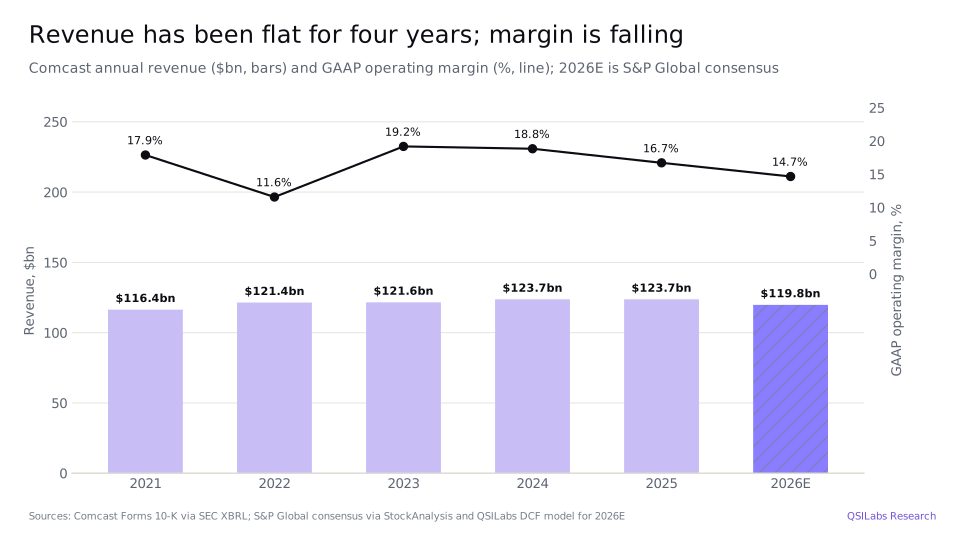
Comcast reported revenue of $29,298m for the third quarter of 2026, 6.1% less than the $31,198m of a year earlier. Most of the fall reflects the businesses Comcast no longer owns: the Versant cable networks, which include CNBC, USA Network and MS NOW, were spun off as a separate listed company on 2 January 2026, and Sky's operations in Germany were sold on 31 May 2026. On the pro forma basis, revenue rose 0.5% and adjusted EBITDA rose 0.8% to $9,106m, which Comcast described as consistent with the prior year.
The two halves of the company moved in opposite directions. Connectivity & Platforms, the cable, broadband, wireless and Sky distribution business, had revenue of $19,663m, down 2.7%, and adjusted EBITDA of $7,588m, down 4.4%. Content & Experiences, which holds the NBC networks, Peacock, Universal's film studio and the theme parks, had revenue of $10,537m, up 6.5%, and adjusted EBITDA of $1,800m, up 29.3%.
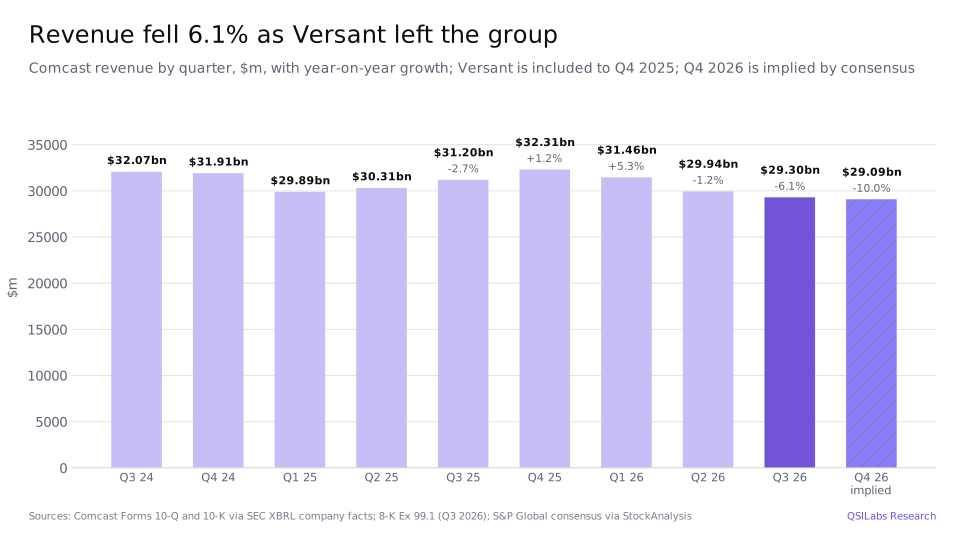
GAAP operating income fell 3.9% to $5,320m, an 18.2% margin, against 17.7% a year earlier. Net income attributable to Comcast rose 3.5% to $3,448m and GAAP diluted EPS rose 7.2% to $0.97, helped by lower interest expense, $962m against $1,128m, and fewer shares: diluted shares averaged 3,562m, against 3,689m. Adjusted EPS, which excludes amortisation of acquired intangible assets and some other items, fell 4.0% to $1.07.
Sport helped the quarter. NBCUniversal's Spanish-language network Telemundo and Peacock carried the FIFA World Cup, which added $224m of revenue in the third quarter. Earlier in the year, the 2026 Winter Olympics and the Super Bowl, both on NBC, brought in $1,420m and $758m of revenue.
- 2 Jan 2026Versant, the cable networks business including CNBC and USA Network, is spun off and lists on Nasdaq as VSNT; CMCSA closes at $27.69Form 10-Q; Yahoo Finance
- 11 Feb 2026CMCSA closes at $32.48, its 52-week closing highYahoo Finance
- Q1 2026The Winter Olympics and the Super Bowl on NBC bring in $1,420m and $758m of revenue8-K Ex 99.1
- 31 May 2026Sale of Sky's operations in Germany completedForm 10-Q
- June 2026Comcast announces its intention to spin off NBCUniversal and Sky as a separate listed companyForm 10-Q
- 1 Jul 2026Share buybacks paused, expected to stay paused at least through the separationQ3 2026 earnings call
- July 2026Agreement to buy ITV's Media & Entertainment business for up to GBP 1.6bnForm 10-Q
- 30 Sep 2026Q3 2026 ends: revenue $29,298m (-6.1%, +0.5% pro forma), 144,000 broadband customers lost8-K Ex 99.1
- 9 Oct 2026CMCSA closes at $20.66, its 52-week closing lowYahoo Finance
- 22 Oct 2026Q3 results and Form 10-Q; a fourth-quarter charge of over $1bn flagged; CMCSA closes at $22.848-K; 10-Q; call; Yahoo
- 2 Nov 2026CMCSA closes at $23.87, the price used in our valuationYahoo Finance
- Mid-2027NBCUniversal and Sky spin-off expected to be completedForm 10-Q
- H2 2027ITV Media & Entertainment acquisition expected to closeForm 10-Q
Why is Comcast losing broadband customers?
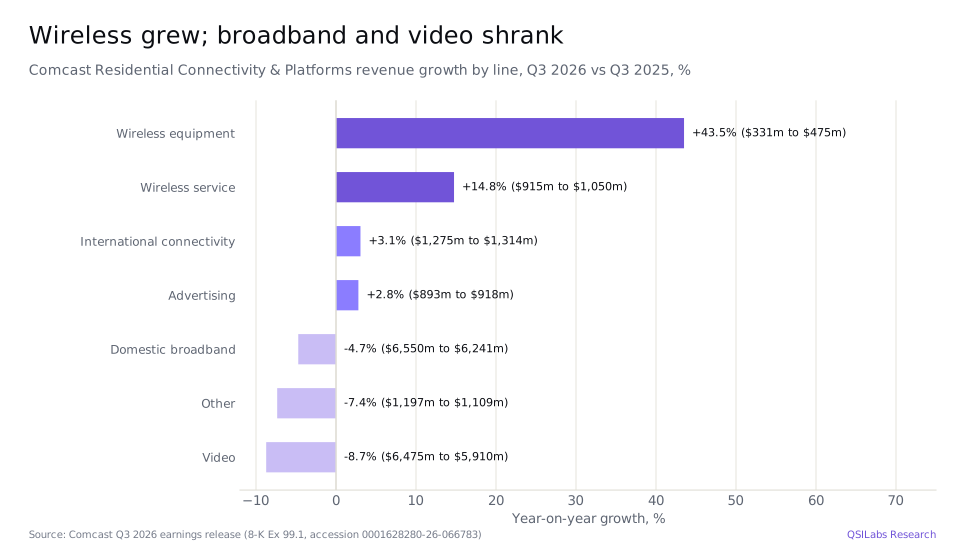
Comcast ended September with 28.34m domestic residential broadband customers, 554,000 fewer than a year earlier, after losing 144,000 in the quarter. Domestic broadband revenue fell 4.7% to $6,241m, as both the number of customers and average rates fell. Comcast has changed how it sells broadband over the past year, with simpler pricing and packaging, an improved customer experience and deeper bundling with mobile, and Armstrong said "competition remains intense, with particularly aggressive fiber promotions in certain markets".
Mike Cavanagh, Comcast's president, said fixed wireless, the home internet that mobile operators sell over their cellular networks, "remains aggressive and continues to take share, while fiber construction remains elevated, with pockets of irrational pricing and promotional activity." He described the pressure on results as the cost of investments that "position the business for return to growth over the long term", but gave no date.
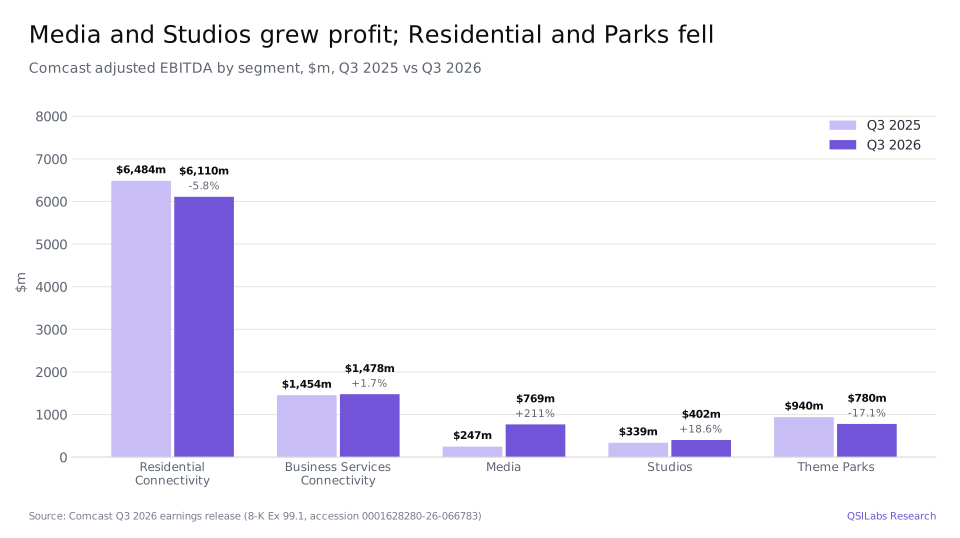
Within Connectivity & Platforms, Residential revenue fell 3.5% to $17,018m and its adjusted EBITDA fell 5.8% to $6,110m, a 35.9% margin, down from 36.8%. Video revenue, from cable TV, fell 8.7% to $5,910m after Comcast lost another 274,000 video customers, leaving 10.39m. Business Services Connectivity, which sells broadband and networking to companies, did better: revenue rose 2.7% to $2,645m and adjusted EBITDA 1.7% to $1,478m, a 55.9% margin.
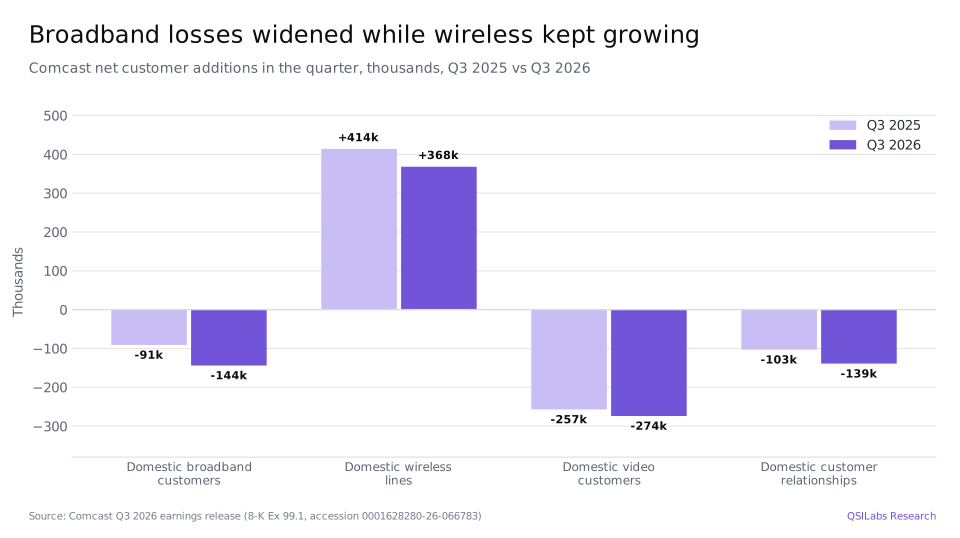
Comcast points to signs that the new approach is working with existing customers: nearly 45% of broadband customers take gig-plus speed tiers, up nearly 10 points in a year, and it said customer service contact rates had fallen by about 20%. The test is whether that slows losses. Domestic customer relationships fell by 139,000 in the quarter to 30.04m.
Is wireless making up for the lost broadband customers?
Not yet in revenue, but it is the fastest-growing part of the cable business. Comcast added 368,000 domestic wireless lines in the quarter and 1.6m over 12 months, reaching 10.56m lines, about 18% of its broadband customers and, Comcast said, 7% of the wireless lines in its footprint. Domestic wireless service revenue rose 14.7% to $1,050m and equipment revenue 43.6% to $475m.
Management said about 90% of Xfinity Mobile traffic travels over Wi-Fi, mostly on Comcast's own network, and calls this a capital-light model, because it avoids the spectrum and network costs of traditional wireless operators. Chairman and co-chief executive Brian Roberts said wireless was "having our best year". About 70% of customers on free promotional lines have gone on to pay, management said.
Comcast now reports "convergence revenue", broadband plus wireless, as a single line. It fell 2.3% to $7,292m, because the $135m increase in wireless service revenue did not cover the $309m fall in broadband revenue.
How did Peacock, the studios and the theme parks do?
Content & Experiences had its strongest quarter of the year so far. Media revenue rose 13.0% to $5,359m, or 8.3% excluding the World Cup, and its adjusted EBITDA rose to $769m from $247m. Peacock was the main reason: its revenue rose to about $1.8bn from $1.4bn, including World Cup amounts, and its adjusted EBITDA swung to a $261m profit from a $217m loss. Paid subscribers rose 17% to 48m. Cavanagh said a bundle of Peacock with YouTube Premium is coming, aimed at younger viewers who already watch NBC clips on YouTube.
Studios revenue fell 1.1% to $2,967m because content licensing fell 23.7% to $1,553m, but theatrical revenue rose 76.6% to $1,129m and adjusted EBITDA rose 18.6% to $402m. Cavanagh said Universal became the first studio this year to pass $5bn at the global box office, led by The Odyssey, "the highest-grossing film in the studio's history".
Theme Parks were the weak spot. Revenue fell 4.4% to $2,597m and adjusted EBITDA 17.1% to $780m, a 30.0% margin. Comcast cited lower attendance and more promotions in Orlando, where demand has been soft since June and Epic Universe, opened in 2025, has had capacity problems, and in Japan, where China-related travel restrictions weighed on attendance. Cavanagh said Comcast expects performance to strengthen through 2027, "with a return to growth in the second half of the year."
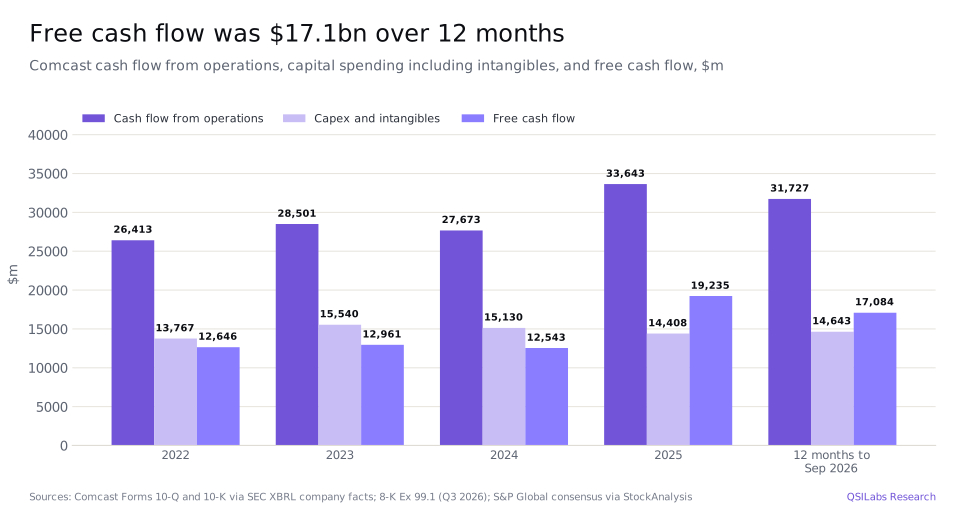
How much free cash flow does Comcast generate?
Comcast generated free cash flow of $4,211m in the third quarter, down 14.8%, and $12,716m in the first nine months of 2026, against $14,866m a year earlier. Comcast defines free cash flow as cash from operations less capital expenditure and cash paid for intangible assets, mainly software. Armstrong said the third quarter benefited from timing effects that will reverse in the fourth.
Over the 12 months to September 2026, operating cash flow was $31.7bn and capital spending, including intangibles, $14.6bn, leaving about $17.1bn. That is lower than the $19.2bn of 2025, which itself was higher than the roughly $12.5bn to $13.0bn of 2022 to 2024. S&P Global's consensus for 2026 free cash flow, reported by StockAnalysis, is $13.59bn.
Comcast paid $3,606m of dividends in the first nine months and bought back 76m shares for $2.2bn under its repurchase programme before pausing buybacks on 1 July. Armstrong said the pause will stay "at least through the separation", to keep both companies with strong balance sheets and investment-grade ratings. Comcast repaid $10,405m of debt and borrowed $1,990m in the nine months. At 30 September it had debt of $87,366m, including $3,560m due within a year, against cash of $7,596m.
What happens with the NBCUniversal and Sky spin-off?
In June 2026 Comcast said it intends to separate into two listed companies through a tax-free spin-off of NBCUniversal and Sky: mainly the Media, Studios and Theme Parks segments, plus Sky's broadband and TV businesses. Comcast would keep the rest, mainly its US broadband, wireless, cable TV and business services operations. The spin-off is expected in mid-2027, subject to board approval, tax opinions, regulatory approvals and financing, and Comcast expects to keep up to 19.9% of the new company for up to a year, then sell it in a tax-efficient way.
Cavanagh said the separation was on track and that Chris Halpin had joined as NBCUniversal's chief financial officer. Michael Angelakis is preparing to become Comcast's chief executive next year, and Cavanagh said the company intends to give "more context" on its plans early next year, with Angelakis joining. In July 2026 Comcast also agreed to buy ITV's Media & Entertainment business from ITV plc for up to GBP 1.6bn, including GBP 1.2bn of cash; that deal is expected to close in the second half of 2027.
Our model values Comcast as it is today. It does not try to model the separation, which could change debt levels, costs and how investors value each part.
How has CMCSA stock performed in 2026?
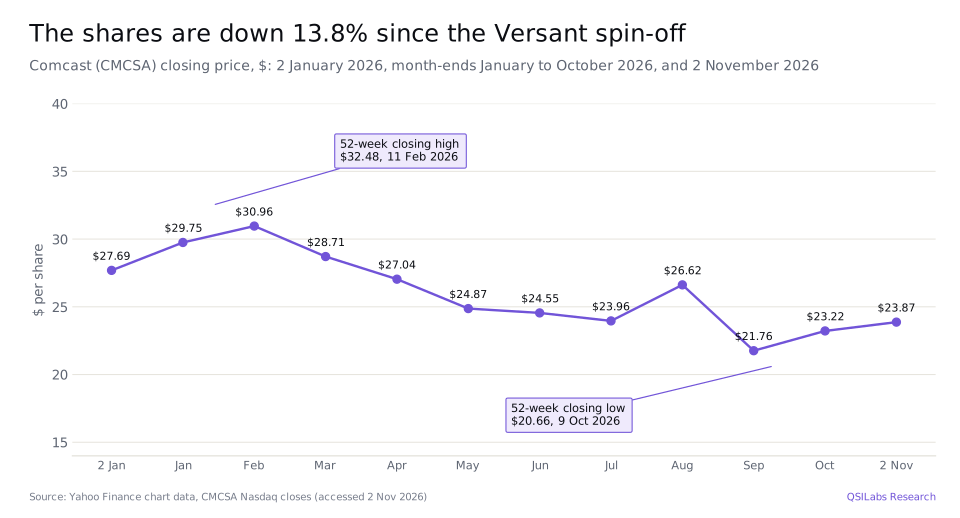
Comcast shares closed at $23.87 on 2 November 2026, 13.8% below the $27.69 close on 2 January, the first trading day after the Versant spin-off. They reached a 52-week closing high of $32.48 on 11 February, fell to a closing low of $20.66 on 9 October, and have risen 15.5% since. They closed at $22.84 on results day, 22 October.
At $23.87 the $1.32 annual dividend is a yield of 5.5%. The shares trade at 6.8 times S&P Global consensus 2026 adjusted EPS of $3.50.
Comcast stock Q3 2026: is CMCSA undervalued?
On our numbers, yes, by a wide margin. Our discounted cash flow model values Comcast at $85.08 a share, about 3.6 times the $23.87 close on 2 November 2026. At that price Comcast's equity was worth about $84.8bn, on 3,551m shares, and its enterprise value, adding debt of $87.4bn and deducting $7.6bn of cash, about $164.5bn. That is 4.9 times the $33.5bn of EBITDA S&P Global records for the past 12 months, and 12.5 times our estimate of 2026 unlevered free cash flow, $13.16bn.
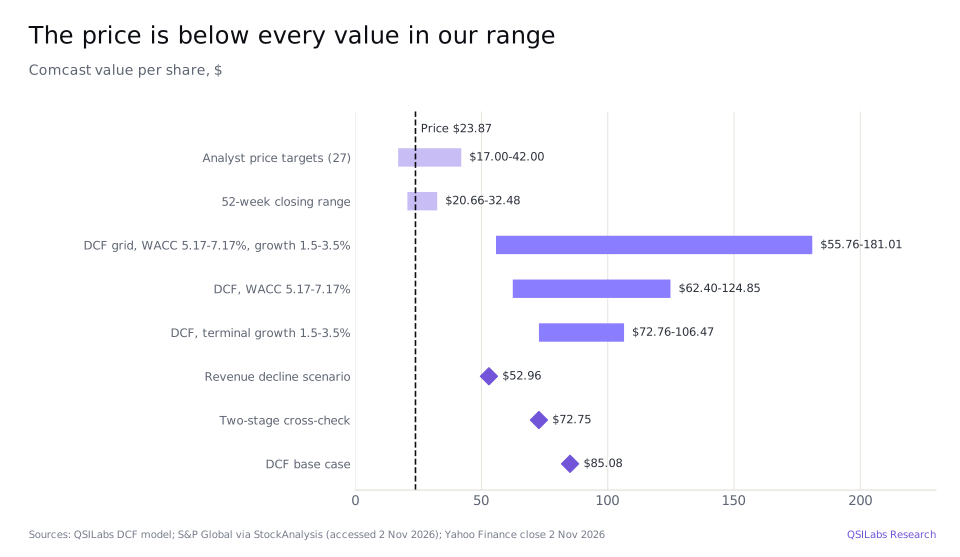
The gap comes from how long the market thinks Comcast's cash flow will last. Our enterprise value of $375.4bn is 11.2 times trailing EBITDA. Because debt is larger than the market value of the equity, small changes in enterprise value move the value per share a lot: a 10% change in our enterprise value changes our value per share by about 12%, and a 10% change in the market's enterprise value would move the share price by about 19%.
Analysts are much closer to the market. The 27 analysts tracked by S&P Global rate Comcast a Hold on average, with an average price target of $27.98, a median of $27.25 and a range from $17 to $42. In October 8 rated it a Strong Buy, 1 a Buy, 14 a Hold, 1 a Sell and 3 a Strong Sell. After the results TD Cowen cut its target to $36 from $39 with a Buy rating on 23 October, and Freedom Capital Markets cut its target to $25 from $29 with a Hold on 26 October.
Method
We forecast revenue and GAAP operating margin year by year to 2035, apply a 25.3% tax rate, Comcast's effective rate for the first nine months of 2026 ($2,983m of tax on $11,791m of pre-tax income), and deduct capital spending, including software and other intangibles, and working capital to reach unlevered free cash flow. We discount those cash flows at a 6.17% weighted average cost of capital, built from Damodaran's January 2026 data for US cable TV companies: equity is 40.5% of capital at a cost of 8.42%, and debt is 59.5% at a pre-tax cost of 6.18%, the yield on Comcast's own bonds blended with its lease rate, taxed at 25%. After 2035 we assume growth of 2.5% a year; that terminal value is 73.3% of our enterprise value of $375.4bn. Deducting debt of $87.37bn, including finance leases and the debt of the Universal Beijing Resort, which Comcast consolidates, adding cash of $7.60bn, investments of $7.86bn and about $0.86bn of cash generated between 30 September and 2 November, and deducting the $1.17bn dividend payable and $0.14bn of minority interests, gives equity value of $303.1bn, or $85.08 a share on 3,562m diluted shares.
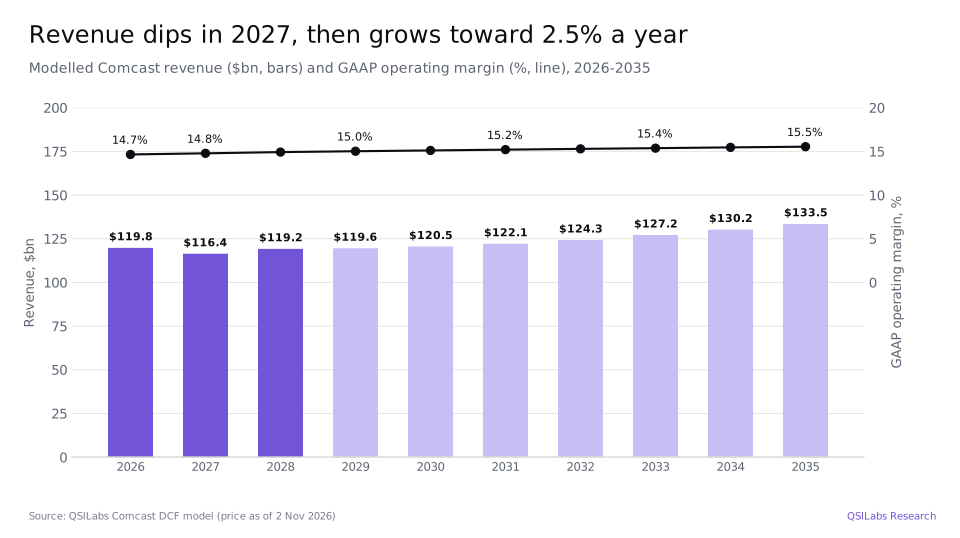
For 2026 we use the S&P Global consensus revenue of $119.78bn, down 3.2%, and GAAP operating profit of $17.55bn, a 14.65% margin. That implies fourth-quarter revenue of about $29.1bn and operating profit of about $2.9bn, which includes the charge of over $1bn Armstrong flagged. For 2027 we use consensus revenue of $116.43bn, down 2.8%, with no Winter Olympics, Super Bowl or World Cup. For 2028 growth of 2.4% takes revenue to about $119.2bn, in line with S&P Global's three-year forecast of a 1.22% annual decline from 2025, with the Los Angeles Summer Olympics on NBC. Growth then rises by half a point a year to 2.3% in 2033, PwC's forecast of annual growth in global internet access spending from 2025 to 2030, and to 2.5% by 2035. Comcast gives no long-term revenue target.
The operating margin edges up from 14.8% in 2027 to 15.5% by 2035. We hold the margin before amortisation of acquired intangible assets at its 2026 level of about 19.7% and keep that amortisation at its current dollar amount, so it shrinks as a share of revenue. Capital spending, including intangibles, is $14.6bn in 2026, the level of the past 12 months, and $14.2bn in 2027, the same share of revenue, falling to $13.5bn by 2035.
We forecast unlevered free cash flow of $13.2bn in 2026 and $12.0bn in 2027, rising to $13.7bn in 2030 and $17.4bn in 2035. That is below Comcast's own free cash flow measure because we charge tax at the full effective rate on operating profit, treat share-based pay as a cost, and leave out deferred tax effects. Our previous model, dated 26 October and priced at $22.84, gave $95.43; it assumed revenue growth of 2% to 3% a year from 2027, which we have replaced with the consensus path above, and it had lower capital spending and a 25% tax rate.
How the number moves if you argue with us
The table shows our value per share at different costs of capital and terminal growth rates. Even at a 7.17% cost of capital and 1.5% terminal growth, the model gives $55.76, about 2.3 times the share price.
| Cost of capital | Growth 1.5% | Growth 2.0% | Growth 2.5% | Growth 3.0% | Growth 3.5% |
|---|---|---|---|---|---|
| 5.17% | $99.16 | $110.00 | $124.85 | $146.49 | $181.01 |
| 5.67% | $84.36 | $91.91 | $101.82 | $115.39 | $135.15 |
| 6.17% | $72.76 | $78.19 | $85.08 | $94.10 | $106.47 |
| 6.67% | $63.42 | $67.43 | $72.37 | $78.63 | $86.83 |
| 7.17% | $55.76 | $58.77 | $62.40 | $66.87 | $72.54 |
A harsher scenario, in which revenue falls 1.22% every year from 2027 to 2035, the operating margin stays at 14.65% and there is no growth at all after 2035, gives $52.96 a share. A two-stage version of the model, which extends the fade over more years, gives $72.75. A bottom-up cost of capital of 7.50%, our cross-check, is above our base rate and would lower the value, to below the $62.40 of the 7.17% row at 2.5% growth.
Our numbers and the market's can both be right only if Comcast's cash flow shrinks faster and for longer than consensus expects, or if investors demand a much higher return than the 6.17% cost of capital for cable companies implies. The pressures are real: broadband customers are falling, fiber and fixed wireless are spreading, and the cable TV business is in long decline. We think the price already allows for most of that.
Risks to the Comcast investment case
- Broadband competition. Domestic broadband revenue fell 4.7% and Comcast lost 554,000 broadband customers in a year. If fiber builders and fixed wireless keep taking share, or price competition stays at what Cavanagh called irrational levels in some markets, the cable business's cash flow could shrink faster than consensus expects.
- Cable TV decline. Video revenue fell 8.7% and Comcast lost 274,000 video customers in the quarter. Video is still $5.9bn of quarterly revenue, so its decline weighs on the whole company.
- The transformation and its charge. Comcast expects a fourth-quarter charge of over $1bn and is changing how it operates. The savings management hopes for are not yet quantified, and the plan comes with a change of chief executive.
- Separation risk. The spin-off of NBCUniversal and Sky depends on approvals and financing. It will split the debt, create separate costs and could leave each company with less room to invest; buybacks are paused until it is done.
- Theme parks and sport. Theme Parks EBITDA fell 17.1% in the quarter, and Comcast does not expect growth until the second half of 2027. Sports rights such as the NBA, the Olympics and the World Cup bring revenue but are expensive, and revenue swings with the event calendar.
- Debt and valuation risk. Debt of $87.4bn is larger than the market value of the equity, which magnifies any change in the value of the business. Our value depends heavily on the terminal value, 73.3% of enterprise value, and on a 6.17% cost of capital; a higher rate or a long decline would bring it much closer to the share price.
FAQ
What value does QSILabs put on Comcast stock?
QSILabs values Comcast at $85.08 a share, based on a discounted cash flow model updated with Q3 2026 results and the Form 10-Q. That is about 3.6 times the $23.87 close on 2 November 2026. A two-stage cross-check gives $72.75, a scenario with revenue declining every year gives $52.96, and analysts' average price target is $27.98.
Is Comcast stock a buy after its Q3 2026 results?
Our model says CMCSA trades well below what its cash flows justify, even using consensus revenue for 2026 to 2028, which falls. The risks are real: broadband customers are declining, a charge of over $1bn is coming in the fourth quarter, and the company is splitting in two. Analysts rate the stock a Hold on average. This is not investment advice.
How much revenue did Comcast make in its latest quarter?
Comcast's revenue for Q3 2026, the quarter to 30 September 2026, was $29,298m, down 6.1% from $31,198m a year earlier and up 0.5% on a pro forma basis that removes Versant and Sky Germany. Connectivity & Platforms brought in $19,663m and Content & Experiences $10,537m. Revenue for the first nine months was $90,695m.
What businesses does Comcast own?
Comcast owns Xfinity, the US cable, broadband and mobile provider; Comcast Business; Sky, the European broadband and TV company; and NBCUniversal, which includes the NBC and Telemundo networks, the Peacock streaming service, Universal Pictures, the Universal theme parks in Orlando, Hollywood and Japan, and a 30% stake in Universal Beijing Resort, which it consolidates. It plans to spin off NBCUniversal and Sky in mid-2027.
Does Comcast pay a dividend?
Yes. Comcast pays $0.33 a share each quarter, $1.32 a year, a yield of about 5.5% at the 2 November 2026 price. It paid $3,606m of dividends in the first nine months of 2026. It paused share buybacks on 1 July 2026 and expects the pause to last at least until the NBCUniversal spin-off.
What price target do analysts have for CMCSA?
The 27 analysts tracked by S&P Global, as reported by StockAnalysis on 2 November 2026, have an average price target for Comcast of $27.98, a median of $27.25, a low of $17 and a high of $42, with a consensus rating of Hold. Our DCF value of $85.08 is about double the highest target.
How much debt does Comcast have?
Comcast had $87,366m of debt at 30 September 2026, including $3,560m due within a year, against cash of $7,596m, leaving net debt of about $79.8bn, roughly 2.4 times trailing EBITDA. It repaid $10.4bn of debt in the first nine months of 2026 and had $11.8bn available under its revolving credit facility.
Is Peacock profitable now?
Yes, on Comcast's adjusted EBITDA measure. Peacock made $261m of adjusted EBITDA in Q3 2026, its second consecutive profitable quarter, against a $217m loss a year earlier, on revenue of about $1.8bn. It had 48m paid subscribers, up 17%.
Who will be Comcast's next chief executive?
Michael Angelakis is preparing to become Comcast's chief executive next year, Cavanagh said on the 22 October 2026 call, and the company plans to give more detail on its strategy early next year with Angelakis taking part. Brian Roberts is chairman and co-chief executive.
Sources
- Comcast Corporation, third-quarter 2026 results (Form 8-K, Exhibit 99.1, 22 Oct 2026; accession 0001628280-26-066783) www.sec.gov
- Comcast Corporation, Form 10-Q for the quarter ended 30 Sep 2026 (filed 22 Oct 2026; accession 0001628280-26-066863) www.sec.gov
- SEC XBRL company facts for Comcast Corporation (CIK 1166691): quarterly and annual revenue, operating income and cash flow from Forms 10-Q and 10-K data.sec.gov
- Comcast Q3 2026 earnings call transcript, 22 Oct 2026, via The Motley Fool (accessed 2 Nov 2026) www.fool.com
- StockAnalysis: Comcast forecast and analyst ratings, S&P Global data (accessed 2 Nov 2026) stockanalysis.com
- StockAnalysis: Comcast statistics (accessed 2 Nov 2026) stockanalysis.com
- PwC, Global Entertainment & Media Outlook 2026-30 press release, 22 Jun 2026 www.pwc.com
- Yahoo Finance chart data: CMCSA closing prices and dividends (November 2025 to November 2026) query1.finance.yahoo.com
- Damodaran Online: cost of capital by industry (US), January 2026 pages.stern.nyu.edu
- QSILabs Comcast discounted cash flow model (internal; price as of 2 Nov 2026)
Disclaimer
This article is for information only and is not investment advice, a recommendation or an offer to buy or sell any security. QSI Labs and its authors may hold positions in the securities discussed. Forecasts and valuations are estimates that depend on assumptions that may prove wrong. Figures are taken from company filings and third-party sources believed to be reliable, but we do not guarantee their accuracy. Do your own research or consult a licensed adviser before investing.
More from QSI Labs
Related analysis: Netflix stock Q3 2026: ads and buybacks, Alphabet stock Q3 2026: YouTube and cloud, Meta stock Q3 2026: AI and capex and Amazon stock Q3 2026.
Read our white paper, QSI Labs: An AI-Native Trading Firm Built on a Training Loop (October 2026), available on request, or browse the research index.