Research / Earnings and valuation
Western Digital Stock Q3 2026:Revenue Up 55% as Exabytes and Pricing Climb
As of: Figures are as of Western Digital's fiscal first-quarter 2027 results (the 13 weeks ended 2 October 2026, which cover July to September 2026 and are the company's Q3 2026 in calendar terms), reported 22 October 2026 in a Form 8-K, with the Form 10-Q filed 23 October 2026. Western Digital's fiscal year ends on the Friday nearest 30 June, so fiscal 2027 runs to early July 2027. The share price used in our valuation is the Nasdaq close of WDC on 2 November 2026, $338.59. Analyst data were accessed on 2 November 2026. Published 2 November 2026.
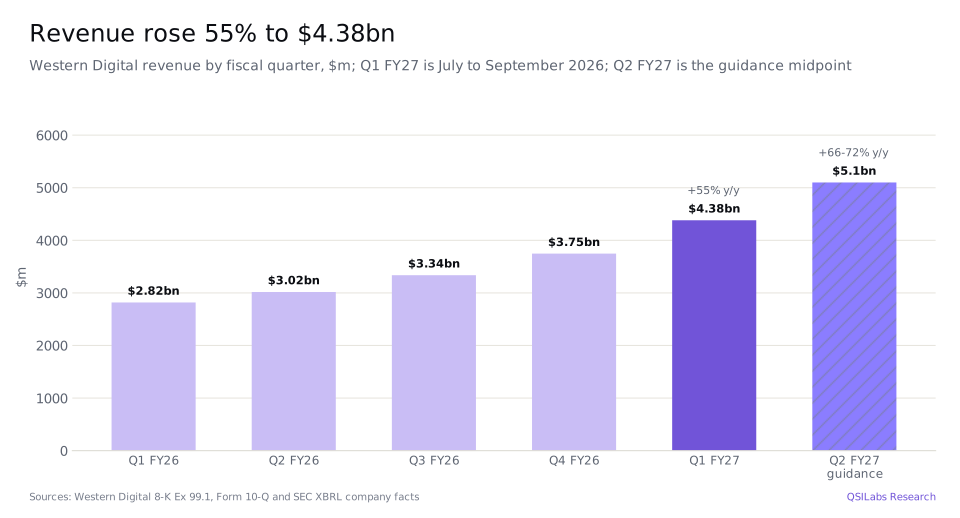
The short answer. Western Digital stock Q3 2026 is a story of a hard drive boom and a share price that has already given back half of its gains. In the three months to 2 October 2026, its fiscal first quarter of 2027, Western Digital's revenue rose 55% to $4,381m as it shipped 22% more exabytes of storage at prices per terabyte 28% higher. The GAAP gross margin rose to 57.8% from 43.5%, diluted earnings per share rose to $4.63 from $3.07, and the company guided December-quarter revenue up 66% to 72%. The shares closed at $338.59 on 2 November 2026, up 96.5% for the year but 54.6% below their June high. Our discounted cash flow model values the shares at $247.70, about 0.73 times the price; the gap comes mainly from our assumption that today's margins, the highest in the company's recent history, fall back towards their long-run average by fiscal 2036.
Key takeaways
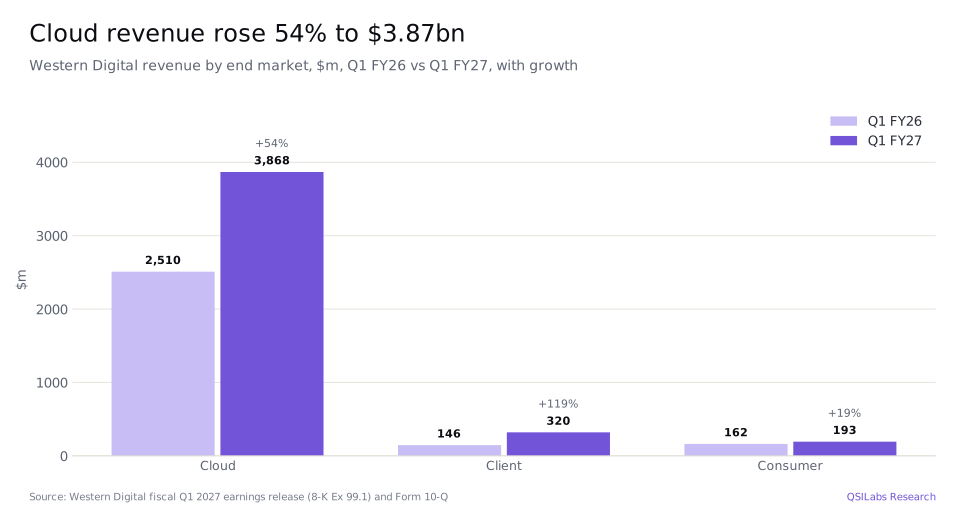
- Revenue grew 55%. Revenue was $4,381m, up from $2,818m a year earlier and $3,747m in the June quarter. Cloud, 88% of revenue, grew 54% to $3,868m.
- Volume and price both rose. Western Digital shipped 248 exabytes, up 22% from a year earlier, and its average price per terabyte rose 28%, up from growth in the high teens in the June quarter.
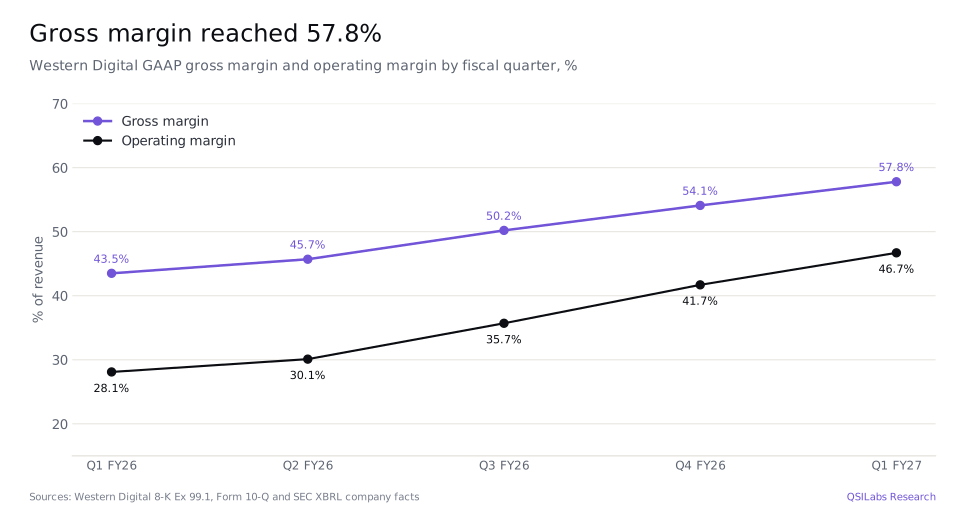
- Margins kept widening. The GAAP gross margin was 57.8% and the GAAP operating margin 46.7%, up from 43.5% and 28.1%. Non-GAAP earnings per share rose 161% to $4.64.
- The next quarter should be bigger again. Western Digital guided Q2 fiscal 2027 revenue of $5.1bn, plus or minus $0.1bn, a non-GAAP gross margin of 60% to 61% and non-GAAP earnings per share of $5.80, plus or minus $0.20.
- More cash back. Free cash flow was $1,377m. Western Digital bought back $1,001m of shares, ended the quarter with net cash of about $0.5bn and raised its quarterly dividend 17% to $0.175.
- Our value: $247.70 a share, against a $338.59 close on 2 November 2026. Across costs of capital from 11.2% to 13.2% and terminal growth from 1.5% to 3.5% the model gives $231.21 to $269.46. Analysts' average target is $613.38.
- What to watch. Whether hard drive prices keep rising, the HAMR drive qualifications with two hyperscale customers due in the first quarter of calendar 2027, input costs for memory chips, and capital spending.
Key numbers from Western Digital's Q3 2026 earnings
| Measure | Q1 FY27 (Jul-Sep 2026) | Q1 FY26 | Change |
|---|---|---|---|
| Revenue | $4,381m | $2,818m | +55% |
| GAAP gross margin | 57.8% | 43.5% | +14.3 points |
| GAAP operating income | $2,046m | $792m | +158% |
| GAAP operating margin | 46.7% | 28.1% | +18.6 points |
| Non-GAAP operating income | $2,153m | $856m | +152% |
| Diluted net income | $1,779m | $1,154m | +54% |
| GAAP diluted earnings per share | $4.63 | $3.07 | +51% |
| Non-GAAP diluted earnings per share | $4.64 | $1.78 | +161% |
| Cash from operations | $1,604m | $672m | +139% |
| Free cash flow | $1,377m | $599m | +130% |
Source: Western Digital fiscal Q1 2027 earnings release (Form 8-K, Exhibit 99.1). Non-GAAP measures and free cash flow are defined by Western Digital.
Western Digital Q3 2026 earnings: what happened
Western Digital reported results for its fiscal first quarter of 2027 on 22 October 2026, after the market closed. The quarter ran from 4 July to 2 October 2026, so it is the company's July-to-September quarter, or Q3 2026 in calendar terms. Revenue rose 55% to $4,381m and 17% on the June quarter. Chief executive Irving Tan said the results exceeded expectations, "driven by robust customer demand and disciplined execution."
Almost all of the growth came from nearline hard drives, the high-capacity drives that cloud companies use to store data. Western Digital shipped 248 exabytes in the quarter, up 22% from a year earlier and 8% from the June quarter, helped by the ramp of its latest ePMR drives with capacities of up to 40 terabytes. Chief financial officer Kris Sennesael said the year-on-year rise in average price per terabyte "further increased to 28% versus the high teens we reported in the prior quarter."
Because prices rose faster than costs, profit grew much faster than revenue. GAAP gross profit was $2,534m, a 57.8% margin, and GAAP operating income rose 158% to $2,046m. Non-GAAP operating expenses were $391m, about 9% of revenue. Diluted net income was $1,779m and GAAP diluted earnings per share were $4.63, up 51%; on Western Digital's non-GAAP measure, which excludes items such as stock-based compensation and amortisation, earnings per share were $4.64, up 161%. GAAP growth was slower mainly because the year-earlier quarter included a $611m gain on Western Digital's retained interest in Sandisk, which it no longer reports.
- 21 Nov 2025WDC closes at $139.19, its 52-week closing lowYahoo Finance
- 31 Dec 2025WDC ends 2025 at $172.27Yahoo Finance
- February 2026Innovation Day: long-term model of more than 20% revenue growth a year and operating margins above 40%MarketBeat via Yahoo Finance; NAND Research
- 18 Jun 2026WDC closes at $746.23, its 52-week closing highYahoo Finance
- July 2026Fiscal 2026 ends with revenue of $12.92bn, up 36%Form 10-K
- 22 Oct 2026Q1 FY27 results after the close: revenue up 55%, dividend raised 17%8-K Ex 99.1
- 23 Oct 2026WDC falls 3.0% to $343.67Yahoo Finance
- 2 Nov 2026WDC closes at $338.59, the price used in our valuationYahoo Finance
- 17 Dec 2026Raised dividend of $0.175 a share is paid8-K Ex 99.1
- Calendar 1H 2027HAMR drives expected to reach volume production after qualification with two hyperscalersEarnings call
Which Western Digital markets grew fastest?
Western Digital reports revenue in three end markets. Cloud, which is mainly nearline drives sold to hyperscale data centre operators and other large customers, rose 54% to $3,868m and made up 88% of revenue. Client, drives sold to PC and other device makers, more than doubled to $320m from $146m. Consumer, the company's own branded external drives, rose 19% to $193m.
By where customers took delivery, revenue in the Americas rose 89% to $2,081m, Asia rose 45% to $1,708m, and Europe, the Middle East and Africa rose 9% to $592m.
Tan tied the demand to artificial intelligence: "AI is fundamentally a data system. Every workload creates more data, and that data must be stored, managed and accessed in a scalable and economical manner." He said that for Western Digital's top seven customers "we have good visibility up to 2030, 2031." Management expects exabyte demand to grow by more than 25% a year over the long term.
Why are Western Digital's margins rising so fast?
The GAAP gross margin has risen in each of the last five quarters, from 43.5% in Q1 fiscal 2026 to 57.8%, and the operating margin from 28.1% to 46.7%. Sennesael credited a shift towards higher-capacity drives, disciplined execution and "a favorable pricing environment across our portfolio." Operating expenses grew far more slowly than revenue, so more of each extra dollar of gross profit reached operating income.
Technology is the other lever. Western Digital expects its newest ePMR drives to make up 30% of nearline shipments in the December quarter and 50% in the March quarter. Its next technology, heat-assisted magnetic recording, or HAMR, is on track to finish qualification with two hyperscale customers in the first quarter of calendar 2027, with volume shipments starting in the first half of calendar 2027. Higher capacity per drive lets the company sell more exabytes without building more drive capacity.
At its Innovation Day in February 2026, Western Digital set out a long-term model for the next three to five years: revenue growth of more than 20% a year, a gross margin above 50%, an operating margin above 40%, a free cash flow margin above 30% and earnings per share above $20. The first quarter of fiscal 2027 already beats all of those margin targets.
What did Western Digital guide for the December quarter?
For the second quarter of fiscal 2027, which ends in early January 2027, Western Digital expects revenue of $5.1bn, plus or minus $100m, up 66% to 72% from $3,017m a year earlier. It guided a non-GAAP gross margin of 60% to 61%, operating expenses of $400m to $410m, a tax rate of about 17% and non-GAAP earnings per share of $5.80, plus or minus $0.20, on about 380m diluted shares.
Sennesael flagged one headwind: "We are facing some input cost increases," since Western Digital uses DRAM and flash memory chips inside its hard drives. On spending, he said: "we expect capital expenditures to average 4% to 6% of revenue over a 5-year period," and "modestly above that range over the next 2 years" as the company invests in heads, media and factory automation. Capital expenditures were $227m in the quarter, 5.2% of revenue.
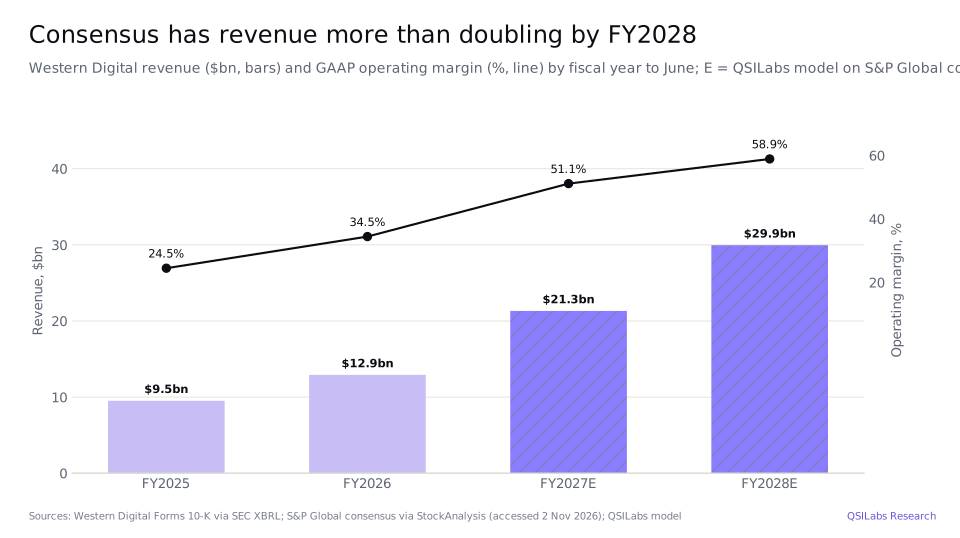
S&P Global consensus, as published by StockAnalysis, has fiscal 2027 revenue of $21.32bn, up 65%, and earnings per share of $24.72, and fiscal 2028 revenue of $29.95bn and earnings per share of $40.40. At $338.59, the shares trade at 13.7 times fiscal 2027 consensus earnings and 8.4 times fiscal 2028.
How much cash does Western Digital return to shareholders?
Western Digital generated $1,604m of cash from operations and $1,377m of free cash flow in the quarter, up from $599m a year earlier. It spent $1,001m buying back 2.0m shares and $56m on dividends; Sennesael said the company "returned $1.1 billion to shareholders." It also paid $570m to settle convertible notes, which "substantially" reduced the remaining 2028 convertible notes, and ended the quarter with cash of $1,314m against $789m of debt, a net cash position of about $0.5bn.
The board raised the quarterly dividend 17% to $0.175 a share, payable on 17 December 2026 to shareholders of record on 4 December. The dividend was $0.125 a quarter at the end of 2025 and $0.15 from June 2026. At $0.70 a year, the new rate is a yield of about 0.2% at the 2 November close; buybacks are by far the larger part of cash returns.
How has WDC stock performed in 2026?
WDC closed 2025 at $172.27 and climbed to a 52-week closing high of $746.23 on 18 June 2026. It then fell back to $454.46 at the end of September and $366.11 on 30 October. The shares fell 3.0% to $343.67 on 23 October, the first trading day after the results, and closed at $338.59 on 2 November 2026, down 7.5% on the day. That is still up 96.5% for the year and more than double the $158.02 close a year earlier, but 54.6% below the June high. At 380m diluted shares the market value of the equity is about $128.7bn.
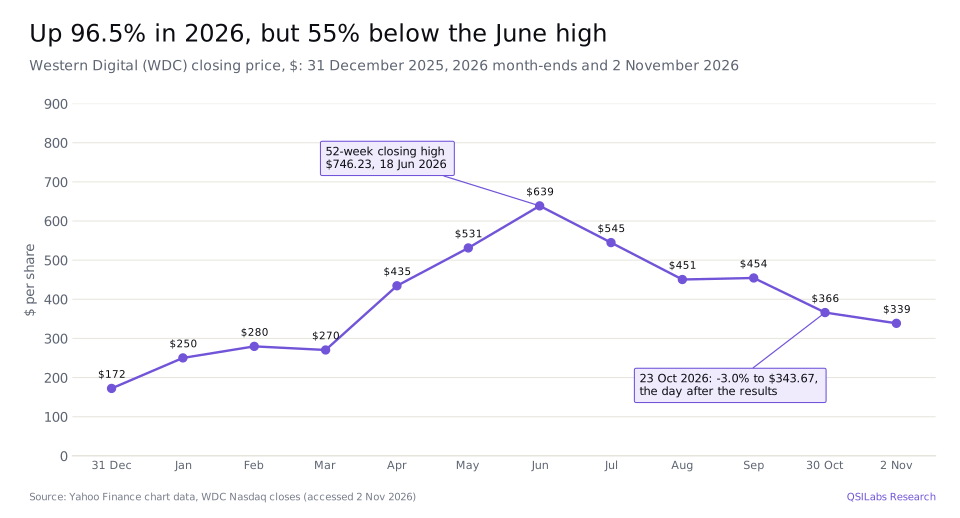
Analysts are far more positive than the recent share price. Of the 26 analysts StockAnalysis tracks, the consensus rating is Buy, and the average 12-month price target is $613.38, with a median of $622.50, a low of $405 and a high of $900.
Western Digital stock Q3 2026: is WDC overvalued?
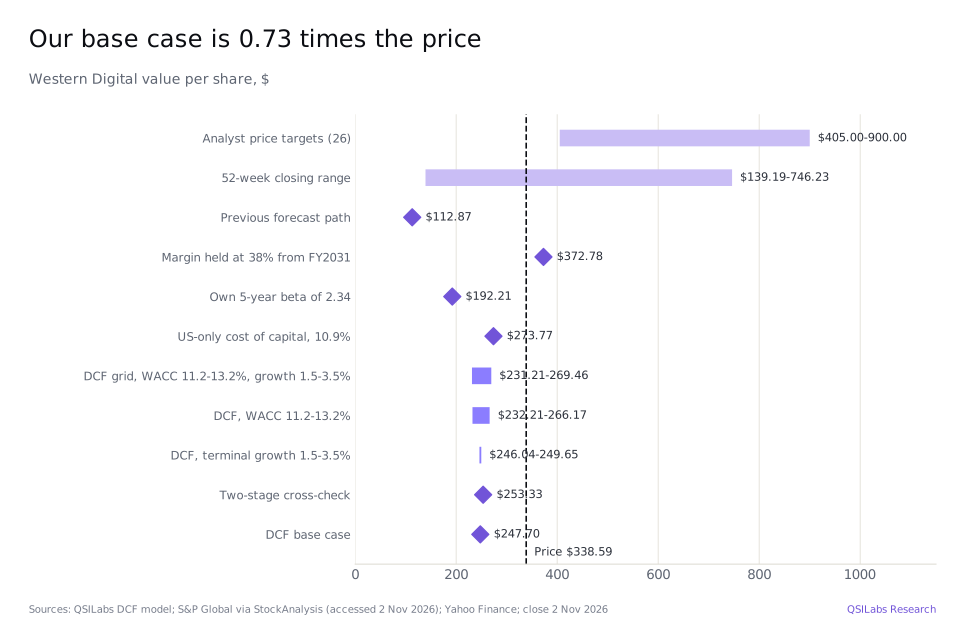
On our numbers, yes, but the answer turns on how long today's margins last. Our discounted cash flow model values Western Digital at $247.70 a share, 0.73 times the $338.59 close on 2 November 2026. Our equity value is $94.1bn, against a market value of about $128.7bn.
We value the cash available to all lenders and shareholders, unlevered free cash flow: operating profit after tax at 17%, the rate Western Digital guided, plus depreciation and amortisation, less capital expenditures and the extra working capital that growth needs. That gives $7.42bn for fiscal 2027, of which we count only the part still to come after 2 November, $12.71bn in fiscal 2028, a peak of $15.61bn in fiscal 2030 and $6.05bn in fiscal 2036. From the enterprise value of $93.06bn we add cash of $1.31bn, deduct the $650m drawn on the revolving credit facility, and add $400m for the capped call options linked to the 2028 convertible notes, valued at their cap. We do not deduct the remaining $141m of convertible notes because the roughly 3.7m shares they convert into are already in the 380m share count.
We discount at a weighted average cost of capital of 12.2%. The cost of equity is 12.26%: a US 10-year Treasury yield of 5.12% plus a beta of 1.43 times an equity risk premium of 5.01%. The beta is the global computers and peripherals industry's unlevered beta of 1.42, relevered at Western Digital's debt-to-equity ratio of 0.005. The risk premium is weighted by where Western Digital's customers took delivery in fiscal 2026: 40.0% in the United States, 31.2% in China and Hong Kong and 28.8% elsewhere. Debt is only 0.5% of capital, at an after-tax cost of 4.85%. After fiscal 2036 we assume growth of 2.5% a year; that terminal value is 22.5% of our enterprise value, which is low because we expect margins to have faded by then.
Plainly, the value is below the price because we do not assume today's margins last. The cash flows in our model peak in fiscal 2030 and then shrink as the margin falls. The market is pricing in margins that stay high for longer. Western Digital's own five-year beta is 2.34, much higher than the industry figure: using it would raise the cost of capital to 16.8% and cut the value to $192.21.
Our forecast for Western Digital
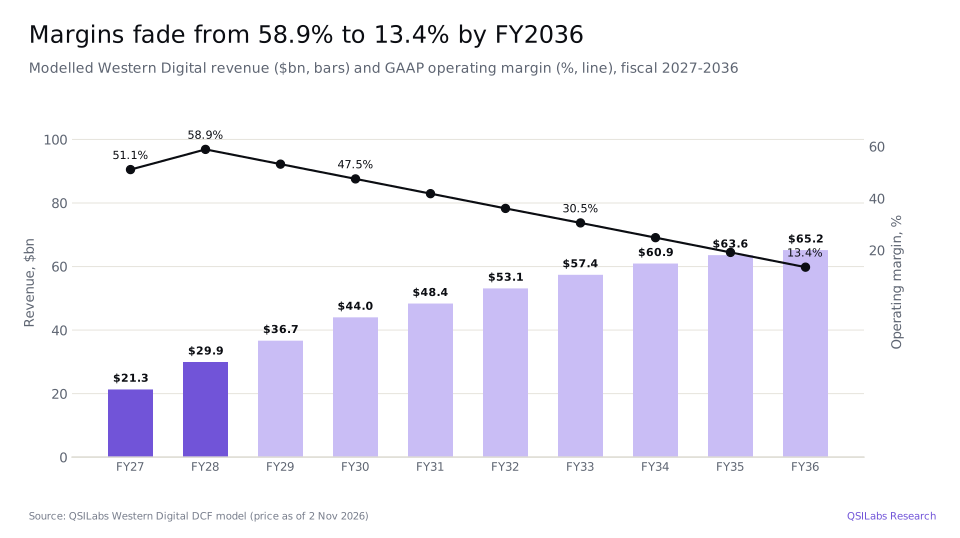
Revenue is $21.32bn in fiscal 2027, the first quarter's $4,381m plus the rest of S&P Global consensus, and $29.95bn in fiscal 2028, consensus again, up 40.5%. For fiscal 2029 we use the consensus three-year growth forecast of 41.6% a year from fiscal 2026, which gives $36.68bn, up 22.5%. Fiscal 2030 grows 20%, in line with the company's long-term model of revenue growth above 20%. For fiscal 2031 and 2032 we use 9.9% a year, Mordor Intelligence's forecast growth for nearline and cold-data storage drives from 2027 to 2032, before growth fades to 2.5% by fiscal 2036.
The GAAP operating margin is 51.1% in fiscal 2027: consensus non-GAAP operating income of $11.47bn, converted to GAAP at the first quarter's ratio of GAAP to non-GAAP operating income. For fiscal 2028 we work back from consensus earnings per share of $40.40 at the guided 17% tax rate and 380m shares, which gives a GAAP margin of 58.9%. From there the margin falls in a straight line to 13.4% by fiscal 2036. That is Western Digital's average GAAP operating margin for its hard drive business over fiscal 2020 to 2026, total operating profit divided by total revenue, which covers both the downturn of fiscal 2023 and the current boom.
Depreciation and amortisation starts at 2.37% of revenue, the first quarter's rate, and rises to 3.39% by fiscal 2036. Capital expenditures are 6% of revenue in fiscal 2027 and 2028, the top of the company's 4% to 6% range, and 5% from fiscal 2029, the middle of it. Working capital grows with revenue.
Our previous model, priced at the 22 October close of $354.19, gave $101.07. It built fiscal 2027 from the second-quarter guidance and then used growth of 20% in fiscal 2028, 5% in 2029, none in 2030 and 3% a year after that, with a margin of 42.3% in fiscal 2028 fading to 13.4% by 2032, none of it tied to a published source. Run in today's model, that old path gives $112.87, so the sourced forecast adds $134.83. Capital spending makes little difference: letting it drift up to 6.2% of revenue by fiscal 2036, above the company's range, gives $249.52.
How the number moves if you argue with us
The table shows our value per share at different costs of capital and terminal growth rates. Even at an 11.2% cost of capital and 3.5% terminal growth, the corner of the grid, the model gives $269.46, about 0.80 times the share price. Terminal growth matters little because the terminal value is a small part of the total.
| Cost of capital | Growth 1.5% | Growth 2.0% | Growth 2.5% | Growth 3.0% | Growth 3.5% |
|---|---|---|---|---|---|
| 11.225% | $263.46 | $264.75 | $266.17 | $267.73 | $269.46 |
| 11.725% | $254.38 | $255.40 | $256.50 | $257.71 | $259.04 |
| 12.225% | $246.04 | $246.84 | $247.70 | $248.63 | $249.65 |
| 12.725% | $238.34 | $238.97 | $239.63 | $240.35 | $241.12 |
| 13.225% | $231.21 | $231.70 | $232.21 | $232.75 | $233.33 |
A two-stage version of the model, which adds a 10-year period after fiscal 2036 in which growth fades gradually to 2.5% and returns on new investment fall towards the cost of capital, gives $253.33. A US-only cost of capital of 10.9% gives $273.77. Weighting the risk premium by first-quarter revenue instead gives 12.3% and $246.16, and using a separate cost of capital for each region, each with its own industry beta, gives 12.6% and $241.87.
The assumption that matters most is the margin. If the operating margin falls only to 38% by fiscal 2031, Western Digital's long-term target of a non-GAAP margin above 40% converted to GAAP, and stays there, the model gives $372.78, about 1.10 times the price. For the share price to be right on our method, investors need to believe that hard drive margins will stay close to the company's target for good, not return to their history.
Risks to the Western Digital investment case
- The pricing cycle. Price per terabyte rose 28% from a year earlier. Hard drive prices and margins have fallen sharply in past downturns, and our value already assumes they fade; a faster fall would cut it further.
- Customer concentration. Cloud is 88% of revenue, and Western Digital lists the concentration of revenue in its Cloud end market and among its top customers as a key risk. A pause in data centre spending by a few hyperscalers would hit revenue quickly.
- Technology execution. The ePMR ramp and HAMR qualifications in early 2027 underpin the capacity gains. Delays would slow exabyte growth and could hand share to rivals.
- Input costs. Western Digital uses DRAM and flash chips in its drives, and Sennesael said the company faces "some input cost increases."
- Market size. Mordor Intelligence puts the whole hard disk drive market at $54.99bn in 2027 and $75.62bn in 2032. Our forecast, built on consensus, has Western Digital's revenue at $53.1bn in fiscal 2032, about 70% of that, which needs either large share gains or much higher prices than Mordor assumes.
- Volatility. WDC rose more than fivefold from its November 2025 low to its June high and has since more than halved from that high. Its five-year beta of 2.34 says the shares move much more than the market.
FAQ
What value does QSILabs put on Western Digital stock?
Our discounted cash flow model gives $247.70 a share, against a $338.59 close on 2 November 2026. Across costs of capital from 11.2% to 13.2% and terminal growth from 1.5% to 3.5% the value ranges from $231.21 to $269.46. A two-stage cross-check gives $253.33.
Should I buy WDC shares after these results?
We do not give personal advice. Results were very strong, with revenue up 55% and guidance for faster growth next quarter, but on our numbers the shares trade above the value of their cash flows unless today's margins last well beyond fiscal 2030. Read the sensitivity table and the risks above before deciding.
How much did Western Digital earn last quarter?
In the quarter to 2 October 2026, diluted net income was $1,779m, or $4.63 a share on a GAAP basis, up from $3.07. Non-GAAP earnings per share were $4.64, up 161%. Revenue was $4,381m.
What is driving Western Digital's revenue growth?
Cloud companies are buying more high-capacity drives to store data, much of it linked to AI, and prices are rising. Western Digital shipped 22% more exabytes than a year earlier at a 28% higher average price per terabyte.
What revenue does Western Digital expect next quarter?
Western Digital expects $5.1bn, plus or minus $100m, for the quarter ending in early January 2027, up 66% to 72%, with non-GAAP earnings per share of $5.80, plus or minus $0.20.
Does Western Digital pay a dividend?
Yes. The board raised the quarterly dividend 17% to $0.175 a share, payable on 17 December 2026 to shareholders of record on 4 December. Western Digital also bought back $1,001m of shares in the quarter.
What price target do analysts have for WDC?
The average 12-month target of the 26 analysts tracked by StockAnalysis is $613.38, with a range of $405 to $900, and the consensus rating is Buy.
How much debt does Western Digital have?
Very little. At 2 October 2026 it had $789m of debt, all due within a year, against cash of $1,314m, a net cash position of about $0.5bn.
What is HAMR and when will Western Digital ship it?
Heat-assisted magnetic recording uses a laser to heat the disk while writing, which lets each drive hold more data. Western Digital expects to finish qualification with two hyperscale customers in the first quarter of calendar 2027 and to start volume shipments in the first half of calendar 2027.
Who runs Western Digital?
Irving Tan is chief executive officer and Kris Sennesael is chief financial officer.
Sources
- Western Digital, fiscal first-quarter 2027 earnings release (Form 8-K, Exhibit 99.1, 22 Oct 2026; accession 0001628280-26-066882) www.sec.gov
- Western Digital, Form 10-Q for the quarter ended 2 Oct 2026 (accession 0001628280-26-066933) www.sec.gov
- Western Digital, Form 10-K for the fiscal year ended 3 Jul 2026 (SEC EDGAR filing list) www.sec.gov
- SEC XBRL company facts for Western Digital (CIK 106040): quarterly and annual revenue, gross profit, operating income and cash flow data.sec.gov
- Western Digital Q1 fiscal 2027 earnings call transcript, 22 Oct 2026 (The Motley Fool; accessed 2 Nov 2026) www.fool.com
- StockAnalysis: Western Digital forecast and analyst ratings, S&P Global data (accessed 2 Nov 2026) stockanalysis.com
- StockAnalysis: Western Digital statistics (accessed 2 Nov 2026) stockanalysis.com
- MarketBeat via Yahoo Finance: Western Digital investor day, HAMR and long-term model (4 Feb 2026) finance.yahoo.com
- NAND Research: research note, Western Digital Innovation Day (9 Feb 2026) nand-research.com
- Mordor Intelligence, Hard Disk Drive (HDD) Market report (accessed 2 Nov 2026) www.mordorintelligence.com
- Yahoo Finance chart data: WDC closing prices and dividends (November 2025 to November 2026) query1.finance.yahoo.com
- Damodaran Online: global industry betas, cost of capital and country equity risk premiums, January 2026 pages.stern.nyu.edu
- QSILabs Western Digital discounted cash flow model (internal; price as of 2 Nov 2026)
Disclaimer
This article is for information only and is not investment advice, a recommendation or an offer to buy or sell any security. QSI Labs and its authors may hold positions in the securities discussed. Forecasts and valuations are estimates that depend on assumptions that may prove wrong. Figures are taken from company filings and third-party sources believed to be reliable, but we do not guarantee their accuracy. Do your own research or consult a licensed adviser before investing.
More from QSI Labs
Related analysis: Sandisk stock Q3 2026: datacenter sales and NAND, Micron stock Q3 2026: HBM and margins, Dell stock Q3 2026: AI servers and backlog and NVIDIA stock Q3 2026: Vera Rubin and guidance.
Read our white paper, QSI Labs: An AI-Native Trading Firm Built on a Training Loop (October 2026), available on request, or browse the research index.