Research / Earnings and valuation
Cisco Stock Q3 2026:AI Orders Reach $9.3bn as Revenue Grows 18%
As of: Figures are as of Cisco Systems' fiscal Q4 FY2026 results (the quarter ended 25 July 2026, reported 12 August 2026 in a Form 8-K) and its fiscal 2026 Form 10-K, filed 2 September 2026. Cisco's fiscal year ends in late July, so fiscal Q4 FY2026 is its latest quarter ending in the July-September 2026 window. The share price is the Nasdaq close of CSCO on 30 October 2026, $104.51. Published 2 November 2026.
The short answer. Cisco stock Q3 2026 rests on Cisco's fiscal Q4 FY2026, the quarter to 25 July 2026: revenue rose 18% to $17.25bn, product orders rose 35% and hyperscalers placed $4bn of AI infrastructure orders, taking the fiscal-year total to $9.3bn. Cisco guided fiscal 2027 revenue to $72.2-73.4bn, about 15% growth, and non-GAAP EPS to $5.05-5.11. Our discounted cash flow model values Cisco at $76.04 a share, against a $104.51 close on 30 October 2026. Cisco is growing faster than at any time in more than a decade; the share price assumes that pace, and a wider margin, last for longer than we do.
Key takeaways
- Revenue up 18%. Fiscal Q4 FY2026 revenue was $17,252m, up from $14,673m a year earlier and 9% above fiscal Q3. Product revenue rose 24% to $13,459m; services revenue was flat at $3,793m.
- Networking is the engine. Networking revenue rose 28% to $9,791m, and networking product orders rose 40%, the eighth consecutive quarter of double-digit order growth.
- AI orders of $9.3bn. Hyperscalers ordered $4bn of AI infrastructure from Cisco in Q4 and $9.3bn in fiscal 2026. Cisco booked about $4bn of AI infrastructure revenue in fiscal 2026 and expects $7.5bn in fiscal 2027.
- Margins: GAAP up, non-GAAP gross down. GAAP operating margin was 24.7%, from 21.0%. Non-GAAP gross margin fell to 66.3% from 68.4% as lower-margin AI systems and higher memory costs grew in the mix.
- Guidance. Fiscal Q1 FY2027 revenue of $18.0-18.2bn (about 22% growth); fiscal 2027 revenue of $72.2-73.4bn, GAAP EPS of $4.00-4.06 and non-GAAP EPS of $5.05-5.11.
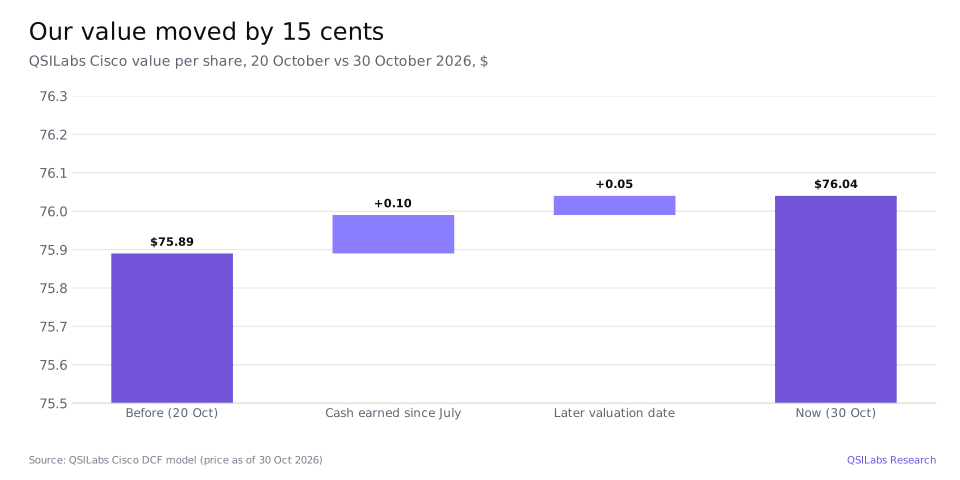
- Our value: $76.04 a share, up from $75.89 on 20 October and about 27% below the $104.51 close on 30 October. A two-stage cross-check gives $76.06; analysts' average target is $136.16.
- What to watch. Fiscal Q1 FY2027 results, due in November, will show whether the $18.1bn revenue guide is met and whether gross margin holds inside the 65-66% range.
Key numbers from Cisco's fiscal Q4 FY2026 earnings
| Metric | Fiscal Q4 FY2026 | Fiscal Q4 FY2025 | Change |
|---|---|---|---|
| Revenue | $17,252m | $14,673m | +18% |
| Product revenue | $13,459m | $10,886m | +24% |
| Services revenue | $3,793m | $3,787m | flat |
| Networking revenue | $9,791m | +28% | |
| Product orders | +35% | ||
| GAAP gross margin | 64.1% | 63.2% | +0.9 pts |
| Non-GAAP gross margin | 66.3% | 68.4% | -2.1 pts |
| GAAP operating income | $4,264m | $3,087m | +38% |
| GAAP operating margin | 24.7% | 21.0% | +3.7 pts |
| Non-GAAP operating income | $6,198m | $5,029m | +23% |
| GAAP net income | $3,859m | $2,550m | +51% |
| Diluted EPS (GAAP) | $0.97 | $0.64 | +52% |
| Non-GAAP EPS | $1.22 | $0.99 | +23% |
| Operating cash flow | $5,386m | $4,234m | +27% |
Cisco Q4 FY2026 earnings: what happened
Cisco reported results for its fiscal fourth quarter, the three months to 25 July 2026, on 12 August. Its fiscal year ends in late July, so this is its latest quarter ending in the July-September 2026 window; the fiscal Q1 FY2027 quarter, which ended on 24 October, has not yet been reported. Revenue of $17,252m was the first above $17bn, and growth of 18% was the fastest in the four quarters of fiscal 2026, after 7.5%, 9.7% and 12.0%.
Cisco described the quarter as "a networking supercycle". Product orders rose 35% year on year and 25% excluding hyperscalers, with double-digit growth in every geography and customer market. Revenue grew 18% in the Americas, to $10,396m, 19% in EMEA, to $4,350m, and 14% in Asia Pacific, Japan and China, to $2,506m.
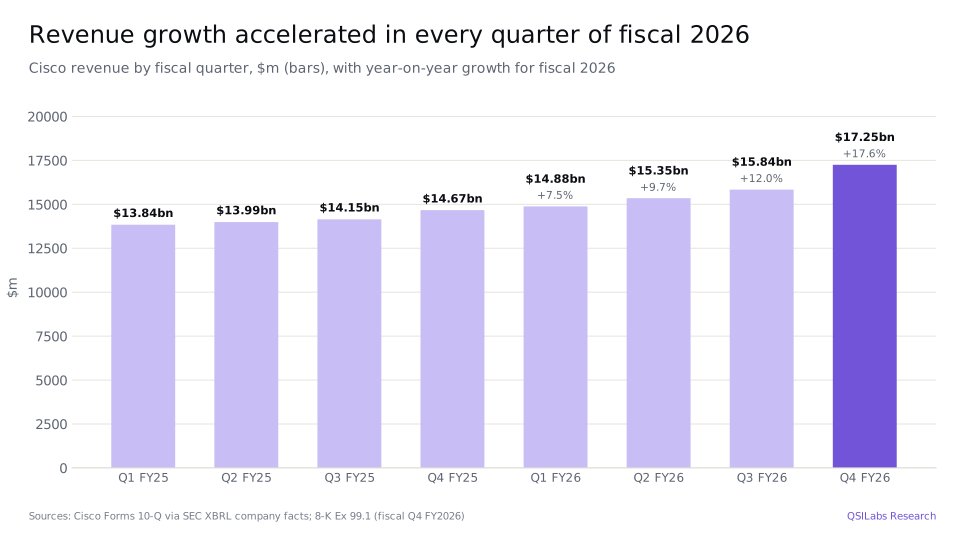
Profit rose faster than revenue. GAAP operating income was $4,264m, up 38%, even after $511m of restructuring charges in the quarter, against $35m a year earlier. GAAP net income rose 51% to $3,859m, or $0.97 a diluted share, helped by $822m of other income, mostly gains on investments. Non-GAAP EPS, which excludes share-based pay, amortisation of acquired intangibles, restructuring and those gains, was $1.22, up 23%.
For the full fiscal year Cisco reported revenue of $63,325m, up 12%, GAAP operating income of $15,368m, a 24.3% margin against 20.8% in fiscal 2025, and GAAP net income of $13,267m, or $3.33 a share. Non-GAAP operating income was $22,040m, a 34.8% margin, and non-GAAP EPS $4.33.
- 25 Jul 2026Fiscal 2026 ends; fiscal Q4 revenue $17,252m (+18%), the first quarter above $17bn8-K Ex 99.1
- 12 Aug 2026Fiscal Q4 results: product orders +35%, $4bn of hyperscaler AI orders in the quarter; FY2027 revenue guidance $72.2-73.4bn. CSCO closes at $123.888-K Ex 99.1; Yahoo Finance
- 13 Aug 2026CSCO closes at $113.47, down 8.4% on the day after the resultsYahoo Finance
- 2 Sep 2026Fiscal 2026 Form 10-K filed: 3,942.6m shares outstanding at 27 August; hyperscaler AI infrastructure about 6% of FY2026 revenueForm 10-K
- 9 Oct 2026Form 8-K: Girish Rishi appointed to the board of directorsForm 8-K
- 21 Oct 2026Quarterly dividend of $0.42 a share paid8-K Ex 99.1
- 30 Oct 2026CSCO closes at $104.51 on Nasdaq, the price used in our valuationYahoo Finance
- 2 Nov 2026CSCO closes at $101.59; fiscal Q1 FY2027 results (quarter to 24 October) are due in NovemberStockAnalysis
Which Cisco businesses grew fastest in fiscal Q4 2026?
Networking grew fastest. Networking revenue rose 28% to $9,791m, 57% of total revenue and 73% of product revenue. Security rose 14% to $2,226m, collaboration 12% to $1,167m and observability 6% to $275m. Services revenue, mostly support contracts on the installed base, was flat at $3,793m.
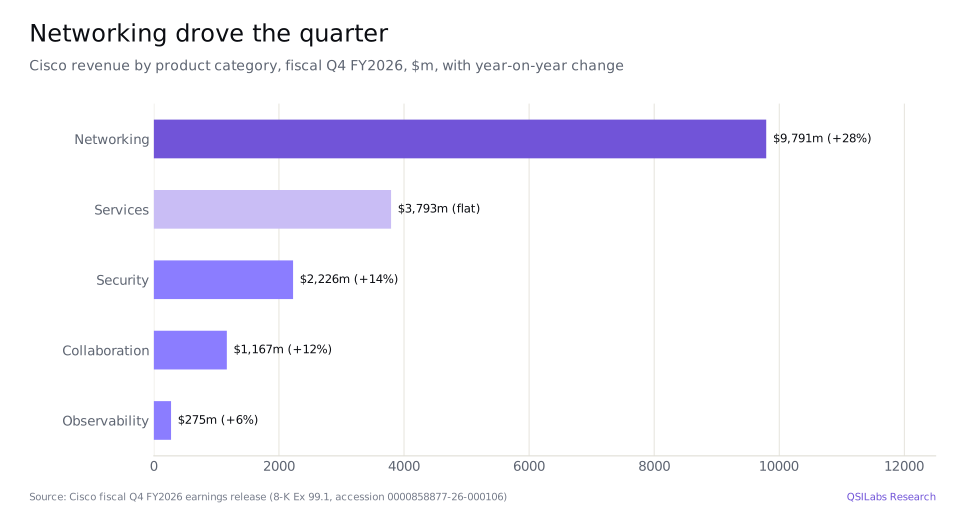
The networking surge has two sources. The first is AI data centres: hyperscalers are buying Cisco's Silicon One switching chips and systems, along with optics, to connect large clusters of AI accelerators. The second is a refresh among enterprises, service providers and the public sector, which are replacing campus switches, routers and wireless equipment; orders excluding hyperscalers rose 25%, which suggests the cycle is broad rather than confined to a handful of cloud companies.
Software and recurring revenue grew more slowly. Cisco's 10-K puts fiscal 2026 software revenue at $23.2bn, up 4%, with subscription revenue up 1%. Remaining performance obligations, contracted revenue not yet recognised, were $46.7bn at 25 July, up 7% from $43.5bn, and deferred revenue was $29.8bn, up 3.5%. The growth in fiscal 2026 came overwhelmingly from hardware.
Cisco kept buying. In the fourth quarter it acquired Galileo Technologies, a privately held observability company, and Astrix Security, which specialises in securing non-human identities such as service accounts and AI agents' credentials.
How big is Cisco's AI infrastructure business?
Cisco took $9.3bn of AI infrastructure orders from hyperscalers in fiscal 2026, including $4bn in the fourth quarter alone. It recognised about $4bn of AI infrastructure revenue in the year and expects $7.5bn in fiscal 2027. The 10-K says hyperscaler AI infrastructure was about 6% of fiscal 2026 revenue, against less than 2% in fiscal 2025.
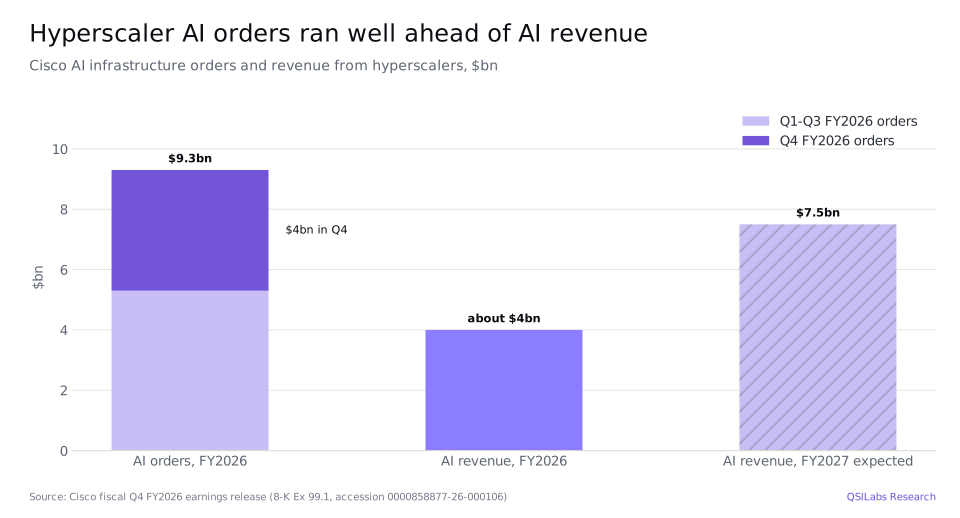
The gap between orders and revenue matters. Orders of $9.3bn against revenue of about $4bn mean Cisco entered fiscal 2027 with a large AI backlog, which is the main reason its guidance implies revenue growth of about 22% in fiscal Q1 FY2027. If Cisco delivers $7.5bn of AI revenue in fiscal 2027, AI alone would add about $3.5bn of revenue, close to 40% of the $9.5bn increase implied by the midpoint of guidance.
The AI business is concentrated, though. A small number of hyperscalers place these orders, in large and irregular amounts, and they also build their own networking hardware or buy from rivals such as Arista Networks, Broadcom and NVIDIA. AI systems also carry lower gross margins than Cisco's software and enterprise products, which is already visible in the company's margins.
How profitable is Cisco? Gross margin, operating margin and costs
Cisco's GAAP operating margin was 24.7% in fiscal Q4 FY2026, against 21.0% a year earlier, and has held between 24.6% and 25.0% for three quarters. Its non-GAAP operating margin, which Cisco uses for guidance, was 35.9%, up from 34.3%.
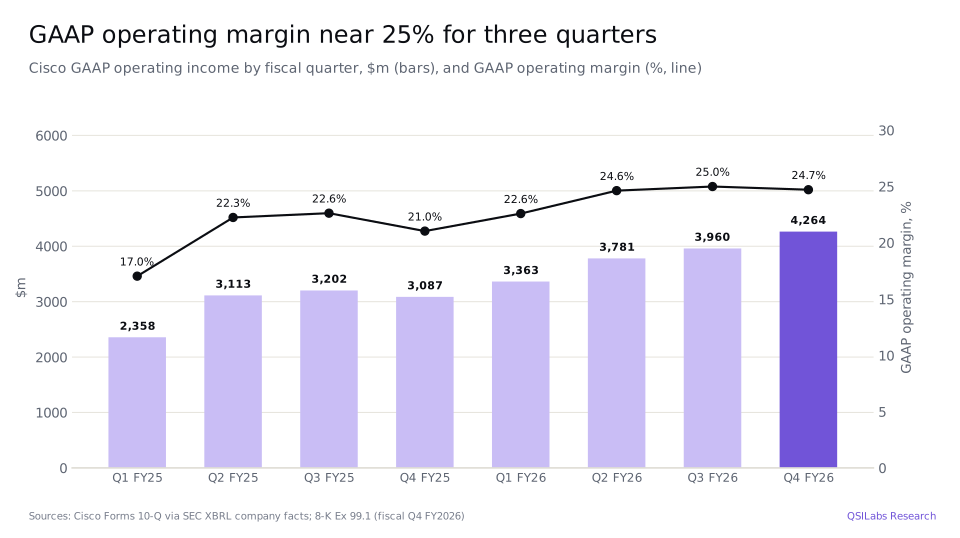
Gross margin is the weaker line. On a GAAP basis it rose to 64.1% from 63.2%, but on Cisco's non-GAAP basis it fell to 66.3% from 68.4%, and non-GAAP product gross margin fell to 64.8% from 67.5%. Cisco's 10-K attributes the pressure to product mix, as lower-margin AI infrastructure grows, and to higher memory and component costs. Inventories rose to $5.7bn at 25 July from $3.2bn a year earlier, which the 10-K attributes to demand for Cisco Silicon One, higher memory prices and commitments with suppliers to secure memory and components.
Operating expenses grew more slowly than revenue. GAAP operating expenses were $6.8bn, up 10%, and fell to 39.4% of revenue. Cisco started a restructuring plan in the fourth quarter to shift spending towards silicon, optics, security and AI; it expects pre-tax charges of up to $1bn, of which $511m was taken in fiscal 2026, and to complete the plan by the end of fiscal 2027. Share-based compensation was $3,830m in fiscal 2026, 6.0% of revenue; it is excluded from non-GAAP profit but included in our model, because it is a real cost to shareholders.
How much cash does Cisco generate?
Cisco generated $14,177m of operating cash flow in fiscal 2026, flat on fiscal 2025, and spent $1,410m on property and equipment, leaving free cash flow of $12,767m, a 20% margin. Fourth-quarter operating cash flow was $5,386m, up 27%.
Cash flow lagged profit for three reasons, all visible in the cash flow statement: inventories absorbed $2,541m, financing receivables, mostly loans and leases to customers through Cisco Capital, absorbed $1,835m, and cash taxes rose to $4,821m from $3,892m.
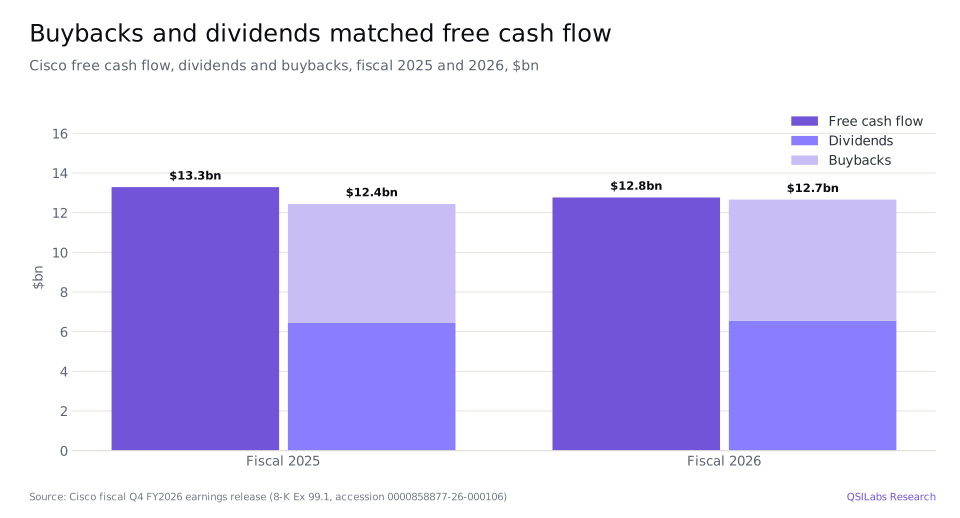
Cisco returned $12,659m to shareholders in fiscal 2026: $6,553m of dividends and $6,106m of buybacks. In the fourth quarter it bought back about 13 million shares at an average of $111.53, for $1.5bn, and $8.1bn remained under its repurchase authorisation. The quarterly dividend is $0.42 a share, or $1.68 a year, a yield of about 1.6% at $104.51; the latest was paid on 21 October 2026.
At 25 July Cisco held $15.9bn of cash and investments against $29.5bn of debt: $23.0bn of senior notes and $6.7bn of commercial paper. Net debt was $13.6bn, about 0.6 times fiscal 2026 non-GAAP operating income. Cisco also held $8.3bn of financing receivables, which partly offset the debt that funds them.
Cisco's fiscal 2027 guidance: what to expect
Cisco guided fiscal Q1 FY2027 revenue to $18.0-18.2bn, growth of about 21-22% on the $14,883m of a year earlier, and full-year fiscal 2027 revenue to $72.2-73.4bn, growth of 14-16%. At the midpoint, $72.8bn, revenue would rise about $9.5bn, or 15%.
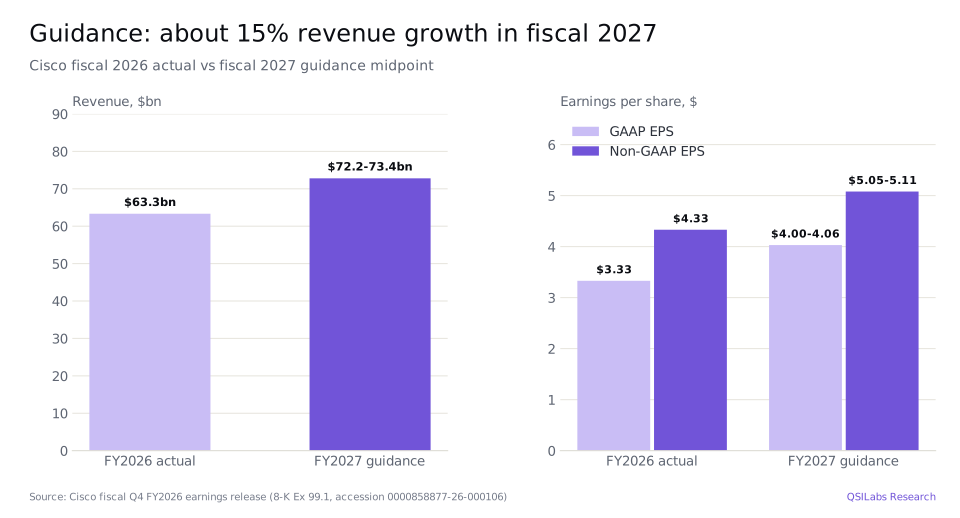
| Guidance | Fiscal Q1 FY2027 | Fiscal 2027 |
|---|---|---|
| Revenue | $18.0-18.2bn | $72.2-73.4bn |
| Non-GAAP gross margin | 65-66% | |
| Non-GAAP operating margin | 35.5-36.5% | |
| GAAP EPS | $1.08-1.10 | $4.00-4.06 |
| Non-GAAP EPS | $1.32-1.34 | $5.05-5.11 |
| GAAP tax rate | about 14.5% |
Guidance implies non-GAAP EPS growth of about 17% and GAAP EPS growth of about 21% for the year. The Q1 non-GAAP gross margin range of 65-66% is below the 66.3% of fiscal Q4, so Cisco expects the AI mix and memory costs to keep pressing on margins for at least another quarter.
Analysts are slightly above the guidance. The S&P Global consensus compiled by StockAnalysis has fiscal 2027 revenue of $73.17bn, up 15.6%, and fiscal 2028 revenue of $78.09bn, up 6.7%, with adjusted EPS of $5.15 and $5.62.
Cisco stock Q3 2026: is CSCO overvalued?
On our numbers, yes. Our discounted cash flow model values Cisco at $76.04 a share, against a $104.51 close on 30 October 2026, 27% lower. At that price Cisco's equity was worth about $416bn on a diluted basis and its enterprise value, including $13.6bn of net debt, about $429bn. That is 20.6 times the midpoint of fiscal 2027 non-GAAP EPS guidance, 25.9 times GAAP EPS guidance and 34 times fiscal 2026 free cash flow.
The shares have risen 40% in a year, from $74.45 on 3 November 2025, and set a 52-week high of $130.37. They closed at $123.88 on the day of the fiscal Q4 results and fell 8.4% the next day, to $113.47. They closed at $101.59 on 2 November.
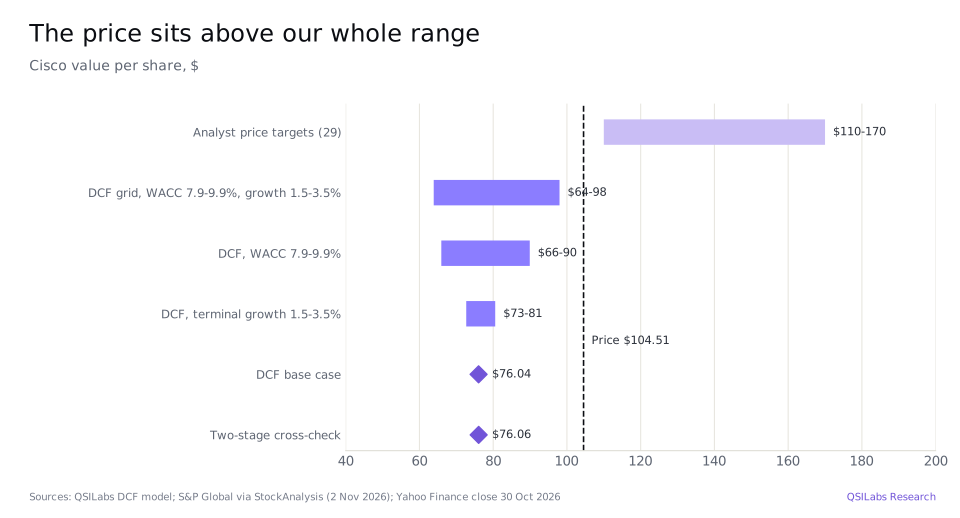
We are not saying the business is weak. Cisco is growing at 15-18%, generates about $13bn of free cash flow a year and has a strong position in an AI networking market that is growing quickly. We are saying the price assumes something better than our forecast: that growth stays well above our path after fiscal 2027, that margins widen further than the roughly 31% we assume, or that investors accept a lower return than the 8.9% cost of capital we use. Our enterprise value of $304.2bn is 71% of the market's.
Analysts are more optimistic. The 29 analysts tracked by StockAnalysis rate Cisco a Buy on average, with an average price target of $136.16 and a range from $110 to $170.
Method
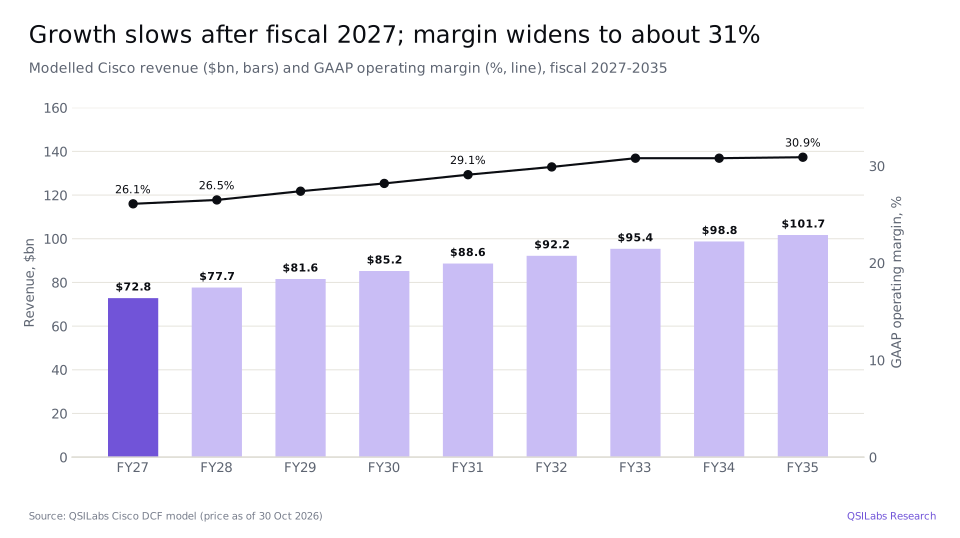
We forecast Cisco's revenue and GAAP operating margin year by year to fiscal 2035, apply a 15% tax rate, capital spending and working capital, and discount the cash flows at an 8.9% weighted average cost of capital. The cost of capital comes from Damodaran's January 2026 data for US telecom equipment companies: a beta of 0.92 and a cost of equity of 9.2%. After fiscal 2035 we assume growth of 2.5% a year; that terminal value is 58% of our enterprise value.
For fiscal 2027 we use the midpoint of Cisco's revenue guidance, $72.8bn (+15.0%), and GAAP operating income of $19.0bn, a 26.1% margin consistent with GAAP EPS guidance of $4.00-4.06 and a 14.5% tax rate. For fiscal 2028 we use the consensus growth rate of 6.7%, to $77.7bn. Growth then slows to 5% in fiscal 2029 and 3% by fiscal 2035, when revenue reaches $101.7bn. GAAP operating margin widens gradually to about 31% as amortisation of acquired intangibles falls and margins converge towards those of mature networking peers.
Our value rose $0.15 a share since 20 October, with no change to the forecast because Cisco has not reported a quarter since August. Cash earned since the 25 July balance sheet, which we estimate at about $3.4bn after buybacks to 30 October, added $0.10. Moving the valuation date forward ten days added $0.05.
How the number moves if you argue with us
The table shows our value per share at different costs of capital and terminal growth rates. Even at a 7.9% cost of capital and 3.5% terminal growth, the model reaches $97.99, below the share price.
| Cost of capital | Growth 1.5% | Growth 2.0% | Growth 2.5% | Growth 3.0% | Growth 3.5% |
|---|---|---|---|---|---|
| 7.9% | $84.32 | $86.89 | $89.92 | $93.55 | $97.99 |
| 8.4% | $78.07 | $80.07 | $82.39 | $85.11 | $88.38 |
| 8.9% | $72.69 | $74.25 | $76.04 | $78.11 | $80.55 |
| 9.4% | $67.99 | $69.22 | $70.61 | $72.21 | $74.05 |
| 9.9% | $63.87 | $64.84 | $65.93 | $67.16 | $68.57 |
The bigger levers are growth after fiscal 2027 and the long-run margin. If AI networking keeps growing at today's pace for several more years, rather than slowing to the 6.7% the consensus expects for fiscal 2028, revenue would run well above our path. A GAAP operating margin closer to Cisco's non-GAAP 35% would also lift our value substantially.
Risks to the Cisco investment case
- Valuation risk. At about 21 times guided fiscal 2027 non-GAAP EPS, the shares price in strong growth beyond this year. A miss against the $18.0-18.2bn Q1 guide could hit the price hard, as the 8.4% fall after the August results showed.
- Hyperscaler concentration. AI infrastructure orders come from a few very large customers. They can pause, switch suppliers or design their own hardware, and orders can swing sharply from quarter to quarter.
- Gross margin pressure. Non-GAAP gross margin fell 2.1 points in fiscal Q4, and guidance of 65-66% for Q1 implies further pressure. Memory and component prices are outside Cisco's control.
- Competition. Arista Networks, Broadcom, NVIDIA and white-box suppliers compete for AI data centre networking, and Juniper, now part of HPE, competes in enterprise networking.
- Inventory and cash flow. Inventories rose to $5.7bn from $3.2bn. If demand slows, Cisco could face write-downs, and operating cash flow was already flat in fiscal 2026 despite 30% growth in net income.
- Slow software growth. Software revenue grew 4% and subscription revenue 1% in fiscal 2026. If the hardware cycle fades, Cisco's recurring revenue may not grow fast enough to fill the gap.
- Upside risk. If AI revenue keeps growing well beyond the $7.5bn expected for fiscal 2027 and the enterprise refresh lasts several years, revenue and margins would beat our forecast, and our value would rise.
FAQ
What is Cisco stock worth after its latest earnings?
QSILabs values Cisco at $76.04 a share, based on a discounted cash flow model updated with fiscal Q4 FY2026 results and the fiscal 2026 10-K. That is about 27% below the $104.51 close on 30 October 2026. A two-stage cross-check gives $76.06; analysts' average price target is $136.16.
Is Cisco stock a buy in Q3 2026?
Our model says CSCO trades above what its cash flows justify, because the price assumes faster growth or higher margins after fiscal 2027 than we forecast. The business is strong: revenue up 18% in fiscal Q4, product orders up 35% and about $13bn of annual free cash flow. This is not investment advice.
How much revenue did Cisco make in fiscal Q4 2026?
Cisco's fiscal Q4 FY2026 revenue, for the quarter to 25 July 2026, was $17,252m, up 18% from $14,673m a year earlier. Product revenue was $13,459m (+24%) and services revenue $3,793m (flat). Fiscal 2026 revenue was $63,325m, up 12%.
How much AI revenue does Cisco make?
Cisco took $9.3bn of AI infrastructure orders from hyperscalers in fiscal 2026, $4bn of them in the fourth quarter. It recognised about $4bn of AI infrastructure revenue in fiscal 2026, about 6% of total revenue, and expects $7.5bn in fiscal 2027.
What is Cisco's guidance for fiscal 2027?
Cisco guided fiscal 2027 revenue to $72.2-73.4bn, about 15% growth at the midpoint, GAAP EPS to $4.00-4.06 and non-GAAP EPS to $5.05-5.11. For fiscal Q1 FY2027 it guided revenue to $18.0-18.2bn and non-GAAP EPS to $1.32-1.34.
Why did Cisco's gross margin fall?
Cisco's non-GAAP gross margin fell to 66.3% in fiscal Q4 FY2026 from 68.4% a year earlier because lower-margin AI infrastructure products grew as a share of sales and memory and component costs rose. Cisco guided fiscal Q1 FY2027 non-GAAP gross margin to 65-66%.
Does Cisco pay a dividend?
Yes. Cisco pays $0.42 a share each quarter, $1.68 a year, a yield of about 1.6% at the 30 October 2026 price. It paid $6.55bn of dividends and bought back $6.11bn of shares in fiscal 2026.
When does Cisco report its next earnings?
Cisco's fiscal Q1 FY2027 quarter ended on 24 October 2026, and the results are due in November 2026. Cisco has guided revenue of $18.0-18.2bn for the quarter.
Sources
- Cisco Systems, Inc., fiscal Q4 and full-year FY2026 earnings release (Form 8-K, Exhibit 99.1, 12 Aug 2026; accession 0000858877-26-000106) www.sec.gov
- Cisco Systems, Inc., Form 10-K for the fiscal year ended 25 Jul 2026 (filed 2 Sep 2026; accession 0000858877-26-000132) www.sec.gov
- Cisco Systems, Inc., Form 8-K, director appointment (filed 9 Oct 2026; accession 0000858877-26-000156) www.sec.gov
- SEC XBRL company facts for Cisco (CIK 858877): quarterly revenue and operating income from Forms 10-Q, accessions 0000858877-25-000171, 0000858877-26-000021 and 0000858877-26-000078 data.sec.gov
- StockAnalysis: Cisco forecast and analyst ratings, S&P Global data (page updated 26 Oct 2026, accessed 2 Nov 2026) stockanalysis.com
- Yahoo Finance chart data: CSCO closing prices and dividends (November 2025 to November 2026) query1.finance.yahoo.com
- Damodaran Online: cost of capital by industry (US), January 2026 pages.stern.nyu.edu
- QSILabs Cisco discounted cash flow model (internal; price as of 30 Oct 2026)
Disclaimer
This article is for information only and is not investment advice, a recommendation or an offer to buy or sell any security. QSI Labs and its authors may hold positions in the securities discussed. Forecasts and valuations are estimates that depend on assumptions that may prove wrong. Figures are taken from company filings and third-party sources believed to be reliable, but we do not guarantee their accuracy. Do your own research or consult a licensed adviser before investing.
More from QSI Labs
Related analysis: Broadcom stock Q3 2026: AI XPUs, NVIDIA stock Q3 2026, Micron stock Q3 2026: HBM and memory prices and Microsoft stock Q3 2026.
Read our white paper, QSI Labs: An AI-Native Trading Firm Built on a Training Loop (October 2026), available on request, or browse the research index.