Research / Earnings and valuation
Thermo Fisher Stock Q3 2026:Revenue Up 9% to $12.1bn as Organic Growth Reaches 6%
As of: Figures are as of Thermo Fisher Scientific's third-quarter 2026 results (the quarter ended 26 September 2026, reported 21 October 2026 in a Form 8-K) and its Form 10-Q for that quarter, filed 30 October 2026. Thermo Fisher's fiscal year is the calendar year, so its Q3 2026 covers July to September 2026. The share price used in our valuation is the NYSE close of TMO on 30 October 2026, $697.00; analyst data were accessed on 2 November 2026. Published 2 November 2026.
The short answer. Thermo Fisher stock Q3 2026 rests on a quarter in which the company that calls itself the world leader in serving science returned to solid growth. Revenue for the three months to 26 September 2026 rose 9% to $12.14bn, with 6% organic growth, adjusted operating margin widened to 24.5% from 23.3%, and adjusted EPS rose 15% to $6.68. Thermo Fisher raised its 2026 guidance to revenue of $47.7bn to $48.2bn and adjusted EPS of $25.13 to $25.43. Our discounted cash flow model values TMO at $336.70 a share, against a $697.00 close on 30 October 2026. The business is executing well; the price assumes growth and margins well above the path the company itself has set out.
Key takeaways
- Revenue up 9%. Q3 2026 revenue was $12,137m, up from $11,122m a year earlier. Organic growth was 6%, acquisitions added 4 points and the sale of the microbiology business took off 1 point.
- Pharma and biotech led. Revenue from pharma and biotech customers grew at a high single-digit rate, industrial and applied also grew at a high single-digit rate, diagnostics and healthcare grew in the low single digits and academic and government was flat, according to chief executive Marc Casper.
- Margins widened. GAAP operating profit rose 17% to $2,263m, an 18.6% margin. Adjusted operating margin was 24.5%, up 120 basis points, helped by about $60m of net tariff refunds.
- Guidance raised. Thermo Fisher now expects 2026 revenue of $47.7bn to $48.2bn, up 7% to 8%, organic growth of about 4%, adjusted EPS of $25.13 to $25.43 and free cash flow of $7.0bn to $7.5bn.
- Cash flow and capital returns. Free cash flow was $4.62bn in the first nine months, up from $3.32bn. Thermo Fisher spent $4.0bn on buybacks and $9.1bn on the Clario acquisition this year.
- Our value: $336.70 a share, about 52% below the $697.00 close on 30 October 2026. A two-stage cross-check gives $320.53; analysts' average target is $752.12.
- What to watch. Whether organic growth moves toward the top of the company's 3% to 6% range in 2027, how quickly Clario and the bioprocessing business grow, and the 2027 guidance due on 2 February 2027.
Key numbers from Thermo Fisher's Q3 2026 earnings
| Metric | Q3 2026 | Q3 2025 | Change |
|---|---|---|---|
| Revenue | $12,137m | $11,122m | +9% |
| Organic revenue growth | 6% | n/a | n/a |
| GAAP operating income | $2,263m | $1,941m | +17% |
| GAAP operating margin | 18.6% | 17.4% | +1.2 pts |
| Adjusted operating income | $2,968m | $2,587m | +15% |
| Adjusted operating margin | 24.5% | 23.3% | +1.2 pts |
| Net income | $1,721m | $1,616m | +6% |
| GAAP diluted EPS | $4.64 | $4.27 | +9% |
| Adjusted EPS | $6.68 | $5.79 | +15% |
| Cash flow from operations | $2,551m | $2,239m | +14% |
| Free cash flow | $2,115m | $1,840m | +15% |
| Total debt (period end) | $41,370m | n/a | n/a |
Thermo Fisher Q3 2026 earnings: what happened
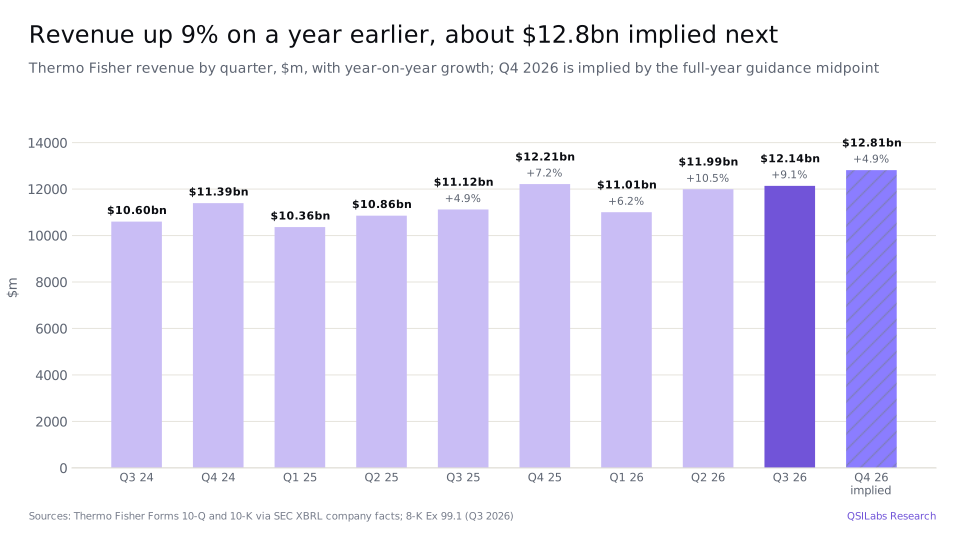
Thermo Fisher reported revenue of $12,137m for the third quarter of 2026, 9.1% more than a year earlier and 1.2% more than the $11,994m of the June quarter. Of the 9% reported growth, 6 points were organic, 4 points came from acquisitions, mainly Clario and the filtration and separation business bought from Solventum in September 2025, and the divested microbiology business took off 1 point. Currency had no net effect in the quarter. Revenue for the first nine months was $35,136m, up 8.6%.
Chief financial officer Jim Meyer said revenue was more than $200m ahead of the assumptions in the company's previous guidance, including about two points of stronger organic growth, and adjusted EPS was $0.26 ahead. Of that $0.26, $0.15 came from tariff refunds that Thermo Fisher recovered during the quarter, net of extra spending the company chose to make with the money, $0.08 from operations and $0.03 from currency. The refunds added about $60m to adjusted operating income, or 50 basis points of margin, and had a negligible effect on revenue.
GAAP operating income was $2,263m, up 17%, and GAAP diluted EPS rose 9% to $4.64. Net income grew less than operating profit, by 6% to $1,721m, because interest expense rose to $417m from $347m as debt rose to fund buybacks and the Clario acquisition, and the tax charge rose to $352m from $207m. Average diluted shares fell to 371m from 378m because of buybacks. On Thermo Fisher's adjusted basis, which excludes $519m of amortisation of acquired intangible assets, $199m of restructuring and other costs and some smaller items, operating income rose 15% to $2,968m and EPS 15% to $6.68.
By region, North America and Europe grew at mid-single-digit organic rates and Asia-Pacific at a low double-digit rate, including China, Meyer said.
- Jan 2026Thermo Fisher buys back $3bn of its sharesQ3 2026 earnings call
- 13 Mar 2026Shares go ex-dividend for the first $0.47 quarterly dividend, up from $0.43Yahoo Finance
- 24 Mar 2026Thermo Fisher completes the acquisition of Clario, a clinical trial data provider, for a purchase price of $9.1bnForm 10-Q
- 15 May 2026TMO closes at $438.34, its 52-week closing lowYahoo Finance
- 20 May 2026Investor day: 3-6% organic growth framed for 2026-27 and a 7% organic growth rate for 2028-2031 and beyondInvestor day presentation
- Q2 2026A further $1bn of share buybacks, taking the 2026 total to $4bnQ3 2026 earnings call
- Q3 2026Sale of the microbiology business closes in the middle of the quarter, bringing in about $1bnForm 10-Q; earnings call
- 26 Sep 2026Q3 2026 ends: revenue $12,137m (+9%), adjusted operating margin 24.5%8-K Ex 99.1
- 21 Oct 2026Q3 results; 2026 guidance raised to $47.7-48.2bn of revenue and $25.13-25.43 of adjusted EPS; TMO closes at $694.028-K Ex 99.1; earnings call; Yahoo Finance
- 27 Oct 2026Executive vice president Michael D. Shafer to retire on 31 December 2026Form 8-K
- 29 Oct 2026TMO closes at $709.18, its 52-week closing highYahoo Finance
- 30 Oct 2026Form 10-Q filed; TMO closes at $697.00, the price used in our valuationForm 10-Q; Yahoo Finance
- 2 Feb 2027Q4 2026 results and 2027 guidance dueQ3 2026 earnings call
Which Thermo Fisher segments grew fastest?
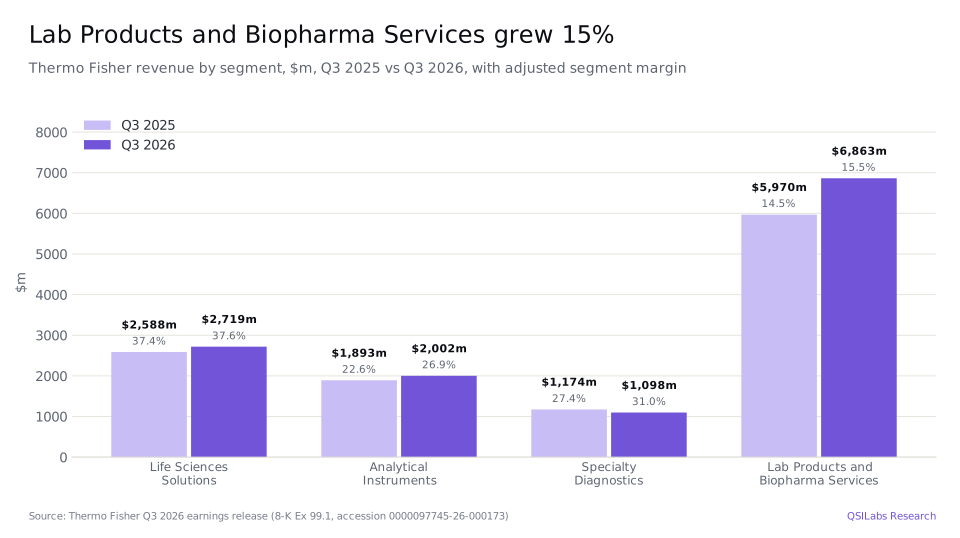
Laboratory Products and Biopharma Services, the largest of Thermo Fisher's four segments, grew revenue 15% to $6,863m, with 10% organic growth. It contains the pharma services business, which makes drugs under contract for drug companies, the PPD clinical research business, now including Clario, and the research and safety market channel, which distributes laboratory supplies. Its adjusted margin rose to 15.5% from 14.5%.
Analytical Instruments grew 6%, both reported and organic, to $2,002m, and was the segment with the biggest margin gain: adjusted operating income rose 26% and the margin rose to 26.9% from 22.6%, helped by productivity, volume and a favourable mix. Life Sciences Solutions, the highest-margin segment, grew 5% to $2,719m, but only 1% organically; growth came mainly from bioproduction, and the margin edged up to 37.6%. Specialty Diagnostics revenue fell 6% to $1,098m because of the microbiology sale; organic growth was flat and the margin rose to 31.0% from 27.4%.
Where did Thermo Fisher's growth come from?
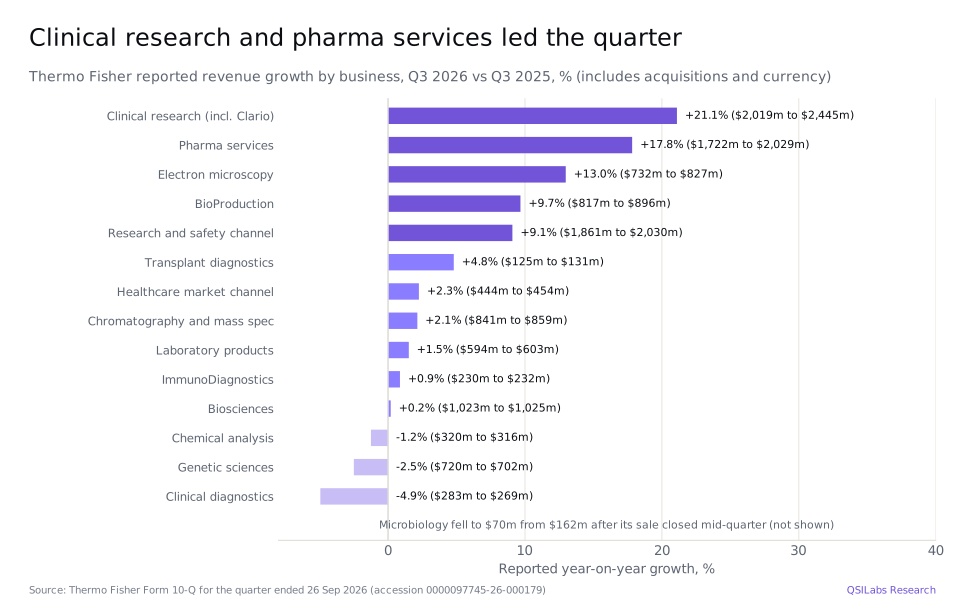
The 10-Q breaks segment revenue down by business, which shows where the quarter's growth came from. Clinical research revenue rose 21% to $2,445m, helped by Clario, which Thermo Fisher bought in March. Pharma services rose 18% to $2,029m; Meyer described growth there as very strong, and the company is adding capacity. Electron microscopy rose 13% to $827m, which Casper attributed to demand from semiconductor makers, where Thermo Fisher's microscopes are used in research and in quality control as new chip plants ramp up. BioProduction, which sells the media and equipment used to make biologic drugs, grew 10% to $896m, including the filtration and separation acquisition.
Several large businesses barely grew. Biosciences revenue was flat at $1,025m, genetic sciences fell 3% to $702m and chromatography and mass spectrometry rose 2% to $859m, consistent with flat spending by academic and government customers. Microbiology revenue fell to $70m from $162m because the business was sold in the middle of the quarter.
By customer type, pharma and biotech, which made up 57% of revenue in the 12 months to March 2026, grew at a high single-digit rate. Casper said biotech "continues to improve" and that customer confidence there was strong. Academic and government customers, 14% of revenue, held spending flat, as the company expected. Industrial and applied customers, also 14%, grew at a high single-digit rate, and diagnostics and healthcare, 15%, grew at a low single-digit rate, similar to the first half.
Why are Thermo Fisher's margins rising?
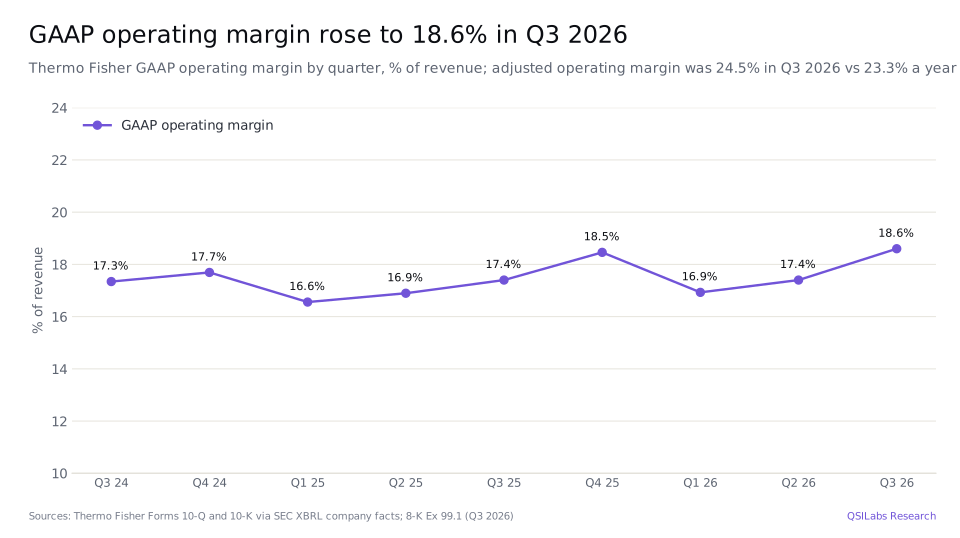
Thermo Fisher's GAAP operating margin was 18.6% in the third quarter, up from 17.4% a year earlier and the highest of the nine quarters shown below. Adjusted operating margin rose 120 basis points to 24.5%. Management credited its PPI Business System, a set of cost and productivity programmes, and the extra volume from faster growth, partly offset by an unfavourable business mix and spending on new capacity and AI. Roughly 50 basis points of the improvement came from the tariff refunds, which will not recur. Excluding them, adjusted margin would have been about 24.0%, still 70 basis points higher than a year earlier.
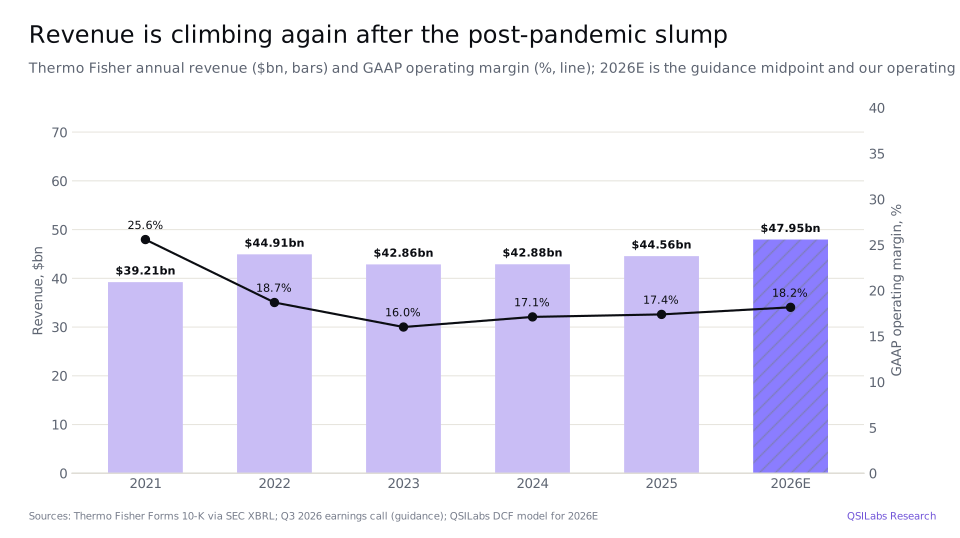
The longer view shows how much of Thermo Fisher's recent history has been about digesting the pandemic. Revenue reached $44.92bn in 2022, helped by Covid-19 testing and vaccine work, fell to $42.86bn in 2023 and stayed flat in 2024. GAAP operating margin fell from 25.6% in 2021 to 16.0% in 2023 as Covid revenue disappeared. Growth resumed in 2025, and guidance implies revenue of about $47.95bn in 2026, with our estimate of the GAAP operating margin at 18.2%.
How much free cash flow does Thermo Fisher generate?
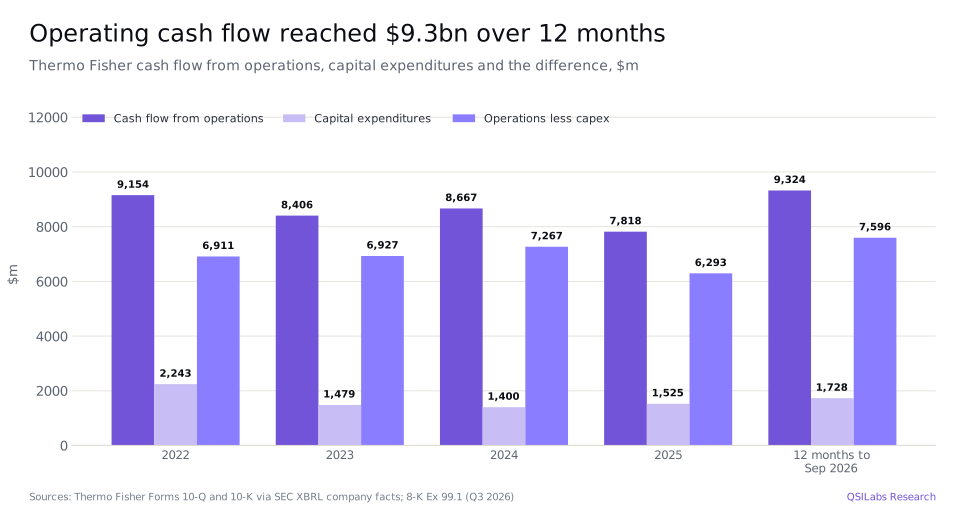
Cash flow from operations was $2,551m in the third quarter and $5,867m in the first nine months of 2026, up from $4,361m a year earlier. After capital spending of $1,263m and small asset sales, Thermo Fisher's free cash flow was $4,618m for the nine months, against $3,319m. Over the 12 months to September, cash flow from operations was $9,324m and capital spending $1,728m. The company now expects 2026 free cash flow of $7.0bn to $7.5bn, after net capital spending of $1.9bn to $2.0bn, or roughly 15% of revenue.
Thermo Fisher deploys most of its cash on acquisitions and buybacks. In the first nine months of 2026 it paid $8,877m for acquisitions, net of cash acquired, mainly Clario, $4,000m for share buybacks and $511m in dividends, and received $1,021m from selling its microbiology business. It funded the gap partly with new debt: total debt rose to $41,370m at 26 September from $39,384m at the end of 2025, while cash and short-term investments fell to $6,061m from $10,105m. Meyer said gross leverage was 3.4 times adjusted EBITDA and net leverage 2.9 times.
What did Thermo Fisher guide for 2026?
Thermo Fisher raised its 2026 guidance with the results. It now expects revenue of $47.7bn to $48.2bn, up from $47.4bn to $48.1bn, which would be growth of 7% to 8% on 2025's $44.56bn, and adjusted EPS of $25.13 to $25.43, up from $24.93 to $25.33 and 10% to 11% above 2025. Organic growth is now expected to be about 4% for the year, with the fourth quarter also at about 4%. Currency should add about $200m to revenue, unchanged from the previous guide.
The guidance assumes 80 basis points of adjusted operating margin expansion for the year, net interest expense of about $650m, an adjusted tax rate of 11.5%, net capital spending of $1.9bn to $2.0bn and free cash flow of $7.0bn to $7.5bn, raised from the previous range. The guidance assumes $4bn of buybacks for the year, all already completed, $3bn in January and $1bn in the second quarter, about $700m of dividends and an average of 371m to 372m diluted shares.
Subtracting nine-month revenue of $35,136m from the full-year range implies fourth-quarter revenue of $12.56bn to $13.06bn, against $12.22bn in Q4 2025. Analysts tracked by S&P Global expect 2026 revenue of $48.01bn and adjusted EPS of $25.28, both slightly above the midpoint of guidance, and 2027 revenue of $50.54bn, up 5.3%, with adjusted EPS of $27.78.
What growth has Thermo Fisher promised investors beyond 2026?
At its investor day on 20 May 2026, Thermo Fisher set out a "mid-term" framing for 2026 and 2027 of 3% to 6% organic revenue growth, 50 to 70 basis points of margin expansion and high single-digit growth in adjusted operating income. For 2028 to 2031 and beyond it set a long-term formula of a 7% organic revenue growth rate, 40 to 50 basis points of margin expansion, substantial capital deployment and adjusted EPS and free cash flow growing at a low-teens rate. It put the size of its market at $255bn.
The company described 2025, when organic growth was 2%, as held back by policy and tariff effects in pharma and biotech, uncertainty over US academic and government funding, weakness in China and the last of the pandemic-related revenue running off. On the October call Casper said the goal was "to exit 2027 back in a normal period", sometime between the second half of 2027 and the first half of 2028, and described bioprocessing as a "high single-digit, low double-digit growth business" over the long term.
Seven percent is ambitious for a company of Thermo Fisher's size. DeciBio, a life science market research firm, estimates that the research tools market will grow about 4% to 5% a year, to about $91.2bn in 2029. Thermo Fisher argues that pharma services, clinical research and bioprocessing grow faster than tools, and that it gains share. The company is also changing its leadership bench: on 27 October it said executive vice president Michael D. Shafer, one of its investor day presenters, will retire on 31 December 2026.
How has TMO stock performed over the past year?
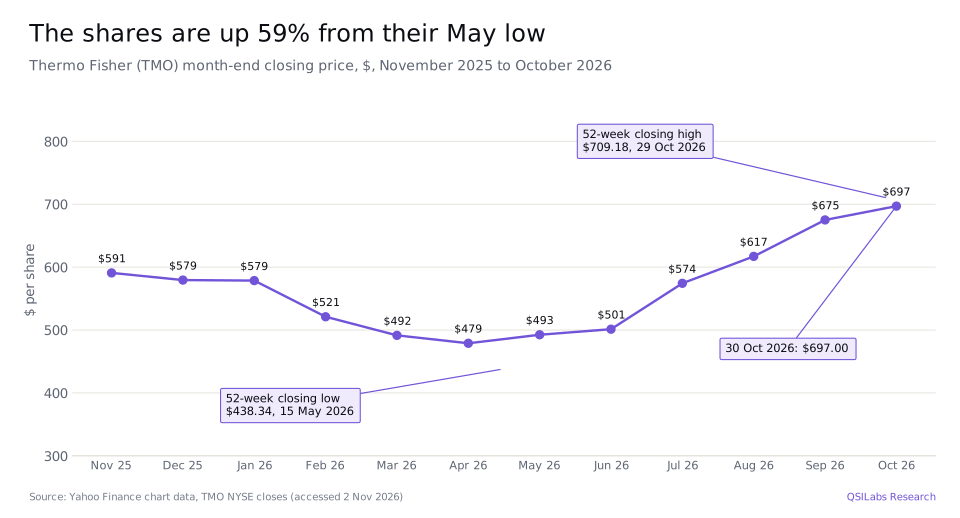
Thermo Fisher shares closed at $697.00 on 30 October 2026, 23% above the $564.88 close of 3 November 2025. The path was uneven. The shares fell through the first half of 2026 to a 52-week closing low of $438.34 on 15 May, five days before the investor day, then rose 59% to the 30 October close as organic growth improved and the company raised its guidance. They closed at $694.02 on results day, reached a 52-week closing high of $709.18 on 29 October and closed at $682.65 on 2 November.
Thermo Fisher stock Q3 2026: is TMO overvalued?
On our numbers, yes. Our discounted cash flow model values Thermo Fisher at $336.70 a share, against a $697.00 close on 30 October 2026, about 52% lower. At that price Thermo Fisher's equity was worth about $258bn, on 370.5m shares, and its enterprise value, after net debt of about $35.3bn, about $294bn. That is 5.8 times consensus 2027 revenue, 27.6 times consensus 2026 adjusted EPS of $25.28 and 25.1 times consensus 2027 adjusted EPS of $27.78. The midpoint of 2026 free cash flow guidance, $7.25bn, is a yield of about 2.8% on the equity value.
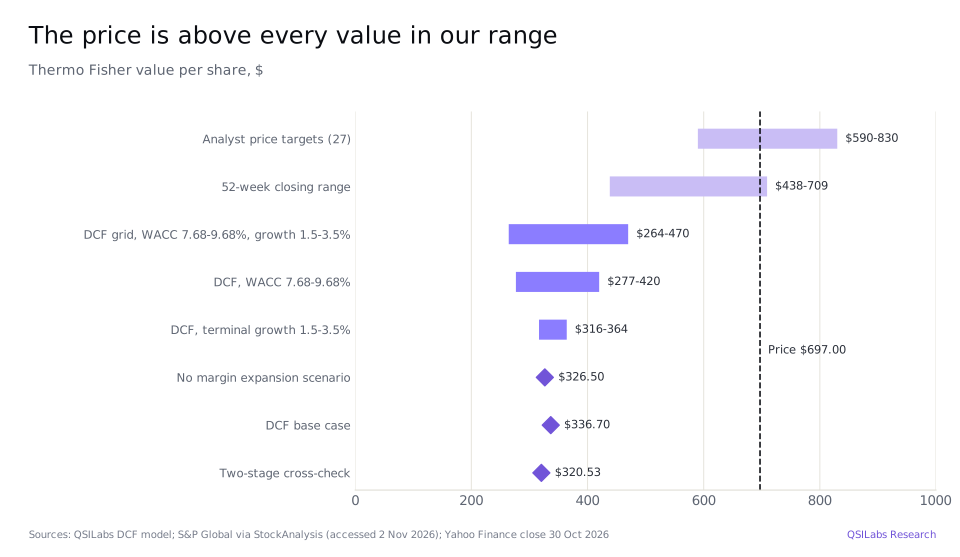
We are not saying the business is weak. Thermo Fisher is growing organically at 6%, has widened its adjusted margin by 120 basis points in a year, and turns about 15% of its revenue into free cash flow. We are saying the price assumes more than our forecast, which already follows consensus for 2027 and the company's own long-term targets: either growth well above 7% for many years, margins far above the company's guidance, or a much lower discount rate than we use.
Analysts disagree. The 27 analysts tracked by S&P Global rate Thermo Fisher a Strong Buy on average, with an average price target of $752.12, a median of $750 and a range from $590 to $830; in October, 20 rated it a Strong Buy, three a Buy, three a Hold and one a Sell. After the results JPMorgan raised its target to $820 from $760 and Citi to $800 from $685, both with Buy ratings; Bank of America kept a Buy at $795, Argus raised its target to $780 from $560 and Barclays kept a Buy at $775.
Method
We forecast revenue and GAAP operating margin year by year to 2035, apply a 15% tax rate, above the 11.5% adjusted rate Thermo Fisher guides for 2026, and deduct capital spending and working capital to reach unlevered free cash flow. We discount those cash flows at an 8.68% weighted average cost of capital, taken from Damodaran's January 2026 data for 204 US healthcare products companies: a beta of 0.91, a cost of equity of 9.17%, debt of about 11.3% of capital at an after-tax cost of 4.85%, and a 5.12% risk-free rate. After 2035 we assume growth of 2.5% a year; that terminal value is 59.1% of our enterprise value of $159.8bn. Deducting debt of $41.37bn, including finance leases, adding cash and short-term investments of $6.06bn and about $0.6bn of cash generated between the balance sheet date and 30 October, and deducting $0.13bn of minority interests gives equity value of $124.9bn, or $336.70 a share on 371m diluted shares.
For 2026 we use the midpoint of guidance, revenue of $47.95bn, and GAAP operating profit of $8.71bn, an 18.2% margin, which allows for about 4.3% of revenue in amortisation of acquired intangibles. For 2027 we use the consensus revenue forecast of $50.54bn, up 5.4%. Growth rises to 6.35% in 2028, in line with S&P Global's three-year consensus growth rate of 6.45% a year, and to 7.0% in 2029, the company's long-term organic target. It then fades by 0.75 points a year, passing through DeciBio's 4% to 5% market growth estimate in 2032, to 2.5% in 2035. We model organic growth only; future acquisitions are not included.
The GAAP operating margin rises by 60 basis points in 2027, the middle of the investor day framing, then 45 basis points a year from 2028 to 2030, the middle of the long-term range, and by smaller steps to 20.7% from 2033. That is about 2.5 points above the 2026 level, or roughly 25% on an adjusted basis before amortisation.
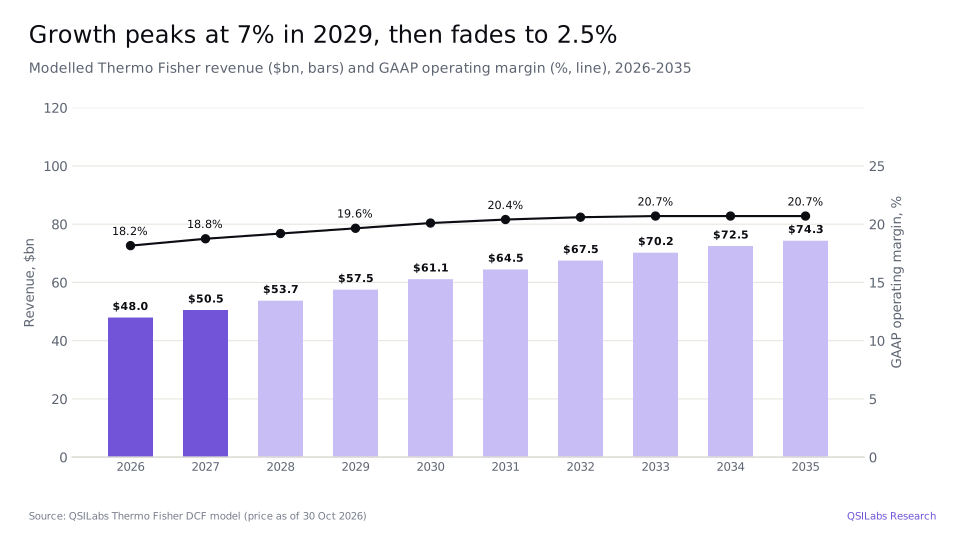
We forecast unlevered free cash flow of $8.1bn in 2027, rising to $10.1bn in 2030 and $12.5bn in 2035. We assume capital spending of $1.95bn in 2026, the top of guidance, and $2.0bn in 2027, rising to about $4.0bn by 2035, and that working capital rises with revenue.
How the number moves if you argue with us
The table shows our value per share at different costs of capital and terminal growth rates. Even at a 7.68% cost of capital and 3.5% terminal growth, the model reaches $469.97, about two-thirds of the share price.
| Cost of capital | Growth 1.5% | Growth 2.0% | Growth 2.5% | Growth 3.0% | Growth 3.5% |
|---|---|---|---|---|---|
| 7.68% | $385.83 | $401.49 | $420.04 | $442.41 | $469.97 |
| 8.18% | $348.51 | $360.59 | $374.68 | $391.36 | $411.47 |
| 8.68% | $316.48 | $325.88 | $336.70 | $349.31 | $364.24 |
| 9.18% | $288.69 | $296.06 | $304.44 | $314.08 | $325.31 |
| 9.68% | $264.36 | $270.17 | $276.70 | $284.12 | $292.66 |
The margin path matters less than it might seem. Holding the EBITDA margin at its 2026 level of 24.9%, instead of expanding it, gives $326.50 a share, only $10.20 below our base case. A two-stage version of the model, which extends the fade over nine more years, gives $320.53. A bottom-up cost of capital of 9.50% is above our base rate and would lower the value. Matching the share price would need Thermo Fisher to grow much faster than its own 7% target for far longer, or to earn much higher margins than it has guided to.
Risks to the Thermo Fisher investment case
- Customer funding. Pharma and biotech made up 57% of revenue in the 12 months to March 2026. Drug pricing policy, tariffs and biotech funding all affect how much these customers spend, and academic and government revenue, 14% of the total, was flat in the quarter.
- Acquisition and debt risk. Thermo Fisher grows partly by buying companies, and its debt reached $41.4bn after the $9.1bn Clario deal, with net leverage of 2.9 times adjusted EBITDA. Interest expense rose to $417m in the quarter. A large new acquisition would add debt and integration risk.
- One-off gains. About $60m of net tariff refunds lifted adjusted operating income in the third quarter. They will not recur, and new tariffs could raise costs again.
- China and trade. Asia-Pacific made up 18% of revenue in the 12 months to March 2026, and China grew at a low double-digit rate in the quarter after weakness in 2025. Export controls or a slowdown could reverse that.
- Execution of long-term targets. The 7% organic growth target for 2028 and beyond is well above the 2% of 2025 and the 4% expected for 2026. If growth settles nearer the research tools market's 4% to 5%, earnings would grow more slowly than the company's targets.
- Valuation risk. At about 28 times consensus 2026 adjusted EPS, the shares already price in strong growth. Analysts' targets range from $590 to $830, all above the top of our sensitivity grid, so the gap between our value and the market price rests on how fast, and for how long, Thermo Fisher can grow.
FAQ
What value does QSILabs put on Thermo Fisher stock?
QSILabs values Thermo Fisher at $336.70 a share, based on a discounted cash flow model updated with Q3 2026 results and the Form 10-Q. That is about 52% below the $697.00 close on 30 October 2026. A two-stage cross-check gives $320.53; analysts' average price target is $752.12.
Is Thermo Fisher stock a buy after its Q3 2026 results?
Our model says TMO trades well above what its cash flows justify, even using consensus revenue for 2027 and the company's own long-term growth and margin targets. The business is strong: 6% organic growth in the September quarter, a 24.5% adjusted operating margin and free cash flow guidance of $7.0bn to $7.5bn for 2026. This is not investment advice.
How much revenue did Thermo Fisher make in its latest quarter?
Thermo Fisher's revenue for Q3 2026, the quarter to 26 September 2026, was $12,137m, up 9% from $11,122m a year earlier, with organic growth of 6%. Laboratory Products and Biopharma Services contributed $6,863m before intersegment eliminations. Revenue for the first nine months of 2026 was $35,136m.
What does Thermo Fisher Scientific do?
Thermo Fisher sells laboratory instruments, consumables and software, and provides services to drug companies. Its brands include Thermo Scientific, Applied Biosystems, Invitrogen, Gibco, Fisher Scientific, Patheon and PPD. It makes and distributes research tools and diagnostic tests, manufactures drugs under contract, runs clinical trials for drug developers and, since buying Clario, supplies clinical trial data services. About 84% of revenue comes from services and consumables.
Does Thermo Fisher pay a dividend?
Yes. Thermo Fisher pays a quarterly dividend of $0.47 a share, or $1.88 a year, raised from $0.43 with the dividend that went ex on 13 March 2026. That is a yield of about 0.3% at the 30 October 2026 price. It paid $511m of dividends in the first nine months of 2026 and expects about $700m for the year; it spent $4.0bn on buybacks.
When does Thermo Fisher report its next earnings?
Thermo Fisher plans to report fourth-quarter and full-year 2026 results, and give 2027 guidance, on 2 February 2027 at 8:30am Eastern Time, Casper said on the October call. Its 2026 guidance implies fourth-quarter revenue of $12.56bn to $13.06bn.
What price target do analysts have for TMO?
The 27 analysts tracked by S&P Global, as reported by StockAnalysis on 2 November 2026, have an average price target for Thermo Fisher of $752.12, a median of $750, a low of $590 and a high of $830, with a consensus rating of Strong Buy. Our DCF value of $336.70 is well below even the lowest target.
How much debt does Thermo Fisher have?
Thermo Fisher had $41,370m of debt at 26 September 2026, including $2,262m due within a year and finance leases, against $6,061m of cash and short-term investments, leaving net debt of about $35.3bn. Its leverage was 3.4 times adjusted EBITDA on a gross basis and 2.9 times net, and it had no commercial paper outstanding.
What is Clario and why did Thermo Fisher buy it?
Clario is a US provider of endpoint data solutions for clinical trials, the data that show whether a drug works. Thermo Fisher completed the purchase on 24 March 2026 for $9,102m, including $5,811m of cash and $3,180m of Clario debt it paid off, and added it to its clinical research business. Casper said the integration was going smoothly and the company expects revenue synergies.
Sources
- Thermo Fisher Scientific Inc., third-quarter 2026 results (Form 8-K, Exhibit 99.1, 21 Oct 2026; accession 0000097745-26-000173) www.sec.gov
- Thermo Fisher Scientific Inc., Form 10-Q for the quarter ended 26 Sep 2026 (filed 30 Oct 2026; accession 0000097745-26-000179) www.sec.gov
- Thermo Fisher Scientific Inc., Form 8-K on an executive officer's retirement (27 Oct 2026; accession 0000097745-26-000181) www.sec.gov
- SEC XBRL company facts for Thermo Fisher Scientific (CIK 97745): quarterly and annual revenue, operating income and cash flow from Forms 10-Q and 10-K data.sec.gov
- Thermo Fisher Q3 2026 earnings call transcript, 21 Oct 2026, via The Motley Fool (accessed 2 Nov 2026) www.fool.com
- Thermo Fisher Scientific, 2026 Investor Day presentation, 20 May 2026 s27.q4cdn.com
- StockAnalysis: Thermo Fisher forecast and analyst ratings, S&P Global data (accessed 2 Nov 2026) stockanalysis.com
- StockAnalysis: Thermo Fisher statistics (accessed 2 Nov 2026) stockanalysis.com
- DeciBio: life science research tools market assessment (accessed 2 Nov 2026) www.decibio.com
- Yahoo Finance chart data: TMO closing prices and dividends (November 2025 to November 2026) query1.finance.yahoo.com
- Damodaran Online: cost of capital by industry (US), January 2026 pages.stern.nyu.edu
- QSILabs Thermo Fisher discounted cash flow model (internal; price as of 30 Oct 2026)
Disclaimer
This article is for information only and is not investment advice, a recommendation or an offer to buy or sell any security. QSI Labs and its authors may hold positions in the securities discussed. Forecasts and valuations are estimates that depend on assumptions that may prove wrong. Figures are taken from company filings and third-party sources believed to be reliable, but we do not guarantee their accuracy. Do your own research or consult a licensed adviser before investing.
More from QSI Labs
Related analysis: Eli Lilly stock Q3 2026: Mounjaro and Zepbound, Merck stock Q3 2026: Keytruda Qlex and Winrevair, AbbVie stock Q3 2026: Skyrizi and Rinvoq and Johnson & Johnson stock Q3 2026: talc and Tremfya.
Read our white paper, QSI Labs: An AI-Native Trading Firm Built on a Training Loop (October 2026), available on request, or browse the research index.