Research / Earnings and valuation
Linde Stock Q3 2026:Electronics Lift Sales as Lincare Charges Weigh
As of: Figures are as of Linde's third-quarter 2026 results (the quarter ended 30 September 2026, reported 29 October 2026 in a Form 8-K earnings release and the Form 10-Q filed the same day). Linde's fiscal year is the calendar year, so Q3 2026 is the July-September 2026 quarter. The share price is the Nasdaq close of Linde (LIN) on 2 November 2026, $519.72. Published 2 November 2026.
The short answer. Linde stock Q3 2026 results, for the July to September quarter, showed steady growth in the industrial gases business and a clean-up at its US home healthcare arm. Sales rose 9% to $9,404m, 5% on an underlying basis, adjusted earnings per share rose 9% to $4.59 and the adjusted operating margin was 29.4%. GAAP EPS fell 11% to $3.66 because of $425m of cost reduction and other charges, much of them at Lincare, the US homecare business Linde has moved out of its Americas segment and is reviewing. Linde nudged its 2026 adjusted EPS guidance up to $17.82-17.92. Our discounted cash flow model puts Linde at $182.52 per share, about 65% below the $519.72 close on 2 November 2026. The business is high quality and its cash flows are dependable; the gap comes from how much growth and how low a cost of capital the share price already assumes.
Linde plc is a global industrial gases and engineering company, with sales of $34bn in 2025. It produces oxygen, nitrogen, argon, hydrogen, helium and specialty gases and sells them through pipelines and on-site plants under long contracts, in bulk to merchant customers and in cylinders, and it builds gas plants for other companies through Linde Engineering. In the quarter to 30 September 2026 net income attributable to Linde was $1,692m, down 12% from $1,929m, while adjusted net income rose 7% to $2,122m (Linde Q3 2026 earnings release). The shares fell 1.0% on results day, 29 October, to $503.15, and closed at $519.72 on 2 November, 26% above their level a year earlier and 5% below their 52-week closing high of $546.64 on 2 July (Yahoo Finance).
In this article we go through Linde's Q3 2026 numbers against a year earlier, explain the charges and what is happening at Lincare, look at each segment and end market, cover the project backlog, the guidance, cash flow and dividends, and then value Linde stock, with every assumption laid out so you can argue with it.
Key takeaways
- Valuation: QSILabs values Linde plc (NASDAQ: LIN) at $182.52 per share as of results for the quarter ended 30 September 2026, against a $519.72 close on 2 November 2026, about 65% below the market price. Our sensitivity range is about $150-234 a share.
- Q3 2026 results: sales were $9,404m in the quarter ended 30 September 2026, up 9% from $8,615m and 5% on an underlying basis (3% price, 2% volume); adjusted operating profit was $2,763m, up 8%, a 29.4% margin against 29.7%; adjusted EPS was $4.59, up 9%, and GAAP EPS $3.66, down 11%.
- Charges and Lincare: Linde booked $425m of cost reduction and other charges in the quarter, $200m of it severance and $183m of non-cash charges mainly in its US homecare business, Lincare. Lincare, with about $2.3bn of annualised sales, now sits in the Other segment while Linde evaluates strategic options.
- Electronics: sales to electronics customers grew 15%, and Linde has about $2bn of electronics projects under construction in the US, South Korea and China.
- Guidance: for 2026 Linde now expects adjusted EPS of $17.82-17.92, up 8-9%, from $17.70-17.90 in July, and $4.40-4.50 for the fourth quarter, up 5-7%. Capital spending is guided at $5.5-6.0bn.
- Backlog and cash: the project backlog was $11bn at 30 September 2026, including $7.9bn of sale-of-gas projects. Operating cash flow was $7,680m in the first nine months, up 5%, and Linde returned $4.8bn through dividends and buybacks.
Key numbers from Linde's Q3 2026 earnings
| July-September, $m | 2025 | 2026 | Change |
|---|---|---|---|
| Sales | 8,615 | 9,404 | +9% |
| Americas sales | 3,253 | 3,601 | +11% |
| EMEA sales | 2,178 | 2,327 | +7% |
| APAC sales | 1,741 | 1,950 | +12% |
| Linde Engineering sales | 519 | 582 | +12% |
| Operating profit (GAAP) | 2,367 | 2,150 | -9% |
| Adjusted operating profit (non-GAAP) | 2,558 | 2,763 | +8% |
| Net income attributable to Linde | 1,929 | 1,692 | -12% |
| GAAP EPS, $ | 4.09 | 3.66 | -11% |
| Adjusted EPS, $ | 4.21 | 4.59 | +9% |
| Operating cash flow | 2,948 | 3,169 | +8% |
| Free cash flow (non-GAAP) | 1,672 | 1,777 | +6% |
Source: Linde Q3 2026 earnings release (Form 8-K, Exhibit 99.1, 29 October 2026) and Form 10-Q. Segment figures reflect Linde's recast segments, with the US homecare business moved from Americas to Other. Adjusted figures exclude Linde AG purchase accounting impacts and cost reduction and other charges. Free cash flow is operating cash flow less capital expenditures ($1,392m in 2026, $1,276m in 2025); 2025 cash figures are the nine-month totals less the first half.
Linde Q3 2026 earnings: what happened
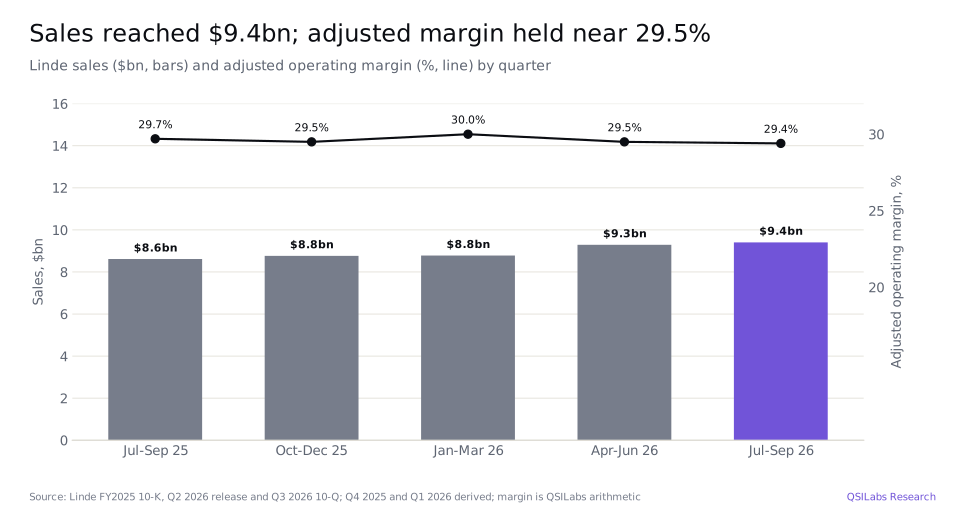
Linde's third quarter had the highest sales of the five quarters shown below, and its adjusted margin stayed in a narrow band of 29.4-30.0% across all five. Chief executive Sanjiv Lamba called sales of $9.4bn, operating profit of $2.8bn and EPS of $4.59 "all quarterly records" on the earnings call, referring to adjusted operating profit and adjusted EPS.
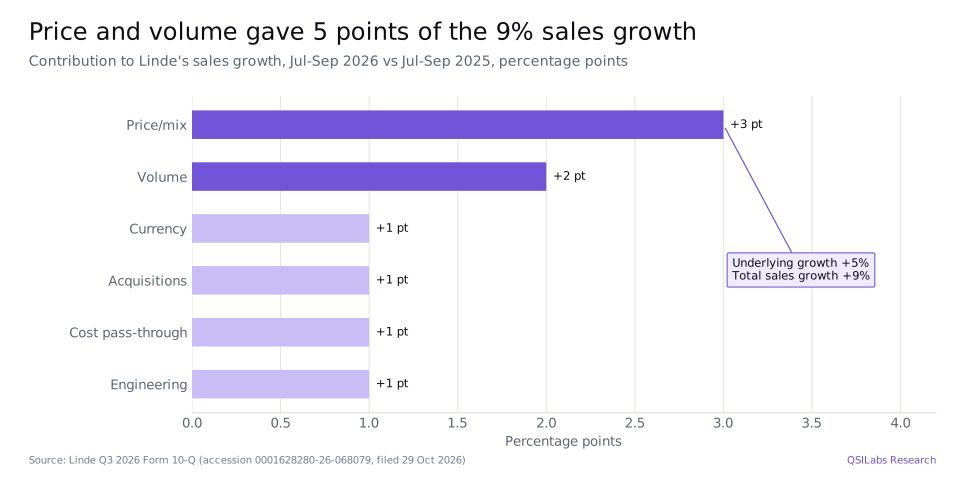
Sales grew 9%. Price and volume together added 5 points, which Linde calls underlying growth. Prices rose 3%, partly to recover higher energy and distribution costs in North America, and volumes rose 2%, split roughly evenly between new projects starting up and organic growth, according to chief financial officer Matt White. Currency, small acquisitions, higher sales of plants to third parties and cost pass-through added a point each. Cost pass-through is the contractual re-billing of energy cost changes to on-site customers; it lifts sales but adds almost nothing to profit, which is why Linde says its margin was flat excluding it.
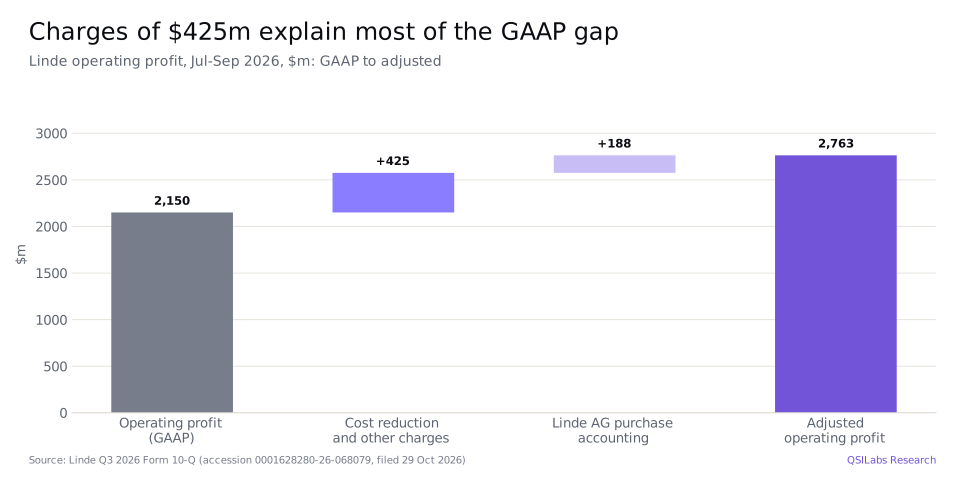
Adjusted operating profit rose 8% to $2,763m. GAAP operating profit fell 9% to $2,150m, and the difference between the two, $613m, is two items: $425m of cost reduction and other charges and $188m of purchase accounting impacts, mostly the amortisation of intangible assets recognised in the 2018 merger of Praxair and Linde AG. Below operating profit, net interest expense was $71m against $64m and the effective tax rate rose to 21.1% from 18.0% (23.8% against 22.7% on an adjusted basis). Income from equity investments rose to $61m from $36m, helped by what White called a customer contract true-up that will not repeat in the fourth quarter.
For the first nine months of 2026, sales were $27,474m, up 9% from $25,222m, segment operating profit was $8,137m against $7,552m, adjusted EPS was $13.41 against $12.26, and GAAP EPS was $11.79 against $11.34 (Linde Form 10-Q for Q3 2026).
- 8 Dec 2025Linde closes at $389.38, its lowest close of the past yearYahoo Finance
- 25 Feb 20262025 annual report (Form 10-K): sales $33,986m, segment operating profit $10,137m10-K
- 2 Jul 2026Linde closes at $546.64, its highest close of the past yearYahoo Finance
- 31 Jul 2026Q2 results: adjusted EPS $4.50, sale-of-gas backlog $8.1bn, 2026 guidance $17.70-17.90. Shares close at $478.38, down 5.9%8-K Ex 99.1; Yahoo Finance
- 30 Sep 2026Q3 2026 ends; Linde closes at $474.65Yahoo Finance
- 29 Oct 2026Q3 results: sales $9.4bn, adjusted EPS $4.59, $425m of charges, Lincare moved to Other, guidance raised to $17.82-17.92. Shares close at $503.15, down 1.0%8-K Ex 99.1; 10-Q; Yahoo Finance
- 2 Nov 2026Linde closes at $519.72, the price used in our valuationYahoo Finance
What are the $425m charges and what is happening at Lincare?
Lamba opened the call by saying that three months earlier Linde had "delivered financial results that were not up to the expectation of our owners", and the charge is part of the response. The Form 10-Q splits the $425m into $200m of global severance, $42m of other cost reduction charges and $183m of non-cash charges, primarily related to the US homecare business. Lamba said roughly half relates to severance, particularly in lower-growth regions, and the rest mostly to portfolio and asset actions at Lincare.
White said the severance should pay back in about two years on a cash basis, with savings starting in the fourth quarter and the full run-rate in the second half of 2027. He added that these savings come on top of the productivity gains Linde normally builds into its plans.
Lincare supplies oxygen and other respiratory services to patients at home in the US. It now reports to White and has moved from the Americas segment to Other, where it accounts for about $2.3bn of annualised sales. White said Lincare has cost Linde about 1.5-2 percentage points of EPS growth so far in 2026, and that Linde will keep evaluating strategic options but "can't assure there will be a strategic option to be had". Lamba expects Lincare's sales to lag the healthcare market as Linde trims the portfolio, but its quality and profitability to improve. Linde's guidance assumes no meaningful improvement at Lincare in the fourth quarter.
How did Linde's segments and end markets do?
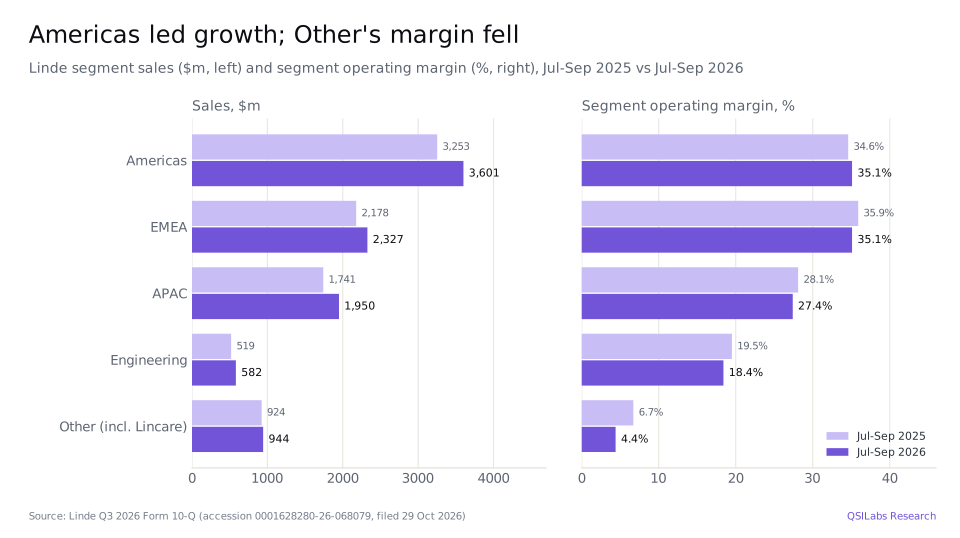
All four main segments grew sales by 7% or more. The Americas, now without Lincare, improved its margin; EMEA and APAC margins fell slightly, mostly because of cost pass-through; and Other, which includes Lincare, earned only $42m.
Americas
Americas sales rose 11% to $3,601m, with underlying sales up 9% on 6% higher prices and 3% higher volumes, mainly in electronics, chemicals and energy, and metals and mining. Operating profit was $1,263m, 35.1% of sales, 50 basis points higher than a year earlier. White said about 2 points of the 6% price rise was recovery of earlier cost inflation, so the underlying rate was about 4%, and that the pricing looks larger partly because Lincare's sales have left the segment.
EMEA
EMEA (Europe, Middle East and Africa) sales rose 7% to $2,327m, with underlying sales up 3% on 2% price and 1% volume, mainly in healthcare and food and beverage. The margin was 35.1%, 80 basis points lower, or flat excluding cost pass-through. Lamba said the volume gain came from equipment sales and that underlying European volumes were flat, adding: "there is absolutely no catalyst, and I have absolutely no reason for any confidence that European market will pick up and give us any growth in the near-term."
APAC
APAC (Asia Pacific) sales rose 12% to $1,950m, with underlying sales up 8% on 5% volume, from electronics, chemicals and energy and project start-ups, and 3% price. White said about half of APAC's price rise came from helium, whose prices rose as the Middle East conflict disrupted supply from Qatar. The margin was 27.4%, 70 basis points lower, or 40 basis points excluding cost pass-through.
Linde Engineering and Other
Linde Engineering sales rose 12% to $582m and operating profit was $107m, 18.4% of sales against 19.5%. Order intake was $499m. The Other segment had sales of $944m and operating profit of $42m, down from $62m a year earlier.
End markets
On the call Lamba gave growth by end market for the quarter: electronics 15%, chemicals and energy 12%, manufacturing 7%, food and beverage 3%, metals and mining 3% and healthcare 2%, or mid-single digits excluding Lincare. Electronics growth came mostly from Asia Pacific and the US, and he expects double-digit growth to continue as about $2bn of electronics projects under construction in the US, South Korea and China start up over the next two to three years. Chemicals and energy benefited from stronger demand along the US Gulf Coast and in China, where customers have a raw material cost advantage during the Middle East conflict.
Linde's backlog and project start-ups
Linde's project backlog was $11bn at 30 September 2026: $7.9bn of sale-of-gas projects, plants Linde builds and then owns and runs to supply customers under long-term contracts, and $2.9bn of third-party plant orders for Linde Engineering. The sale-of-gas backlog was down from $8.1bn at 30 June; projects leave the backlog as they start up. Lamba said start-ups worth up to about $1bn are due in the fourth quarter and that Linde aims to keep the sale-of-gas backlog near $8bn, depending on when customers make final decisions.
One of the largest projects is the hydrogen and nitrogen supply to Woodside's ammonia complex on the US Gulf Coast. Nitrogen supply began in the third quarter; Lamba expects the two hydrogen trains to start in the first half of 2027, the revenue effect to come through in the second half of 2027 and full capacity use "probably" in 2028.
Linde's 2026 guidance and the fourth quarter
Linde now expects 2026 adjusted EPS of $17.82-17.92, 8-9% growth, with currency adding about 2%. In July the range was $17.70-17.90. White said the new range "simply rolls the fourth quarter into the year-to-date actual": the third quarter's $4.59 beat the $4.45-4.55 Linde had guided in July.
For the fourth quarter Linde expects adjusted EPS of $4.40-4.50, up 5-7% on a year earlier. At the midpoint that is about 3% below the third quarter, which White split into about a point each from currency, the one-off equity income in the third quarter, and seasonality and caution. The guidance assumes no economic improvement. Linde will give 2027 guidance in February. Its stated long-term model is EPS growth of 8-12% a year excluding macro effects (Linde investor overview).
Linde cash flow, debt and dividends
Operating cash flow was $3,169m in the third quarter, up 8%, and capital expenditures were $1,392m, giving free cash flow of $1,777m. Linde's cash flow is seasonally higher in the second half because of the timing of taxes, interest and incentive payments.
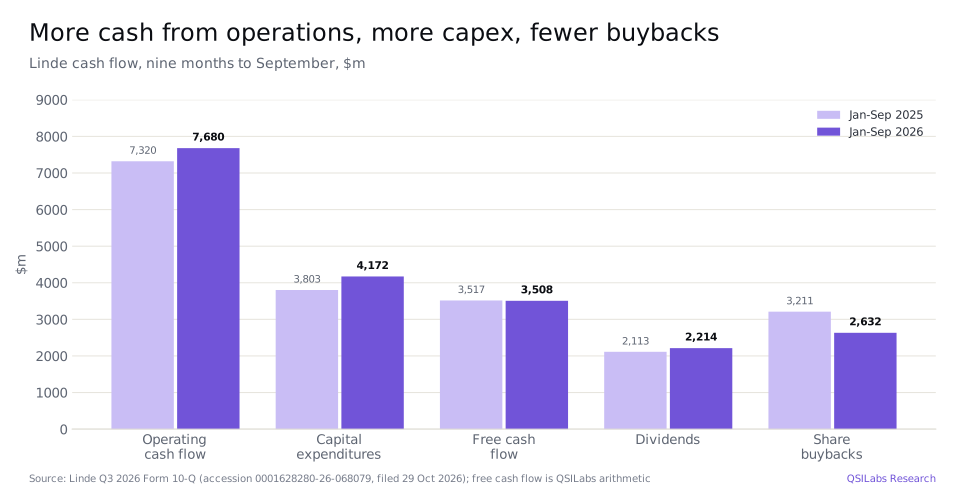
In the first nine months operating cash flow was $7,680m, up from $7,320m, and capital expenditures were $4,172m, up from $3,803m, as Linde builds plants for its backlog. White said base capital spending, growth and maintenance together, was flat on a year earlier. Linde paid $2,214m of dividends and bought back $2,632m of shares, against $3,211m a year earlier.
At 30 September 2026 Linde had $26,702m of interest-bearing debt ($4,645m short-term, $1,464m of long-term debt due within a year and $20,593m of long-term debt) and $3,947m of cash, so net debt was about $22.8bn, less than twice its annual EBITDA. The quarterly dividend is $1.60 a share, up from $1.50 in 2025, or $6.40 a year, a yield of about 1.2% at $519.72. At that price Linde's market value is about $239bn.
Linde stock Q3 2026 valuation: is Linde overvalued?
On our numbers, yes, by a wide margin. Our discounted cash flow model gives Linde a value of $182.52 a share, about 65% below the $519.72 close on 2 November 2026. Put the other way, the share price is about 2.8 times our value. The value is up from $180.34 before this update, mainly because third-quarter results and higher 2027 consensus revenue offset a lower margin path.
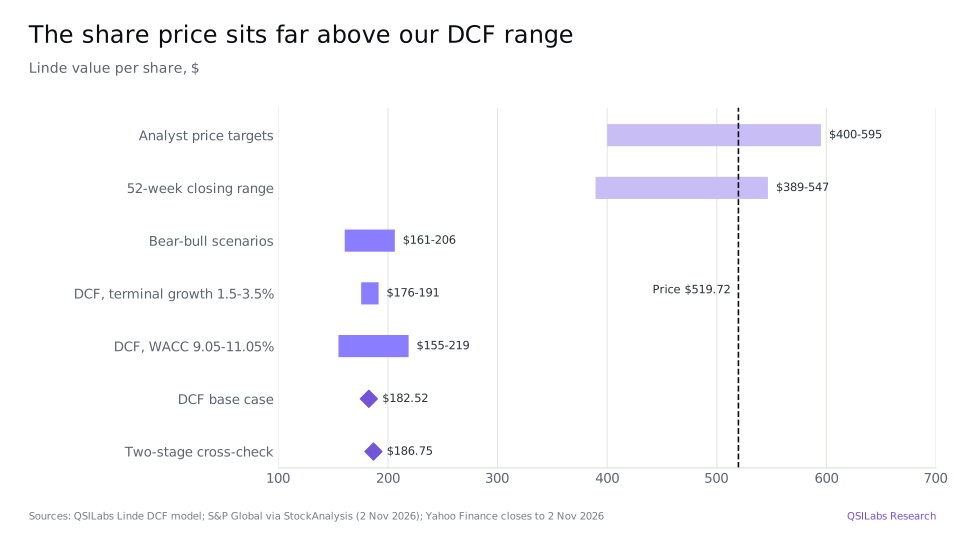
The market sees it very differently. The S&P Global analyst consensus rates Linde a Buy, with an average price target of $549.37 and a range of $400-595. At $519.72 the shares trade at about 29 times the midpoint of Linde's 2026 adjusted EPS guidance and about 27 times consensus 2027 EPS of $19.54. On our 2026 estimates, the enterprise value of about $261bn is about 19 times EBITDA, while our terminal value implies about 6.7 times.
Method
We value the whole business, then subtract debt. We forecast free cash flow to the firm, the cash the business generates after tax, capital spending and working capital but before interest, for 2026 to 2035, discount it at a weighted average cost of capital (WACC), and add a terminal value for the years after 2035. From enterprise value we subtract all interest-bearing debt and minority interests and add cash. The main inputs:
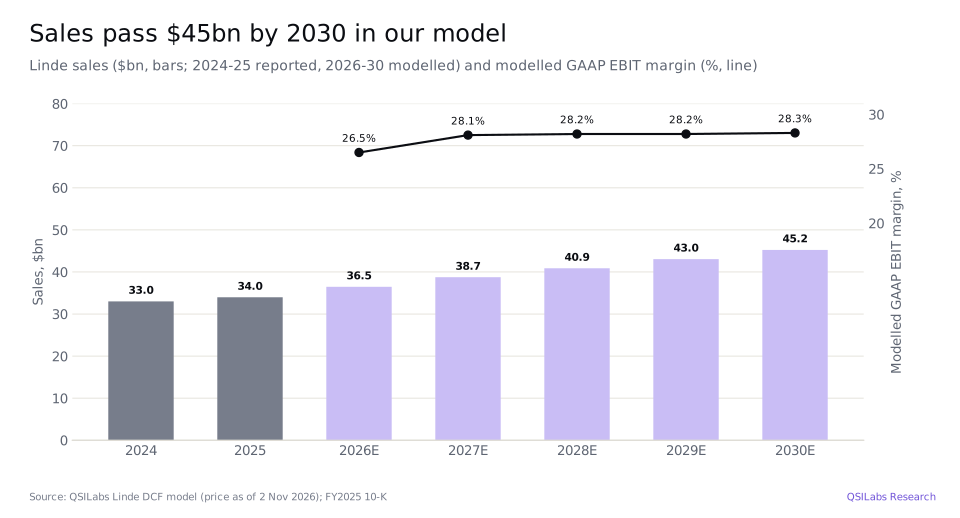
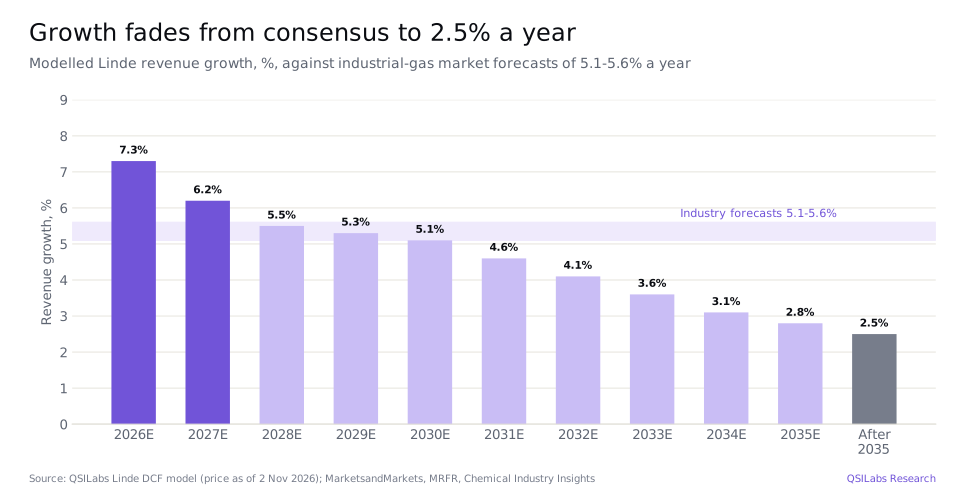
- Revenue: $36.47bn in 2026 and $38.74bn in 2027, analyst consensus, up 7.3% and 6.2%. For 2028-30 we take 5.5%, 5.3% and 5.1%, in line with industrial-gas market forecasts of 5.1-5.6% a year and the low end of Linde's growth model, because Lincare is expected to lag. Growth then fades in equal steps to 2.8% in 2035. Sales reach $45.2bn in 2030 and $54.1bn in 2035.
- Margins: our GAAP EBIT margin is 26.5% in 2026, after the $425m charge, and 28.1% in 2027: consensus adjusted margin of about 29.7%, plus about 0.4 points of restructuring savings, less about 2 points of purchase accounting. After 2027 we hold the margin before acquired-intangible amortisation flat at 29.5%, so the GAAP margin edges up to 28.5% by 2035 as the amortisation stays fixed in dollars.
- Tax: 23%, close to the 22.9% effective rate in the first nine months.
- Capital spending: $5.75bn a year in 2026-29, the midpoint of 2026 guidance held flat, falling from about 16% of sales to about 13%.
- Free cash flow to the firm: $5.5bn in 2026, $6.7bn in 2027, $8.3bn in 2030 and $10.1bn in 2035.
- Discount rate: a WACC of 10.05%, built from a 5.12% risk-free rate, a beta of 1.07 (Damodaran's global specialty chemicals unlevered beta of 0.98, relevered for Linde's debt) and a 5.18% equity risk premium weighted by where Linde earns its revenue, giving a 10.66% cost of equity, with a 4.98% after-tax cost of debt and debt at about 11% of capital. A version using regional industry betas gives 9.82% and $189.29 a share.
- Terminal growth: 2.5% a year after 2035.
- Equity bridge: enterprise value of $108.5bn, less $26.7bn of debt, plus $3.9bn of cash, less $2.7bn of minority interests (including Linde India at its market value), plus a $1.1bn adjustment for fourth-quarter cash flow, gives equity of $84.1bn. Divided by 461.0m diluted shares, that is $182.52 a share. The terminal value is 53.6% of enterprise value.
A two-stage version of the model, which fades growth and returns more gradually after 2035, gives $186.75, close to the same answer.
How the number moves if you argue with us
The table shows our value per share for different discount rates and terminal growth rates. Every figure comes from the model.
| WACC / terminal growth | 1.5% | 2.0% | 2.5% | 3.0% | 3.5% |
|---|---|---|---|---|---|
| 9.05% | $207.4 | $212.7 | $218.8 | $225.8 | $233.9 |
| 9.55% | $190.5 | $194.6 | $199.3 | $204.7 | $210.9 |
| 10.05% | $175.5 | $178.8 | $182.5 | $186.7 | $191.4 |
| 10.55% | $162.3 | $164.9 | $167.8 | $171.0 | $174.7 |
| 11.05% | $150.5 | $152.6 | $154.8 | $157.3 | $160.1 |
We also ran two scenarios through the model. A bear case, with revenue growth 1 point lower in 2028-35 and margins 1 point lower throughout, gives $160.52. A bull case, 1 point higher on both, gives $206.23.
Even the most generous corner of the table, a 9.05% WACC with 3.5% growth for ever, gives $233.9, about 55% below the share price. To justify $519.72 you need a much lower cost of capital than ours, closer to the 7.5% StockAnalysis shows for Linde, together with growth well above industry forecasts for much longer. Linde's history of steady price increases, long contracts and high returns is why investors accept that. Our model gives the company credit for consensus growth in 2026 and 2027 and for margins near today's level for good, but not for a premium valuation multiple that lasts indefinitely.
Risks to the Linde investment case
The risks run in both directions. Things that could make our value too low:
- Cost of capital. Linde's long-term on-site supply contracts make its cash flows steadier than most industrial companies'. If investors keep pricing it at a cost of capital closer to 7-8%, the value rises sharply.
- Electronics and backlog. About $2bn of electronics projects and a $7.9bn sale-of-gas backlog could support growth above the 5-5.5% we assume for 2028-30, and new semiconductor projects could add to it.
- Lincare. A sale or a successful restructuring would remove a business that has cost about 1.5-2 points of EPS growth this year.
Things that could make it too high:
- Europe. Lamba sees no catalyst for European industrial growth, and high energy costs could close more of the chemical plants Linde supplies.
- Inflation and pricing. Part of the Americas price rise was recovery of costs. If energy and distribution costs keep rising, the 3-6 month lag on merchant and packaged gas pricing could squeeze margins.
- Project timing. The Woodside hydrogen supply depends on start-ups in 2027 and a customer that is reviewing the asset; delays would push revenue out.
- Valuation. At about 29 times 2026 earnings guidance, the shares leave little room for a slip.
FAQ
What is QSILabs' value for Linde stock after Q3 2026 earnings?
QSILabs values Linde (LIN) at $182.52 per share as of results for the quarter ended 30 September 2026, based on a discounted cash flow model with a 10.05% cost of capital and 2.5% terminal growth. The shares closed at $519.72 on 2 November 2026, about 2.8 times that value. Our sensitivity range is roughly $150-234 a share.
Is Linde stock a buy after its Q3 2026 results?
On our valuation, Linde stock is expensive: the $519.72 price sits above our whole DCF range of about $150-234, and above the $233.9 we get even with our most generous assumptions. The S&P Global analyst consensus disagrees, rating Linde a Buy with an average target of $549.37. This is analysis, not investment advice.
How much did Linde earn in the third quarter of 2026?
Linde earned net income of $1,692m in the quarter ended 30 September 2026, or $3.66 per diluted share, down from $1,929m and $4.09 a year earlier because of $425m of cost reduction and other charges. Adjusted net income was $2,122m and adjusted EPS $4.59, up 9%. Sales were $9,404m, up 9%.
Why did Linde move Lincare into its Other segment?
Lincare, Linde's US homecare business with about $2.3bn of annualised sales, now reports to the chief financial officer, so from the third quarter of 2026 Linde reports it in Other rather than Americas. Linde says this gives a clearer view of its regional gases businesses while it restructures Lincare and evaluates strategic options; it took $183m of non-cash charges, mainly at Lincare, in the quarter.
Why is Linde's GAAP EPS lower than its adjusted EPS?
Adjusted EPS excludes cost reduction and other charges, $425m of operating profit or $0.57 a share in Q3 2026, and the amortisation and other purchase accounting effects of the 2018 Praxair and Linde AG merger, $188m of operating profit or $0.35 a share. With a $0.01 pension settlement charge, they explain the whole gap between GAAP EPS of $3.66 and adjusted EPS of $4.59.
How large is Linde's project backlog?
Linde's project backlog was about $11bn at 30 September 2026: $7.9bn of sale-of-gas projects that Linde will own and operate under long-term supply contracts, and $2.9bn of third-party plant orders for Linde Engineering. About $2bn of the backlog is electronics projects in the US, South Korea and China.
What dividend does Linde pay?
Linde pays a quarterly dividend of $1.60 a share, or $6.40 a year, a yield of about 1.2% at the 2 November 2026 price of $519.72. It paid $2,214m of dividends and bought back $2,632m of shares in the first nine months of 2026.
How did Linde shares react to the Q3 2026 results?
Linde shares fell 1.0% on 29 October 2026, results day, to close at $503.15, and had risen to $519.72 by 2 November. That was about 5% below the 52-week closing high of $546.64 on 2 July 2026 and 26% above the level a year earlier.
When will Linde give guidance for 2027?
Linde said on its Q3 2026 earnings call that it will give 2027 guidance in February 2027. Its long-term framework is EPS growth of 8-12% a year excluding macro effects, and consensus 2027 EPS is $19.54, about 9% above the midpoint of 2026 guidance.
Sources
- Linde plc, third quarter 2026 earnings release (Form 8-K, Exhibit 99.1, 29 Oct 2026; accession 0001654954-26-009199) www.sec.gov
- Linde plc, Form 10-Q for the quarter ended 30 Sep 2026 (filed 29 Oct 2026; accession 0001628280-26-068079) www.sec.gov
- Linde plc, second quarter 2026 earnings release (Form 8-K, Exhibit 99.1, 31 Jul 2026; accession 0001654954-26-007052) www.sec.gov
- Linde plc, Form 10-K for the year ended 31 Dec 2025 (filed 25 Feb 2026; accession 0001628280-26-011430) www.sec.gov
- Linde Q3 2026 earnings call transcript, 29 Oct 2026 (The Motley Fool) www.fool.com
- Linde, Why Linde: long-term EPS growth model (accessed 2 Nov 2026) www.linde.com
- StockAnalysis: Linde forecast and analyst ratings, S&P Global data (page updated 2 Nov 2026, accessed 2 Nov 2026) stockanalysis.com
- StockAnalysis: Linde statistics (accessed 2 Nov 2026) stockanalysis.com
- Yahoo Finance chart data: LIN closing prices and dividends (November 2025 to November 2026) query1.finance.yahoo.com
- Yahoo Finance chart data: Linde India (LINDEINDIA.NS) close on 30 Oct 2026 and USD/INR on 2 Nov 2026 query1.finance.yahoo.com
- MarketsandMarkets: industrial gases market, 2025-2030 forecast www.marketsandmarkets.com
- Market Research Future: industrial gases market, 2026-2035 forecast www.marketresearchfuture.com
- Chemical Industry Insights: industrial gases market, 2026-2035 forecast chemicalindustryinsights.com
- Damodaran Online: global industry betas, January 2026 (betaGlobal.xls) pages.stern.nyu.edu
- QSILabs Linde DCF model (internal; price as of 2 Nov 2026)
Disclaimer
This article is for information only and is not investment advice or a recommendation to buy or sell any security. QSILabs estimates are opinions based on public information and our own model, and they may be wrong. Figures are as of the dates stated. Do your own research or consult a licensed adviser before investing.
More from QSI Labs
Related analysis: Applied Materials stock Q3 2026: DRAM and China and Caterpillar stock Q3 2026: power generation and backlog.
Read our white paper, QSI Labs: An AI-Native Trading Firm Built on a Training Loop (October 2026), available on request, or browse the research index.