Research / Earnings and valuation
Gilead Stock Q3 2026:HIV Sales +18% on Biktarvy and Yeztugo
As of: Figures are as of Gilead Sciences, Inc.'s Q3 2026 results (quarter ended 30 September 2026, reported 29 October 2026). Balance-sheet figures are from the Form 10-Q for the quarter ended 30 September 2026. The share price is the Nasdaq close of GILD on 30 October 2026, $170.68. Published 2 November 2026.
The short answer. Gilead stock in Q3 2026 is a bet that the HIV franchise keeps growing through a Medicare price cut and, eventually, Biktarvy's patent expiry. Product sales rose 13% to $8.29bn, HIV sales rose 18% to $6.25bn, and Gilead raised its 2026 product sales guidance to $31.0-31.3bn. Our risk-adjusted NPV puts Gilead at $85.37 per share, about 50% below the $170.68 close on 30 October 2026: the market is paying for HIV growth well beyond Biktarvy's 2036 US patent expiry, and for research that has yet to name its products.
Gilead stock Q3 2026 results were the company's best growth quarter in years. Product sales rose to $8,289m from $7,345m a year earlier, and excluding the COVID-19 antiviral Veklury they rose 16% to $8,203m, which chairman and chief executive Daniel O'Day called "our strongest year-over-year base business growth in more than a decade" (Gilead Q3 2026 earnings release). Total revenue rose a slower 7% to $8,300m because a year-earlier sale of intellectual property did not repeat. GAAP EPS fell to $1.94 from $2.43 on losses on equity investments, while non-GAAP EPS rose to $2.55 from $2.47. The shares rose 3.1% the day after results, to $170.68, their highest close in a year (Yahoo Finance).
In this article we go through Gilead's Q3 2026 numbers against a year earlier, the HIV franchise from Biktarvy to Yeztugo, the rest of the portfolio, the raised 2026 guidance, the Medicare price set for Biktarvy from 2028, the patent cliffs behind it, the pipeline led by anito-cel and weekly lenacapavir, and our valuation of GILD, with the assumptions laid out so you can argue with them.
Key takeaways
- Valuation: QSILabs values Gilead Sciences, Inc. (Nasdaq: GILD) at $85.37 per share as of Q3 2026, against a $170.68 close on 30 October 2026, about 50% below the market price. Our bear and bull cases are $69.12 and $96.10.
- Q3 2026 results: Gilead's product sales rose 13% to $8.29bn in the quarter ended 30 September 2026; net income was $2.43bn, GAAP EPS $1.94 and non-GAAP EPS $2.55, against $2.43 and $2.47 a year earlier.
- HIV: HIV sales rose 18% to $6.25bn, 75% of product sales. Biktarvy rose 10% to $4.06bn, Descovy 49% to $1.05bn and the twice-yearly PrEP injection Yeztugo reached $305m.
- Guidance: Gilead now expects 2026 product sales of $31.0-31.3bn (previously $30.1-30.4bn) and a non-GAAP loss per share of $0.85-1.20, after about $9.88 a share of acquired research charges for the Arcellx, Tubulis, Ouro and PepStar deals.
- Biktarvy price: Medicare's price for Biktarvy will be $2,600 per 30-day supply from 2028, about 38% below list. Gilead expects a net hit to Biktarvy revenue of about $1.5bn in 2028 but still expects HIV sales, product sales and EPS to grow that year.
- Pipeline: the FDA is due to decide on the BCMA CAR-T anito-cel in multiple myeloma by 23 December 2026 and on once-weekly oral lenacapavir for HIV prevention in early February 2027.
Key numbers from Gilead's Q3 2026 earnings
| Q3 2026 vs Q3 2025, $m | Q3 2025 | Q3 2026 | Change |
|---|---|---|---|
| Total revenues | 7,769 | 8,300 | +7% |
| Product sales | 7,345 | 8,289 | +13% |
| Product sales excluding Veklury | 7,068 | 8,203 | +16% |
| HIV | 5,277 | 6,249 | +18% |
| Biktarvy | 3,686 | 4,059 | +10% |
| Descovy | 701 | 1,046 | +49% |
| Yeztugo | 39 | 305 | n/m |
| Liver disease | 819 | 927 | +13% |
| Trodelvy | 357 | 506 | +42% |
| Cell therapy (Yescarta and Tecartus) | 432 | 355 | -18% |
| Veklury | 277 | 86 | -69% |
| Research and development | 1,346 | 1,608 | +19% |
| Net income attributable to Gilead | 3,052 | 2,429 | -20% |
| GAAP diluted EPS ($) | 2.43 | 1.94 | -20% |
| Non-GAAP diluted EPS ($) | 2.47 | 2.55 | +3% |
Sources: Gilead Q3 2026 earnings release (accession 0000882095-26-000037) and Q3 2026 Form 10-Q.
Gilead stock Q3 2026: what happened in the quarter?
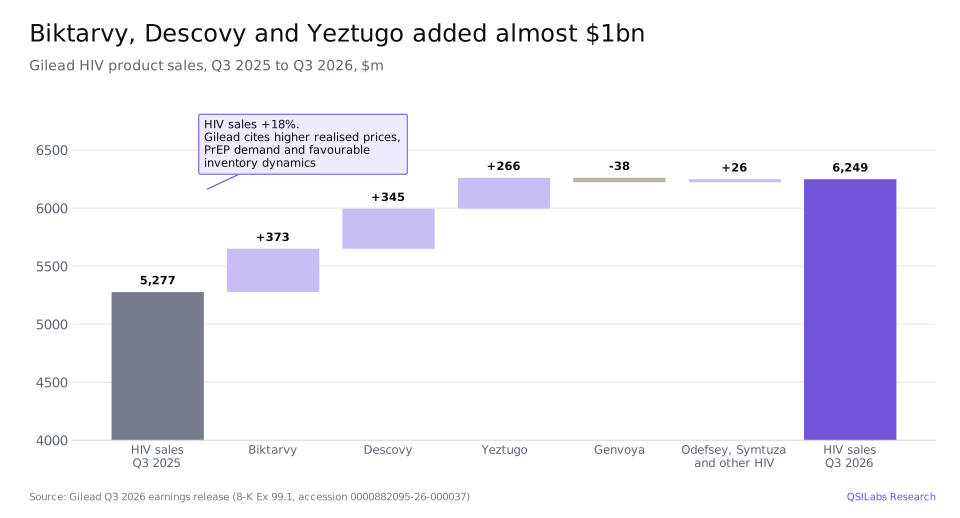
Gilead reported its third quarter after the market closed on 29 October 2026. Product sales grew by $944m, and HIV supplied $972m of it. Trodelvy added $149m and the liver disease drug Livdelzi $98m. Against that, Veklury lost $191m as COVID-19 hospitalisations fell, and the CAR-T cell therapies Yescarta and Tecartus lost $77m between them to what Gilead called "ongoing competitive headwinds".
Not all of the HIV growth was demand. Gilead said HIV sales rose "primarily" on higher average realised prices, higher demand in HIV prevention and favourable inventory dynamics. On the earnings call, chief commercial officer Johanna Mercier said Q3 inventory was "a little bit higher" than usual across the HIV portfolio, so the seasonal stock build in the fourth quarter may be softer than usual (Q3 2026 earnings call).
Geographically, US product sales rose 21% to $6,361m, 77% of the total. Europe fell 8% to $1,058m and the rest of the world fell 6% to $869m. Product gross margin rose to 81.0% from 78.6% (non-GAAP 88.1% from 86.5%) after a royalty obligation tied to tenofovir alafenamide (TAF) expired in November 2025. Research spending rose 19% to $1,608m and selling, general and administrative costs 21% to $1,641m, including higher HIV promotion, integration costs and legal expenses.
Cash generation was strong. Operating cash flow was $5.0bn in the quarter and free cash flow $4.8bn. Gilead paid $1.0bn of dividends and bought back $370m of shares, and declared a fourth-quarter dividend of $0.82 a share. Cash, equivalents and marketable debt securities fell to $6.4bn from $10.6bn at the end of 2025, after $11.3bn spent on acquisitions this year.
- 4 Aug 2026Q2 2026 results; 2026 product sales guidance raised to $30.1-30.4bn8-K Ex 99.1 (Q3 2026)
- Aug 2026Bixlenvo (bictegravir 75mg/lenacapavir 50mg) approved and launched for HIV treatment8-K Ex 99.1; Q3 2026 call
- Q3 2026European Commission approves Trodelvy plus Keytruda in first-line PD-L1-positive metastatic triple-negative breast cancer; Gilead agrees a deal for PepStar's oral IL-23 receptor programme8-K Ex 99.1
- 29 Oct 2026Q3 2026 results after the close; product sales guidance raised to $31.0-31.3bn; Gilead says CMS has set Biktarvy's Medicare price at $2,600 per 30-day supply from 20288-K Ex 99.1; Q3 2026 call
- 30 Oct 2026GILD rises 3.1% to $170.68, its highest close in 52 weeksYahoo Finance
- 23 Dec 2026FDA action date (PDUFA) for anito-cel in fourth-line or later multiple myelomaQ3 2026 call
- Early Feb 2027FDA decision expected on once-weekly oral lenacapavir for HIV preventionQ3 2026 call
- 1 Jan 2028Biktarvy's Medicare maximum fair price takes effect8-K Ex 99.1; Q3 2026 call
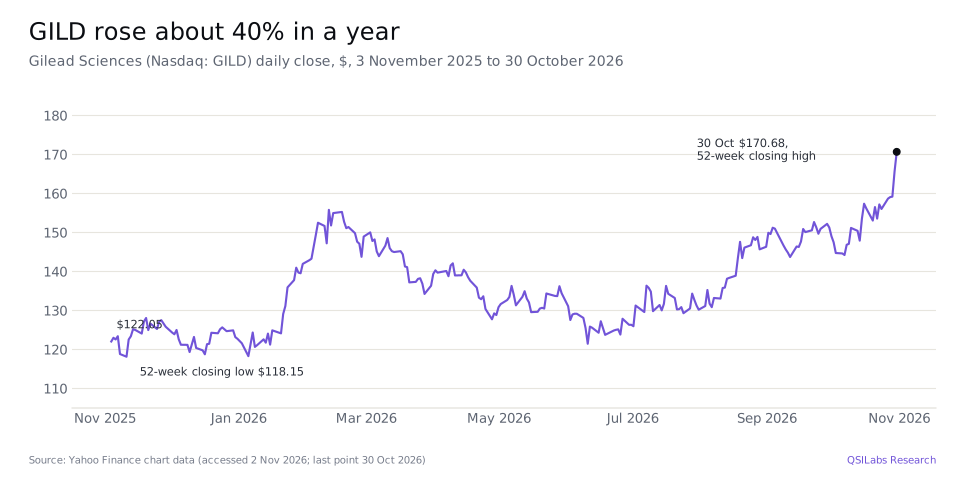
The shares rose from $159.20 on 28 October to $165.61 on 29 October, before the results, and to $170.68 on 30 October. Over 12 months GILD has risen about 40%, from $122.05 on 3 November 2025, with a 52-week closing low of $118.15 on 10 November 2025.
How did Biktarvy, Descovy and Yeztugo drive HIV growth?
Biktarvy, Gilead's once-daily HIV treatment pill, sold $4,059m in Q3 2026, up 10% from $3,686m and 8% from the second quarter. It was 49% of Gilead's product sales on its own. US sales were $3,284m. Gilead said Biktarvy reached an "all-time high" 53% share of US HIV treatment, and Mercier said it was "#1 across naive, switch, restarts".
HIV prevention, known as pre-exposure prophylaxis or PrEP, grew fastest. Descovy, which Gilead sells for both treatment and prevention and which now sells mostly for PrEP, rose 49% to $1,046m. Yeztugo, the twice-yearly lenacapavir injection launched in June 2025, sold $305m, up 31% from the second quarter, and $702m over nine months. Gilead said HIV prevention sales "nearly doubled" from a year earlier and that Yeztugo and Descovy together have a 50% share of PrEP and a $4bn annual run rate.
The older single-tablet regimens were mixed: Genvoya fell 10% to $339m, while Odefsey rose 3% to $286m and Symtuza 6% to $132m. In August Gilead launched Bixlenvo, a bictegravir and lenacapavir combination, which made a "modest initial contribution". For 2026 as a whole, Gilead expects HIV sales to grow about 12%.
How did Trodelvy, Livdelzi and the rest of the portfolio do?
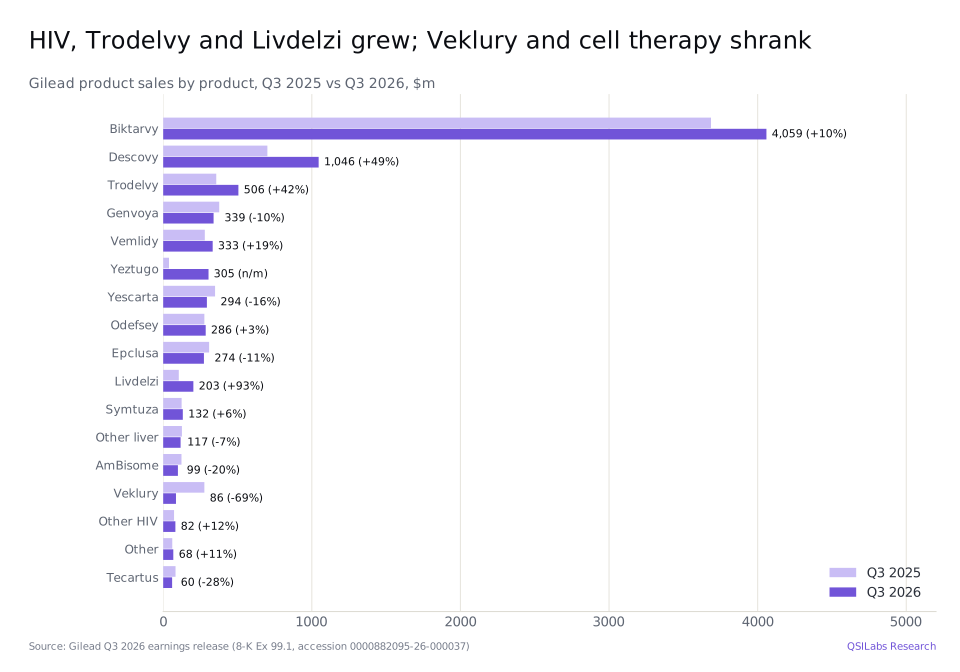
Oncology was the second growth engine. Trodelvy, the TROP2 antibody-drug conjugate for breast cancer, rose 42% to $506m, about a $2bn annual run rate, helped by first-line approvals in metastatic triple-negative breast cancer in the US and Europe. Cell therapy kept shrinking: Yescarta fell 16% to $294m and Tecartus 28% to $60m.
Liver disease sales rose 13% to $927m. Livdelzi, for the rare liver disease primary biliary cholangitis, nearly doubled to $203m from $105m. Vemlidy for hepatitis B rose 19% to $333m, while hepatitis C sales kept falling, with Epclusa down 11% to $274m. Veklury fell 69% to $86m, and Gilead expects about $300m for the year.
What is Gilead's 2026 guidance after Q3?
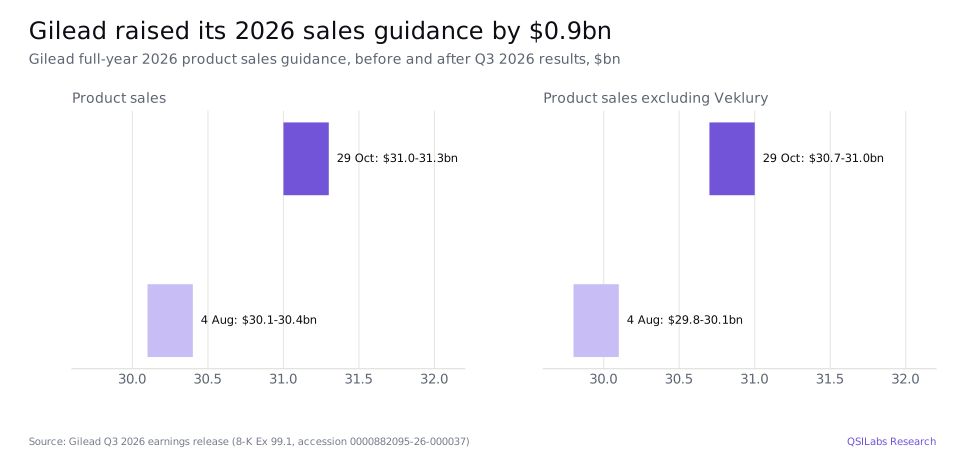
Gilead raised its 2026 product sales guidance again, to $31.0-31.3bn from $30.1-30.4bn in August. Excluding Veklury, it expects $30.7-31.0bn, up from $29.8-30.1bn. The midpoint is $900m above the August guidance and $1.65bn above the guidance Gilead gave in February.
Earnings guidance moved the other way, for one reason: acquisitions. Gilead now expects a GAAP loss of $4.05-4.40 a share and a non-GAAP loss of $0.85-1.20 a share, against $0.30-0.65 in August. Both include about $9.88 a share of acquired in-process research charges, $12.4bn in total, for the Arcellx, Tubulis, Ouro Medicines and PepStar transactions. Chief financial officer Andrew Dickinson said that, excluding about $9.95 a share of acquisition charges, financing costs and one-off revenue, non-GAAP EPS would be $8.75-9.10, $0.25 higher at both ends than the comparable August figure.
| 2026 guidance | 4 August 2026 | 29 October 2026 |
|---|---|---|
| Product sales | $30.1-30.4bn | $31.0-31.3bn |
| Product sales excluding Veklury | $29.8-30.1bn | $30.7-31.0bn |
| Veklury | about $0.3bn | about $0.3bn |
| GAAP loss per share | $3.40-3.75 | $4.05-4.40 |
| Non-GAAP loss per share | $0.30-0.65 | $0.85-1.20 |
Source: Gilead Q3 2026 earnings release.
What does the 2028 Medicare price for Biktarvy mean?
Biktarvy was selected for Medicare price negotiation under the Inflation Reduction Act. Gilead said on the call that the Centers for Medicare & Medicaid Services has set the price at $2,600 per 30-day supply, about 38% below the list price, from 1 January 2028. Dickinson said Gilead expects Biktarvy's 2028 revenue to fall from 2027, with a total net impact of about $1.5bn, covering Medicare and spillover effects in other US channels, net of the end of a Medicare Part D redesign cost that hit Biktarvy in 2025. Even so, Gilead expects total HIV revenue, total product sales and EPS to grow in 2028.
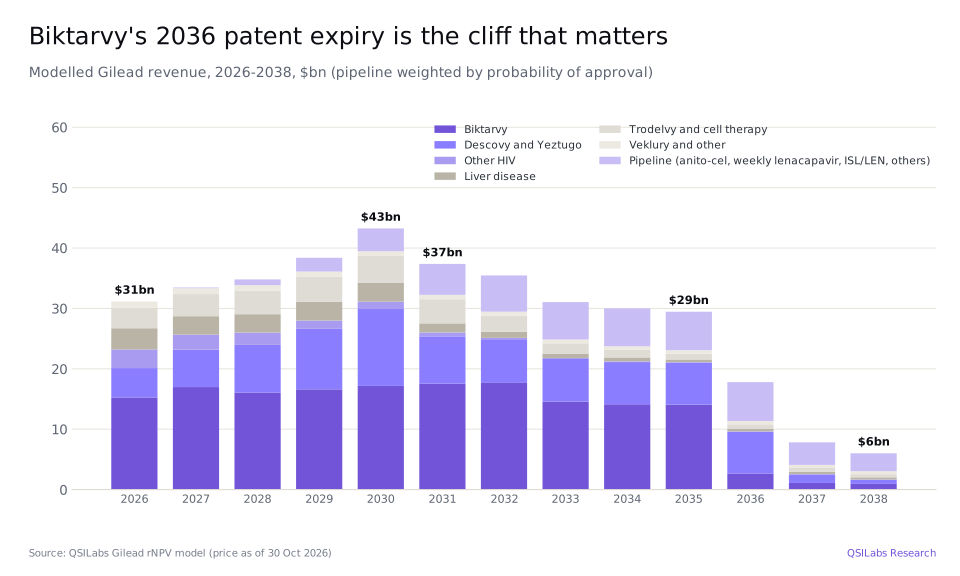
Our model takes the company at its word on the size of the hit. Biktarvy grows to $17.0bn in 2027, falls 5.4% to $16.1bn in 2028 and then grows with the HIV drug market, which The Business Research Company forecasts to grow 3.4% a year from $36.55bn in 2025 to $43.08bn in 2030 (TBRC). In our model Gilead's total revenue still grows in 2028, to $34.8bn from $33.5bn, because Descovy, Yeztugo and the pipeline more than offset the Biktarvy cut.
How long can Gilead's HIV franchise keep growing?
Until Biktarvy's patents expire, the outlook is good. Gilead's 2025 Form 10-K lists Biktarvy's US patent expiry as 2036, and Gilead's October 2025 settlements with Lupin, Cipla and Laurus mean no US generic is expected before 1 April 2036; in Europe protection runs to 2033 (2025 Form 10-K). Descovy, Vemlidy and Symtuza depend on TAF patents that run to 2031 in the US under earlier settlements, and Livdelzi's US orphan exclusivity also ends in 2031.
Our forecast starts from nine months of actual 2026 sales plus a fourth quarter at the Q3 run rate, giving $31.1bn of product sales, inside the guided range. For 2027 we take each product's trailing growth, capped at 20% a year, and calibrate the total to the S&P Global consensus of $33.47bn compiled by StockAnalysis. Growing products then fade towards the HIV market's 3.4% growth by 2030 and to zero by 2033; shrinking products keep their trailing decline. Yeztugo follows the sell-side peak-sales consensus of $6.7bn in 2030 reported by Fierce Pharma, down from $7.7bn in March.
That gives revenue rising to $43.2bn in 2030, then dropping to $37.4bn in 2031 as Descovy, Vemlidy and Livdelzi lose US exclusivity, holding near $30bn to 2035 and falling to $17.8bn in 2036 and $6.0bn in 2038 once Biktarvy and then Yeztugo face generics. The last years matter less than they look, because they are heavily discounted, but they explain why we value Gilead well below its market price: a large share of today's profit has a visible end date.
What is in Gilead's pipeline? Anito-cel, lenacapavir and ISL/LEN
Gilead's next launches are in HIV and blood cancer. Anito-cel, the BCMA CAR-T therapy that came with the Arcellx acquisition, has an FDA action date of 23 December 2026 in fourth-line or later relapsed or refractory multiple myeloma, and Gilead is targeting brand leadership within 18 months of launch. Once-weekly oral lenacapavir for PrEP, a pill version of Yeztugo, is under FDA review with a decision expected in early February 2027. With Merck, Gilead expects to file islatravir plus lenacapavir, which would be the first once-weekly oral treatment for people with HIV who are already virally suppressed.
Further out are once-yearly lenacapavir for PrEP (an update from PURPOSE-365 is expected in 2027, with a potential launch in 2028), the autoimmune T-cell engager gamgertamig, the Tubulis antibody-drug conjugate GS-8824 and emvistegrast, which succeeded in a Phase 2 ulcerative colitis study. Gilead says it has 49 clinical programmes. Two Kite cell therapy studies, PALISADES-1 and PALISADES-2 for KITE-753, are on partial clinical hold.
- Anito-cel (anitocabtagene autoleucel)BCMA CAR-T therapy acquired with Arcellx; BLA in fourth-line or later relapsed or refractory multiple myeloma based on the Phase 2 iMMagine-1 study, PDUFA 23 December 2026; Gilead targets brand leadership within 18 months of launchQ3 2026 call; Arcellx deal release
- Once-weekly oral lenacapavir (PrEP)Weekly pill version of Yeztugo for HIV prevention; under FDA review with a decision expected in early February 2027Q3 2026 call
- Islatravir plus lenacapavirOnce-weekly oral HIV treatment with Merck for people already virally suppressed; positive Phase 3 ISLEND-1 and ISLEND-2; filing expected in 2026Q3 2026 call; 2025 Form 10-K
- Once-yearly lenacapavirPrEP given once a year; PURPOSE-365 update expected in 2027 and a potential launch in 2028 (not in our model)Q3 2026 call
- GamgertamigBCMA x CD3 T-cell engager for autoimmune diseases from the Ouro Medicines deal; Gilead pays royalties of 20-23% of net sales to LakefrontQ2 2026 Form 10-Q
- GS-8824NaPi2b-directed antibody-drug conjugate from the Tubulis acquisitionQ2 2026 Form 10-Q
- EmvistegrastPositive Phase 2 SWIFT study in ulcerative colitis, Phase 3 planned for 2027 (not in our model)8-K Ex 99.1
Is Gilead stock overvalued after Q3 2026?
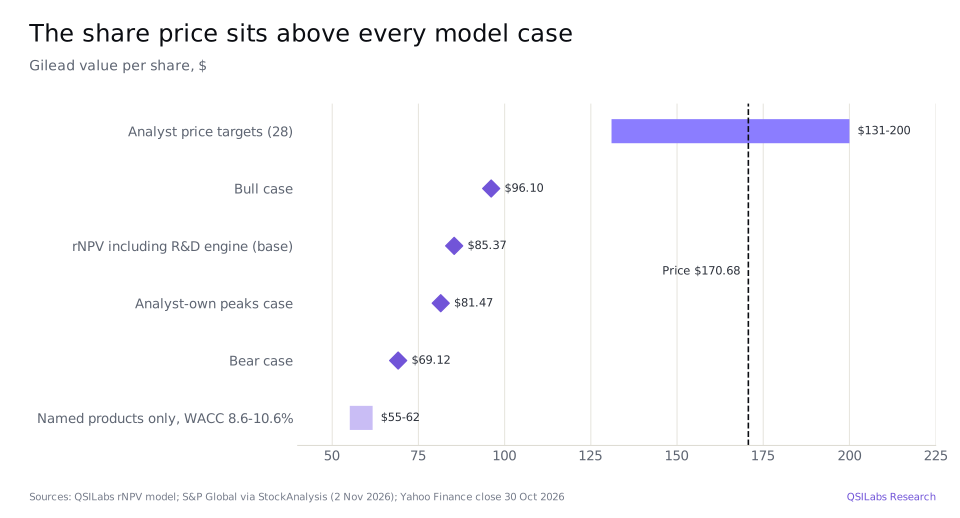
On our numbers, yes. Our risk-adjusted NPV gives an equity value of $106.7bn, or $85.37 per share on 1,249m shares, against a share price of $170.68 on 30 October 2026, a market value of about $213bn. The price is about double our value.
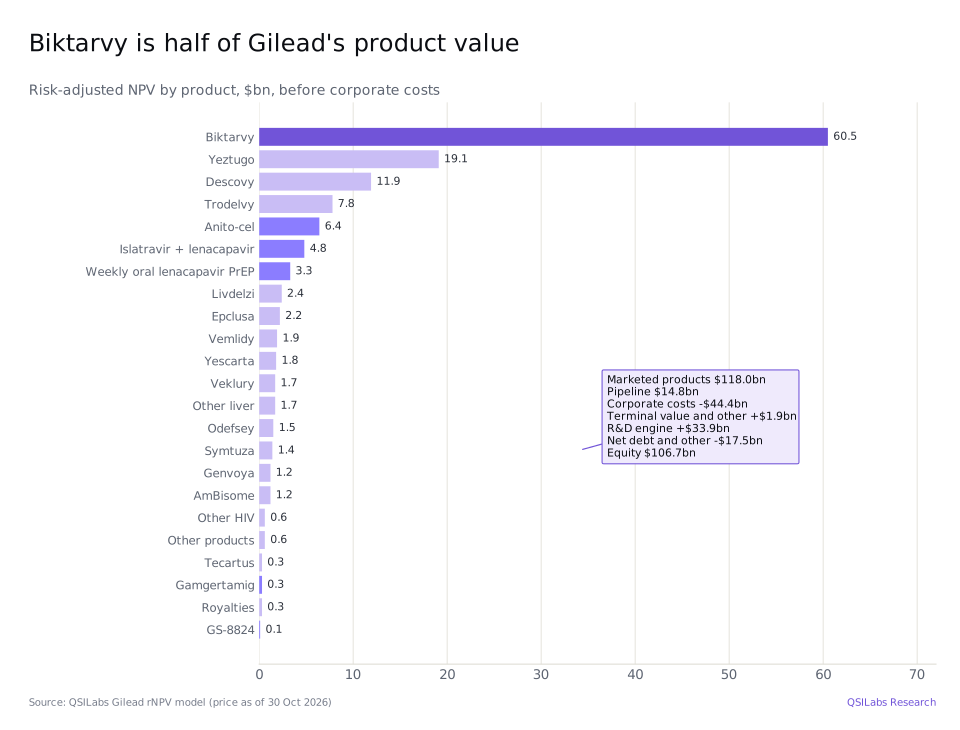
The gap is about $107bn, or $85 a share. To close it, the market has to be right that Gilead will keep HIV profits close to today's level well after Biktarvy's patents expire, through successors such as weekly and yearly lenacapavir, and that its research will create more value than it costs. That gap is larger than the $60.5bn we assign to Biktarvy.
Here is how our value builds up:
| Component | $bn | $ per share |
|---|---|---|
| Marketed products (risk-adjusted NPV) | 118.0 | 94.42 |
| Late-stage pipeline (risk-adjusted NPV) | 14.8 | 11.88 |
| Corporate costs (R&D and administration not tied to a product) | -44.4 | -35.51 |
| Terminal value, capital spending, working capital and tax | 1.9 | 1.48 |
| Enterprise value of named products | 90.3 | 72.28 |
| R&D engine (value of future research spending) | 33.9 | 27.14 |
| Net debt and other claims | -17.5 | -14.04 |
| Equity value | 106.7 | 85.37 |
Source: QSILabs Gilead rNPV model. Cash and marketable debt securities of $6.44bn, equity securities of $2.25bn and debt of $26.23bn (senior notes and term loan of $25.17bn plus a $1.06bn royalty-related liability) are from the Q3 2026 Form 10-Q.
Analysts are far more positive. The 28 analysts tracked by StockAnalysis rate Gilead a Buy, with an average 12-month price target of $172.50, a median of $175 and a range of $131-200 (StockAnalysis). Even the lowest target is well above our $96.10 bull case.
How we value Gilead: the rNPV method and assumptions
We forecast each of 18 marketed product lines and 5 pipeline programmes year by year to 2045, apply each patent expiry, weight pipeline revenue and costs by the probability of approval at each remaining phase, and discount the cash flows at a weighted average cost of capital of 9.63%. That rate is Aswath Damodaran's January 2026 figure for US biotechnology companies (beta 1.14, cost of equity 10.18% on a 5.12% risk-free rate and a 4.46% equity risk premium, after-tax cost of debt 5.39%, debt at 11.5% of capital). We use a single US rate because the US was 77% of Gilead's Q3 product sales, and Gilead's own debt is about 11% of its capital at market value, close to the industry figure. The terminal value, on 2045 cash flow with zero growth, is only 2.2% of enterprise value because most of today's products have run off well before then.
The probabilities come from the BIO, Informa and QLS study of clinical development success rates for 2011-2020. The three filed or soon-to-be-filed programmes, anito-cel, weekly oral lenacapavir for PrEP and islatravir plus lenacapavir, each have a 90.6% chance of approval; gamgertamig has 15.1% and GS-8824 7.9%. Peak sales for the pipeline are our own estimates: $3.0bn for anito-cel, $1.5bn of additional sales for weekly lenacapavir PrEP and $4.0bn for islatravir plus lenacapavir, of which we credit Gilead with about 55% under the Merck agreement. We do not model islatravir plus lenacapavir taking sales from Biktarvy separately.
We tax profits at 20%, the non-GAAP rate Gilead guided to in February before acquisition charges distorted the 2026 figure (the Q3 non-GAAP rate was 19.0%). Corporate costs include research spending of 19% of revenue for discovery and lifecycle work not tied to a named product, and administration at 4.4% of revenue, both in line with the first nine months of 2026. Named products and the pipeline alone give $58.23 a share. The R&D engine, $33.9bn or $27.14 a share, is our estimate of the products that spending will eventually create, assuming a 5.9% return on research. That is about $15bn less than the cost of the spending, so on our assumptions Gilead's unnamed research earns less than its cost of capital.
How sensitive is the named-product value to the discount rate?
| WACC | Named products only, $ per share |
|---|---|
| 8.63% | 61.72 |
| 9.13% | 59.93 |
| 9.63% (base) | 58.23 |
| 10.13% | 56.62 |
| 10.63% | 55.09 |
Our bear case, $69.12, cuts peak sales by 30%, cuts probabilities of success by 30% and delays launches by a year; the bull case, $96.10, raises peak sales by 30% and probabilities by 20%. A third case that replaces the $6.7bn Yeztugo consensus peak with our own trend of about $3.9bn gives $81.47.
What are the main risks for Gilead stock?
- Concentration in HIV. HIV was 75% of Q3 product sales and Biktarvy alone 49%. Anything that hurts Biktarvy before 2036, from competition to pricing, hits Gilead's value directly.
- US drug pricing. The 2028 Medicare price is set, but Gilead's $1.5bn estimate is preliminary, and other products could be selected for negotiation later.
- Inventory and price. Part of Q3's HIV growth came from inventory and channel mix. Gilead expects a softer fourth-quarter stock build, and price gains of this kind can reverse.
- Yeztugo's peak. Sell-side estimates of Yeztugo's peak sales have already fallen from $7.7bn to $6.7bn. If uptake slows, our base case is too high; our own trend gives $81.47 a share.
- Patent cliffs. Descovy, Vemlidy and Livdelzi lose US exclusivity in 2031 and Biktarvy in 2036. The successors, led by lenacapavir, have to be in place by then.
- Acquisitions. Gilead has spent $11.3bn on acquisitions this year and taken $12.4bn of research charges. If anito-cel or the other deals disappoint, that money buys little.
- Upside risk. If weekly and yearly lenacapavir keep Gilead's HIV share as Biktarvy goes generic, or its research is more productive than our 5.9% return assumes, our value is too low. The analysts' average target, $172.50, assumes much of this.
FAQ
What is QSILabs' valuation of Gilead stock after Q3 2026?
Our risk-adjusted NPV gives $85.37 per share, against a $170.68 share price on 30 October 2026, about 50% below the market. Our bear and bull cases are $69.12 and $96.10. Named products and pipeline alone give $58.23; the remaining $27.14 is the value we place on Gilead's future research spending.
How much did Biktarvy sell in Q3 2026?
Biktarvy sold $4,059m in Q3 2026, up 10% from $3,686m a year earlier and 8% from the second quarter, with $3,284m from the US. Gilead says it holds an all-time high 53% share of US HIV treatment.
What is Yeztugo and how fast is it growing?
Yeztugo is lenacapavir given as an injection twice a year to prevent HIV infection. Launched in June 2025, it sold $305m in Q3 2026, up 31% from the second quarter, and $702m in the first nine months. Gilead says it is on track for about $1bn of sales in 2026.
How much will the Biktarvy price cut cost Gilead?
Gilead estimates a net reduction of about $1.5bn in Biktarvy revenue in 2028, when the Medicare price of $2,600 per 30-day supply takes effect. The estimate includes effects in other US channels. Gilead still expects HIV sales, total product sales and EPS to grow in 2028.
Did Gilead raise guidance in Q3 2026?
Yes. Gilead raised its 2026 product sales guidance to $31.0-31.3bn from $30.1-30.4bn, and excluding Veklury to $30.7-31.0bn. It lowered its EPS guidance, to a non-GAAP loss of $0.85-1.20 a share, because of acquired research charges.
Why does Gilead expect a loss per share in 2026?
Gilead expects about $12.4bn, or $9.88 a share, of acquired in-process research charges for the Arcellx, Tubulis, Ouro Medicines and PepStar deals, which turns its 2026 EPS negative. Excluding these and related items, Gilead says non-GAAP EPS would be $8.75-9.10.
When does Biktarvy lose patent protection?
Gilead lists Biktarvy's US patent expiry as 2036, and its settlements with Lupin, Cipla and Laurus mean no US generic is expected before 1 April 2036. European protection runs to 2033.
When could anito-cel be approved?
The FDA's action date for anito-cel in fourth-line or later relapsed or refractory multiple myeloma is 23 December 2026. Gilead is targeting brand leadership within 18 months of launch, and a filing for earlier use based on the iMMagine-3 trial could come as early as 2027.
Does Gilead pay a dividend?
Yes. Gilead declared a fourth-quarter dividend of $0.82 a share, payable on 30 December 2026 to shareholders of record on 15 December. It paid $1.0bn of dividends in Q3 2026 and bought back $370m of shares.
Sources
- Gilead Sciences, Inc., Q3 2026 earnings release (Form 8-K, Exhibit 99.1, 29 Oct 2026; accession 0000882095-26-000037) www.sec.gov
- Gilead Sciences, Inc., Form 10-Q for the quarter ended 30 Sep 2026 (accession 0000882095-26-000039) www.sec.gov
- Gilead Sciences, Inc., Q3 2026 earnings call transcript (The Motley Fool, 30 Oct 2026) www.fool.com
- Gilead Sciences, Inc., Q2 2026 earnings release (Form 8-K, Exhibit 99.1; accession 0000882095-26-000028) www.sec.gov
- Gilead Sciences, Inc., Form 10-Q for the quarter ended 30 Jun 2026 (accession 0000882095-26-000031) www.sec.gov
- Gilead Sciences, Inc., Form 10-K for the year ended 31 Dec 2025 (accession 0000882095-26-000006) www.sec.gov
- Gilead Sciences, Inc., press release on the Arcellx acquisition (Form 8-K, Exhibit 99.1; accession 0001104659-26-018314) www.sec.gov
- Fierce Pharma: Gilead's HIV PrEP franchise and the Yeztugo peak-sales consensus (5 Aug 2026) www.fiercepharma.com
- The Business Research Company: HIV Drug Global Market Report 2026 www.thebusinessresearchcompany.com
- BIO, Informa Pharma Intelligence and QLS: Clinical Development Success Rates 2011-2020 go.bio.org
- StockAnalysis: Gilead forecast and analyst ratings, S&P Global data (accessed 2 Nov 2026) stockanalysis.com
- Yahoo Finance chart data: GILD daily closing prices (November 2025 to October 2026) query1.finance.yahoo.com
- Damodaran Online: cost of capital by industry (US, January 2026) pages.stern.nyu.edu
- QSILabs Gilead risk-adjusted NPV model (internal; price as of 30 Oct 2026)
More from QSI Labs
Related analysis: Merck stock Q3 2026: Keytruda Qlex and Winrevair, Eli Lilly stock Q3 2026: Mounjaro and Zepbound, AbbVie stock Q3 2026: Skyrizi and Rinvoq and Johnson & Johnson stock Q3 2026.
Read our white paper, QSI Labs: An AI-Native Trading Firm Built on a Training Loop (October 2026), available on request, or browse the research index.