Research / Earnings and valuation
Bristol Myers Squibb Stock Q3 2026:Growth Brands Up 12% as Eliquis Cliff Nears
As of: Figures are as of Bristol-Myers Squibb Company's Q3 2026 results (quarter ended 30 September 2026, reported 29 October 2026) and its Form 10-Q for the quarter. Balance-sheet figures are from the Q3 2026 Form 10-Q. The share price is the NYSE close of BMY on 2 November 2026, $63.02. Published 2 November 2026.
The short answer. Bristol Myers Squibb stock in Q3 2026 is a bet that the newer medicines and the pipeline can replace Eliquis and Opdivo, both of which lose US patent protection in 2028. Revenue rose 7% to $13.1bn, the Growth Portfolio rose 12% to $7.7bn and Eliquis rose 25% to $4.7bn, and BMS raised its 2026 revenue guidance to $49.75-50.25bn. Our risk-adjusted NPV puts BMS at $59.58 per share, about 5% below the $63.02 close on 2 November 2026: on our numbers the market is paying a fair price for a company whose revenue falls by almost 30% in 2028 before the newer products take over.
Bristol Myers Squibb reported Q3 2026 results on 29 October 2026. Total revenue rose to $13,069m from $12,222m a year earlier, with US revenue up 9% to $9.1bn and international revenue up 3% (4% excluding currency) to $4.0bn. Chief executive Christopher Boerner said: "We delivered another quarter of double-digit growth in our Growth Portfolio, which increased 12% and reflects the continued momentum across our diversified portfolio" (BMS Q3 2026 earnings release). GAAP EPS was $1.05, against $1.08, and non-GAAP EPS $1.35, against $1.63; both include a $(0.58) per share net charge for acquired in-process R&D (IPRD) and licensing income, against $(0.20) a year earlier.
In this article we go through BMS's Q3 2026 numbers against a year earlier, the Growth Portfolio and the Legacy Portfolio, the raised 2026 guidance, the patent expiries for Eliquis and Opdivo, the pipeline led by milvexian, pumitamig, iza-bren and the CELMoDs Zenbexus and mezigdomide, and our valuation of BMY, with the assumptions laid out so you can argue with them.
Key takeaways
- Valuation: QSILabs values Bristol-Myers Squibb Company (NYSE: BMY) at $59.58 per share as of Q3 2026, against a $63.02 close on 2 November 2026, about 5% below the market price. Our bear and bull cases are $44.81 and $67.07.
- Q3 2026 results: BMS's total revenue rose 7% to $13.07bn in the quarter ended 30 September 2026; GAAP EPS was $1.05 and non-GAAP EPS $1.35, against $1.08 and $1.63 a year earlier, after a $(0.58) per share charge for acquired IPRD and licensing.
- Growth Portfolio: revenue rose 12% to $7.66bn, led by Opdivo Qvantig, Breyanzi (+46%), Reblozyl (+22%), Camzyos (+42%) and Opdualag (+23%). Opdivo fell 6% to $2.37bn as US patients moved to the subcutaneous Qvantig.
- Eliquis: sales rose 25% to $4.69bn and BMS still expects 20-25% growth for 2026, but generics are permitted to launch in the US in 2028, and the chief financial officer expects a $1.5-2bn step-down in 2027.
- Guidance: BMS now expects 2026 revenue of $49.75-50.25bn (previously $49.0-50.0bn) and non-GAAP EPS of $6.35-6.55 (previously $6.75-7.00), including a $(0.60) charge for acquired IPRD and licensing.
- Pipeline: milvexian has Phase 3 data in secondary stroke prevention due before the end of 2026 and in atrial fibrillation in Q1 2027; the FDA is due to decide on mezigdomide by 13 May 2027.
Key numbers from Bristol Myers Squibb's Q3 2026 earnings
| Q3 2026, $m | Q3 2026 | Change vs Q3 2025 |
|---|---|---|
| Total revenues | 13,069 | +7% |
| Growth Portfolio | 7,662 | +12% |
| Opdivo | 2,374 | -6% |
| Opdivo Qvantig | 334 | more than +200% |
| Orencia | 983 | +2% |
| Yervoy | 793 | +7% |
| Reblozyl | 750 | +22% |
| Breyanzi | 526 | +46% |
| Camzyos | 420 | +42% |
| Opdualag | 367 | +23% |
| Legacy Portfolio | 5,415 | +1% |
| Eliquis | 4,690 | +25% |
| Revlimid | 303 | -47% |
| Pomalyst/Imnovid | 130 | -81% |
| Research and development (GAAP) | 2,365 | -6% |
| Selling, general and administrative (GAAP) | 1,699 | -5% |
| Acquired IPRD | 1,558 | +146% |
| GAAP diluted EPS ($) | 1.05 | -3% |
| Non-GAAP diluted EPS ($) | 1.35 | -17% |
Source: BMS Q3 2026 earnings release (Form 8-K, Exhibit 99.1, accession 0000014272-26-000022). Total revenues were $12,222m in Q3 2025.
Bristol Myers Squibb stock Q3 2026: what happened in the quarter?
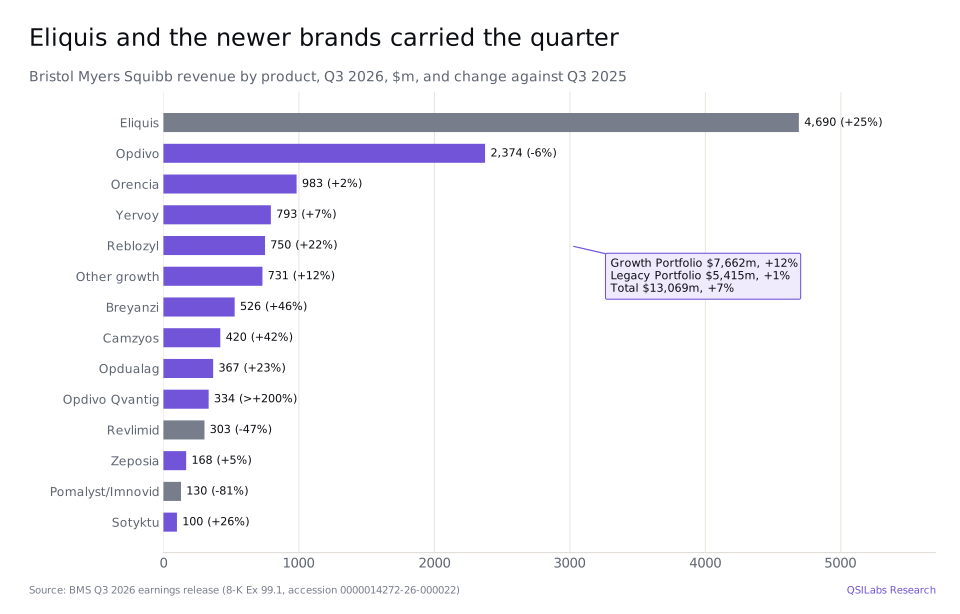
Revenue grew by $847m, and most of it came from two places: Eliquis, the blood thinner BMS sells with Pfizer, and the Growth Portfolio of newer medicines. The Growth Portfolio, $7.66bn, grew 12% in both the US and international markets, with BMS naming Opdivo Qvantig, Breyanzi, Reblozyl, Camzyos and Opdualag as the drivers. The Legacy Portfolio, $5.42bn, grew 1%: Eliquis rose 25% (39% in the US, while international sales fell 7%), and that more than offset generic competition for Revlimid (down 47%), Pomalyst (down 81%), Sprycel (down 38%) and Abraxane (down 12%). On the earnings call management said BMS now has "eight growth portfolio medicines, each annualizing over $1 billion" based on Q3 sales (Q3 2026 earnings call).
Margins were weaker. Gross margin fell to 68.3% from 71.9% on a GAAP basis, and to 68.4% from 72.9% on a non-GAAP basis, which BMS put down mainly to product mix and, to a lesser extent, a one-time charge for a contract termination. Operating costs fell: SG&A by 5% to $1.7bn and GAAP R&D by 6% to $2.4bn. But acquired IPRD charges rose to $1.6bn from $633m, mainly for new licence agreements, and they are the main reason non-GAAP EPS fell 17%. Other expense, net, was $307m on a GAAP basis against income of $108m, partly because royalty income on diabetes products expired at the end of 2025. The GAAP tax rate fell to 14.8% from 29.5%, which BMS attributed to the mix of earnings by country. GAAP net income was $2.2bn, the same as a year earlier.
The balance sheet carries the debt from BMS's earlier acquisitions. At 30 September 2026 BMS had $12.96bn of cash, cash equivalents and marketable debt securities, and $42.6bn of debt, including $260m of short-term borrowings outside the US, according to the Q3 2026 Form 10-Q. In the quarter BMS paid the first $500m of $2.0bn of anniversary payments owed to BioNTech through 2028, and $600m upfront to Hengrui under a new licence. Chief financial officer David Elkins said BMS "ended with $13 billion of cash on hand".
- 13 Aug 2026FDA approves Zenbexus (iberdomide) with daratumumab and dexamethasone in multiple myeloma after at least one prior line, the first approved CELMoD8-K Ex 99.1
- 8 Sep 2026Registrational QUINTESSENTIAL trial of arlo-cel in multiple myeloma meets its primary endpoint8-K Ex 99.1
- 30 Sep 2026FDA approves Camzyos for children weighing 30 kg or more with obstructive hypertrophic cardiomyopathy8-K Ex 99.1
- 8 Oct 2026Phase 3 EXCALIBER-RRMM: Zenbexus combination cuts the risk of progression or death by 51%8-K Ex 99.1
- 12 Oct 2026Phase 3 ALOFT-IPF: admilparant meets its primary endpoint at 60 mg; RYZ101 meets its primary endpoint in ACTION-18-K Ex 99.1
- 29 Oct 2026Q3 2026 results; 2026 revenue guidance raised to $49.75-50.25bn8-K Ex 99.1
- Before end-2026Phase 3 data for milvexian in secondary stroke prevention and Sotyktu in lupusQ3 2026 call
- Q1 2027Phase 3 results for milvexian in atrial fibrillationQ3 2026 call
- 11 Mar 2027FDA action date for Reblozyl in myelofibrosis-associated anemiaQ3 2026 10-Q
- 13 May 2027FDA action date for mezigdomide in relapsed or refractory multiple myelomaQ3 2026 10-Q
- 2028Generic versions of Eliquis permitted to launch in the US under settlements2025 10-K
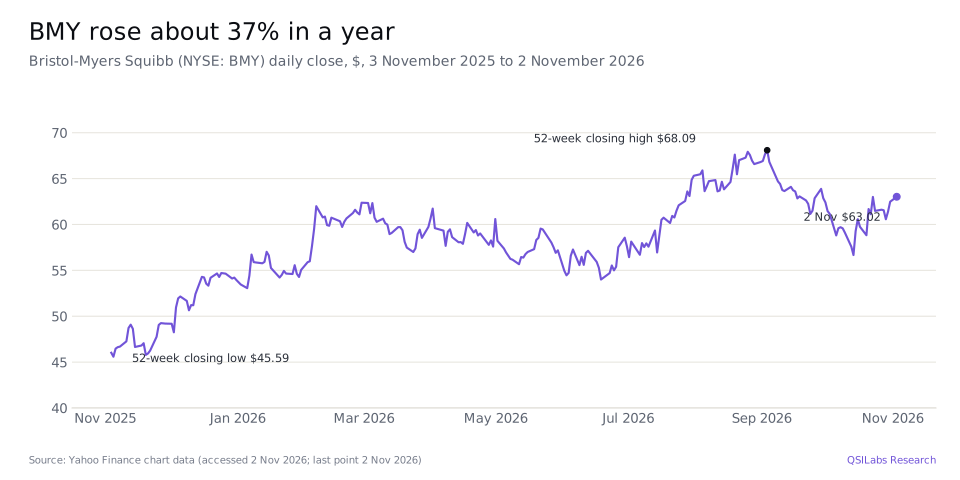
The shares closed at $63.02 on 2 November 2026. Over 12 months BMY has risen about 37%, from $46.02 on 3 November 2025, with a 52-week closing low of $45.59 on 4 November 2025 and a closing high of $68.09 on 3 September 2026. At $63.02 the market value is about $129bn on 2,054m diluted shares.
How are the Growth Portfolio and Legacy Portfolio doing?
The Growth Portfolio is what BMS has to grow into. Its largest product is still Opdivo, the immunotherapy, at $2.37bn in the quarter; it fell 6%, and management put this mainly down to US patients converting to Opdivo Qvantig, the subcutaneous version, which sold $334m. Taken together, the two grew. Orencia, for rheumatoid arthritis, rose 2% to $983m and Yervoy 7% to $793m.
The faster growers are younger. Reblozyl, for anemia in blood disorders, rose 22% to $750m. Breyanzi, a CAR-T cell therapy, rose 46% to $526m. Camzyos, for obstructive hypertrophic cardiomyopathy, rose 42% to $420m and was approved for children weighing 30 kg or more on 30 September. Opdualag, for melanoma, rose 23% to $367m. Smaller brands also grew: Zeposia by 5% to $168m, Sotyktu by 26% to $100m, Krazati by 10% to $58m and Cobenfy, the schizophrenia drug, by 33% to $57m. Other growth products, including royalties from Merck on Winrevair and the newly approved Zenbexus, rose 12% to $731m.
The Legacy Portfolio is mostly Eliquis now. Of the $5.42bn, $4.69bn was Eliquis; the older cancer drugs Revlimid, Pomalyst, Sprycel and Abraxane, all facing generics, made $571m between them. For the full year BMS expects Legacy Portfolio revenue to fall by 3-5%, while Eliquis grows by 20-25%.
What is Bristol Myers Squibb's 2026 guidance after Q3?
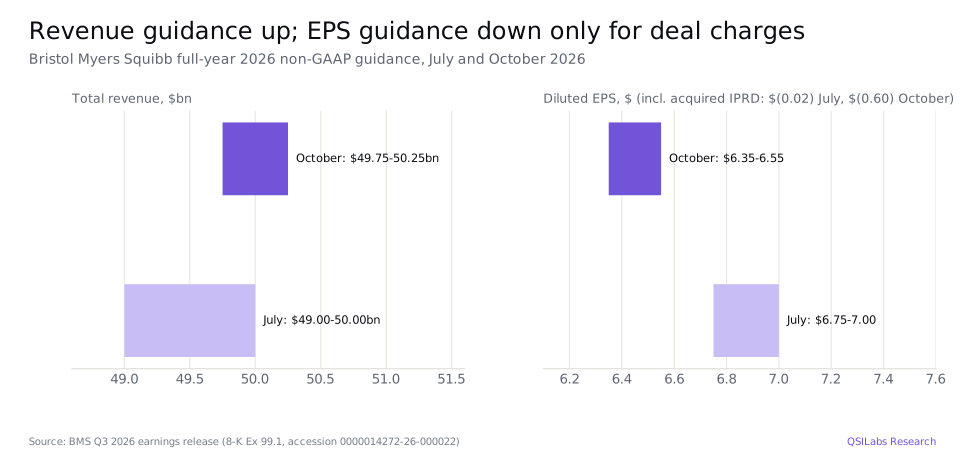
BMS raised its 2026 revenue guidance to about $49.75-50.25bn from $49.0-50.0bn, which it said reflects "broad-based and continuing momentum across the portfolio". It cut non-GAAP EPS guidance to $6.35-6.55 from $6.75-7.00, but that is because the guidance now includes a $(0.60) per share charge for acquired IPRD and licensing income, against $(0.02) in July. Excluding that charge, the EPS range rose. Guidance for gross margin (about 69-70%), operating expenses (about $16.5bn) and the tax rate (about 18%) was unchanged, and other expense is now expected to be about $650m rather than $700m, because of lower net interest.
| 2026 non-GAAP guidance | July 2026 | October 2026 |
|---|---|---|
| Total revenue | about $49.0-50.0bn | about $49.75-50.25bn |
| Gross margin | about 69-70% | unchanged |
| Operating expenses (SG&A and R&D) | about $16.5bn | unchanged |
| Other income/(expense) | about $(700)m | about $(650)m |
| Effective tax rate | about 18% | unchanged |
| Diluted EPS | $6.75-7.00 | $6.35-6.55 |
| Acquired IPRD and licensing income in EPS | $(0.02) | $(0.60) |
| Eliquis revenue growth | 20-25% | unchanged |
Source: BMS Q3 2026 earnings release.
The 28 analysts tracked by StockAnalysis expect 2026 revenue of about $50.16bn and 2027 revenue of about $48.66bn (StockAnalysis). Our model uses $50.2bn for 2026 (the first nine months plus a fourth quarter slightly below the Q3 rate) and matches the $48.66bn consensus for 2027.
When do Eliquis and Opdivo lose patent protection?
BMS's 2025 Form 10-K lists the estimated minimum market exclusivity for each major product (2025 Form 10-K). For Eliquis, the generic companies BMS and Pfizer settled with "are permitted to launch in 2028, subject to additional challenges", and in the EU the composition of matter patents and related SPCs for apixaban expire in November 2026; generics are already sold in some EU countries. Opdivo's US exclusivity ends in 2028 too, and in the EU in 2030.
| Medicine | US | EU |
|---|---|---|
| Eliquis | 2028 | November 2026 (patents and SPCs) |
| Opdivo | 2028 | 2030 |
| Breyanzi | 2033 | 2033 |
| Opdualag | 2034 | 2033 |
| Camzyos | 2036 | 2034 |
| Krazati | 2037 | 2038 |
Source: BMS 2025 Form 10-K, estimated minimum market exclusivity table.
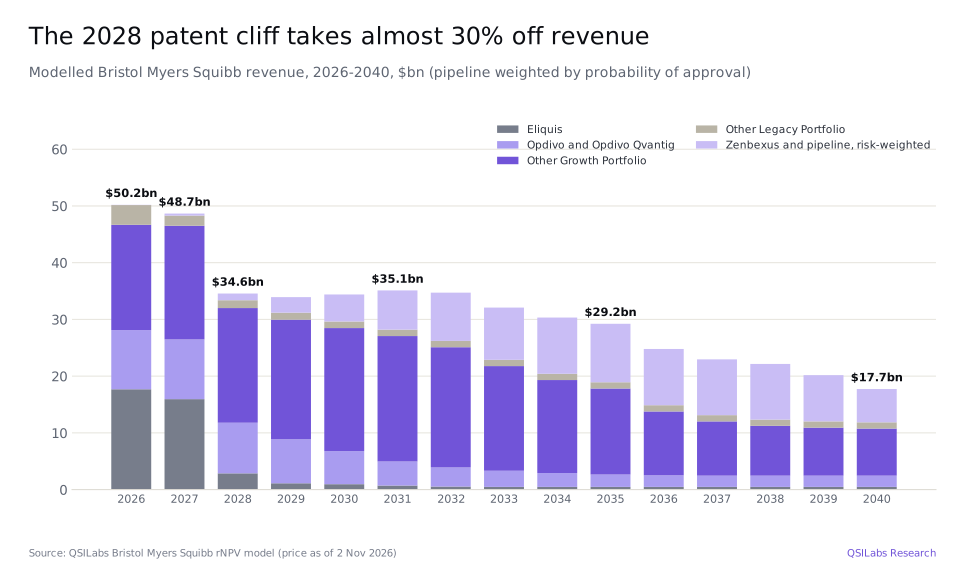
These dates shape our forecast more than anything else. Elkins said BMS expects Eliquis to step down by "$1.5 billion-$2 billion" in 2027, as generics spread outside the US, and we take the $1.75bn midpoint. In 2028 Eliquis and Opdivo face US generics and biosimilars, and our modelled revenue falls from $48.7bn in 2027 to $34.6bn in 2028, with Eliquis down from $15.9bn to $2.9bn. A small-molecule drug normally loses most of its sales within a year or two of generic entry, and nothing in BMS's filings says Eliquis will be different. Revenue then stays at about $34-35bn to 2031 as the Growth Portfolio and new launches grow, and falls to $17.7bn by 2040 as the later patents expire.
What is in Bristol Myers Squibb's pipeline? Milvexian, pumitamig and the CELMoDs
The biggest single readout is milvexian, an oral factor XIa blood thinner that BMS develops with Johnson & Johnson, sharing costs and profits equally. Phase 3 data in secondary stroke prevention are due before the end of 2026, and "in 2027, we continue to expect results for milvexian in atrial fibrillation in the first quarter", BMS said on the call. Management guides to more than $5bn of global peak sales, shared equally with J&J, according to Clinaptis Research (Clinaptis Research). Atrial fibrillation is the Eliquis market, so a successful milvexian would partly replace what BMS loses in 2028.
In cancer, pumitamig is a PD-L1 and VEGF-A bispecific antibody that BMS co-develops with BioNTech, in colorectal, lung and triple-negative breast cancer; BMS owes BioNTech the remaining $1.5bn of $2.0bn of anniversary payments through 2028. Berenberg puts its peak sales potential at $5bn, according to Boerse Express (Boerse Express). Iza-bren, a bispecific antibody-drug conjugate licensed from SystImmune, had positive interim Phase 3 results in breast and lung cancer in China in October, reported by SystImmune's parent Sichuan Biokin; global trials continue.
In multiple myeloma, Zenbexus (iberdomide), the first approved CELMoD, won accelerated FDA approval on 13 August 2026, and its confirmatory EXCALIBER-RRMM trial cut the risk of progression or death by 51%. Analyst peak-sales forecasts for iberdomide range "from a little over $1 billion to $5 billion", according to pharmaphorum (pharmaphorum). The second CELMoD, mezigdomide, has an FDA action date of 13 May 2027; Clarivate expects $1.47bn of G7 sales in 2031 (Clarivate). The CAR-T arlo-cel met its primary endpoint in the registrational QUINTESSENTIAL trial. Outside cancer, admilparant met its primary endpoint in idiopathic pulmonary fibrosis at 60 mg but not at 120 mg; William Blair forecasts $1.3bn of IPF sales in 2032, according to BioSpace (BioSpace).
- MilvexianOral factor XIa inhibitor, shared 50/50 with Johnson & Johnson; Phase 3 secondary stroke prevention data before end-2026, atrial fibrillation results in Q1 2027Q3 2026 call; 2025 10-K
- PumitamigPD-L1 x VEGF-A bispecific antibody, shared with BioNTech; being evaluated in colorectal, small cell and non-small cell lung and triple-negative breast cancer; Phase 2 ROSETTA Lung-107 data positive (25 Oct 2026)8-K Ex 99.1; Q3 2026 10-Q
- Iza-brenBispecific antibody-drug conjugate from SystImmune; Phase 3 PANKU-Breast01 and PANKU-Lung01 positive at interim in China (Sichuan Biokin); global trials continue8-K Ex 99.1
- MezigdomideSecond CELMoD; NDA accepted on Phase 3 SUCCESSOR-2 (52% lower risk of progression or death), PDUFA 13 May 2027Q3 2026 10-Q
- Arlo-celGPRC5D CAR-T in multiple myeloma; registrational QUINTESSENTIAL met its primary endpoint8-K Ex 99.1
- AdmilparantLPA1 antagonist; ALOFT-IPF met its primary endpoint at 60 mg, not at 120 mg; ALOFT-PPF still to read out8-K Ex 99.1; Q3 2026 call
- Reblozyl in myelofibrosissBLA accepted on Phase 3 INDEPENDENCE, PDUFA 11 Mar 2027Q3 2026 10-Q
- Cobenfy, Sotyktu and golcadomideCobenfy in Alzheimer's disease psychosis (ADEPT), Sotyktu in lupus (data by end-2026) and golcadomide in first-line large B-cell lymphomaQ3 2026 call
Is Bristol Myers Squibb stock overvalued after Q3 2026?
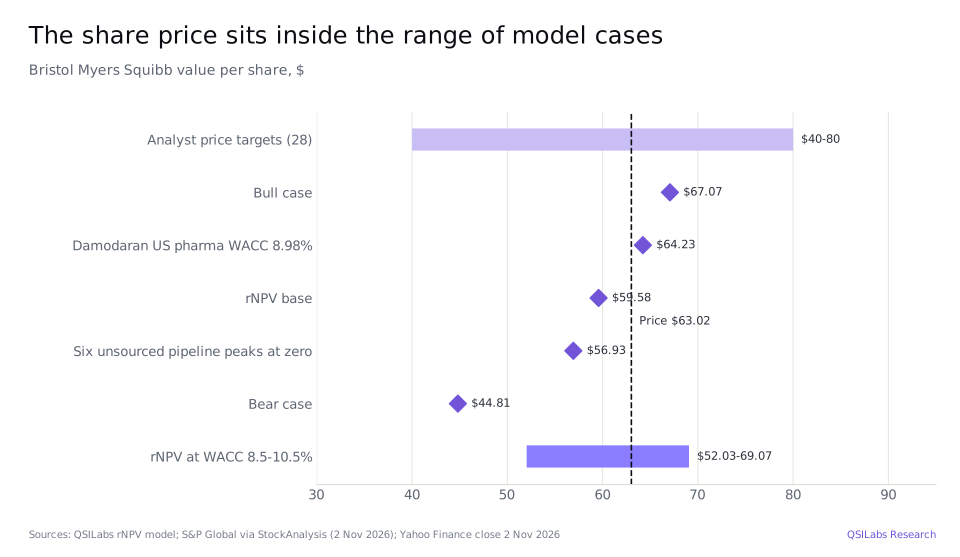
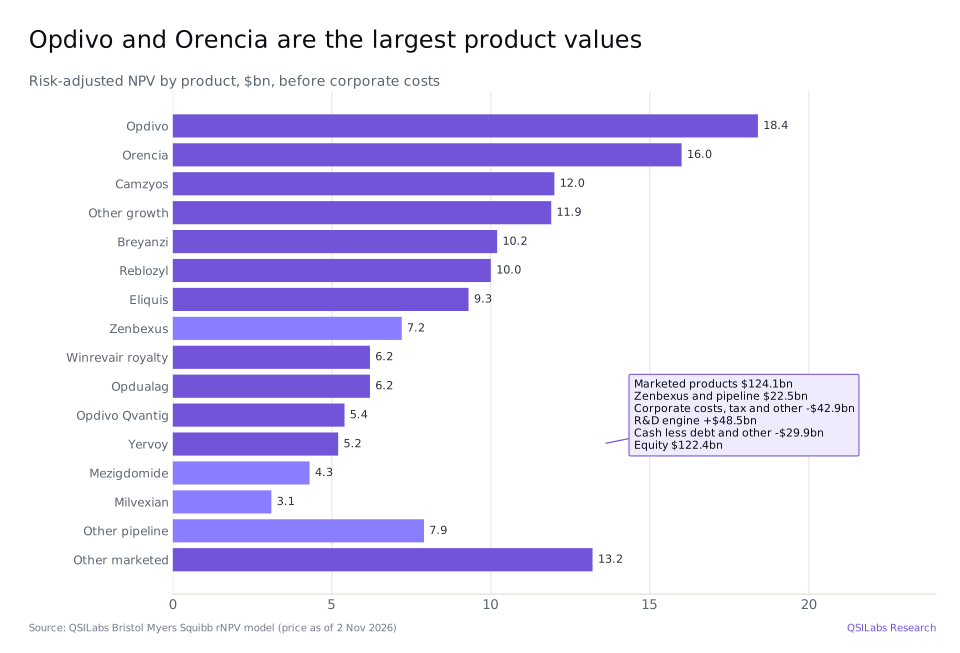
On our numbers, slightly. Our risk-adjusted NPV gives an equity value of $122.4bn, or $59.58 per share on 2,054m diluted shares, against a share price of $63.02 on 2 November 2026, a market value of about $129bn. Our value is 0.95 times the price, so the gap is small next to the uncertainty in the pipeline.
Here is how our value builds up:
| Component | $bn | $ per share |
|---|---|---|
| Marketed products (risk-adjusted NPV) | 124.1 | 60.40 |
| Zenbexus and the late-stage pipeline (risk-adjusted NPV) | 22.5 | 10.98 |
| Corporate costs, tax, capital spending, working capital and terminal value | -42.9 | -20.89 |
| Enterprise value of named products | 103.7 | 50.49 |
| R&D engine (value of future research spending) | 48.5 | 23.63 |
| Cash and investments less debt and commitments | -29.9 | -14.54 |
| Equity value | 122.4 | 59.58 |
Source: QSILabs Bristol Myers Squibb rNPV model. Cash and marketable debt securities of $12,959m, debt of $42,636m and $1,942m of equity investments are from the Q3 2026 Form 10-Q; we also deduct the $607m fair value of the Mirati contingent value rights and the present value of the remaining BioNTech and Hengrui anniversary payments, and add the last quarter of Keytruda and Tecentriq royalties, which end on 31 December 2026. No business is carried at book value.
Named products and the pipeline alone give $35.95 a share. The rest of our value is the R&D engine: what BMS's continuing research, beyond the named pipeline, is likely to produce. That makes our value more dependent on research productivity than on any single drug.
Analysts are close to the market. The 28 analysts tracked by StockAnalysis rate BMS a Hold, with an average 12-month price target of $65.25, a median of $65.50 and a range of $40-80 (StockAnalysis). Our bull case, $67.07, is just above the average target.
How we value Bristol Myers Squibb: the rNPV method and assumptions
We forecast each of 20 marketed product lines and 11 newer or late-stage programmes, including the newly approved Zenbexus, year by year to 2045, apply each patent expiry, weight pipeline revenue by the probability of approval at each remaining phase, and discount the cash flows at a weighted average cost of capital (WACC) of 9.50%.
Revenue. For 2026 we take the first nine months plus a fourth quarter slightly below Q3, $50.2bn, inside BMS's guidance and in line with the $50.16bn consensus. For 2027 total revenue matches the $48.66bn consensus. Eliquis falls by $1.75bn in 2027, the midpoint of the CFO's step-down, and then follows generic erosion from 2028. Legacy products decline in 2027 at their first-nine-months rate, and the decline halves each year. Growth products grow in 2027 at about half their first-nine-months rate, set so that the total matches consensus, and then fade in a straight line to 6.5% a year by 2030, the middle of the IQVIA Institute's 5-8% forecast for growth in the global medicine market to 2030, and to zero by 2035 (IQVIA Institute). Each product then loses exclusivity on the dates in the 10-K.
Pipeline. Peak sales come from published estimates: $5.0bn for milvexian (management, before J&J's half of the profits), $5.0bn for pumitamig (Berenberg), $1.47bn for mezigdomide (Clarivate) and $1.3bn for admilparant (William Blair). For Zenbexus we use $2.0bn, a point inside pharmaphorum's $1-5bn range of analyst forecasts. For iza-bren, arlo-cel, Cobenfy in Alzheimer's disease psychosis, Sotyktu in lupus, golcadomide and Reblozyl in myelofibrosis we could not find a published peak-sales estimate and kept our previous figures; setting all six to zero gives $56.93 a share. Probabilities come from the BIO, Informa and QLS study of clinical development success rates for 2011-2020: 57.8% from Phase 3 to filing and 90.6% from filing to approval. We deduct the milestones BMS may owe SystImmune and BioNTech, weighted by the probability of reaching them.
Costs and tax. We set the 2026 gross margin at 69.5% and operating expenses at $16.5bn, the middle of BMS's guidance, with corporate R&D at 16.0% of revenue and corporate SG&A at 5.7% on top of the costs charged to each product. We tax profits at 18%, BMS's guided non-GAAP rate. Depreciation is 1.1% of revenue, the first-nine-months 2026 ratio from the 10-Q, and capital spending about $1.3bn a year (2.6% of revenue), in line with the $996m spent in the first nine months. Working capital is 9.5% of the change in revenue.
Discount rate. We use Aswath Damodaran's January 2026 global figures for Drugs (Pharmaceutical): an unlevered beta of 0.96, relevered to 1.20 at BMS's debt-to-equity ratio of 34% (debt and leases against the market value). The equity risk premium is 4.82%, a mix of country premiums weighted by where BMS earned its revenue in the first nine months of 2026: 68.9% US and 31.1% international. That gives a cost of equity of 10.92%, and with an after-tax cost of debt of 5.38% and debt at 25.6% of capital, a WACC of 9.50%. BMS's own five-year beta against the S&P 500 is far lower, about 0.15 on monthly returns. Damodaran's single US pharmaceutical row gives a WACC of 8.98% and $64.23 a share; mapping BMS to Drugs (Biotechnology) instead gives a WACC of 10.32% and $53.30, but BMS's portfolio fits pharmaceuticals better.
R&D engine. The R&D engine, $48.5bn or $23.63 a share, is our estimate of the products BMS's continuing research will create, assuming a 5.9% return on research spending, the fixed rate we use for every drugmaker. That is about $21.0bn less than the $69.5bn present cost of the spending, so on our assumptions BMS's unnamed research earns less than its cost of capital.
How sensitive is the value to the discount rate?
| WACC | Value per share, $ |
|---|---|
| 8.50% | 69.07 |
| 9.00% | 64.06 |
| 9.50% (base) | 59.58 |
| 10.00% | 55.62 |
| 10.50% | 52.03 |
Our bear case, $44.81, cuts pipeline peak sales by 30%, cuts probabilities of approval by 30% and delays launches by a year, and cuts marketed products' sales by 20% with their peaks a year later. The bull case, $67.07, raises pipeline peaks by 30% and probabilities by 20%, and marketed sales by 20% with peaks a year earlier. Our previous model value, before the Q3 results, was $55.87. The main changes are the Q3 balance sheet and payments to partners, sourced peak sales in place of our own estimates (our previous peaks give $60.96), the 2027 consensus and the CFO's Eliquis guidance, and a smooth growth path faded to the IQVIA market forecast in place of our own product trends, which on their own would give $53.68; a discount rate weighted by where BMS earns its revenue, rather than the US alone, takes about $4.65 off.
What are the main risks for Bristol Myers Squibb stock?
- The 2028 patent cliff. Eliquis and Opdivo were $7.1bn of Q3 revenue between them, and both lose US exclusivity in 2028. If generics or biosimilars take share faster than we assume, or Qvantig keeps fewer Opdivo patients, the value falls.
- Milvexian. A failure in atrial fibrillation in Q1 2027 would remove the most direct replacement for Eliquis; milvexian is $3.1bn of our risk-adjusted NPV.
- Pipeline estimates. Six of our pipeline programmes have no published peak-sales estimate; without them our value is $56.93.
- Medicare price negotiation. HHS has selected Orencia for negotiated Medicare prices from 2028, according to the 10-Q, and more BMS medicines could follow.
- Celgene CVR lawsuit. An entity claiming to be the trustee for the Celgene contingent value rights alleges BMS avoided a $6.4bn potential obligation by not using "diligent efforts" to win Breyanzi approval before a milestone date, according to the 10-Q; we deduct nothing for this case.
- Debt. BMS has $42.6bn of debt against $13.0bn of cash and securities, and further milestones to Hengrui of up to $14.3bn that we do not deduct.
- Upside risk. If milvexian succeeds in both studies, pumitamig becomes a major PD-(L)1 alternative or BMS's research does better than the industry average, our value is too low; our bull case is $67.07.
FAQ
What is QSILabs' valuation of Bristol Myers Squibb after Q3 2026?
Our risk-adjusted NPV gives $59.58 per share, against a $63.02 share price on 2 November 2026, about 5% below the market. Our bear and bull cases are $44.81 and $67.07. Named products and pipeline alone give $35.95; the remaining $23.63 is the value we place on BMS's future research.
How much did Eliquis sell in Q3 2026?
Eliquis sold $4,690m in Q3 2026, up 25% from a year earlier: $3,653m in the US, up 39%, and $1,037m internationally, down 7%. BMS expects worldwide Eliquis revenue to grow 20-25% in 2026.
When can generic Eliquis launch in the US?
Under BMS and Pfizer's settlements, generic companies are permitted to launch in the US in 2028, subject to additional challenges, according to BMS's 2025 Form 10-K. In the EU the apixaban composition of matter patents and SPCs expire in November 2026.
Why did Bristol Myers Squibb's non-GAAP EPS fall in Q3 2026?
Non-GAAP EPS fell to $1.35 from $1.63 mainly because of $1.6bn of acquired IPRD charges for new licence agreements and collaborations, which cut EPS by $0.58 net of licensing income, against $0.20 a year earlier. Gross margin also fell, to 68.4% from 72.9% on a non-GAAP basis.
What is Zenbexus?
Zenbexus (iberdomide) is BMS's first CELMoD, an oral cereblon-modulating drug for multiple myeloma. The FDA approved it on 13 August 2026 with daratumumab and dexamethasone for patients who have had at least one prior line of therapy, and the confirmatory EXCALIBER-RRMM trial cut the risk of progression or death by 51%.
When are the milvexian Phase 3 results due?
BMS expects Phase 3 data for milvexian in secondary stroke prevention before the end of 2026 and results in atrial fibrillation in the first quarter of 2027. Milvexian is shared equally with Johnson & Johnson.
Did Bristol Myers Squibb raise its outlook in October 2026?
Yes, for revenue. BMS raised 2026 revenue guidance to about $49.75-50.25bn from $49.0-50.0bn. Non-GAAP EPS guidance moved to $6.35-6.55 from $6.75-7.00 only because it now includes a $(0.60) per share charge for acquired IPRD and licensing income.
What discount rate does the QSILabs model use for BMS?
We use a weighted average cost of capital of 9.50%, built from Damodaran's global pharmaceutical beta of 1.20 at BMS's debt level and an equity risk premium of 4.82% weighted by where BMS earns its revenue. Damodaran's US pharmaceutical rate of 8.98% would give $64.23 a share.
Sources
- Bristol-Myers Squibb Company, Q3 2026 earnings release (Form 8-K, Exhibit 99.1, 29 Oct 2026; accession 0000014272-26-000022) www.sec.gov
- Bristol-Myers Squibb Company, Form 10-Q for the quarter ended 30 Sep 2026 (accession 0000014272-26-000024) www.sec.gov
- Bristol-Myers Squibb Company, Form 10-K for the year ended 31 Dec 2025 (accession 0000014272-26-000004) www.sec.gov
- Bristol Myers Squibb, Q3 2026 earnings call transcript (StockAnalysis, 29 Oct 2026) stockanalysis.com
- StockAnalysis: Bristol-Myers Squibb forecast and analyst ratings, S&P Global data (accessed 2 Nov 2026) stockanalysis.com
- IQVIA Institute: 2026 forecast of global medicine use and spending to 2030 www.iqvia.com
- Clinaptis Research: milvexian AF and stroke indications valued separately www.clinaptisresearch.com
- Boerse Express: BioNTech, Berenberg peak-sales estimate for pumitamig www.boerse-express.com
- BioSpace: BMS Phase 3 win for lung drug clouded by high-dose miss (12 Oct 2026) www.biospace.com
- pharmaphorum: FDA starts review of BMS's CELMoD for multiple myeloma pharmaphorum.com
- Clarivate Drugs to Watch: mezigdomide clarivate.com
- Yahoo Finance chart data: BMY daily and monthly closing prices (accessed 2 Nov 2026) query1.finance.yahoo.com
- Damodaran Online: global industry betas and country risk premiums (January 2026) pages.stern.nyu.edu
- QSILabs Bristol Myers Squibb risk-adjusted NPV model (internal; price as of 2 Nov 2026)
More from QSI Labs
Related analysis: Merck stock Q3 2026: Keytruda Qlex and Winrevair, AbbVie stock Q3 2026: Skyrizi and Rinvoq, Johnson & Johnson stock Q3 2026: talc and Tremfya and Eli Lilly stock Q3 2026: Mounjaro and Zepbound.
Read our white paper, QSI Labs: An AI-Native Trading Firm Built on a Training Loop (October 2026), available on request, or browse the research index.